


(ב) בְּמוֹצָאֵי יוֹם טוֹב הָרִאשׁוֹן שֶׁל חָג, יָרְדוּ לְעֶזְרַת נָשִׁים, וּמְתַקְּנִין שָׁם תִּקּוּן גָּדוֹל.
(2) This was the sequence of events: At the conclusion of the first Festival day the priests and the Levites descended from the Israelites’ courtyard to the Women’s Courtyard, where they would introduce a significant repair.
בְּמוֹצָאֵי יוֹם טוֹב כּוּ׳. מַאי תִּיקּוּן גָּדוֹל?
אָמַר רַבִּי אֶלְעָזָר: כְּאוֹתָהּ שֶׁשָּׁנִינוּ: חֲלָקָה הָיְתָה בָּרִאשׁוֹנָה.
וְהִקִּיפוּהָ גְּזוּזְטְרָא, וְהִתְקִינוּ שֶׁיְּהוּ נָשִׁים יוֹשְׁבוֹת מִלְמַעְלָה וַאֲנָשִׁים מִלְּמַטָּה.
תָּנוּ רַבָּנַן: בָּרִאשׁוֹנָה הָיוּ נָשִׁים מִבִּפְנִים וַאֲנָשִׁים מִבַּחוּץ, וְהָיוּ בָּאִים לִידֵי קַלּוּת רֹאשׁ.
הִתְקִינוּ שֶׁיְּהוּ נָשִׁים יוֹשְׁבוֹת מִבַּחוּץ וַאֲנָשִׁים מִבִּפְנִים, וַעֲדַיִין הָיוּ בָּאִין לִידֵי קַלּוּת רֹאשׁ.
הִתְקִינוּ שֶׁיְּהוּ נָשִׁים יוֹשְׁבוֹת מִלְּמַעְלָה וַאֲנָשִׁים מִלְּמַטָּה.
הֵיכִי עֲבִיד הָכִי? וְהָכְתִיב: ״הַכֹּל בִּכְתָב מִיַּד ה׳ עָלַי הִשְׂכִּיל״.
אָמַר רַב: קְרָא אַשְׁכַּחוּ וּדְרוּשׁ —
״וְסָפְדָה הָאָרֶץ מִשְׁפָּחוֹת מִשְׁפָּחוֹת לְבָד מִשְׁפַּחַת בֵּית דָּוִד לְבָד וּנְשֵׁיהֶם לְבָד״.
אָמְרוּ: וַהֲלֹא דְּבָרִים קַל וָחוֹמֶר:
וּמָה לֶעָתִיד לָבֹא, שֶׁעוֹסְקִין בְּהֶסְפֵּד וְאֵין יֵצֶר הָרָע שׁוֹלֵט בָּהֶם — אָמְרָה תּוֹרָה אֲנָשִׁים לְבַד וְנָשִׁים לְבַד. עַכְשָׁיו, שֶׁעֲסוּקִין בְּשִׂמְחָה וְיֵצֶר הָרָע שׁוֹלֵט בָּהֶם — עַל אַחַת כַּמָּה וְכַמָּה.
§ The mishna continues: At the conclusion of the first Festival day, etc., the priests and the Levites descended from the Israelites’ courtyard to the Women’s Courtyard, where they would introduce a significant repair. The Gemara asks: What is this significant repair?
Rabbi Elazar said that it is like that which we learned: The walls of the Women’s Courtyard were smooth, without protrusions, initially.
Subsequently, they affixed protrusions to the wall surrounding the Women’s Courtyard. Each year thereafter, for the Celebration of the Place of the Drawing of the Water, they placed wooden planks on these projections and surrounded the courtyard with a balcony [gezuztra]. And they instituted that the women should sit above and the men below.
The Sages taught in the Tosefta: Initially, women would stand on the inside of the Women’s Courtyard, closer to the Sanctuary to the west, and the men were on the outside in the courtyard and on the rampart. And they would come to conduct themselves with inappropriate levity in each other’s company, as the men needed to enter closer to the altar when the offerings were being sacrificed and as a result they would mingle with the women.
Therefore, the Sages instituted that the women should sit on the outside and the men on the inside, and still they would come to conduct themselves with inappropriate levity.
Therefore, they instituted in the interest of complete separation that the women would sit above and the men below. The Gemara asks:
How could one do so, i.e., alter the structure of the Temple? But isn’t it written with regard to the Temple: “All this I give you in writing, as the Lord has made me wise by His hand upon me, even all the works of this pattern” (I Chronicles 28:19), meaning that all the structural plans of the Temple were divinely inspired; how could the Sages institute changes?
Rav said: They found a verse, and interpreted it homiletically and acted accordingly:
It is stated: “The land will eulogize, each family separately; the family of the house of David separately, and their women separately, the family of the house of Nathan separately, and their women separately” (Zechariah 12:12). This indicates that at the end of days a great eulogy will be organized during which men and women will be separate.
They said: And are these matters not inferred a fortiori?
If in the future, at the end of days referred to in this prophecy, when people are involved in a great eulogy and consequently the evil inclination does not dominate them, as typically during mourning inappropriate thoughts and conduct are less likely, and nevertheless the Torah says: Men separately and women separately; then now that they are involved in the Celebration of the Drawing of the Water, and as such the evil inclination dominates them, since celebration lends itself to levity, all the more so should men and women be separate.
Reform Jews in Germany brought women down from the balcony and abandoned the partition, but still sat men and women separately, following the example of Lutheran churches in Germany. In American churches, however, mixed-gender seating had already become the norm in the eighteenth century as part of church efforts to strengthen the family against the menacing forces of industrialization.
In time it became something of an American mantra that “the family that prays together stays together.” Synagogue practices that “degraded” women by separating them from their families came in for significant criticism. Mixed seating entered the synagogue in 1851, largely for pragmatic reasons. Isaac Mayer Wise’s breakaway congregation in Albany, Anshe Emeth, purchased a church for its use that had been built with family pews, and the congregation “resolved unanimously to retain them,” probably because changing the existing seats would have been highly expensive. Before long, however, mixed seating became a divisive ideological issue.
To its Reform supporters, it represented the “religious equalization of women,” as well as such positive values as family togetherness, conformity to local norms, a modern, progressive image, and saving the youth. To its Orthodox opponents, the same change implied abandonment of tradition, violation of Jewish law, assimilation, Christianization, and promiscuity.
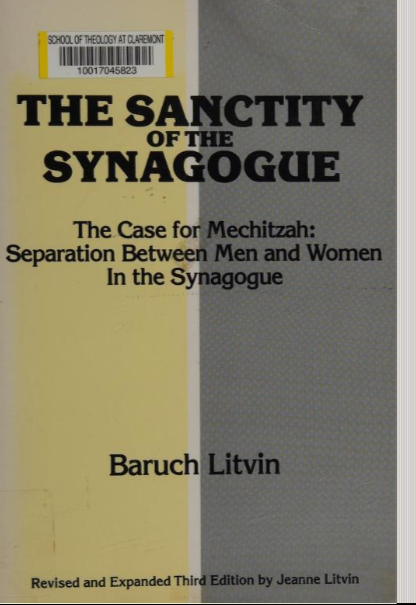
The basic rule is that even if men are on one side and women are on the other, it is still forbidden for them to be without a mechitzah; and this would seem to be a Biblical injunction.
The proof lies in Sukkah 51a: there the Talmud speaks of the balcony that was erected [in the women’s court of the Temple] for the eve of the second day of the Sukkoth Festival, so that the women could be relegated to the upper level and the men to the lower… they came across a verse in Scripture [Zechariah 12:12, signifying] that it was necessary to have a separation between men and women…the import of the reply is that with the verse they found, it is as if the projecting balcony had been explicitly ordained…
Now had the balcony been required only by a Rabbinic proscription, it would be impossible to say that a Rabbinic law could override the Biblical dictum that all this [all the Temple plans, were given] in writing [and hence were not to be modified]...Therefore, if a balcony was required to separate the men and the women, that too must have been by Biblical law…
From the Talmud’s discussing in Sukkah 51a we learn something more: Even if there is a mechitzah (separator), but such as could still permit a state of levity to come about, the same Biblical prohibition remains in force. For originally women were within and men outside; Rashi explains that actually the former were in the women’s court proper while the men occupied the Temple mount and the enclosure within the rampart; there was a great mechitzah between them, as the law required, but because people had to stand near the open gate to see the proceedings, it was noticed that levity soon obtained, against which the mechitzah availed nothing. It was this situation which Biblical law forbade, and therefore it was decided to build a balcony...
Now, at first it was thought that perhaps they became frivolous because the men had to look across the women’s court; although the Sages had known from the beginning that the men would thus have the women in view, this apparently did not in itself warrant their objection, and they permitted this arrangement, not realizing that frivolity would develop. But seeing the spectators reach a state of levity, for, looking at each other they went on chattering idly and illicitly, the Sages decided to reverse the arrangement and have the women outside, behind the men...
Nevertheless levity still came to prevail, for the mechitzah did not fully separate them or screen them from one another’s view; they could still see right through the open gates. Insofar as a mechitzah was required, there was a fully adequate one; but it was of no avail in keeping the men and women separated, since they were still as if commingling, and they yet reached a state of frivolity.
It becomes clear, then, that a balcony was necessary by original Biblical law, so that the women would be above and the men below, and then they would in no sense mingle or communicate…
In my humble opinion a mechitzah reaching above shoulder-height is sufficient. We have noted that the mechitzah need not prevent the people’s glimpsing one another, for originally an arrangement was sanctioned in the Temple with the knowledge that it would permit such glimpsing, but by itself this was no cause for concern. Even after the amendment on the balcony is mentioned… and “balcony” does not imply any screen or curtain… Only when such visibility can lead to frivolity should a prohibition be in effect.
My stringent position regarding the mingling of men and women [in the Synagogue], arises from several reasons.
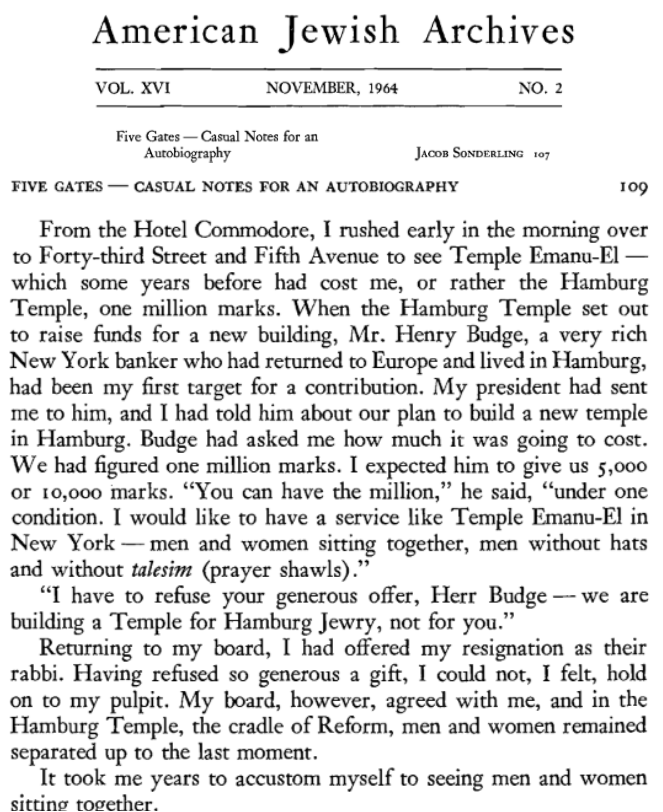
First of all, such mingling is forbidden according to the halachah. In certain instances, Biblical law prohibits praying in a synagogue where men and women are seated together. Such a locale has none of the sanctity of a synagogue; any prayers offered there are worthless in the eyes of the Jewish Law.
Secondly, the separation of the sexes in the synagogue derives historically from the Sanctuary, where there were both a Court of Women and a Court of Israelites. In its martyr’s history of a thousand years, the people of Israel have never violated this sacred principle. Moreover, when primitive Christianity arose as a sect in the Holy Land, and began to slowly introduce reforms, one of the innovations which the sect established at once in the externals of synagogue practice, was to have men and women sit together. In may instances mixed seating what the unmistakable sign by which a Jew could recognize that he had found not a place of sanctity for Jews to pray, but rather a prayer-house for a deviating sect… It would seem to me that our remembrance of history alone should keep us from imitating today the practice of primitive Christianity almost 1900 years ago.
Thirdly, the entire concept of “family pews” is in contradiction to the Jewish spirit of prayer. Prayer means communion with the Master of the World, and therefore withdrawal from all and everything. During prayer man must feel alone, removed, isolated. He must then regard the Creator as an only Friend, from whom alone he can hope for support and consolation. Behold, as the eyes of servants look unto the hand of their master, as the eyes of a maiden unto the hand of her mistress; so our eyes look unto the Lord our God, until He be gracious unto us (Psalms 123:2).
Clearly, the presence of women among men, or of men among women, which often evokes a certain frivolity in the group, either in spirit or in behavior, can contribute little to sanctification or to the deepening of religious feeling; nor can it help instill that mood in which a man must be immersed when he would communicate with the Almighty. Out of the depths have I called to Thee, O Lord (Psalms 130:1), says the Psalmist. Such a state of being will not be realized amid “family pews.”
נוהגין לעשות כסא לאליהו שנקרא מלאך הברית וכשמניחו יאמר בפיו שהוא כסא אליהו:
הגה ונוהגין להדר אחר מצוה זו להיות סנדק לתפוס התינוק למוהלו (הגהות מיימוני פרק ג' דמילה) ויפה כח הסנדק מכח המוהל להקדימו לקריאת התורה דכל סנדק הוי כמקטיר קטורת (מהרי"ל בשם ר"פ)
ולכן נוהגין שלא ליתן שני ילדים לבעל ברית אחד כדאמרינן גבי קטורת חדשים לקטורת (שם בשם ר"פ) ואין לאשה להיות סנדק לתינוק במקום שאפשר באיש משום דהוי כפריצות ומ"מ היא עוזרת לבעלה ומביאה התינוק עד בית הכנסת ואז לוקח האיש ממנה ונעשה סנדק (שם בשם מוהר"ם) אבל האיש יכול לעשות הכל בלא אשה (כן עשה מהרי"ל) נהגו המוהלים להתפלל ביום המילה שנאמר רוממות אל בגרונם וחרב פיפיות בידם:
Seif 11 - It is customary to set up a chair for Elijah, who is called the "angel of the covenant." When placing it, one should say aloud that it is Elijah's chair.
Rama: It is also customary to honor this mitzvah by being the sandak (the one who holds the baby during the circumcision ceremony) for the mohel (the one who performs the circumcision). (Hagahot Maimoni, chapter 3 on Hilkhot Milah) The power of the sandak is considered greater than that of the mohel, entitling him to be called up first to the Torah reading, for every sandak is likened to one who offers incense (MaHaRIL, in the name of R' Peretz).
Therefore, it is customary not to assign two children to a single father for the circumcision, just as we say regarding the incense offering, "new [attendants] for the incense offering" (ibid., in the name of R' Peretz). A woman should not be the sandak for a child where a man is available, as it would be considered immodest. However, she can assist her husband by bringing the child to the synagogue, and then her husband takes the child from her and becomes the sandak (ibid., in the name of Maharam). But a man can perform all these roles without a woman (as MaHaRIL did). It has become customary for mohels to pray on the day of the circumcision, as it is said, "High praises of God are in their throats, and two-edged swords in their hands." (Psalms 149:6)