


הַקּוֹשֵׁר וְהַמַּתִּיר. קְשִׁירָה בַּמִּשְׁכָּן הֵיכָא הֲוַאי? אָמַר רָבָא: שֶׁכֵּן קוֹשְׁרִין בְּיִתְדוֹת אֹהָלִים. קוֹשְׁרִים?! הָהוּא קוֹשֵׁר עַל מְנָת לְהַתִּיר הוּא. אֶלָּא אָמַר אַבָּיֵי: שֶׁכֵּן אוֹרְגֵי יְרִיעוֹת שֶׁנִּפְסְקָה לָהֶן נִימָא קוֹשְׁרִים אוֹתָהּ. אֲמַר לֵיהּ רָבָא: תָּרֵצְתְּ קוֹשֵׁר, מַתִּיר מַאי אִיכָּא לְמֵימַר? וְכִי תֵּימָא: דְּאִי מִתְרְמֵי לֵיהּ תְּרֵי (חוּטֵי) קִיטְרֵי בַּהֲדֵי הֲדָדֵי, שָׁרֵי חַד וְקָטַר חַד — הַשְׁתָּא לִפְנֵי מֶלֶךְ בָּשָׂר וָדָם אֵין עוֹשִׂין כֵּן, לִפְנֵי מֶלֶךְ מַלְכֵי הַמְּלָכִים הַקָּדוֹשׁ בָּרוּךְ הוּא, עוֹשִׂין?! אֶלָּא אָמַר רָבָא וְאִיתֵּימָא רַבִּי עִילַּאי, שֶׁכֵּן צָדֵי חִלָּזוֹן קוֹשְׁרִין וּמַתִּירִין.
בין אבות המלאכות במשנה נימנו גם הקושר והמתיר. ושואלים: קשירה במשכן היכא הואי [היכן היתה]? אמר רבא: שכן קושרין ביתדות אהלים, שהיו קושרים את המשכן אל יתדותיו. ודוחים: וכי לכך קוראים קושרים כמלאכה גמורה?! הלא ההוא קושר על מנת להתיר הוא, שהרי במסעם היו מפרקים את המשכן ומתירים בתוך כך את כל הקשרים, וכל קשר העומד להתרה אין חייבים על עשייתו בשבת. אלא אמר אביי: שכן אורגי יריעות שנפסקה להן נימא (חוט) קושרים אותה. אמר ליה [לו] רבא: תרצת מלאכת קושר, ואולם מלאכת מתיר מאי איכא למימר [מה יש לומר בה]? היכן מוצא אתה במשכן שמתירים קשר? וכי תימא [ואם תאמר] ותפרש בדרך זו: דאי מתרמי ליה תרי חוטי קיטרי בהדי הדדי, שרי חד וקטר חד [שאם מזדמנים לו שני חוטים קשורים זה ליד זה, מתיר אחד וקושר אחד], ואולם השתא [עכשיו, הרי] לפני מלך בשר ודם אין עושין כן, שהיריעה שכך עשו בה נראית פגומה, לפני מלך מלכי המלכים הקדוש ברוך הוא, במשכן העדות עושין?! אלא אמר רבא ואיתימא [ויש אומרים] שאמר זאת ר' עילאי, שכן צדי חלזון שהיו נצרכים לו לצביעת המשכן קושרין ומתירין את הרשתות שלהם.
מַתְנִי׳ וְאֵלּוּ קְשָׁרִים שֶׁחַיָּיבִין עֲלֵיהֶן: קֶשֶׁר הַגַּמָּלִין וְקֶשֶׁר הַסַּפָּנִין, וּכְשֵׁם שֶׁהוּא חַיָּיב עַל קִישּׁוּרָן, כָּךְ הוּא חַיָּיב עַל הֶיתֵּרָן. רַבִּי מֵאִיר אוֹמֵר: כׇּל קֶשֶׁר שֶׁהוּא יָכוֹל לְהַתִּירוֹ בְּאַחַת מִיָּדָיו — אֵין חַיָּיבִין עָלָיו.
יֵשׁ לְךָ קְשָׁרִין שֶׁאֵין חַיָּיבִין עֲלֵיהֶן כְּקֶשֶׁר הַגַּמָּלִין וּכְקֶשֶׁר הַסַּפָּנִין: קוֹשֶׁרֶת אִשָּׁה מִפְתַּח חֲלוּקָהּ, וְחוּטֵי סְבָכָה, וְשֶׁל פָּסִקְיָא, וּרְצוּעוֹת מִנְעָל וְסַנְדָּל, וְנוֹדוֹת יַיִן וָשֶׁמֶן, וּקְדֵירָה שֶׁל בָּשָׂר. רַבִּי אֱלִיעֶזֶר בֶּן יַעֲקֹב אוֹמֵר: קוֹשְׁרִין לִפְנֵי הַבְּהֵמָה בִּשְׁבִיל שֶׁלֹּא תֵּצֵא.
משנה ואלו קשרים שחייבין עליהן אם קושרים אותם בשבת: כגון קשר הגמלין וקשר הספנין שהם קשרים של קיימא (המתקיימים), שעושים אותם כדי שישארו כך לעולם, וכשם שהוא חייב על קישורן של אלה, כך הוא חייב על היתרן. ר' מאיר אומר, כלל יש בדבר: כל קשר שהוא יכול להתירו באחת מידיו — אין חייבין עליו אם קשרו, שקשר רופף כזה אינו קרוי קשר של קיימא, אפילו נתכוון לכך.
משנה יש לך קשרין שאין חייבין עליהן כשעושה אותם בשבת בשוגג קרבן חטאת כמו על קשר הגמלין, וכקשר הספנין, אבל אסור מלכתחילה לעשותם, וכגון: קושרת אשה מפתח חלוקה ברצועות וכן חוטי סבכה שבראשה, וכן שרוכים של פסקיא (חגורה רחבה הנקשרת בשרוכים), וכן קושרים רצועות של מנעל ושל סנדל ושל נודות (נאדות) יין ושמן, וקדירה של בשר שקושרים בגד על פיה. ר' אליעזר בן יעקב אומר: קושרין חבל לרוחב הפתח לפני הבהמה בשביל שלא תצא.
"וּרְצוּעוֹת מִנְעָל וְסַנְדָּל". אִיתְּמַר: הִתִּיר רְצוּעוֹת מִנְעָל וְסַנְדָּל, תָּנֵי חֲדָא: חַיָּיב חַטָּאת, וְתַנְיָא אִידַּךְ: פָּטוּר אֲבָל אָסוּר, וְתַנְיָא אִידַּךְ: מוּתָּר לְכַתְּחִילָּה. קַשְׁיָא מִנְעָל אַמִּנְעָל, קַשְׁיָא סַנְדָּל אַסַּנְדָּל. מִנְעָל אַמִּנְעָל לָא קַשְׁיָא: הָא דְּקָתָנֵי חַיָּיב חַטָּאת — בִּדְאוּשְׁכָּפֵי. פָּטוּר אֲבָל אָסוּר — בְּדַרְבָּנַן. מוּתָּר לְכַתְּחִלָּה — בְּדִבְנֵי מָחוֹזָא. סַנְדָּל אַסַּנְדָּל לָא קַשְׁיָא: הָא דְּקָתָנֵי חַיָּיב חַטָּאת — בִּדְטַיָּיעֵי דְּקָטְרִי אוּשְׁכָּפֵי. פָּטוּר אֲבָל אָסוּר — בִּדְחוּמַרְתָּא דְּקָטְרִי אִינְהוּ. מוּתָּר לְכַתְּחִילָּה — בְּסַנְדָּל דְּנָפְקִי בֵּיהּ בֵּי תְרֵי.
שנינו במשנה: ומתירים לקשור בשבת רצועות מנעל וסנדל. איתמר [נאמר] ששנו בברייתא במקום אחר: מי שהתיר בשוגג בשבת רצועות מנעל וסנדל, תני חדא [שנויה ברייתא אחת] שהעושה כן חייב חטאת. ותניא אידך [ושנויה ברייתא אחרת] שהוא פטור מחטאת אבל אסור לו לעשות כך מלכתחילה. ותניא אידך [ושנויה ברייתא אחרת]: מותר לכתחילה. ואם כן קשיא [קשה] מענין מנעל על ענין מנעל, וכן קשיא [קשה] מענין סנדל על ענין סנדל. ומתרצים: מענין מנעל על ענין מנעל לא קשיא [קשה], שכן אפשר לומר כי הא דקתני [ברייתא זו ששנינו] בה שחייב חטאת — מדברת בדאושכפי [בקשר הסנדלרים], שהם קושרים במנעל קשר קבוע שלא יינתק. וברייתא זו ששנינו בה שפטור אבל אסור — מדברת בדרבנן [במנעל של חכמים], כשלעתים הם מתירים את קשר הרצועה, וברייתא זו ששנינו בה שמותר לכתחלה מדברת במנעל של בני העיר מחוזא המקפידים בלבושיהם ורצועות מנעליהם עשויות להיפתח ולהיקשר בכל יום. וכן מענין סנדל על ענין סנדל לא קשיא [קשה], שכן ניתן לחלק ולומר כי הא דקתני [ברייתא זו ששנינו] בה שחייב חטאת — מדברת בדטייעי דקטרי אושכפי [בסנדלי הערבים שקושרים הסנדלרים] בהם קשר קבוע. וברייתא זו ששנינו בה שפטור אבל אסור — מדברת בדחומרתא דקטרי אינהו [ברצועות שקושרים הם, שאר בני האדם]. וברייתא זו ששנינו בה שמותר לכתחילה — מדברת בסנדל דנפקי ביה בי תרי [שיוצאים בו שנים] לסירוגין, וכל אחד מהם מתירו וקושרו לפי מידתו.

בדאושכפי - בקשר שהאושכף עושה כשתוחב הרצועה במנעל קושר קשר מתוכו שלא תוכל לצאת והוא קיים לעולם:
בדרבנן - כשקושרים סביב רגלים אין קושרין בדוחק שפעמים שחולצו כשהוא קשור ונועלו כשהוא קשור ומיהו קשר של קיימא לא הוי שבשעת הטיט מתירין אותו וקושרין אותו בדוחק שלא ידבק בטיט וישמט מרגליו:
בדבני מחוזא - שהם רחבי לבב ומקפידים על לבושיהן ונעליהן להיות מכוונין וקושרין אותו בדוחק וצריך להתירו ערבית:
דטייעי דקטרי אושכפי - בסנדלים של ישמעאלים סוחרים שהאושכפים קושרים בהן הרצועות בקשר קבוע:
בדחומרתא דקטרי אינהו - אלו סנדלים של שאר אנשים שאין רצועות קבועות בהן ע"י אומן אלא הם עצמן קושרין אותם בחומרתא בעלמא וקושרין ומתירין ופעמים שמתקיים שבת או חדש:
דנפקי בי תרי - וצריך כל אחד ואחד לקשור לפי רגלו הלכך בכל יום קושרו ומתירו:
(א) הַקוֹשֵׁר קֶשֶׁר שֶׁל קַיָּמָא וְהוּא מַעֲשֵׂה אֻמָּן חַיָּב. כְּגוֹן קֶשֶׁר הַגַּמָּלִין וְקֶשֶׁר הַסַּפָּנִין וְקִשְׁרֵי רְצוּעוֹת מִנְעָל וְסַנְדָּל שֶׁקּוֹשְׁרִין הָרַצְעָנִין בִּשְׁעַת עֲשִׂיָּתָן. וְכֵן כָּל כַּיּוֹצֵא בָּזֶה. אֲבָל הַקּוֹשֵׁר קֶשֶׁר שֶׁל קַיָּמָא וְאֵינוֹ מַעֲשֵׂה אֻמָּן פָּטוּר. וְקֶשֶׁר שֶׁאֵינוֹ שֶׁל קַיָּמָא וְאֵינוֹ מַעֲשֵׂה אֻמָּן מֻתָּר לְקָשְׁרוֹ לְכַתְּחִלָּה:
(ב) כֵּיצַד. נִפְסְקָה לוֹ רְצוּעָה וּקְשָׁרָהּ, נִפְסַק הַחֶבֶל וּקְשָׁרוֹ, אוֹ שֶׁקָּשַׁר חֶבֶל בִּדְלִי אוֹ שֶׁקָּשַׁר רֶסֶן בְּהֵמָה הֲרֵי זֶה פָּטוּר. וְכֵן כָּל כַּיּוֹצֵא בְּאֵלּוּ הַקְּשָׁרִים שֶׁהֵן מַעֲשֵׂה הֶדְיוֹט וְכָל אָדָם קוֹשֵׁר אוֹתָן לְקַיָּמָא. וְכָל קֶשֶׁר שֶׁאֵינוֹ שֶׁל קַיָּמָא אִם קְשָׁרוֹ קֶשֶׁר אֻמָּן הֲרֵי זֶה אָסוּר:
(1) A person who ties a knot which is intended to remain permanently and which can be tied [only] by craftsmen1A knot that requires professional expertise and cannot be tied by an untrained person. is liable. Included in this category are the knots tied by camel drivers, the knots tied by seamen, the knots tied by shoemakers when making shoes and sandals.2The fishermen who would catch chilazon that were necessary for the construction of the Sanctuary would tie their nets with special knots that required professional expertise. Similarly, these knots were intended to remain permanently. Therefore, tying such a knot is considered a category of forbidden labor.
It must be emphasized that Rashi and Rabbenu Asher do not accept the criteria mentioned here by the Rambam (which are based on the Halachot of Rabbenu Yitzchak Alfasi from Shabbat 111b). They maintain that tying a knot with the intention that it remain permanently causes one to be liable if the knot is strong enough to remain, even though tying the knot does not require professional expertise.
The Shulchan Aruch (Orach Chayim 317:1) follows the Rambam's perspective. The Ramah, however, rules according to the view of Rashi and Rabbenu Asher.
One who ties a knot that is intended to remain permanently, but does not require a craftsmen [to tie it], is not liable. A knot that will not remain permanently and does not require a craftsman may be tied with no compunctions.
(2) How is [the intermediate category] defined? If one of a person's sandal straps tore and he tied it, a rope tore and one tied it, one tied a rope to a bucket, or one tied the bridle of an animal, the person is not liable. The same applies to all other knots that do not require professional expertise, but are always tied with the intention that they remain permanently.3According to Rashi and Rabbenu Asher, one would be liable for tying such knots.
Any knot that is not intended to remain permanently is forbidden to be tied using a knot that requires professional expertise.4Rabbi Yosef Korcus explains the difference between the two clauses of this halachah. Since the knots mentioned in the first clause are intended to last permanently, one would think that one is liable. Therefore, the Rambam emphasizes that one is not.
By contrast, since the knots mentioned in the second clause are not intended to last permanently, one would think that it is permitted to tie them. Hence, the Rambam emphasizes that this is forbidden.
(3) A woman may tie the opening of her cloak although it has two openings.5This law - and most of the subsequent clauses of this halachah - are based on Shabbat 15:2. In each of the clauses, the Rambam (based on the Talmud) further develops the concepts stated in the Mishnah.
In this instance, Shabbat 112a explains that such a cloak had two straps, each one extending from one corner of the garment to the other. Since a woman could remove the garment by untying only one strap and slipping it over her head, there is reason to think that one of the knots would be considered as permanent, and therefore forbidden to be tied on the Sabbath. Nevertheless, this hypothesis is not accepted, and tying and untying both knots is permitted. She may tie the strands of a hairnet although it hangs loosely on her head.6Shabbat (loc. cit.) relates that these nets are also tied to a woman's hair. Hence, since the net is not tight fitting, it could be slipped off without untying it. Thus one might consider the knot as permanent. Nevertheless, since usually, these nets are untied, there is no difficulty in tying them.
One may tie the straps of shoes and sandals that are tied around one's foot when donning them.7Since they will be untied when the shoes are removed, tying them is permitted. One may tie pouches of wine and pouches of oil although they have two protrusions.8Shabbat (loc. cit.) explains that the pouches were tied at each of these protrusions. Although the liquid could be removed by opening only one of them, neither of the knots is considered to be permanent, because it was customary to open both knots, for then the liquids flowed more freely. One may tie a pot of meat although it is possible to remove the meat without untying the knot.9Shabbat (loc. cit.) states that although the food could be removed from the pot without untying the knot, we do not consider the knot permanent. We assume that the people will follow the usual practice and untie the knots before opening the pot.
One may tie a bucket with a linen cord, a belt or another similar entity, but not with an ordinary rope.10It is forbidden to tie a bucket with an ordinary rope, because it is likely that one will leave the rope there permanently. A linen cord, a belt, or another similar entity is not really fit for this purpose. Hence, it is probable that one will untie it after using it (Maggid Mishneh, based on Shabbat 113a).
Even though the Rambam would maintain that tying an ordinary rope to a bucket does not make one liable according to Torah law, there is still reason for this additional decree. One may tie a rope before an animal or tie it to an animal's foot so that it will not go out, although this involves two knots.11The animal's owner closed the stall by tying a rope before it, tying it to both ends of the entrance (or, according to other commentaries, by tying two ropes). Although the stall could be opened by untying only one knot, we do not assume that the rope(s) will be left there permanently (Shabbat 112b).
If a rope is tied to a cow, one may tie it to its feeding trough. If a rope is tied to a feeding trough, one may tie it to a cow. One may not, however, bring a rope from one's home and tie it to [both] a cow and a feeding trough. If, however, one has a weaver's rope which one is permitted to carry,12This phrase is the key to the Rambam's understanding of this law (which is based on Shabbat 113a). Since tying the animal does not necessitate using a knot that requires professional expertise, the Rambam would not consider it prohibited according to Torah law. And as the Rambam states, since the intention is not to leave the animal tied permanently, there is no reason for even a Rabbinic prohibition. Nevertheless, since it is forbidden to use a rope on the Sabbath unless it was designated for use beforehand, one may not bring a rope from home. If one tied the rope to the animal or to the feeding trough before the commencement of the Sabbath, however, it is obvious that one intended to use it on the Sabbath. one may bring it and tie it to both the cow and the feeding trough.
[The rationale for these laws is that] all [the above] knots do not require professional expertise, nor are they intended to remain. On the contrary, a person ties them and unties them at will. Therefore, it is permitted to tie them with no compunctions.
One may untie the openings of baskets of dates and dried figs, break off or cut off the cord, take them and eat them.13Shabbat 146a explains that dates and dried figs were strung on a cord and placed in palm branch baskets. One may untie the baskets and cut the cords and eat the fruit.
(4) Any substance that is fit to be used as animal fodder may be used for tying on the Sabbath.14Other substances fit for tying would be muktzeh, forbidden to be carried on the Sabbath. Therefore, if the straps of a person's sandals snapped in a carmelit, he may take a moist reed15In his Commentary on the Mishnah (Shabbat 24:5), the Rambam explains that a reed will never be used to tie a permanent knot. that is fit to be eaten by an animal, wind it around [the sandal] and tie it.16This halachah is based on Shabbat 112a, which relates that Rav Yirmiyah saw Rabbi Abahu act in this manner when his sandal strap snapped on the Sabbath. That narrative took place in a carmelit.
The Talmud continues mentioning a situation where Abbaye's sandal strap snapped in a private courtyard and Rav Yosef forbade him to employ a similar technique. The Shulchan Aruch (Orach Chayim 308:15) mentions both these rulings.
If a sandal strap slips from its place, or one's foot slips from the sandal, one may return the strap to its place,17In his gloss on the Shulchan Aruch (Orach Chayim 317:2), the Ramah mentions that this is permitted only when it does not involve much effort. provided one does not tie a knot.18The Magen Avraham 317:8 states that were one to tie a knot, it would be forbidden, because we can assume that the knot would be left permanently.
(5) It is permitted to tie a loop [on the Sabbath],19The Ramah (Orach Chayim 317:5) states that one may even tie a single knot with a loop above it, provided one does not intend to leave it permanently. See Shulchan Aruch HaRav 317:3, Mishnah Berurah 317:29. for it will not be interchanged with a knot.20I.e., there is no reason to decree that a loop is forbidden, lest one tie a knot. Therefore, if a rope snapped, one may gather the two ends together, wind a linen cord around them and tie a loop.21The Kessef Mishneh objects to the Rambam's decision, noting that Shabbat 113a states that if one employs a linen cord, one may tie a knot, but if one employs a rope, one must tie a loop. In his Shulchan Aruch (Orach Chayim 317:4), Rav Yosef Karo rules according to his understanding of that passage.
Yad David and others reconcile the Rambam's wording, explaining that he means "wind a linen cord around it, or tie it [i.e., the rope itself] with a loop."
(6) It is permissible to tie a knot that is not permanent in nature for the purpose of a mitzvah.22In his Commentary on the Mishnah (Shabbat 24:5), the Rambam states that leniency was granted with regard to tying knots that are intended to remain permanently if they are tied for the sake of a mitzvah on the Sabbath. Rashi, by contrast maintains that the Mishnah grants leniency with regard to measuring alone and not with regard to tying knots that are not temporary in nature.
On this basis, this halachah must be interpreted to mean that one is allowed to tie knots that will not remain permanently, even with a knot that requires professional expertise, or a knot that is intended to remain for an extended period if it does not require professional expertise. (See the Be'ur Halachah 317.) For example, one may tie a knot to calibrate one of the Torah's measures.23The concluding Mishnah in the tractate of Shabbat states that "In the days of Rabbi Tzadok's father and Abba Shaul ben Botnit, they... tied a cup with a reed to ascertain whether a vat possessed an opening that was a handbreadth in size."
One may tie a harp string that snaps in the Temple,24This is not considered a permanent knot, because we assume that after the Sabbath it will be changed. There are opinions in the Talmud (Eruvin 102b) that permit only a loop to be tied. Based on the p rinciple, "Restrictions in the category of sh'vut are not enforced in the Temple," the Rambam, however, chooses the more lenient view (Kessef Mishneh, Or Sameach). but not anywhere else. One may not tie a harp string for the first time on the Sabbath, even in the Temple.
(7) A person is liable for untying any knot that he is liable for tying.25Just as tying is one of the 39 categories of forbidden labor, so is untying. Accordingly, all the principles described above concerning tying apply with regard to untying. Whenever a person is not liable for tying a knot, he is not liable for untying it. Whenever a person is permitted to tie a knot, he is permitted to untie it.26Tosafot (Shabbat 73a) states that one is liable only when one unties with the intent of retying, for this was the practice of the chilazon fishermen in the construction of the Sanctuary. Significantly, the Rambam does not mention that requirement. Rashi (Shabbat 74b) rules more stringently, holding one liable even when one does not have the intent of retying the knot immediately. Needless to say, even according to Rashi's view, one must untie the knot for a positive purpose.
(8) A person who winds together a rope from palm branches, love grass,27Our translation is based on Rav Kapach's version of the Rambam's Commentary on the Mishnah (Keilim 17:17). strands of wool, strands of flax, strands of goat's hair or the like is liable for performing a derivative of the [forbidden] labor of tying.28The commentaries question why this activity is not considered a derivative of the forbidden labor of spinning thread. The Migdal Oz resolves this question by citing as a source the Jerusalem Talmud, Shabbat 15:1. That passage relates that an experienced tailor connects two ends of a thread together by undoing their twine, and then rewinding them. Since the tailor's object is to connect the two ends, the activity is considered a derivative of tying.
The minimum measure for which one is liable is a length of rope sufficient to remain wound without being tied, for then the work the person performed is permanent.29See Chapter 9, Halachah 13 and Halachah 1 of this chapter.
Similarly, a person who unwinds cords performs a derivative of the forbidden labor of untying and is liable. [This applies] provided one's intent is not merely destructive in nature.30See Chapter 1, Halachot 17-18. The minimum measure for which one is liable is the same as that for winding a cord.
(9) A person who sews two stitches is liable,31This is one of the 39 categories of forbidden labor. provided he ties32Many of the commentaries question why the Rambam does not mention that the person is also liable for tying. It would appear, however, that this knot does not require professional expertise. Furthermore, sewing and not tying, is the subject of the Rambam's statements here. the stitches at both ends so that they will remain and not slip out.33Only if the stitches are tied at both ends will they remain permanently. Rav Kapach notes that in Hilchot Kilayim 10:24, the Rambam does not require the two stitches to be attached for one to be liable for sha'atnez, echoing a similar ruling of the Mishnah (Kilayim 9:10).
Rav Kapach explains that the obligations of the two prohibitions differ. With regard to sha'atnez, there is no requirement that wool and linen be permanently attached for one to be liable. In contrast, if the forbidden activity one performs on the Sabbath is not lasting in nature, one is not liable. If, however, one sews an additional stitch, one is liable even if one did not tie [the ends], for one's stitching will remain.
A person who pulls taut a thread used for sewing34After one sews several stitches, one pulls the thread taut (Shabbat 75a). on the Sabbath is liable, because this activity is necessary for sewing.
(10) A person who tears [a length of a garment] sufficient to tie two stitches35Our translation is based on the gloss of Rabbi Akiva Eiger. for the sake of tying two stitches is liable.36This is one of the 39 categories of forbidden labor. Although this activity was performed in the Sanctuary for this purpose, the Rambam maintains that a person who performs a מלאכה שאינה צריכה לגופה is liable. Therefore, he maintains that one is liable even if he tears for other purposes. The Mishnah (Shabbat 7:2), however, describes this forbidden labor as "one who tears to sew two stitches." In contrast, one who tears with the intent to ruin is not liable, for [his activity] is destructive in nature.37See Chapter 1, Halachot 17-18.
A person who tears in a fit of rage or [one who rends his garments] for the sake of a deceased person for whom he is required to rend his garments38The Rambam discusses the obligation to rend one's garments over a deceased person in Hilchot Eivel, Chapters 8 and 9. is liable, for by doing so he settles his mind and calms his natural inclination. Since his anger is soothed through this act, it is considered to be constructive in nature and he is liable.39See Chapter 8, Halachah 8, and notes.
A person who makes an opening for a neck [in a garment] on the Sabbath is liable.40The Merkevet HaMishnah states that this refers to simply opening up a place for the head in a garment. Since the Rambam maintains that a person who performs a מלאכה שאינה צריכה לגופה is liable, he maintains that a person is liable for cutting such an opening even if he does not sew it.
Rashi (Shabbat 48a) states that one is liable for this activity for performing a derivative of the forbidden category of labor מכה בפטיש, making an entity ready for use. (Rashi cannot hold one liable for tearing, since he differs with the Rambam and maintains that a person who performs a מלאכה שאינה צריכה לגופה is not liable.)
The latter interpretation is reflected in the statements of Rabbenu Avraham, the Rambam's son, quoted in the Ma'aseh Rokeach, which explain that after a garment was completed, the neck was sewed up with temporary stitches to show that it was never worn. When the purchaser desired to put on the garment, these stitches were undone. See also Shulchan Aruch and Ramah (Orach Chayim 317:3).
(11) A person who attaches paper or hides together with scribe's glue and the like is liable for performing a derivative of the forbidden labor of sewing.41For just as a person who sews, he attaches two entities to each other.
Conversely, a person who separates papers or hides that are stuck together is liable for performing a derivative of the forbidden labor of tearing42See the Magen Avraham 340:18, which states that the entities one separates must have been attached to each other with the intent of remaining permanently. Based on a similar rationale, the Chacham Tzvi (Responsum 39) does not hold one liable for opening an envelope, since the flap is not intended to remain permanently closed.
There is a common application of this principle today: the use of disposable baby diapers. Since the flap is not intended to remain permanently closed, fastening it or unfastening it is not considered as related to the forbidden labors of sewing and tearing. if his intent is not merely destructive.
(12) A person is liable for building even the slightest amount.43This is one of the 39 categories of forbidden labor. One is liable for even the smallest act of construction, because if there was even the slightest nick or hole in one of the walls of the Sanctuary, hot lead would be poured into it to fill it (Shabbat 102b).
A person who levels the floor inside a house is liable.44For building, since with this activity, he prepares the building's floor. As mentioned in Chapter 8, Halachah 1, a person who performs this activity in a field is liable for plowing.
Significantly, based on Rashi (Eruvin 104a), Shulchan Aruch HaRav 313:24 also holds one liable for performing a derivative of building when one levels the ground in one's yard. Whether he lowers a raised piece of earth or fills a cavity, he is considered to be building and is liable.
When one person places down a stone and another the mortar, the one who places down the mortar is liable.45Without the mortar, the stones would not hold in place. For the highest row [of stones], one is liable merely for lifting up the stone and placing it on the mortar, since other mortar is not placed upon it.
A person who builds on a base of utensils is not liable.46As the source for this halachah, the Maggid Mishneh points to the following passage from the Jerusalem Talmud (Shabbat 7:2, 12:1):
Where was [the forbidden labor of] building found in the Sanctuary? In the placement of the boards in their sockets.
Is this meant to imply that building on a base of utensils is considered building? The sockets are considered as the ground.
From this passage, it is clear that building on a base of utensils is not considered to be building according to Torah law. Note that this law refers to constructing a building by using a utensil as a base. The discussion of whether fashioning a utensil or connecting its parts is a derivative of the forbidden labor of building is discussed in the following halachah and notes.
(13) A person who erects a permanent tent is liable for performing a derivative47The commentaries question why the erection of a tent is merely given the status of a derivative and is not considered to be a מעין מלאכה of the forbidden labor of building. The P'nei Yehoshua (Sukkah 16b) explains that a building is a stable structure, while a tent is far more fragile in nature.
The Even HaEzel explains that building involves two actions:
a) joining separate entities into a single whole;
b) spreading a roof over a structure.
Constructing a structure - or part of a structure - which contains both these actions is considered to be building proper. If either - but only one - of the two is involved, the act is deemed a derivative. Thus, erecting a tent is considered a derivative, because it involves spreading a roof, and making cheese is considered a derivative, because it involves joining separate entities into a single whole. [of the forbidden labor] of building.48Significantly, neither in this halachah nor in Chapter 22, Halachah 27, when he mentions the Rabbinic prohibition against erecting a temporary tent does the Rambam explain whether the concept of permanence depends on the strength of the structure or the intent of the builder. It appears that he relies on his statements in Chapter 9, Halachah 13, "Whenever one performs a labor that does not have a permanent effect on the Sabbath, one is not liable." (See the notes on that halachah.)
Similarly, a person who fashions an earthenware utensil - e.g., an oven or a jug - before they are fired [in a kiln] is liable for performing a derivative [of the forbidden labor] of building.49Beitzah 22a relates a difference of opinion between the School of Hillel and the School of Shammai. The School of Shammai maintains that one is liable for performing a derivative of the forbidden labor of building when fashioning a utensil, while the School of Hillel rejects this thesis: "There is no [concept of] building with regard to utensils."
There is, however, a difference of opinion between the Rabbis about the interpretation of this statement. Rashi understands the statement simply. Fashioning a utensil can never be a derivative of building. One is liable for making a utensil, but one's liability stems from the forbidden labor of מכה בפטיש, completing a utensil. This view is shared by Rav Hai Gaon, Rabbenu Yitzchak Alfasi (according to Rabbenu Nissim), and others.
As obvious from this halachah, the Rambam differs and maintains that one is liable for building when fashioning a utensil. The leniency mentioned by the School of Hillel refers only to putting together a utensil that is made up of several component parts. [This is, however, forbidden by Rabbinic decree, because it resembles building (Chapter 22, Halachah 26).] Fashioning a new utensil, by contrast, is surely considered a derivative of building.
This latter opinion is shared by Tosafot (Shabbat 74b), the Ramban, the Rashba, and others. It is also accepted by the Shulchan Aruch (Orach Chayim 314:1).
Similarly, one who makes cheese performs a derivative [of the forbidden labor] of building.50See Chapter 7, Halachah 6. One is not liable until one makes an amount of cheese equivalent to the size of a dried fig.51Although one is liable for building even the slightest amount, with regard to this derivative the minimum measure for which one is liable is the size of a dried fig - the minimum measure associated with the labors related to food. Unless one makes an amount of cheese that size, one's activity is not significant at all.
A person who inserts the blade of an axe onto its handle or one who performs any similar activity performs a derivative [of the forbidden labor] of building. Similarly, one who attaches one piece of wood to another, whether he attaches them with a nail or by inserting one piece of wood into another until they become a single entity, is liable for performing a derivative [of the forbidden labor] of building.52The Rambam discusses the Rabbinic prohibitions associated with this activity in Chapter 22, Halachah 25. (See also the discussion of the issue in the Shulchan Aruch [Orach Chayim 313:9] and commentaries.)
(14) A person who makes even the slightest hole in a chicken coop to let light in is liable for building.53Note that in Halachah 16, the Rambam states that one who makes a hole in a building is liable for performing a derivative of the forbidden labor of מכה בפטיש. Similarly, in Chapter 23, Halachah 1, he states that a person who makes a hole in a chicken coop for the sake of letting light in and letting foul air out is liable for performing a derivative of the forbidden labor of מכה בפטיש.
Among the resolutions offered is that in addition to being liable for מכה בפטיש, one is liable for building (Lechem Mishneh). Alternatively, in this halachah, the Rambam mentions making a hole of any size, while in Chapter 23, he mentions making an opening, implying that it is of a larger size, and only then is one liable for מכה בפטיש (Sefer HaKovetz).
A person who returns a door of a well, a cistern, or a wing of a building [to its place] is liable for building.54These doors serve as part of the floor of the building. Therefore, putting them in place is a derivative of building. (See also Chapter 22, Halachah 25, and the commentary of the Maggid Mishneh.)
(15) A person who demolishes even the slightest amount is liable, provided he demolishes with the intent to build.55Whenever the encampment of the Jewish people moved, the Sanctuary was taken down and then reconstructed in the new camp (Shabbat 31b).
The commentaries note that in Chapter 1, Halachah 18, the Rambam mentions that one is liable for "demolishing to build in its place," while in this halachah, the words "in its place" are not mentioned. If his intent in demolishing is merely destructive, he is not liable.56As mentioned in Chapter 1, Halachah 17, one is not liable for performing any forbidden labor with merely a destructive intent. Nevertheless, as mentioned in Chapter 8, Halachah 8, if one destroys with the intent of venting one's anger, one is liable. Seemingly, the Rambam should have mentioned this point in this context as well.
A person who demolishes a permanent tent or separates a piece of wood attached to another is liable for performing a derivative [of the forbidden labor] of demolishing, provided his intent is to improve it [afterwards].57The Maggid Mishneh explains that the Rambam's intent is to illustrate how one is liable for demolishing for performing the converse of every positive activity for which one is liable for building.
Perhaps the Rambam's wording also alludes to the concept that a person is liable only when he demolishes a structure that is strong enough to last. If the structure he demolishes is not that sturdy, he is not liable. See Shulchan Aruch HaRav 313:19.
(16) A person who gives the [final] blow with a hammer is liable. [Similarly,] a person who performs any activity that represents the completion of a task is liable for performing a derivative of dealing [the final] hammer blow.58In his Commentary on the Mishnah (Shabbat 7:2), in definition of this category of forbidden labor, the Rambam writes:
A person who beats [an article] with a hammer, even at the conclusion of the work as the craftsmen do. They strike very light blows to straighten the surface of a utensil.... Therefore, every activity involved in fashioning and completing a utensil, planing it, polishing it, and making it attractive are all derivatives of dealing [the final] hammer blow.
This is what [our Sages implied with] their statement (Shabbat 75b), "For any activity that constitutes the completion of a task, one is liable for dealing [the final] hammer blow."
What is implied? A person who blows a glass vessel,59Tosafot, Shabbat 74b, asks: Since glass utensils are fashioned by blowing, why is one not liable for building as one is for making any other vessel? (See Halachah 13.) Indeed, the Jerusalem Talmud (Shabbat 7:2) holds a person who blows a glass utensil liable for performing that forbidden labor.
The Yesodei Yeshurun and Rav Kapach point out that Rashi (Shabbat 75b) explains that the activity referred to involves cutting a glass utensil by exposing it to a current of air. This is also implied by the Hebrew words המנפח בכלי זכוכית - "one who blows at a glass utensil." one makes a design, or even a portion of a design, on a utensil,60If, however, one makes a drawing or a design on a paper (or on a similar substance), one is liable for performing a derivative of writing or dyeing (Jerusalem Talmud, Shabbat 7:2). (See also Chapter 11, Halachah 17, and Be'ur Halachah 340.) one who planes61The Maggid Mishneh in his gloss on Chapter 11, Halachah 7, renders the term used in our halachah as מגרר, "scrape." [the edges of a utensil],62See also Chapter 23, Halachah 4. one who makes a hole of even the smallest size in a piece of wood, a building, a piece of metal, or a utensil is liable for performing a derivative of dealing [the final] hammer blow.
One is not liable for making [a hole] unless it can be used to bring in and bring out.63I.e., to cause one to be held liable, any opening must be fit to be used as an entrance through which entities are brought in, and an exit through which entities are taken out.
(17) A person who pierces a blister on the Sabbath to widen the opening of the wound, as physicians do, with the intent of widening the opening of the wound is liable for performing [a derivative of] dealing [the final] hammer blow,64The Ra'avad, Rashi (Shabbat 107a), and others maintain that performing this activity is a derivative of the labor of building. The Ziv HaMishnah explains the Rambam's position, focusing on the words "for this is a labor performed by a physician" - i.e., one is not building a structure, but completing a specific labor that physicians perform. for this is a labor performed by a physician.
If one pierced it to remove its pus, [the act] is permitted.65I.e., one may perform the act without any compunctions (Shabbat 107a). Although the Rambam's ruling is quoted by the Shulchan Aruch (Orach Chayim 328:28), Shulchan Aruch HaRav 328:32 and the Mishnah Berurah 328:88 suggest that it is preferable to have this act performed by a gentile.
According to Rashi and many other authorities, this activity is permitted, because it is a מלאכה שאינה צריכה לגופה. Although generally there would be a Rabbinic prohibition against such an act, in this instance, no prohibition was enforced because of the suffering involved.
This explanation is, however, untenable for the Rambam, for as explained in Chapter 1, Halachah 7, he holds one liable for performing a מלאכה שאינה צריכה לגופה. Among the explanations given for the Rambam's position is that in removing the pus one does not complete the task involved, for an opening sufficient to be useful for another purpose has not been made (Maggid Mishneh). Similarly, Sefer HaBatim explains that in removing the pus, the person thinks only of relieving his pain and does not have any intent of making an opening. Thus the situation differs from the examples stated in Chapter 1, where the person performed the forbidden activity intentionally.
See also the commentary of Rav Chayim Soloveichik who explains that this decision is not dependent on the principle of מלאכה ש אינה צריכה לגופה, but rather on the concept of אינו מתכווין (see Chapter 1, Halachot 5-6) that a person who performs an activity which unintentionally causes a forbidden labor to be performed is not liable.
Although the Rambam agrees that when it is certain that one's actions will result in the performance of a forbidden labor, one is liable, the latter principle does not apply when one does not appreciate the results of the performance of the forbidden labor (פםיק רישא דלא ניחא ליה). In such an instance, the Rambam follows the opinion of the Aruch who maintains that one is not liable.
(18) One who files a stone66Our translation is based on the Rambam's Commentary on the Mishnah (Shabbat 12:1), where he explains that this refers to "smoothing it with a tool known to be used for this purpose." Rashi (Shabbat 102b) renders this term as "chisel." to even the slightest degree is liable for performing [a derivative of] dealing [the final] hammer blow. A person who aligns a stone in the foundation of a building, adjusting its position with his hands and settling it in its proper place,67The Or Sameach (based on Shabbat 102b) states that this applies only in setting the stones of a building's foundation, and not those of its walls.
One might ask: Why is the person who performs this activity not liable for building (see Rashi and Tosafot, Shabbat, loc. cit.)? It is possible to explain that it goes without saying that the Rambam would hold such an individual liable for building, the new concept taught by this halachah is that he is also liable for dealing [the final] hammer blow. is liable for performing [a derivative of] dealing [the final] hammer blow.
A person who removes threads, straws, or splinters of wood68Our translation is based on the commentary of Rabbenu Chanan'el on Shabbat 75b. from a garment by hand - for example, the splinters that are found in woolen garments - is liable for performing [a derivative of] dealing [the final] hammer blow. [This applies] provided the person is disturbed by them.69The Kessef Mishneh explains that this means that the person removes them from the garment with the intention of making it more attractive, even though he could wear the garment while they are still adhering to it. This interpretation is quoted by Shulchan Aruch HaRav 302:7 and the Mishnah Berurah 302:10. If, however, he removes them as a matter of course, [without thinking,]70As explained in Chapter 1, Halachah 11, a person is not liable for performing a forbidden activity as a מתעסק - i.e., without consciously controlling his behavior. In this instance as well, it is common for people to pick at their clothes, without giving the matter any thought at all. he is not liable.71It is, nevertheless, forbidden according to Rabbinic decree (Shulchan Aruch HaRav 302:6, Mishnah Berurah 302:11).
A person who shakes out a new black garment to make it attractive and to remove any remnants of white wool72The early manuscripts and printings of the Mishneh Torah state הציהוב הלבן. Based on the dictionary of Rabbi Tanchum of Jerusalem, this term is interpreted to mean "bright white threads." adhering to it, as is a tailor's practice,73Based on Shabbat 147a, the Ra'avad, Rashi, and others, interpret this as shaking dew from a new garment, and the activity being a derivative of the forbidden labor of whitening. This interpretation is accepted by the Shulchan Aruch (Orach Chayim 302:1). is liable to bring a sin offering.74Rav Sa'adiah Adana explains that according to the general principles the Rambam outlined in the beginning of the text, it would have been sufficient for him to state "is liable," as is his practice throughout the text. Nevertheless, in this instance he quotes the Sages' expression (Shabbat 147a), "is liable for a sin offering"; because of the nature of the activity, one might think that one is liable only for stripes for rebelliousness, the punishment given for violating a Rabbinic decree. If he is not disturbed by them, it is permissible [to do so].
(19) A person who traps a living creature from a species that is common to trap75See Halachah 24, where the Rambam mentions some of the species not included in this category. - e.g., beasts, fowl,76The commentaries note that Shabbat 106b differentiates between a צפור דרור - a swallow - and other fowl. On this basis, the Shulchan Aruch (Orach Chayim 316:1) states that other birds are also considered trapped when enclosed in houses, and it is only a swallow - because it is small - that must be trapped in a closet.
The Merkevet HaMishneh and others explain that Rabbenu Yitzchak Alfasi and the Rambam interpret the conclusion of that Talmudic passage as indicating that there is no difference between one type of fowl and another. It is too difficult to trap any bird when enclosed in a house. or fish - is liable77This is one of the 39 categories of forbidden labor. provided he traps them in a place where no further efforts are required to trap them.
What is implied? One chased after a deer until one caused it to enter a room,78The Hebrew בית usually means house. Here, however, it refers to a one-room structure. a garden, or a courtyard, and one locked it inside, one caused a fowl to fly into a closet and locked it, one removed a fish from the sea and placed it in a bowl of water. [In all these instances,] the person is liable.79The commentaries explain that a deer is trapped even when there are open windows and when there is no roof.
If, however, a person caused a bird to fly into a room and locked it, caused a fish to swim from the sea into a pool of water, or chased a deer until he caused it to enter a large hall, and locked it, he is not liable. [The living creature] is not completely trapped, for if he to desired to take it, he would have to chase it and trap it in [this new place].80See Hilchot Sh'vitat Yom Tov 2:7, where the Rambam develops this principle. Therefore, a person who traps a lion is not liable until he causes it to enter the pen in which it will be enclosed.
(20) [The following] - a place in which if a person ran, he could reach the animal in a single movement,81The Maggid Mishneh states that this means "without having to pause." and a place so narrow that the shadow of both walls would merge in the middle - are considered to be small places. If one chased a deer or the like into such a place, one is liable. If a place is larger than this, a person who chases an animal or a fowl into it is not liable.
(21) [The following principle applies regarding] the eight creeping animals mentioned in the Torah82Leviticus 11:29. See Chapter 8, Halachah 9, for a definition of the species referred to. and similarly, other creeping animals and crawling things:83The distinction between the eight species mentioned in the Torah and other crawling animals is relevant within the context of the Mishnah, Shabbat 14:1, which follows the view of Rabbi Shimon that one is not held liable for performing a [forbidden] labor when he has no need for the actual labor he performed. Hence, it is necessary to differentiate between the eight species mentioned in the Torah (which are generally trapped for their hides) and other crawling animals when that is not necessarily the case. When a species is usually trapped, a person who traps any one of them - whether for a purpose, or without a purpose, even merely for the sake of sport - is liable, since he intended to trap and actually did so.84This ruling depends on the principle stated by the Rambam immediately afterwards, that one is held liable for performing a [forbidden] labor when he has no need for the actual labor he performed. A person is liable for performing a [forbidden] labor even if he has no need for the actual labor he performed.85This subject, referred to as a מלאכה שאינה צריכה לגופה in Hebrew, is discussed at length in Chapter 1, Halachah 7. As mentioned, there are many authorities who differ with the Rambam's opinion on this issue.
A person who traps an animal that is sleeping or a blind animal is liable.86As obvious from Halachah 24, a person who traps an animal that is physically disabled is not liable. Shabbat 106b differentiates between the animals mentioned in that halachah and those mentioned in this halachah as follows: An animal that is sleeping or blind is sensitive to man's steps. Unless he approaches stealthily, the animal will be startled and flee. In contrast, those mentioned in Halachah 24 will not be able to escape capture.
(22) When a person sends out dogs to trap deer, rabbits, and the like, the deer flees because of the dog,87Note the Maggid Mishneh, who quotes Rabbenu Chanan'el's commentary, which explains this as a continuation of the concepts mentioned in the previous halachah. Rashi (Shabbat 106b) interprets the passage differently. (See the Be'ur Halachah 316.) and the person chases after the deer or stands before it and as such, frightens it so that the dog can catch it,88The Ramah (Orach Chayim 316:2) emphasizes that even during the week, this behavior is undesirable. In his Darchei Moshe, he emphasizes that such cruelty will prevent a person from participating in the feast of the Leviathan in the era of the redemption. he is liable for [performing] a derivative [of the forbidden labor] of trapping.89The Magen Avraham 316:4 emphasizes that if the person merely sends out the dogs and is not personally involved in the deer's capture, he is not held liable at all. There is, however, a Rabbinic prohibition involved. The same applies with regard to [trapping] fowl.
(23) When a deer enters a room and one person closes90Here, we have chosen to translate the Hebrew נעל as "close," rather than "lock." Closing the door is sufficient to confine the deer inside and cause one to be liable for trapping it. it, the latter is liable.91Although he did not actively pursue the deer into the room, since it becomes trapped through his deed, he is responsible. If two people close it, they are not liable. If the door cannot be closed by a single person and they both close it, they are both liable.92This halachah illustrates the principle stated in Chapter 1, Halachot 15- 16:
Whenever two people share in the performance of a [forbidden] labor that one of them could have performed by himself, they are [both] free of liability.... When, however, a single individual cannot perform [the forbidden labor] alone and must be joined by others, [all the individuals involved are held liable].
See Sefer HaKovetz and others for explanations why this is not a mere reiteration of the principles stated previously.
When one person sat in the entrance and did not block it, and a second person sat down and blocked it, the second person is liable.93The first person's act did not obstruct the deer's escape, while the second person's did. Although the first person assisted the second, since his assistance was passive - he did absolutely nothing - he does not share in the liability. Furthermore, as the Rambam states in his Commentary on the Mishnah (Shabbat 13:7), he is permitted to remain seated.
When the one person blocks the entrance when he sits down, and a second person sits down next to him [in a manner that also obstructs the entrance], the first person [alone] is liable.94For he completed the capture of the animal by sitting down. This is a fait acccompli to which the second person adds nothing. [This applies] even if he later rises and leaves, [and the second person remains blocking the entrance],95Without moving. for the second person has not done anything. He is permitted to remain seated in the doorway until the evening and then take the deer.96He may not, however, take the deer on the Sabbath itself. Although it is already trapped, it is muktzeh, forbidden to be handled. (See Chapter 25, Halachah 26.) To what could this be compared? To one who locks his house to protect it and finds a trapped deer inside.97In this instance, we have translated the Hebrew נע ל as "lock" rather than "close" as above. Were a person to close the door and thus trap the deer, he would be liable. The Rambam is speaking of a situation where the deer was trapped previously (in the analogy, by the first person) and then locked in (blocked further by the second person).
If a fowl enters under the edge of a person's clothes, he may [continue] sitting and watch it until nightfall.98In this instance as well, it is forbidden to take the bird on the Sabbath because it is muktzeh. It is [then] permitted [to take it].
(24) A person who traps a deer that is old, limping, sick, or small is not liable.99As explained in the notes on Halachah 21, one is not liable for trapping these creatures, because no real effort is required in doing so.
A person who releases an animal, a beast, or a fowl from a trap is not liable.100The Maggid Mishneh questions why the Rambam uses the term "is not liable," which implies that it is forbidden to do so by Rabbinic decree. What prohibition is there in releasing an animal from a trap? He answers that perhaps the intent is that the person is liable for violating the Rabbinic prohibition that deems an animal as muktzeh. Note the Magen Avraham 316:11 which states that one may release an animal or a fowl from a trap, provided one does not touch them. A person who traps a beast or a fowl that is in his domain - e.g., ducks, chickens, or doves from a cote - is not liable.101See Hilchot Sh'vitat Yom Tov 2:5, where the Rambam states that chickens and ducks are considered as within a person's grasp. Note, however, the distinction between the different types of doves mentioned in that halachah and in this halachah. Because of that difference, the Maggid Mishneh considers the mention of doves in this halachah as a printing error. Mention of them is found, however, in most early manuscripts and printings, and other authorities justify their mention. A person who traps a living being whose species is not usually trapped - e.g., locusts,102Rav Kapach states that this refers to non-kosher locusts. A person who catches kosher locusts is liable. The Mishnah Berurah 316:13, however, differs, and maintains that the Rambam does not hold one liable for trapping such species. wild bees, hornets, mosquitoes, fleas, and the like - is not liable.103Since it is not customary to trap these species, even a person who traps them for a specific purpose is not held liable (Shulchan Aruch HaRav 316:4). There is, however, a Rabbinic prohibition involved. For that reason, one must even take precautions not to trap such creatures accidentally (Ramah, Orach Chayim 316:3).
(25) Crawling beasts that are dangerous - e.g., snakes, scorpions and the like - may be trapped104I.e., not only is one not liable, but is permitted to do so. on the Sabbath. [This leniency is granted] even when they are not deadly, but merely bite, provided one's intent is to prevent [someone from] being bitten.105Most commentaries explain this ruling according to the opinions that do not hold one liable for performing a מלאכה שאינה צריכה לגופה. Although generally there would be a Rabbinic prohibition against such an act, in this instance no prohibition was enforced because of the danger involved.
This explanation is, however, untenable for the Rambam, for as explained in Chapter 1, Halachah 7, he follows Rabbi Yehudah's ruling that holds one liable for performing a מלאכה שאינה צריכה לגופה.
The Avnei Nezer (Likkutim 189) explains that this situation is different, because of the unique nature of the labor of trapping. The concept of trapping is relevant only when one traps an object of value. Therefore even Rabbi Yehudah frees one of liability when trapping an animal whose species is not usually trapped.
Similarly, in the instance at hand, since one has no concern for the object one is trapping, merely for one's personal welfare, the entire concept of trapping does not apply. See also the notes on Halachah 17 of this chapter and Chapter 11, Halachah 4.
What should one do? Place a utensil over them, cover them with something, or tie them so they cannot cause damage.
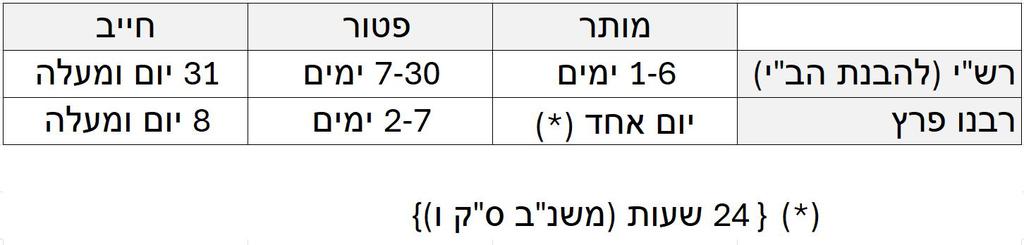
ובמספר הימים שצריך שיהא עשוי להתקיים לשיהיה אסור לקושרו ... פירש"י בגמרא (שם) גבי יש קשרים שאין חייבין עליהם כלומר אבל איסורא איכא קיטרא דקטרי בזממא שאסור לכתחלה לקושרם שם מפני שפעמים שמניח שבוע או שבועיים וגם כתב גבי בדחומרתא דקטרי אינהו ופעמים שמתקיים שבת או חדש אלמא דאף על גב דעומד להתקיים שבועיים או חדש פטור. לכן נ"ל כל שאינו עומד להתקיים ז' ימים מיקרי עשוי להתירו בכל יום ושרי ולמד כן רבינו מדפירש"י שאסור לכתחלה לקושרם שם מפני שפעמים שמניח שבוע וגם כתב ופעמים שמתקיים שבת אלמא דעומד להתקיים שבת אחת פטור אבל אסור ובבציר מהכי ליכא איסורא וכ"נ מדברי המרדכי גבי אבנט שאם מתקיים הקשר שבוע אחד אסור ולענין עד אימתי יהיה עומד להתקיים ולא יתחייב חטאת נראה מדברי רש"י שכתב ופעמים שמתקיים שבת או חדש דכל שאינו עומד להתקיים יותר מחדש פטור וכל שעומד להתקיים יותר מחדש חייב. ...
והגאון מהרי"א כתב וז"ל מצאתי בא"ח בשם הר"פ דכל קשר שעומד שבעה ימים בלא התרה נקרא קשר של קיימא ... וגם לפ"ז י"ל דדוקא בעשוי להתירו בכל יום הוא דשרי לכתחלה דמאי דנקט ז' ימים היינו לומר דלא מחייב חטאת בעשוי להתקיים ז' אבל אין ה"נ דבעשוי להתקיים פחות מכאן נמי איסורא איכא עד שיהא עשוי להתירו בכל יום.
יש להדגיש, כי חומרת דין הקשר וכן החיוב עליו, נקבעים בדעתו של אדם. דהיינו, כאשר הקושר מתכוון בדעתו להעמיד את הקשר זמן ארוך או לעולם, הרי הוא נחשב קשר לזמן ארוך או לעולם. וכאשר הקושר מתכוון בדעתו להעמידו זמן קצר, הרי הוא נחשב קשר לזמן קצר. ויש אומרים שקשר שברור לכל שהוא עומד להתקיים לעולם, ומציאותו מעידה עליו שאין שום כוונה להתירו, לא אחרי זמן קצר ולא אחרי זמן ארוך, הרי שגם להלכה אין חומרתו וחיובו נקבעים על פי דעתו של הקושר אלא על פי מציאותו, והוא נחשב כקשר העשוי לעולם.
אסור לקשור קשר על דעת להתירו באותו יום במקום שאדם עשוי להימלך בדעתו ולהשאירם שם לימים רבים, אפילו הוא קשר רגיל ועליו קשר מסוג עניבה. ואסור לקשרו במקום זה, אפילו אם בשעת הקשירה חושב להתירו באותו יום, כיון שחוששים שיימלך וישאיר את הקשר זמן ארוך מיום אחד ונמצא למפרע שעבר איסור דרבנן.
כל קשר שלפעמים הוא נמלך עליו ומבטלו לעולם, אף על פי שבשעת עשייתו לא היתה דעתו על מנת לקיימו לעולם, נחשב כאילו הוא קשר של קיימא, ואסור לקשרו בשבת. אבל קשר שאין דרך לקיימו רק לאיזה זמן מסויים, ולא לבטלו לעולם, אם גילה דעתו בפירוש שברצונו להתירו במוצאי שבת, מותר לקשרו בשבת.
ח. י"א שכל קשר שלפעמים הוא נמלך עליו ומבטלו לעולם, אף על פי שבשעת עשייתו לא היתה דעתו על מנת לקיימו לעולם, נחשב כאילו הוא קשר של קיימא, ואסור לקשרו בשבת. ויש חולקים. וכן עיקר להקל.
מַתְנִי׳ אֲבוֹת מְלָאכוֹת אַרְבָּעִים חָסֵר אַחַת: (...) הַקּוֹשֵׁר, וְהַמַּתִּיר, וְהַתּוֹפֵר שְׁתֵּי תְפִירוֹת, הַקּוֹרֵעַ עַל מְנָת לִתְפּוֹר [שְׁתֵּי תְפִירוֹת]. (...) הַכּוֹתֵב שְׁתֵּי אוֹתִיּוֹת, וְהַמּוֹחֵק עַל מְנָת לִכְתּוֹב שְׁתֵּי אוֹתִיּוֹת. הַבּוֹנֶה, וְהַסּוֹתֵר (...).
הקושר והמתיר - צ"ע אי מיחייב במתיר שלא על מנת לקשור אי לא. ומדלא תני ליה כדתני מוחק ע"מ לכתוב, אין לדקדק דהכי נמי לא קתני סותר ע"מ לבנות, ובפ' במה מדליקין (לעיל שבת לא:) אמרינן בהדיא דבעינן סותר ע"מ לבנות. ולפי מה שפירש רש"י בגמרא (דף עד:) דאי מתרמי ליה תרי קיטרי בהדי הדדי בשני חוטין זה אצל זה שרי חד ומניח חד משמע דמיחייב בלא על מנת לקשור. ולשון קטר לא משמע כפירושו אבל ר"ח פירש וכן משמע בירושלמי כשנפסק חוט בשני מקומות ונקשר מתירין ב' הקשרים ומשליכין לחוץ האמצעי וחוזרין וקושרין שתי הראשים זה בזה ואין בו אלא קשר א' ולפי זה משמע דבעי מתיר ע"מ לקשור, והא דלא תני ליה במתיר ובסותר פירשתי בפרק ב' (דף לא:) ד"ה וסותר:
וקשר אומן לא נתברר לי היטב היאך הוא, מיהו נראה מלשון אלפסי הוא קשר שקושרים אותו הדק היטב... דהוה קשר אמיץ.
הרי דמעשה אומן נקרא אפילו לא מיהדק שפיר ולפ"ז לכאורה צ"ע על הט"ז שכתב דמעשה אומן נקרא כשהקשר חזק מאד ואפשר דכונתו שהוא חזק מאד היינו שלא יהיה ניתר בשום אופן מעצמו כדרך האומן היודע אופן תיקון עשייתו ומעשה הדיוט הוא כשהקשר אינו עשוי בטוב שיוכל לפעמים במשך הזמן להיות ניתר מעצמו.
האומנות הנדרשת אינה קשורה לחוזק אלא לטיב המסויים של הקשר... עצם העובדה שקשר מסויים זה הוא מעשה שרק אומנים יודעים לעשותו, זה גופא מה שמקנה לו את חשיבותו.
מַתְנִי׳ (...) וּמַעֲשֶׂה בִּימֵי אָבִיו שֶׁל רַבִּי צָדוֹק וּבִימֵי אַבָּא שָׁאוּל בֶּן בָּטְנִית שֶׁפָּקְקוּ אֶת הַמָּאוֹר בַּטָּפִיחַ, וְקָשְׁרוּ אֶת הַמְּקִידָּה בְּגֶמִי לֵידַע אִם יֵשׁ בַּגִּיגִית פּוֹתֵחַ טֶפַח אִם לָאו, וּמִדִּבְרֵיהֶם לָמַדְנוּ, שֶׁפּוֹקְקִין וּמוֹדְדִין וְקוֹשְׁרִין בְּשַׁבָּת.
משנה (...) ומעשה בימי אביו של ר' צדוק ובימי אבא שאול בן בטנית, שפקקו את המאור בטפיח (כלי חרס), וקשרו את המקידה (שבר חרס) בקשר שאינו של קיימא בגמי (קנה קש ארוך) כדי לידע אם יש בגיגית חלל כדי פותח טפח אם לאו [לא], ומדבריהם ומעשיהם למדנו, שפוקקין ומודדין וקושרין בשבת.
(יג) מלאכות הבגד / קושר ומתיר
מלאכת 'קושר' היא מלאכה המחברת דברים על ידי קשירה, וכאשר צריך להפריד ביניהם, מתירים את הקשר, וזוהי מלאכת 'מתיר'. שלא כמלאכת 'תופר' שמצמידה דברים רכים זה לזה לעשותם כאחד, ושלא כמלאכת 'בונה' שמצמידה דברים קשים זה לזה לעשותם כאחד, על ידי קשירה אפשר לחבר דברים בלא להצמידם ולמזגם זה בזה.
כפי שלמדנו (לעיל ט, ב), כל המלאכות שנאסרו בשבת יש להן שורש במלאכת הקמת המשכן. גם מלאכת קושר ומתיר שורשה במשכן, שהיו צריכים לקשור את חוטי היריעות שנחתכו בזמן אריגתם, וכן היו צריכים להכין רשתות כדי לצוד בהן את חלזונות התכלת לצורך צביעת חוטי היריעות, והכנת הרשתות נעשית על ידי קשירה. ופעמים שהיה חסר חוט ברשת אחת, והתירו לשם כך חוט מרשת אחרת (שבת עד, ב. בירושלמי פרק טו הלכה א, נחלקו אמוראים אם גם קשירת יריעות המשכן והחצר ליתדות אסורה מהתורה).
ארבע דרגות של קשרים ישנן:
- א) קשר חזק וקבוע שאין מתירים אותו לעולם – אסור מהתורה. דוגמא לכך, קשר התפילין וקשר הציצית. ויש להיזהר שלא לחזק בשבת את קשר הציצית
- ב) קשר שיש בו מקצת קביעות, כגון שמתכוונים להשאירו למשך שבוע – אסור מדברי חכמים. וכן קשר מקצועי של אומנים, אפילו אם נועד להתקיים פחות משבוע, יש בו קצת קביעות, ואסרו חכמים לקושרו בשבת.
- ג) קשר ארעי, שנועד לפחות משבוע והוא אינו קשר מקצועי – מותר לקושרו בשבת.
- ד) קשרים שהם רופפים כל כך, עד שאינם נחשבים כלל קשרים, כדוגמת קשר יחיד ועניבה – מותר לחבר בהם דברים גם למשך זמן ממושך.
דין התרת הקשר כדין הקשירה, שכל קשר שאסור מהתורה לקשור – אסור מהתורה להתיר, וקשר שחכמים אסרו לקשור – אסור מדברי חכמים להתיר, וקשר שמותר לקשור – מותר גם להתיר. קשר שמצד הדין מותר להתיר אלא שבפועל קשה להתירו, מותר לחתוך את החוט הקושר, ואין לעשות זאת בפני עם הארץ, שמא יבוא להורות היתר בדברים אסורים (משנה ברורה שיז, ז).
-----
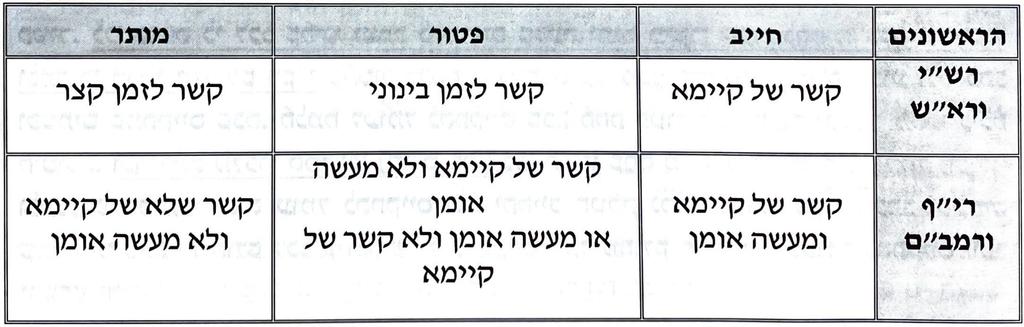
למדנו במשנה (שבת קיא, ב) ובגמרא (קיב, א) שיש שלושה סוגי קשרים: האחד אסור מהתורה כדוגמת קשר גמלים וספנים, השני אסור מדרבנן, והשלישי מותר. שתי דעות ישנן בראשונים בהגדרת דרגות הקשרים: לשיטה הראשונה שהיא שיטת רש"י, רא"ש, תרומה, סמ"ג, סמ"ק, רוקח, או"ז ועוד, קשר של קיימא – אסור מהתורה. ואם נועד לזמן בינוני – אסור מדרבנן. ואם נועד לזמן קצר – מותר. זמן בינוני למרדכי וטור – שבוע, ופחות מזה קצר. ולכלבו והגה"מ: יממה – בינוני, ופחות – קצר. וקשר של קיימא לדעת רוב הפוסקים הוא לתמיד, וכ"כ שבולי הלקט, יראים, ריב"ש, ט"ז, שועה"ר ומשנה ברורה, וכך מוסכם על רוב ככל הפוסקים (ודעת רבנו ירוחם שגם לחצי שנה נחשב של קיימא, ולרבנו פרץ גם לשמונה ימים נחשב של קיימא. ועי' במנו"א ח"ג יד, ד)
לשיטה השנייה שהיא שיטת ר"ח, רי"ף, רמב"ם, ריב"ש ושו"ע או"ח שיז, א, קשר שמצריך מעשה אומן והוא של קיימא – אסור מהתורה. ואם הוא מעשה אומן אבל לא של קיימא, או של קיימא ומעשה הדיוט – אסור מדברי חכמים. ואם הוא קשר הדיוט ולא של קיימא, אפילו שנועד להתקיים זמן רב – מותר, כך הוא הפירוש המקובל בדעתם (פמ"ג, מחה"ש, באו"ה 'שאינו'). אמנם לשלטי גיבורים ותהל"ד שיז, א, אם הקשר נועד לזמן בינוני, למרות שאינו קשר אומן, גם לרי"ף ולרמב"ם אסור מדרבנן.
להלכה, הואיל ואלו שתי שיטות חשובות, גם בספק דרבנן לכתחילה נכון לחוש לשתיהן, ולכן כללתי למעלה את שתי השיטות. אמנם בשעת הצורך, כאשר הספק הוא בדרבנן, אפשר להקל. וכאשר מצטרף עוד ספק לקולא, גם שלא בשעת הצורך הלכה כמקילים, ורק המהדרים יחמירו.
למעשה נחלקו השיטות בשני דברים: א) קשר של אומן שנעשה לזמן קצר (פחות מיממה או פחות משבוע), לרי"ף ורמב"ם – אסור מדרבנן. ולרש"י ורא"ש – מותר. וכיוון שחוששים לשתי השיטות מחמירים. ב) קשר הדיוט שנעשה לזמן בינוני: לרש"י ורא"ש – אסור מדרבנן, ולרי"ף ורמב"ם עפ"י רוב המפרשים – מותר. וכיוון שממילא יש סוברים לרש"י ורא"ש שעד שבוע הוא זמן קצר, יש להתיר קשר הדיוט שנועד לפחות משבוע. ומנגד לשבוע ויותר אין להתיר, שכך היא דעת רוב הפוסקים, שכן לשיטת רש"י ורא"ש בוודאי אסור, ואף לשיטת הרי"ף והרמב"ם, יש סוברים שהוא אסור (שלטי גיבורים ותהל"ד).
עוד היתר חשוב בדיני קשרים ישנו לפי הסבר הלבוש (שיז, ג), שקשר הדיוט שנעשה על ידי בעל מלאכה ונועד להתקיים עד שיבא בעל הבית לקחתו, כגון שתיקן נעליים וקשרן יחד כדי שישארו זוג עד שיבואו לקחתן, אף שהקשר מתקיים לזמן בינוני, מותר להתירו. ואמנם הט"ז ושועה"ר מחמירים בזה. אולם כדעת הלבוש משמע משו"ע שיז, ג, ומ"ב כא. וזאת מפני שזמניותו של הקשר ברורה לחלוטין, ורק מפני שלא באו לקחתו עוד לא התירו אותו, והוא גם אינו משמש כקשר שמטלטלים על ידו את הנעליים. ולא זו בלבד, אלא שכל מה שנחלקו הט"ז ושועה"ר על הלבוש הוא רק לפי שיטת רש"י ורא"ש, אבל לשיטת הרי"ף והרמב"ם, כיוון שהוא קשר הדיוט לזמן בינוני, אין בו איסור. ואכן מקובל להורות כדעת הלבוש, וכ"כ בשש"כ ט, הערה ס.
בפועל, אף שהעקרונות מוגדרים, לגבי הקשרים השכיחים אצלנו התעוררו ספקות, האם הם קשר של אומן או של הדיוט, ופעמים שיש ספק אם הם נחשבים אפילו לקשר, כמבואר בהלכה הבאה. ובכל מקרה ומקרה ההלכה על פי שקלול כל השיטות והספקות.
----
(יד) מלאכות הבגד / קשרים אסורים
אסור לקשור קשר כפול, והאיסור קיים גם כאשר הכוונה להתירו באותו היום. שהואיל והוא קשר חזק שיכול להתקיים זמן רב, יש לחשוש שהוא נחשב כקשר של אומן (שלטי גיבורים), ואזי לדעת כמה ראשונים (רי"ף ורמב"ם), גם לזמן קצר אסור מדברי חכמים לקושרו. וכל זה אמור לגבי קשר כפול מהודק, כפי שקושרים לפעמים נעליים או שקית של פח זבל. אבל מותר לאשה לקשור את מטפחת הראש שלה בקשר כפול, הואיל ואין רגילים להדקה. והמהדרות נוהגות להחמיר בזה.
אם אירע לאדם שנעליו נקשרו בקשר כפול, במקום צער, מותר לו להתיר את הקשר.
----
לשיטת רש"י ורא"ש, כל קשר שנעשה לזמן קצר מותר, וממילא גם קשר כפול בדבר שרגילים לקושרו לזמן קצר מותר. אולם לדעת הרי"ף והרמב"ם, שאוסרים מדרבנן קשר של אומן לזמן קצר, נחלקו הפוסקים בדין קשר כפול. לשלטי גיבורים, יש לחוש שהגדרת קשר של אומן הוא קשר חזק, וקשר כפול נחשב חזק. וכ"כ רמ"א שיז, א; פר"ח; רב פעלים ח"ב או"ח מד. ולערוה"ש (שיז, ג), וחזו"א (נב, יז), זו חומרא, כי לקשירת קשר של אומן נדרשת מקצועיות, וקשר כפול אינו מצריך מקצועיות. וכיוון שהרבה פוסקים אליבא דהרי"ף והרמב"ם אוסרים קשר כפול, כך נוהגים לכתחילה. אולם בשעת הצורך, כשהנעליים נקשרו בקשר כפול, מותר להתירן, שכן לשיטת רש"י ורא"ש, הואיל ונועדו לזמן קצר, אין בהם איסור. ואף לרי"ף ורמב"ם יש מתירים. ואף לאוסרים – האיסור מדרבנן, ובשעת הצורך אפשר לסמוך על המקילים. וכל זה בקשר כפול מהודק, אבל בקשר מטפחת, שאין מהדקים אותו, אין איסור (וכ"כ שש"כ טו, הערה קעה; מנו"א ח"ג יד, ה; ועי' ארח"ש י הערה טז. אמנם ברב פעלים שם, וקצוש"ע פ, מה, החמירו)
-----
אסור לקשור חוט בקצהו בקשר אחד, כפי שרגילים לקשור את חוט התפירה או את קצות חוטי הציצית. מפני שקשר זה חזק, ויש לחוש שהוא נחשב קשר של אומן, וממילא לדעת חלק מהפוסקים, אם קושרים אותו לזמן קצר – איסורו מדברי חכמים, ואם לתמיד – איסורו מהתורה (סמ"ג, רמ"א, או"ח שיז, א). כיוצא בזה אסור לקשור שקית ניילון שיש בה מאכלים בקשר אחד מהודק, אבל מותר לקשור אותה בקשר עניבה או בקשר רגיל על ידי שני צידי שפתיה.
(טו) מלאכות הבגד / קשרי עניבה וקשר יחיד
עניבה אינה נחשבת קשר, משום שבמשיכה אחת של החוט היא נפתחת, ואפילו עניבה על עניבה אינה נחשבת קשר, שגם את שתי העניבות ניתן לפתוח במשיכה אחת (שו"ע או"ח שיז, ה; משנה ברורה שיז, כט). גם קשר אחד אינו נחשב קשר, הואיל ואינו יכול להחזיק מעמד. וכיוון שעניבה וקשר יחיד אינם נחשבים קשרים, מותר לקשור אותם גם כאשר הכוונה להשאירם זמן רב.
קשר אחד ועליו עניבה (כפי שרבים נוהגים לקשור את הנעליים). יש מקילים וסוברים שדינו כקשר אחד, שאינו נחשב לקשר, ומותר לקושרו בלא הגבלה. ויש מחמירים וסוברים, שהואיל ויחד הם חזקים יותר, דינם כדין קשר רגיל (קשר הדיוט), ואזי אם המגמה לקשור אותם למשך פחות משבוע – מותר, ואם לשבוע – אסור. וכן ראוי לנהוג לכתחילה. אבל בגלילת ספר תורה, אין צריך להחמיר, ומותר לקשור את התורה בקשר אחד ועליו עניבה גם למשך חודשים רבים.
קשר אחד ועליו עניבה ועליו קשר, כפי שעושים הרוצים לחזק את קשר הנעליים – דינו כדין קשר רגיל, שאם נועד לפחות משבוע – מותר, לשבוע – אסור. ויש מהדרים שלא לקושרו כלל בשבת.
----
קשר ועליו עניבה – לדעת האגור, רמ"א שיז, ה, לבוש והגר"א, אינו קשר כלל, ומותר לקושרו לזמן רב. ולדעת מרדכי, ט"ז ומ"א, נחשב כקשר של הדיוט, שלשיטת רש"י ורא"ש, אסור לקושרו לזמן בינוני. ורבים חששו לשיטה זו, וכתבו שאסור לקשור את הנעליים ליותר מיום אחד (משנה ברורה שיז, כט; שש"כ טו, נו). אולם נראה שזו חומרה יתירה. ולמעשה, עד למשך שבוע, מותר לקושרו, מפני שיש בזה ספק ספק ספיקא בדרבנן:
א) אם הלכה כרי"ף ורמב"ם, כיוון שהוא קשר הדיוט ואינו לתמיד, אין בו איסור לרוה"פ. ב) לדעת הרמ"א אינו נחשב קשר כלל, ומותר לקושרו לזמן ארוך. ג) למרדכי וטור, עד שבוע הוא זמן קצר, ואין בו איסור קשירה גם לרש"י ורא"ש (גם בבאו"ה שיז, ד, 'שאינם', הסכים שבשעת הצורך אפשר להקל כמותם). וגם למחמירים האיסור דרבנן, ולכן די שנחמיר שלא לקשור קשר ועניבה למשך יותר משבוע.
בספר תורה נהגו להקל לקשור קשר ועליו עניבה אפילו למשך זמן בינוני. ואף שכמה פוסקים חששו והחמירו ליותר מיממה או שבוע (מנחת שבת פ, קנה; שש"כ טו, נו; ברית עולם קושר ומתיר ד; ארח"ש י, כח). אולם למעשה המנהג נכון. כי הוא ספק ספק ספיקא בדרבנן: א) לכל הסוברים כרי"ף ורמב"ם אין בזה איסור כלל. ב) אף לדעת רש"י ורא"ש, נחלקו אם יש בו איסור, שלדעת הרמ"א, או"ח אינו נחשב כלל קשר. ג) גם לדעת המחמירים האיסור מדרבנן, ולדעת הרי"ף והרמב"ם והטור, לצורך מצווה התירו חכמים לקשור קשר שאיסורו מדברי חכמים (שו"ע או"ח שיז, א; משנה ברורה שיז, יג). וכ"כ בציץ אליעזר ז, כט.
דין קשר ועליו עניבה ועליו קשר כדין קשר רגיל. ויש שנטו להחמיר להחשיבו כקשר כפול, שאסור לקושרו אפילו ליום אחד. אולם גם בקשר כפול רבים מקילים, ק"ו כאן שבמשיכת חוט אחד הוא ניתר. לפיכך יש להחשיבו כקשר רגיל, ומותר לקושרו לפחות משבוע. ועי' בארח"ש י, יד-טו; ושש"כ טו, נו, ובהרחבות יג, יג, ה.
-----
מי שרגיל בכל יום לקשור ולהתיר את העניבה שלצווארו, מותר לו לקשור אותה בשבת. ומי שרגיל לקשור אותה לזמן ארוך, אסור לו לקושרה בשבת, ובשעת הדחק הוא רשאי להקל לקושרה בשבת ויכוון להתירה במוצאי שבת.
----
בעניבה לא יכול להיות איסור תורה, כי בוודאי אינה נחשבת קשר של אומן, ואינה מיועדת להישאר לתמיד. אמנם נראה שאם קושרים אותה לזמן בינוני יש בה איסור דרבנן לרש"י ורא"ש, כי אף שבמשיכת חוט אחד היא ניתרת, כיוון שיש בה כעין קשר ועניבה, והיא יכולה להחזיק מעמד זמן רב, דינה כקשר. אמנם בדיעבד, נראה שגם מי שרגיל לקשור אותה לזמן בינוני, רשאי להקל על דעת שיתיר אותה במוצאי שבת. שכן לדעת רי"ף ורמב"ם, כיוון שאינה קשר של אומן ואינה מיועדת לתמיד, אין בה כלל איסור. ואף לרש"י ורא"ש, יתכן שבזה שהוא מתכוון להתירה במוצאי שבת, כפי שיש נוהגים לעשות תמיד, הרי שהיא לזמן קצר ואין בו איסור. ועי' בשש"כ טו, סב.
-----
(טז) מלאכות הבגד / דינים שונים
הפותל חבל, היינו שוזר חוטים ועושה מהם חבל, עובר באיסור 'קושר', והמפרק את החבל לחוטיו עובר באיסור 'מתיר' (רמב"ם י, ח).
----
רשז"א החמיר לאסור סגירת שקית אוכל על ידי ליפוף של חוט ברזל למשך יותר מעשרים וארבע שעות, שהואיל והליפוף עומד וקיים, הרי זה קשר (שש"כ טו, הערה קעד). וכן מובא בשם ריש"א בארח"ש י, ל. ואין נראה להחשיבו כקושר, הואיל ולא הליפוף מעמידו אלא חוזקו של החוט, והרי זה כסגירת כפתורים ופתיחתם, שאין בהם שום איסור. כיוצא בזה כתבו ברבבות אפרים ג, תקנב; שבט הלוי ז, נה; ובארח"ש שם בשם ר"ן קרליץ. ומכל מקום כיוון שאין מתכוונים להשאיר זאת לעולם, ואין זה קשר של אומן, אין בזה חשש איסור תורה, וספק דרבנן לקולא.
-----
אסור לחרוז מחרוזת פנינים על חוט, שמא יבואו לקשור את החוט. וגם כאשר הפנינים נשמטו אסור להחזירן, שמא יבואו לקשור את החוט (משנה ברורה שיז, כ). אבל מותר לילדים לחרוז מחרוזת של משחק שאינה מיועדת להתקיים, שהקשר שעושים במחרוזת זו אינו של קיימא (שש"כ טז, כב).,יש אומרים שאסור להשחיל שרוך בנעל חדשה, מפני שעל ידי כך מתקינים את הנעל לשימוש, ויש בזה איסור 'מתקן כלי' (קצה"ש קמו, בדה"ש ג). ויש אומרים שגם בנעל ישנה אסור להשחיל שרוך חדש (משנה ברורה שיז, יח, שש"כ טו, סד). ויש אומרים שכיום מותר להשחיל שרוכים בנעליים חדשות, מפני שכיום יש בחורי הנעליים מקום רחב ונוח להשחלת השרוכים, ואין השחלת השרוכים בהם נחשבת כמלאכה (יבי"א ח"ט קח, קסב). וכדי לצאת ידי כולם, נכון להשחיל את השרוך בצורה משונה, כגון בדילוג על חלק מן החורים, או רק בחורים העליונים, כך שבמוצאי שבת יצטרך להתקין שוב את השרוכים כמקובל, וממילא אינו נחשב כ'מתקן כלי' (שש"כ טו, סד).,מותר להכניס חגורה למכנסיים חדשים, מפני שהחגורה אינה מיועדת להישאר שם תמיד. וכן מותר לצפות כר חדש בציפית. אבל אסור להכניס שרוך או רצועה לשמלה או מכנסיים חדשים, כאשר הם צריכים להישאר שם תמיד, משום שעל ידי הכנסתם מתקינים אותם לשימוש (משנה ברורה שיז, טז; שש"כ טו, סו).
(1) Melakhot Pertaining to Clothing / Introduction,Clothing is very important, as it covers the body and protects it from heat and cold. Adam and Eve originally had no need for clothing, but after they sinned they developed an awareness of their nakedness and thus clothing became necessary. As long as Adam and Eve were pure, the physical world did not exert too strong a pull on them, and they were able to appropriately emphasize the spiritual aspect of their existence. For them, the body served as a practical tool for revealing the essence of the soul. But after they sinned, the body was weakened and the evil inclination was strengthened. The “lower” functions of the body exerted a disproportionately strong pull, while the soul was neglected and man’s divine destiny was forgotten. This is the source of shame. A person’s dignity can be attributed primarily to his creation in God’s image. This dignity is revealed through his soul, and expresses itself via Torah study and the performance of mitzvot and good deeds. When one forgets his destiny and lets his physical desires control him, he loses this dignity. Clothes that cover us externally serve to modify our attraction to the physical world, and help repair the damage caused by the sin of Adam and Eve. Covering the body allows the soul to reach greater expression. We can then perfect the body and give it full expression, with holiness and joy, guiding it toward Torah and mitzvot. Therefore, a person’s clothing is his dignity.,Like every other good thing, clothing can be used correctly or incorrectly. Those who wear modest and pleasant clothes enjoy the true respect that results from emphasizing the spiritual. Those who wear immodest clothes emphasize the body and arouse the evil inclination. Instead of using clothes to emphasize the soul, they use them to further hide and conceal it. There is nothing more shameful than this.,The sin of Adam and Eve led to an additional change as well. Man was expelled from the Garden of Eden into this harsh world. The ability of the body to take care of itself was diminished. Thus clothing became necessary to protect the body from the cold during the winter and from the sun’s rays during the summer. In the wake of the sin the body was doubly damaged: It could no longer serve as the complete instrument of the soul without clothing, and it could not even protect itself from the elements.,Since clothing is a unique means of correction for man’s sin, clothes are not found in nature; rather, man must work and perform many activities in order to make them for himself. There are 13 melakhot involved in making cloth garments, and seven more in making leather garments.,As we have seen, the 39 melakhot are the same melakhot that were performed in building the Mishkan. The sources of the melakhot connected with clothing are the melakhot that were involved in making curtains for the Mishkan, which were meant both to honor and conceal the divine glory.
(2) Melakhot Pertaining to Clothing / Melakhot Pertaining to Clothing,There are 13 melakhot involved in making clothes (m. Shabbat 7:2):,1) Gozez Tzemer (shearing wool; the laws pertaining to this activity will be explained below in 14:1): If plants are used to make the clothing, then one may not pick the plants on account of the prohibition of harvesting (below 19:6).,2) Melaben (laundering): This includes removing debris and oil from the wool (as explained below in sections 3-8).,3) Menapetz (combing wool): Combing through wool makes it easier to form the wool into threads. One who beats the sinews of an animal to make threads from them violates a tolada of this melakha.,4) Tzove’a (dyeing): This involves infusing wool with dye in order to make colored thread and clothing from it (below 18:5).,5) Toveh (spinning): This is forming threads from raw wool. Similarly, one who makes thread from raw materials like flax violates this melakha.,Now we arrive at the melakhot that pertain to turning individual threads into one weave. As a rule, cloth is made from threads that run lengthwise (the “warp”) and threads that run widthwise (the “weft”). The warp threads form the foundation of the cloth, while the weft threads are interwoven perpendicular to them. In the past, hand-operated looms were used for weaving. This process involved a few more melakhot:,6) Meisekh (warping): This involves setting up the warp threads on the loom.,7) Oseh Shtei Batei Nirin (making two loops): In order to integrate the weft threads with the warp threads, one must first prepare the loom. Vertical cords (“heddles”) containing loops are suspended from two frames (“shafts” or “harnesses”). First the odd-numbered warp threads are threaded through the heddles of one harness and between the heddles of the other. Then the process is repeated with the even-numbered warp threads. This allows the weft threads to slip under and over those of the warp. Some say that the prohibition is to form two loops to hold the warp threads (Tosafot Rid on Shabbat 73a). Others maintain that only one who places two warp threads into these loops transgresses this melakha (Rashi, ad loc.).,8) Oreg Shnei Ḥutin (weaving two threads): This is when one combines the weft threads with the warp threads, actually creating the weave.,9) Potze’a Shnei Ḥutin (separating two threads): This is fixing the material by removing threads when there is a tear or imperfection in the weave. The melakha of Potze’a includes the prohibition of unraveling the hem of a woven item of clothing or a bandage.,The general rubric of weaving also prohibits weaving a basket, net, or strainer, as well as weaving (“roping”) a rope bed. Each of these items is made with a crosshatch design, whether of thread, rope, or wicker (MT 9:16).,Nowadays weaving is done with more advanced machines that perform all the above melakhot at once. One who turns on such a machine on Shabbat transgresses all of these melakhot simultaneously.,Other melakhot connected to creating an item of clothing are:,10) Kosheir (tying a knot),11) Matir (untying a knot): This is explained below in sections 13-15.,12) Tofer Shtei Tefirot (sewing two stitches),13) Kore’a al Menat Litfor Shtei Tefirot (tearing in order to sew two stitches): This is explained below in sections 10-12.,The melakhot connected with tanning leather are also connected to making clothes, since leather is used not only to create parchment, but also to make clothes and shoes. These melakhot are Tzad (trapping), Shoḥet (slaughtering; below 20:6-9), Mafshit (skinning), Me’abed (tanning), Memaḥek (smoothing), Mesartet (marking; below 18:6), and Meḥatekh (cutting; below 15:10).
(3) Melakhot Pertaining to Clothing / Libun and Kibus,The melakha of Libun is cleaning wool or linen and whitening it before making it into clothes. Kibus, which refers to washing clothes, is a tolada of this melakha (MT 9:10-11).,There are three stages of Kibus: soaking, scrubbing, and wringing. Since in each stage some of the dirt in the clothing is removed, each stage is prohibited by Torah law. We will now describe these stages in detail.,First, Kibus is done by soaking an item of clothing in water. Soaking causes stains on the clothing to become lighter, and some of the dirt absorbed in the clothing is removed and transferred to the water. Therefore, it is prohibited by Torah law to soak dirty clothes in water. For example, one may not leave dirty baby clothes in water, even though he intends to do the primary washing after Shabbat, since the soaking begins the cleaning process.,The second stage is scrubbing the clothing while it is still wet. This is the main phase of Kibus, because through the scrubbing, the dirt that is stuck to the clothing is removed, disappearing into the water.,The third stage is wringing out the clothing and removing the water it absorbed. When the water is wrung out of clothing, the filth that was transferred to the water is removed as well. Since a little bit of dirt comes out with each wringing, it is prohibited by Torah law. Even if clothing got wet in the rain, one may not dry it by wringing it out, since this will definitely clean it somewhat as well. To ensure that one will not end up wringing anything out, the Sages forbade picking up clothing that is soaking wet. Despite this, one may continue wearing clothes that got wet in the rain. This permission even extends to a case where one had taken off the wet clothes; if he has nothing else to wear, he may put them back on. However, one may not move them around for no reason (SA 301:45-46).,Sometimes there is a fourth stage – drying the clothes with heat. After wringing out the wet clothes, they are often placed on or near a heat source to dry. This evaporates the remaining moisture together with any remaining dirt, leaving the clothing clean and bright. This used to be part of the way that raw wool was processed. After it was sheared and washed, it was whitened in an oven. This action is called Libun and is prohibited by Torah law. Therefore, one may not place a wet coat or a wet towel next to a heater if the temperature will reach yad soledet bo (SA 301:46; see above 10:4).,It is important to realize that it is not just laundering an entire garment that is forbidden. Even removing a single stain is prohibited by Torah law. This prohibition applies whether the stain is removed with water, spit, or any other cleaning agent, including kerosene or benzene. Similarly, if a greasy substance fell onto a garment on Shabbat, one may not spread talcum powder on it to prevent staining (SSK 15:27).,The Sages also prohibited things that might cause others to think that one violated a Torah prohibition and washed clothing on Shabbat. Therefore, clothes that got wet on Shabbat may not be hung on a clothesline or the like. Rather, they should be hung somewhere that people do not generally hang clothing after it is laundered, such as over a chair or on a hanger. Nevertheless, clothes that were hung to dry before Shabbat may be left on the line over Shabbat (SA 301:45).1If a “dry clean-only” suit gets wet, it may be hung out on a clothesline, since no one will think that it was washed on Shabbat. Similarly, a hand towel that gets wet from normal use may be hung in its normal place. One may also hang out a plastic tablecloth, since it may be rinsed with water on Shabbat, as explained below in section 5. The general rule is that one may perform any action that will not lead people to suspect that he washed clothing on Shabbat. See SSK 15:13; Yalkut Yosef 302:79-82; Menuḥat Ahava 2:12:23.
(4) Melakhot Pertaining to Clothing / Soaking Clothes in Liquid,As we saw above, the first stage in washing clothes is soaking them in water, since this soaking gets rid of some of the dirt. Even wetting a small part of an item of clothing is forbidden, because wetting cloth with water or another cleansing liquid is considered Kibus.,The Rishonim disagree whether the prohibition of soaking clothes in water applies even to clothing that is not dirty. According to many Rishonim, it is only forbidden to wet clothing if it is dirty; but if the clothing is clean, one may wet it. Others maintain that one may never wet clothing, because any wetting accomplishes some minimal cleaning. In practice, since this is a disagreement pertaining to a Torah law, many Aḥaronim follow the stringent position, maintaining that even clean clothing may not be wetted.2em>Zevaḥim 94b states: “‘Soaking an item of clothing constitutes washing it.’ Rava is being consistent, as he also states: ‘One who threw a scarf into water is liable.’” According to Sefer Ha-TerumaOr Zaru’a, Rosh, Smag, and Smak, the prohibition applies only if the item of clothing is dirty. This would seem to be Rambam’s position as well. Rosh writes that even if the item of clothing is blackened because of hard usage, as long as there is no stain, one may soak it. However, if one soaks it for the purpose of cleaning it, then even those who would otherwise permit this concede that it is forbidden (MB 302:46). According to Rashbam, Yere’im, and Tur, it is always prohibited by Torah law to wet an item of clothing (this is implied by SA 302:9 as well). Many Aḥaronim rule stringently, since this is a doubt about a Torah law, as we see in BHL 302:9 s.v. “she-yesh” and Kaf Ha-ḥayim 302:74. In my humble opinion, if the item of clothing is fresh from the wash and completely clean, even those who are stringent would concede that the prohibition is only rabbinic. Thus one may wash such clothing if truly necessary, in accordance with the opinion of most Rishonim (see BHL 302:10 s.v. “de-lo”).,However, one may wet clothing or any cloth item if this will make it dirty rather than clean. For example, one may use a towel to dry one’s hands, because the water from one’s hands does not clean the towel. On the contrary, it dirties it slightly. Some make a point of first air-drying their hands slightly and only afterward using the towel, so that the towel will absorb less water. In any case, the halakha is that one may wet a cloth in a way that dirties the cloth. This is true even if the towel is already dirty, as long as one’s intention is to dry his hands, not to remove stains (SA and Rema 320:10; BHL s.v. “de-lo”).
(5) Melakhot Pertaining to Clothing / Cleaning Off the Table and Washing Dishes,If a little water spills on the table, one may use a towel to clean it, as wetting the towel in this case dirties it rather than cleans it. Similarly, if a little wine or juice spilled on the table, one may wipe it up with a towel or cloth. Although the cloth will absorb some of the color of the wine or juice, and one may not dye on Shabbat, this is permitted because one’s intent is to clean the table, not dye the cloth. Also, the dyeing is ineffective; it merely dirties the cloth.3. MB 302:55 states, based on Yere’im and SA 320:20, that if a colored drink spilled on a tablecloth and one wishes to clean it up, he should not drag the colored liquid over the tablecloth, because doing so will color additional parts of it. However, MB 302:59 adds that some are lenient because this coloring dirties the tablecloth. This is the opinion of Radbaz 4:131, Ḥakham Tzvi, Eliya Rabba, and others. On the other hand, Ben Ish Ḥai, Year 2, Tetzaveh 6 is stringent. Nevertheless, in a time of need one may be lenient, since even according to those who are stringent this is a case of psik reisha de-lo niḥa lei as well as a double rabbinic prohibition (the coloring is done through a destructive action as well as a shinui). When such a combination of factors exists, we are lenient in cases of necessity. Livyat Ḥen §92 states something along these lines.,If a lot of water spills on the table or floor, it is rabbinically prohibited to soak it all up with a towel. This is due to the concern that once the towel absorbs a large quantity of water, one will wring it out, thus transgressing a Torah prohibition.4We saw in section 3 that wringing is a stage of washing and is prohibited by Torah law. According to most poskim, the prohibition applies only to wringing out water, as is implied by SA 320:18. However, Ramban maintains that wringing out wine is prohibited as well, because wine can have a cleaning effect. Taz 320:12 maintains that there is no prohibition on wringing out red wine, in contrast to white wine. It is important to note that our discussion has only dealt with how wringing pertains to the prohibition of laundering. However, there is another possible issue here – the Torah prohibition of Dash, which applies to squeezing grapes and olives. Thus, if one squeezes liquid out of a towel, he may be transgressing the melakha of Dash. If one wants the squeezed-out liquid, Rishonim disagree whether this is prohibited rabbinically or by Torah law. In contrast, if one does not want the liquid, all agree that the prohibition is only rabbinic (as explained in 11:17 and in Harḥavot). If so, in our case, when one does not want the liquid he is wringing out of the towel, the prohibition would only be rabbinic. Furthermore, one may pick up the saturated towel, as we do not build fences around rabbinic prohibitions. There are a few solutions to this problem: 1) Multiple towels may be used, so that each one absorbs only a little water. Thus, there is no concern about wringing them out. 2) A cloth that is not generally wrung out may be used, even if it absorbs a large quantity of water (MB 301:172). Thus, one may use a napkin or paper towel, since they are not wrung out but thrown away immediately. 3) If it is not possible to utilize either of the first two solutions, two people may work together to mop up the liquid. First, they should place a towel on the water; then they can pick it up and put it in a bucket or elsewhere. The rabbinic prohibition to pick up clothes saturated with water was limited to one person; two people may do so because if one of them forgets and starts to wring the clothing, his friend will remind him that it is Shabbat (SSK ch. 15 n. 55). (This does not follow the stringent opinion requiring ten people, as explained in Harḥavot. See below 15:9 regarding permissible ways to clean the floor.),One may not use an ordinary sponge or scouring pad to wash dishes because it absorbs water and is then wrung out in the course of washing the dishes and afterward. However, one may use a plastic sponge if the fibers are not tightly packed and are not absorbent, and they cannot be wrung out. We will discuss the use of wipes below (14:6).,If a dishrag falls into the sink, one may turn on the water even though the rag will get wet, because this is not considered cleaning or washing. If there is a wet rag in the sink, some allow picking it up and removing it. Since people are not insistent on using only dry rags, there is no concern that one might wring it out (Orḥot Shabbat 13:48). On the other hand, in practice, people are accustomed to wring it out. Therefore if one wishes to remove the rag from the sink, it is proper to use a fork or knife to do so. This shinui will serve as a reminder to him that it is Shabbat, ensuring that he will not wring out the rag.
(6) Melakhot Pertaining to Clothing / Removing Mud from Leather Clothing and Shoes,Leather clothes are different from normal clothes. Normal clothes made from threads of wool or linen and the like may not be soaked, because this cleans them. However, a leather item may be soaked in water. Only true washing, meaning vigorous scrubbing, is prohibited by the Torah for leather. The reason for this distinction is that unlike cloth garments, which absorb the water that permeates the threads and removes the dirt and stains, leather does not absorb water readily; since water does not permeate it, the water cannot remove the dirt absorbed in the leather. Although soaking leather in water might remove the dirt that is stuck on its surface, the dirt that is absorbed within it will not be removed. The only way to remove absorbed dirt from leather is by washing it – scrubbing it vigorously by rubbing the two sides together or by using a brush or the like. This constitutes the Torah prohibition of Kibus.,Accordingly, if something disgusting fell on a leather item, it may be rinsed off, because rinsing leather removes only what is on the surface. However, one may not rub the dirty spot, because that will remove the absorbed dirt.5Generally, a leather garment is soft, and the consensus is that scrubbing it vigorously on Shabbat is prohibited by Torah law. Gently scrubbing it while it is submerged in water is forbidden as well (MB 302:41; BHL s.v. “aval”; it is unclear whether this is prohibited rabbinically or by Torah law). Some maintain that very gentle scrubbing is permitted (as explained by Tzitz Eliezer 5:10). In the case of hard leather, BHL ad loc. provides a summary of the different positions. According to Rashi and Ran, there is no prohibition of Kibus at all, as hard leather is like wood. According to Rif, Rambam, and Rosh, vigorous scrubbing is rabbinically prohibited. According to She’iltot, vigorous scrubbing is prohibited by Torah law. In practice one should be stringent, as most poskim maintain that this activity is prohibited, whether rabbinically or by Torah law.,It is rabbinically forbidden to wring out a wet leather item. Wringing out cloth garments is forbidden by Torah law because the water is easily wrung out of them; since the wringing removes the dirt together with the water, this is considered a method of cleaning them. But leather garments are not normally wrung out during washing; it is difficult to do, and it is not a particularly good way to clean them. Therefore, wringing them out is only rabbinically prohibited (BHL 302:9, s.v. “asur”).,If leather shoes get dusty, one may remove the dust with one’s hand or a rag, because the dust is not absorbed into them, but merely sits on the surface. However, one may not polish them with a brush or rag in order to shine them (on account of Memaḥek, below 18:6; see AHS 327:4; SSK 15:40).,If clay or mud is stuck on a shoe or piece of clothing, removing it and crumbling it is transgressing a rabbinic prohibition pertaining to Toḥen. But if it is uncertain whether its removal will cause it to crumble to dust, it may be removed. When necessary, even if it is clear that it will crumble to dust, one may remove it with a shinui. For example, mud on a shoe can be removed by rubbing the shoes together, and clay on clothing can be removed by hitting it with the back of one’s hand (above 12:1 and n. 1).
(7) Melakhot Pertaining to Clothing / Nylon, Plastic, and Polyester Tablecloths and Clothing,The prohibition of Kibus applies to clothes and pieces of cloth that absorb dirt. However, wooden furniture and plastic items, which do not absorb dirt, may be cleaned with water to remove dirt that is stuck to them. Based on this, it would seem at first glance that one may clean plastic or nylon tablecloths. Since they are made from one piece of nonabsorbent material, they do not absorb dirt; thus Kibus would not be relevant to them. Indeed, R. Ben-Zion Abba Shaul rules this way in practice (Or Le-Tziyon 2:24:6). However, most poskim maintain that since these tablecloths function the same way as when they are made of cloth, one should be stringent and avoid vigorously scrubbing them as one does when washing clothing. However, since they do not absorb water, one may rinse them and even gently rub them (Igrot Moshe, YD 2:76; Tzitz Eliezer 5:10; Yalkut Yosef 302:22).,Another question arises regarding clothing, a tablecloth, or pantyhose made from synthetic material such as polyester. Everyone agrees that they may not be scrubbed or wrung out, because this would involve cleaning them in the way one normally washes clothing. The question is whether one may rinse them off or soak them in water. Some maintain that since the synthetic material itself does not absorb dirt or water, one may rinse clothing made of such material and even soak it. Soaking would only be forbidden if the clothing was made of natural fibers as well (SSK 15:7-8). Others maintain that even clothing that is fully synthetic may not be soaked; since dirt is absorbed between the threads, when the clothing is soaked or rinsed part of the dirt dissolves and disappears (Or Le-Tziyon 2:24:6). It would seem in practice that one may not soak clothing made from synthetics.,One may clean contact lenses, both hard and soft. The law is more lenient in the case of contact lenses, compared to nylon tablecloths, which may only be lightly scrubbed, because not only are they non-absorbent, they are also not considered clothing, and therefore scrubbing them does not resemble Kibus (see Harḥavot). Similarly, one may clean a pacifier or the nipple of a baby bottle, or scrub it to remove stuck-on dirt. Since they are made out of rubber, Kibus does not apply; and since they do not look like clothing, scrubbing them does not resemble Kibus.
(8) Melakhot Pertaining to Clothing / Removing Stains and Dust,As we saw above (section 3), Kibus is generally accomplished using water or other cleaning agents. However, even when one does not use water, one may not remove stains from clothing via scrubbing the way one does when washing. One may, however, remove a stain using a shinui. There are two types of stains: mild stains and serious stains. Mild stains may be removed using a minor shinui. When necessary, serious stains may be removed using a major shinui. Let us explain.,A mild stain is one that would not prevent the clothing’s owner from wearing it in public. The Sages forbid removing such a stain by scrubbing it in the way one normally would when hand-washing it. However, one may remove this kind of stain by scrubbing it in an unusual way. Therefore, one may try to remove the stain by scratching it with a nail or a knife. After taking a brief break of a few seconds’ duration, he may scrape at it again. This is because as long as he stops between attempts, this does not resemble scrubbing clothing to wash it. Similarly, one may remove the stain with one rub of a dry rag or handkerchief. If necessary, after pausing for a few seconds one may rub the stain with the rag a second time. As long as the scrubbing is not constant, it is not considered the normal way to wash clothing.,If the stain is so severe that one would not wear the stained clothing publicly, the stain may not be removed by scraping it or rubbing it with a rag, because that is exactly how one would remove such a stain during the week. There are even Rishonim who maintain that doing so is prohibited by Torah law. If, however, a major shinui is used, the poskim disagree whether there is still a rabbinic prohibition to remove the stain. If necessary, we rely on the opinion of those who are lenient. Therefore, at a time of need, such a stain may be removed with a major shinui. For example, one could rub the stained clothing that he is wearing against a door, closet, or bed. Alternatively, if he is wearing the stained clothing, he may rub or scrape away the stain by taking the sleeve with the stain and using the other unstained sleeve to rub or scrape it off in a way that does not resemble normal scrubbing. If the stain is thick, most of it may be removed by scraping it with a nail or a knife, or by rubbing it with a rag, as long as the entire stain is not removed this way. The rest must be removed with a major shinui.,One whose clothing gets dusty may not remove the dust in the normal fashion by shaking out the clothing, hitting it, or rubbing it. However, one may flick the clothing with one’s finger, as this is a major shinui. When a couch is dusty, however, one may beat it to remove the dust. Since a couch is not considered clothing in which one is embarrassed to be seen, beating the dust out is not considered Kibus. However, one may not scrub the couch in the way one normally cleans it.,If something unwanted is resting on a garment but not attached to it in any way, it may be removed. Therefore, one may remove a feather, cotton, a thread, or the like from clothing (Rema 302:1; SSK 15:33).6There are two pertinent halakhic discussions that inform this ruling. The first is found in Shabbat 141a: “R. Kahana said: ‘As for the clay on one’s clothing, one may rub it off from the inside but not from the outside.’” The prohibition is rabbinic because rubbing and scrubbing resemble washing. Shabbat 140a adds that one may not scrub a scarf in order to make it brighter. This is also the ruling of SA 302:5, 7. Aḥaronim disagree regarding a stain that needs to be scraped multiple times with a knife or a nail in order to remove all of it. Taz 302:6 maintains that scraping is not similar to Kibus and is permitted, while MB 302:36 and BHL 302:7 s.v. “de-havei” maintain that it is prohibited. This is the standard ruling. But if one pauses between each scrape, it is permitted, as this does not resemble KibusThe second halakhic discussion involves a disagreement whether one may shake dust from a new black cloak, if the owner would not wear it outside in such a state. According to Tosafot, Rabbeinu Tam, Rosh, Magid Mishneh in the name of Rashba, Ran, Mordechai, and Raavad, one may shake the dust from the cloak, as there is no Torah prohibition of Kibus without a cleaning agent – water or a different substance. According to Behag, Rabbeinu Ḥananel, Rashi, Or Zaru’aYere’imSefer Ha-Teruma, and Shibolei Ha-leket, it is prohibited by Torah law. Since the dust disturbs the owner so much that he will not go outside wearing the clothing until it is cleaned, cleaning it is considered an act of Kibus. Since the normal way to remove dust from clothing is to shake it out, this is prohibited by Torah law. The same law applies to a stain that is so severe that one would not wear the garment outside. Removing the stain in the normal fashion would be prohibited by Torah law, according to the stringent position (see SHT 302:41 and BHL 302:1 s.v. “alei”). Indeed, the Gemara (Shabbat 147a) limits the prohibition on shaking to a new black item of clothing about which the owner is particular, and many rule this way in practice, including SAH 302:1 and Ketzot Ha-shulḥan §116, Badei Ha-shulḥan §3. However, BHL loc. cit. clarifies that everybody is assumed to be particular about a new black item of clothing; however, if the owner is particular about a different type of clothing, then even if it is not new and black, according to the stringent view it is forbidden by Torah law to clean such clothing. In practice, the position of SA 302:1 follows most Rishonim, who are lenient. This is the position of Yalkut Yosef 302:10 as well, except that in its opinion it is preferable to remove the dust with a shinui. Rema 302:1 writes that it is preferable to be stringent. According to Eliya Rabba, the halakha demands being stringent since many Rishonim are stringent, and furthermore it is a case of a doubt about a Torah law. This is also the opinion of MB 302:6; Ben Ish Ḥai, Year 2, Vayeḥi 8; and SSK 15:26-30. However, Or Le-Tziyon 2:24:1 states that while it would be proper to defer to those who are stringent, since human dignity (kevod ha-briyot) is at stake here one can be lenient and remove dust or a stain using a shinui, which downgrades the disagreement to the level of a rabbinic prohibition. Accordingly, one may remove the dust from clothing using a shinui, such as flicking with one’s finger.
Let us return to the case of a stain that the owner is particular about. During the week, one would remove it by scraping. Therefore, according to the stringent position, this is prohibited by Torah law. Since this is a case of uncertainty about a matter of Torah law, we are stringent (see BHL loc. cit. citing Behag; SSK 15:27). However, if one uses a major shinui, such as rubbing the stained clothing that he is wearing against the door, then even those who are stringent would agree that the prohibition is now only rabbinic. According to those who are lenient, since this act of rubbing is not a normal act of Kibus, it is permitted. One may rely upon this ruling since it is the majority opinion, the disagreement concerns a rabbinic law, and it pertains to kevod ha-briyot. If one removes only part of the stain by scraping or wiping it once, which is not the normal way of cleaning a stain, he may afterward remove the rest of the stain using a major shinui.
(9) Melakhot Pertaining to Clothing / Folding a Talit on Shabbat, and Additional Laws,The Sages forbade folding an item of clothing on Shabbat because folding helps it maintain its shape, ensures that it sits right on the body, and prevents wrinkling. Therefore, when one folds clothes it looks like one is fixing a kli (see below ch. 15). Only if one has a new white garment that he can fold by himself, and he plans to wear it on Shabbat because he has no other appropriate clothing, he may fold it on Shabbat (Shabbat 113a). Based on this, some prohibit folding a talit after prayer services; since it will not be worn again that Shabbat, folding it constitutes preparing on Shabbat for the weekday. Additionally, if the talit is not new, one may not fold it because this act of folding is more significant than folding a new item (Ḥayei Adam 44:24). Some who are meticulous follow this position.,In contrast, according to a minority position in the Rishonim (Orḥot Ḥayim), the type of folding that the Sages prohibited no longer exists. In the past, a clothes press operated by two people would be used to make the folds in clothing permanent. This is why the Sages only permitted folding a new white talit when the act is done by only one person. However, the type of folding we do nowadays is not so significant, and it does not look like “fixing” anything. Therefore, one may fold a talit along its original creases after services. Moreover, this is not considered preparing on Shabbat for the weekday. Just as a couch may be arranged on Shabbat even if no one is planning to sit on it, because its disarray detracts from the honor of Shabbat, so too a talit may be folded in order to honor Shabbat. Furthermore, doing so honors the talit as well; as an item used to fulfill a mitzva, it should not be left in an unfolded mess. Some prominent Aḥaronim follow this position and maintain that a talit may be folded normally on Shabbat. (See Kaf Ha-ḥayim 302:32 in the name of Yafeh La-lev; AHS 302:12; Or Le-Tziyon 2:24:3.),The middle position, which most poskim follow, is that a talit may be folded on Shabbat as long as it is not folded along the lines of the original creases. The prohibition of folding clothes on Shabbat applies only when they are folded according to set folds; as long as the folding does not follow the ironed-in folds exactly, it is not similar to the melakha of Metaken Maneh and is not prohibited. This is the halakha (SA 302:3; MB 302:18; Ben Ish Ḥai, Year 2, Vayeḥi 13; SSK 15:49; Yeḥaveh Da’at 2:40). It should be noted that in practice, today’s talitot are ironed in a way that makes them difficult to fold exactly as they were at the start. Therefore, one may fold his talit in the regular fashion after prayer services, since he is not folding on its ironed-in folds.,A hat that got misshapen may be reshaped or straightened out on Shabbat. This is because it is a very simple thing to do, and is not considered fixing a kli (SSK 15:50).,The poskim disagree whether one may fold paper into forms such as boats or airplanes, or to fold napkins into special shapes. One who is lenient has grounds for his leniency, and one who is stringent should be commended (as explained below in 15:7).
(10) Melakhot Pertaining to Clothing / Tofer,The melakha of Tofer (sewing) refers to binding together curtains or material in a manner similar to the way the curtains were sewn for the Mishkan. The difference between Tofer and Boneh is that the former refers to joining soft objects together, while the latter refers to joining hard objects together.,One who sews two stitches in a way that the stitches will last transgresses the Torah prohibition of Tofer. If the stitches will only last temporarily, he transgresses a rabbinic prohibition (Shabbat 74b; MB 340:27).,Similarly, one may not tighten a thread that is starting to unravel. If this tightening will last, it is prohibited by Torah law; if it is temporary, the prohibition is rabbinic (Shabbat 75a; SA 340:6). Similarly, if a button comes loose, one may not pull its thread to tighten it (SSK 15:71).,One may join two parts of a garment together using buttons and buttonholes, zippers,7One may not fix a broken zipper, because this would constitute fixing a kli. If it is not completely broken, and can be fixed by simply moving it up and down, this is permitted (SSK 15:78). snaps, or Velcro. One may do so even if he intends to leave them closed for an extended period of time. These connections are made to open and shut, so the prohibitions of sewing and tearing do not apply to opening and shutting them, just as the prohibitions of building and destroying are not relevant to opening and shutting windows or doors (see below 15:3).,One may pull on a drawstring to tighten a hood or jacket, because this is not sewing but normal use of the clothing. Additionally, using the drawstring is different from sewing since it is generally threaded very loosely through its casing. One may also pull closed a drawstring that is threaded through loops at the waist (see SA 340:7).,One may connect two parts of an item of clothing with a safety pin, since this does not resemble sewing. Some are stringent about this, but the halakha follows the lenient position. One who is stringent and refrains from using a safety pin that he plans to leave in for an extended period of time should be commended. In contrast, a brooch may be attached to clothing, even for an extended period, because it does not connect two pieces of cloth.,Just as sewing is prohibited by Torah law, so is attaching one thing to another, which is a tolada of Tofer. Therefore, one may not attach papers or pieces of cloth to one another. If the attachment is long lasting, it is prohibited by Torah law, while if it is temporary the prohibition is rabbinic (see SHT 303:68).,Similarly, it is forbidden by Torah law to staple papers together. Since the staple connects the papers with two holes, this is like sewing two stitches. But one may hold papers together with a paper clip, since this is an external connector and does not really join them together at all.
(11) Melakhot Pertaining to Clothing / Kore’a,Fixing an item of clothing sometimes requires that it be torn in order to be re-sewn. This tearing constitutes the melakha of Kore’a. Tearing in order to sew is a violation of a Torah prohibition. In the Mishkan, worms would sometimes chew holes in the curtains. Mending the hole as is would leave the curtain rumpled. Therefore, the curtain needed to be torn apart and re-sewn.,Purposeful, constructive (“le-to’elet”) tearing is prohibited by Torah law. One example of this is taking down a hem in order to lengthen an item of clothing. Non-purposeful, destructive tearing is prohibited rabbinically.,Tearing plastic bags or plastic tablecloths from a roll in order to use them is prohibited by Torah law. Similarly, tearing toilet paper in order to use it is prohibited by Torah law. Some maintain that tearing along the perforations is also a transgression of the melakha of Meḥatekh. Tearing toilet paper with a shinui is a rabbinic transgression. At a time of need, such as in order to avoid serious embarrassment, the Sages permit violating their ordinances. Therefore, one who finds himself in a situation where he cannot wipe himself without tearing toilet paper may tear it in order to preserve his dignity. He should do so with a shinui, such as using his elbows to pull the paper from the roll. He should be careful not to tear along the perforations (SA 312:1; MB ad loc. 12; SSK 23:19; Orḥot Shabbat 11:40).,If a book has some uncut pages, it is forbidden by Torah law to cut them on Shabbat. If the pages were cut properly, but they became stuck together by a stray bit of glue, they may be separated; this is because they were stuck together accidentally, with no intent of permanent attachment (MA 340:18; MB ad loc. 45). One may not pull apart tissues that were not cut properly and thus are still partially joined together at some points.,Just as attaching papers or pieces of cloth is a tolada of Tofer, separating these attached items is a tolada of Kore’a. Therefore, one may not separate pages that were stapled together. Similarly, one may not tear out a page from a writing pad.,One may tear open a bag containing food, just as one may peel an orange in order to eat it. This is because the tearing or peeling is not for the sake of the bag or the peel, but in order to eat what is inside. Similarly, one may open the top of a bag of sugar that is glued shut. Some are stringent and do not allow this, but the lenient position is the primary one (below 15:12).,If one did not manage to remove the manufacturer’s tags from a new item of clothing before Shabbat, he may cut the plastic thread connecting it to the garment on Shabbat; the tags are only loosely attached to the clothing and thus are not considered sewn to it.8According to BHL 314:8 s.v. “ḥotalot,” there is no prohibition here of tearing a thread, since it is only tearing in order to sew that is prohibited by Torah law. While the Sages prohibited even tearing that is not for the purpose of sewing, they did not prohibit tearing a thread that is impossible to sew. Nevertheless, one may not tear a thread that is attached to the edge of a garment, because doing so is considered applying the finishing touch on the clothing, a violation of Makeh Be-fatish. This follows the stringency found in Menuḥat Ahava 3:16:8, in contrast to the leniency found in Orḥot Shabbat ch. 11 n. 26.If a dry cleaner stapled a tag to a garment in such a way that the tag is not visible, then it should not be removed. If it is visible, and people normally would not go out with it visible, at a time of necessity one may rely on those who maintain that this is an impermanent type of sewing, and remove it. (See Rema 317:3; MB ad loc. 21; Yeḥaveh Da’at 6:24.)
Opening a letter: The poskim disagree whether one may open a sealed letter on Shabbat when there is a chance that its contents are relevant to Shabbat. According to Pri Ḥadash, Ḥayei Adam, and MB 340:41, this is forbidden because of Kore’a. However, according to Maharil, Taz, and MA, this is permitted because its seal was meant to be temporary. In a time of need, one may open such a letter as long as he makes a point of ripping it open and thus destroying the envelope (Ḥazon Ish and Yeḥaveh Da’at 6:24).
(12) Melakhot Pertaining to Clothing / Diapers, Adhesive Bandages, and Sticky Notes,Diapers may be used on Shabbat just as they are used during the week. At first glance, one might think otherwise. Using a disposable diaper involves fastening tapes and then separating them. We saw earlier that one may not attach papers together on account of Tofer, and one may not separate them on account of Kore’a. However, since diapers are typically fastened using Velcro tapes that can be opened and closed multiple times, fastening them is comparable to buttoning and unbuttoning buttons, which is permitted. (One also does not need to worry about separating the Velcro when preparing the diaper for use, as explained in the note below.),Even diapers that use adhesive tape (rather than Velcro) may be used. Since this tape is made for temporary use, many poskim maintain that just as there is no prohibition of Tofer when sewing something that will be used only for a short period of time, so too one may fasten a diaper. It is also possible that even those who prohibit sewing or attaching items for a short period of time would be lenient in the case of diapers, because the tape in a diaper is meant to be reusable, so that the diaper can be adjusted as needed. Therefore, fastening them should not be considered sewing, and detaching them should not be considered tearing. Rather, fastening them is comparable to joining items together using buttons or Velcro. However, one should be careful in one regard. During the week, when dirty diapers are thrown away, they are usually taped up using the tabs, in order to confine the contents. Since this taping is likely to last a long time, it is proper to refrain from doing so on Shabbat.9When the diaper is closed using Velcro there is no problem at all, because Velcro is comparable to buttons. However, there are still diapers that are fastened with adhesive tapes, as was once standard. The law regarding diapers with these tapes hinges on a disagreement among Rishonim whether sewing and tearing is comparable to tying and untying. There is a principle in the laws of Kosheir that one may tie a knot if the knot will remain for a short time only, and one may untie such a knot as well. Some maintain that this permission pertains only to a knot that is designed to last under 24 hours, while others extend it to a knot that will last under a week (Rema 317:1). In a time of need, we follow this lenient position (BHL 317:4 s.v. “she-einam”). If it is a knot that will last until the item’s owner or buyer comes to retrieve it, Levush 317:3 explains that even if it ends up staying tied for more than a week, the knot is considered impermanent. Thus one may tie and untie it. This is the accepted ruling (see below, n. 10).According to Rabbeinu Yoel, Raavya, Rashbam, and others, this rule applies to sewing and tearing as well, and there is no prohibition of sewing when it will only last a short period of time. However, according to Rabbeinu Peretz and Mordechai, such sewing is rabbinically forbidden. R. Yosef Karo is stringent in SA 340:7, though it would seem that he is lenient in Beit Yosef 317:3. Tehila Le-David 340:6 resolves the discrepancy by explaining that R. Karo is stringent regarding Tofer but lenient regarding Kore’a; he also believes that this is the position of Rema. Others maintain that Rema is lenient regarding Tofer as well as Kore’a (SSK). Accordingly, following those who are lenient, one may fasten the tapes of a diaper and undo them, because this attaching is done for the short term, while for those who are stringent this is prohibited. Yeḥaveh Da’at 6:24 states, based on a number of Aḥaronim, that the halakha follows those who are lenient, and therefore one may use diapers with adhesive tapes. Another strong rationale for being lenient is that since the tapes are made so that they can be opened and closed multiple times, fastening them is not considered sewing. Rather, they are similar to buttons or Velcro, which may be used to connect and disconnect parts of an item of clothing (Orḥot Shabbat 11:36).
As far as opening the tapes initially so that one can then fasten the diaper, based on Levush and those who rule like him (as explained in n. 10), one may open them even though more than a week has gone by since they were taped shut in the factory. Additionally, the taping done in the factory is not considered attaching because the intention is not to connect two items, but rather to prevent the adhesive from drying out (SSK 35 n. 67; some are stringent and make sure to open the tapes before Shabbat).
After removing a dirty diaper, it is proper to avoid sealing it with the tapes, because this seal is intended to be permanent. Even so, I only wrote “it is proper” in the main text, because if we consider the tapes comparable to a button, there is no prohibition involved. Additionally, according to R. Shlomo Zalman Auerbach (cited in SSK 35 n. 67), since one only cares that it stays closed while it is in his garbage pail, this is considered a short-term seal.,Adhesive bandages (“Band-Aids”) may be used when needed, because sticking something onto the body is not considered sewing. If necessary, an adhesive bandage can also be used to hold a cloth bandage in place, because this is meant to last only a short time. (The laws pertaining to adhesive bandages and cloth bandages are explained below in 28:9.),One may use sticky notes to mark one’s place in a book. Since they are repositionable and designed to be used dozens of times, using them is comparable to fastening and unfastening buttons or Velcro, where Tofer and Kore’a are not concerns.
(13) Melakhot Pertaining to Clothing / Kosheir and Matir,The melakha of Kosheir refers to binding things together by tying them, while Matir refers to separating things by undoing this connection. Unlike Tofer, which refers to joining together soft things and uniting them, and unlike Boneh, which refers to joining together hard things and uniting them, Kosheir refers to connecting things without actually joining and integrating them together as one.,As we have seen (9:2), all the melakhot that are forbidden on Shabbat have their roots in a melakha that was necessary to erect the Mishkan. This is true of Kosheir and Matir as well. It was necessary to tie the threads of the curtains that were cut during the weaving into knots. Additionally, it was necessary to tie knots in order to prepare nets for trapping snails. These snails provided tekhelet for dyeing the threads of the curtains. If a net was missing a strand, it was sometimes necessary to undo the knots from a different net and remove a strand from it (Shabbat 74b). (In y. Shabbat 15:1, Amora’im disagree whether tying the curtains of the Mishkan to the tent pegs was prohibited by Torah law.),There are four types of knots: 1) A strong and durable knot that is not meant to ever be undone. Tying such a knot is prohibited by Torah law. Examples of this type of knot include the knots of tefilin and the knots of tzitzit. One should be careful to avoid tightening tzitzit knots on Shabbat. 2) A knot that has an element of permanence, like a knot that one plans to leave intact for a week. Tying such a knot is rabbinically prohibited. Similarly, a professional knot tied by a craftsman, even if it is meant to last less than a week, has an element of permanence, and the Sages prohibited tying it on Shabbat. 3) A temporary knot, which is meant to last for less than a week and is not a professional knot. One may tie such a knot on Shabbat. 4) Knots that are so weak that they are not even categorized as knots. Examples include a single knot and a bow knot (the type used to tie shoelaces). One may use such knots to tie things together even for an extended period of time.,The laws of untying knots are parallel to those of tying them. If tying a certain kind of knot is prohibited by Torah law, untying it is prohibited by Torah law as well; if tying it is rabbinically prohibited, so is untying it. If one may tie it, one may untie it as well. A knot that one may untie in principle but that in practice is difficult to undo, may be cut. However, one should not do so in front of an ignorant person, who may come to permit things that are prohibited (MB 317:7).10The Mishna (Shabbat 111b) and Gemara (112a) describe three types of knots. The first type, which includes a camel driver’s knot and a sailor’s knot, is prohibited by Torah law. The second type of knot is rabbinically prohibited, and the third type is permitted. There are two positions among Rishonim regarding the definitions of these types of knots. The first position, advanced by Rashi, Rosh, Sefer Ha-Teruma, Smag, Smak, Roke’aḥ, Or Zaru’a, and others, maintains that a permanent knot is prohibited by Torah law. If it is meant to last for an intermediate amount of time, it is rabbinically prohibited; and if it is meant to last for a short period of time it is permitted. An intermediate amount of time, according to Mordechai and Tur, refers to a week or less. Kol Bo and Hagahot Maimoniyot insist that an intermediate amount of time is 24 hours, while less than that is a short period of time. A permanent knot, according to most poskim (including Shibolei Ha-leket, Yere’im, Rivash, Taz, SAH, and MB) is one that is intended to last forever. Virtually all poskim agree with this. (Rabbeinu Yeruḥam maintains that half a year is enough to be considered permanent, while Rabbeinu Peretz says that even eight days counts as permanent; see Menuḥat Ahava 3:14:4.)The second position, advanced by Rabbeinu Ḥananel, Rif, Rambam, Rivash, and SA 317:1, maintains that if a knot requires a craftsman to tie it and is permanent, it is prohibited by Torah law. If it is a craftsman’s knot but it is not permanent, or if it is permanent but can be done by a layman, it is rabbinically prohibited. If it is a layman’s knot and is impermanent, then even if one plans to leave it for an extended period of time it is permitted. This is how the second position is understood according to most Aḥaronim (Pri Megadim; Maḥatzit Ha-shekel; BHL s.v. “she-eino”). However, according to Shiltei Giborim and Tehila Le-David 317:1, if the knot is meant for an intermediate amount of time, even though it is not a craftsman’s knot, Rif and Rambam would agree that it is rabbinically forbidden.
The bottom line is that, since these are both important positions, it is proper to follow both of them even in a case of doubt about a rabbinic law. Therefore, I included both positions in the main text. However, if necessary, as long as the doubt is about a rabbinic law, one may be lenient. When there is an additional reason to be lenient, then one may be lenient even if it is not a time of need, and only those who are particularly meticulous would still be stringent.
There are two cases that are points of contention separating the two positions:a) A craftsman’s knot that is made to last only a short period of time (either less than 24 hours or less than a week). According to Rif and Rambam, this is prohibited rabbinically; while according to Rashi and Rosh, it is permitted. However, since we try to follow both positions, we are stringent in this case.b) A layman’s knot that will last for an intermediate amount of time. According to Rashi and Rosh, this is rabbinically prohibited; while according to Rif and Rambam (following the way that most understand them), it is permitted. Since in any case some maintain that up to a week is considered short term according to Rashi and Rosh, a layman’s knot meant to last less than a week can be permitted. However, if it is meant to last a week or longer it should not be permitted, as this is the opinion of most poskim. After all, according to Rashi and Rosh it is certainly forbidden, and some maintain that even according to Rif and Rambam it is forbidden (Shiltei Giborim; Tehila Le-David).
Based on the understanding of Levush 317:3, there is another leniency for knots. If a craftsman tied a layman’s knot intending for it to be temporary, but it was left for an extended period of time, it may be untied. For example, let us say that a shoemaker repairs a pair of shoes and ties them together to keep them paired until the owner comes to retrieve them, but the owner does not come for an extended period of time. Although the knot actually lasts an intermediate amount of time, according to Levush one may untie it. Taz and SAH, though, are stringent. It seems that SA 317:3 and MB ad loc. 21 would agree with Levush. This is because the temporary nature of the knot is absolutely clear. It is only because the owners did not come to reclaim the shoes that it has not yet been untied. It is not even being used to carry around the shoes. Besides, the whole disagreement between Taz and SAH on one hand and Levush on the other is relevant only to the position of Rashi and Rosh. In contrast, Rif and Rambam maintain that when a layman’s knot is made to last an intermediate amount of time, there is no prohibition of tying or untying it. The accepted ruling follows Levush, as SSK ch. 9 n. 60 states.
In practice, although the principles of Kosheir and Matir are well defined, uncertainties have arisen regarding many knots that are common nowadays. These include questions about whether certain knots should be considered craftsmen’s knots or laymen’s knots, and whether certain types of knots are considered knots at all, as explained in the next paragraph in the main text. In each case, the halakha is based on consideration of all opinions and uncertainties.
(14) Melakhot Pertaining to Clothing / Prohibited Knots,One may not tie a double knot even if he plans to untie the knot on the same day. Since this is a strong knot that can remain intact for an extended period, it may be that it is comparable to the knot of a craftsman (Shiltei Giborim). According to some Rishonim (Rif and Rambam), tying such a knot for the short term is rabbinically forbidden. All this refers to a tight double knot, which one might use to tie his shoes or to close a garbage bag. But a woman may tie a head scarf this way, since the scarf is not pulled tight. Those who are especially meticulous are stringent and do not use a double knot to tie their head scarves.,If it happens that one’s shoes were tied with a double knot and this causes him anguish, he may undo the knot.11According to Rashi and Rosh, any knot tied for a short period of time may be tied and untied. Accordingly, even a double knot that is generally tied for the short term may be untied. However, according to Rif and Rambam, who maintain that it is rabbinically prohibited to tie a craftsman’s knot for a short period of time, there is disagreement regarding a double knot. Shiltei Giborim states that we must take into account the possibility that a craftsman’s knot is defined by its strength; since a double knot is a strong knot, it should be prohibited as well. This is the position of Rema 317:1; Pri ḤadashRav Pe’alim, OḤ 2:44. In contrast, AHS 317:3 and Ḥazon Ish 52:17 maintain that this constitutes a stringency, as a craftsman’s knot requires professionalism, while a double knot does not. Since many poskim who follow Rif and Rambam forbid a double knot, le-khatḥila one should avoid it. However, at a time of need, if one’s shoes were tied with a double knot he may undo them. According to Rashi and Rosh, one may do so because they were tied for only a short time; even according to Rif and Rambam, some are permissive. Furthermore, even according to those who prohibit this, the prohibition is rabbinic, so at a time of need one may rely on those who are lenient. All of this applies to a tight double knot, but untying the knot of a head scarf that is not pulled tight is not prohibited. (This is the approach of SSK ch. 15 n. 175; Menuḥat Ahava 3:14:5; see Orḥot Shabbat ch. 10 n. 16. However, Rav Pe’alimloc. cit. and Kitzur SA 80:45 are stringent.),One may not tie off the end of a thread even with a single knot, the way one does when sewing or when tying the end of a tzitzit string. Since this knot is strong, it might be considered a craftsman’s knot. According to some poskim, if it is meant to be temporary it is rabbinically prohibited, while if it is meant to be permanent it is prohibited by Torah law (Smag; Rema 317:1). Similarly, one may not use a tight knot to tie a plastic bag with food in it, but one may use a bow knot or tie the bag handles together with one tie.
(15) Melakhot Pertaining to Clothing / Bow Knots and Single Knots,A bow knot is not considered a knot because one pull undoes the whole thing. Even if one bow is tied on top of another, it is not considered a knot because both bows can be undone with one yank (SA 317:5; MB ad loc. 29). A single knot is not considered a knot either, since it does not last. Since bow knots and single knots are not considered knots, one may tie them even if one intends to keep them intact for a long time.,Some maintain that a single knot with a bow on top of it (which is how many people tie their shoes) retains the status of a single knot. Accordingly, it is not considered a knot, and may be tied without any worries. Others are stringent and maintain that since the two knots together are stronger than one, it should be considered a regular “layman’s knot.” Accordingly, one may tie it if one intends that it last for less than a week. However, if it is meant to last for a week or more, one may not tie it. It is appropriate to follow this position le-khatḥila. However, one may tie a gartel around a Torah scroll using a single knot with a bow on top of it, even if it is intended to remain that way for many months.,A single knot followed by a bow followed by a single knot, which people use when they wish to tie their shoes more tightly, is considered a regular knot. If it is meant to last less than a week, one may do so; if it is meant for a week or more, one may not do so. Some are meticulous and completely avoid tying such knots on Shabbat.12. According to Agur, Rema 317:5, Levush, and the Vilna Gaon, a knot with a bow on top is not considered a knot at all, and may be tied even for an extended period of time. According to Mordechai, Taz, and MA, it is considered a layman’s knot, which, according to Rashi and Rosh, should not be tied for an intermediate amount of time. Many take this position into account and write that one may not leave one’s shoes tied for more than one day (MB 317:29; SSK 15:56). But it would seem that this is excessively stringent. In practice, one may tie such a knot with the intent to leave it intact for up to a week, because this is a case of a rabbinic rule with multiple doubts: a) If the halakha follows Rif and Rambam, since this is a layman’s knot that is not meant to be permanent, there is no prohibition according to the majority of poskim; b) according to Rema, it is not considered a knot at all, and may be tied even for an extended period of time; c) according to Mordechai and Tur, up to a week is considered short term. Therefore, even Rashi and Rosh would agree that there is no prohibition on tying this knot (and BHL 317:4 s.v. “she-einam” agrees that at a time of need one can be lenient). Even for those who are stringent, it is only a rabbinic prohibition. Therefore it is sufficient that we are stringent in avoiding tying a knot with a bow on top for more than a week.Regarding a Torah scroll, the custom is to be lenient and tie a knot with a bow on top, even for an intermediate amount of time. While some poskim are stringent even in this case if the knot is meant to last more than a day or a week (Minḥat Shabbat 80:155; SSK 15:56; Brit Olam, Ha-kosheir U-matir §4; Orḥot Shabbat 10:28), nevertheless, the lenient position is correct because this is another case of a rabbinic rule with multiple doubts: a) For those who follow Rif and Rambam here, there is no prohibition at all; b) even according to Rashi and Rosh, there is a disagreement whether there is a prohibition, and Rema maintains that this is not considered a knot at all; c) even according to those who are stringent, the prohibition is rabbinic. Rif, Rambam, and Tur rule that for the sake of a mitzva, the Sages permitted tying a knot that is rabbinically prohibited (SA 317:1; MB ad loc. 13). This is also the position of Tzitz Eliezer 7:29.
Regarding a single knot followed by a bow followed by a single knot, the rule is the same as for a regular knot. Some are inclined to be stringent and consider it the equivalent of a double knot, which one may not tie even for a single day. However, many are lenient even regarding a double knot, and there is even more reason to be lenient here, where one good yank can undo the whole thing. Therefore, it should be considered a regular knot, and it may be tied for less than a week (see SSK 10:14-15 and Harḥavot 13:13:5).,If one ties and unties his necktie each time he wears it during the week, he may tie it on Shabbat as well. If one ties his necktie and leaves the knot intact for an extended period of time, he may not tie it on Shabbat. In a case of necessity, he may be lenient and tie it on Shabbat, as long as he intends to undo the knot on Saturday night.13It is impossible to transgress a Torah prohibition with a necktie, because it certainly is not a craftsman’s knot and it is not meant to last forever. However, it would seem that if a necktie is tied for an intermediate amount of time, one transgresses a rabbinic prohibition according to Rashi and Rosh. Even though one yank can undo it, since it looks like a knot and can last for an extended period of time, it is considered a type of knot. However, be-di’avad it would seem that even one who usually ties his necktie for an intermediate amount of time may be lenient, as long as he plans to untie it on Saturday night. According to Rif and Rambam, since it is not a craftsman’s knot and is not intended to last forever, it is not prohibited at all. Even according to Rashi and Rosh, it may be that since one intends to undo it on Saturday night (as many people always do anyway) this is considered short term and is not forbidden (see SSK 15:62).
(16) Melakhot Pertaining to Clothing / Miscellaneous Laws,One who twists fibers together to form a rope transgresses the prohibition of Kosheir, and one who pulls apart the strands of a rope transgresses Matir (MT 10:8).14R. Shlomo Zalman Auerbach was stringent and forbade closing a bag of food with a twist tie for more than 24 hours; since the twist tie will remain in its position, it is considered a knot (SSK ch. 15 n. 174). This is also cited in the name of R. Elyashiv in Orḥot Shabbat 10:30. However, it would seem that this should not be considered Kosheir; since it is not the act of twisting that keeps it in its position but the strength of the twist tie itself; twisting it is comparable to opening and closing a button, which is permitted. Indeed, a similar approach appears in Rivevot Ephraim 3:552; Shevet Ha-Levi 7:55; and Orḥot Shabbatloc. cit. in the name of R. Nissim Karelitz. In any case, since one does not intend to leave the twist tie closed forever and it is not a craftsman’s knot, there is certainly no Torah prohibition; and when there is a doubt about a rabbinic mitzva, we are lenient.,One may not string pearls on Shabbat, because one may come to tie a knot at the end of the string. Similarly, if a pearl necklace snaps, one should not restring the pearls, because one may come to tie the string in a knot (MB 317:20). However, children may string beads that come in children’s craft sets and are not meant to last, since the knots of such necklaces are not permanent (SSK 16:22).,Some maintain that one may not insert shoelaces into new shoes because this makes the shoe wearable, thus transgressing the prohibition of fixing a kli (Ketzot Ha-shulḥan §146, Badei Ha-shulḥan §3). Others maintain that one may not insert new laces even into old shoes (MB 317:18; SSK 15:64). Still others maintain that nowadays one may insert laces into new shoes, because the eyelets in modern shoes are wide, so inserting shoelaces in is easy and is not considered a melakha (Yabi’a Omer 9:108:162). In order to comply with all the positions, it is proper to insert the laces in an unusual way. For example, one can either skip some of the eyelets or lace only the top ones. This will ensure that on Saturday night he will need to re-lace the shoes in the normal way and therefore has not fixed a kli on Shabbat (SSK 15:64).,One may thread a belt through the belt loops of a new pair of pants, since the belt is not meant to remain there forever. Similarly, one may insert a pillow into a pillowcase. However, one may not insert a tie or strap into a new dress or pair of pants if it is meant to remain there permanently, because doing so is fixing the item of clothing by making it wearable (MB 317:16; SSK 15:66).