


(א) וְשָׂרַי֙ אֵ֣שֶׁת אַבְרָ֔ם לֹ֥א יָלְדָ֖ה ל֑וֹ וְלָ֛הּ שִׁפְחָ֥ה מִצְרִ֖ית וּשְׁמָ֥הּ הָגָֽר׃ (ב) וַתֹּ֨אמֶר שָׂרַ֜י אֶל־אַבְרָ֗ם הִנֵּה־נָ֞א עֲצָרַ֤נִי יקוק מִלֶּ֔דֶת בֹּא־נָא֙ אֶל־שִׁפְחָתִ֔י אוּלַ֥י אִבָּנֶ֖ה מִמֶּ֑נָּה וַיִּשְׁמַ֥ע אַבְרָ֖ם לְק֥וֹל שָׂרָֽי׃ (ג) וַתִּקַּ֞ח שָׂרַ֣י אֵֽשֶׁת־אַבְרָ֗ם אֶת־הָגָ֤ר הַמִּצְרִית֙ שִׁפְחָתָ֔הּ מִקֵּץ֙ עֶ֣שֶׂר שָׁנִ֔ים לְשֶׁ֥בֶת אַבְרָ֖ם בְּאֶ֣רֶץ כְּנָ֑עַן וַתִּתֵּ֥ן אֹתָ֛הּ לְאַבְרָ֥ם אִישָׁ֖הּ ל֥וֹ לְאִשָּֽׁה׃
Her worth is far beyond that of rubies.
(א) וַיְהִ֥י דְבַר־יקוק אֵלַ֥י לֵאמֹֽר׃ (ב) בֶּן־אָדָ֕ם הוֹדַ֥ע אֶת־יְרוּשָׁלַ֖͏ִם אֶת־תּוֹעֲבֹתֶֽיהָ׃ (ג) וְאָמַרְתָּ֞ כֹּה־אָמַ֨ר אדושם יקוק לִיר֣וּשָׁלַ֔͏ִם מְכֹרֹתַ֙יִךְ֙ וּמֹ֣לְדֹתַ֔יִךְ מֵאֶ֖רֶץ הַֽכְּנַעֲנִ֑י אָבִ֥יךְ הָאֱמֹרִ֖י וְאִמֵּ֥ךְ חִתִּֽית׃ (ד) וּמוֹלְדוֹתַ֗יִךְ בְּי֨וֹם הוּלֶּ֤דֶת אוֹתָךְ֙ לֹא־כָרַּ֣ת שָׁרֵּ֔ךְ וּבְמַ֥יִם לֹא־רֻחַ֖צְתְּ לְמִשְׁעִ֑י וְהׇמְלֵ֙חַ֙ לֹ֣א הֻמְלַ֔חַתְּ וְהׇחְתֵּ֖ל לֹ֥א חֻתָּֽלְתְּ׃
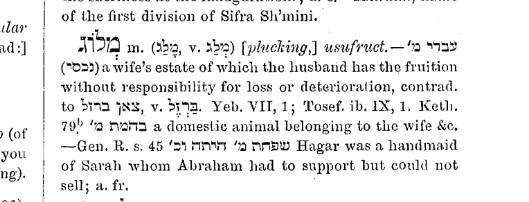
(א) אַלְמָנָה לְכֹהֵן גָּדוֹל, גְּרוּשָׁה וַחֲלוּצָה לְכֹהֵן הֶדְיוֹט, הִכְנִיסָה לוֹ עַבְדֵי מְלוֹג וְעַבְדֵי צֹאן בַּרְזֶל, עַבְדֵי מְלוֹג לֹא יֹאכְלוּ בַתְּרוּמָה, עַבְדֵי צֹאן בַּרְזֶל יֹאכֵלוּ. וְאֵלּוּ הֵן עַבְדֵי מְלוֹג, אִם מֵתוּ, מֵתוּ לָהּ, וְאִם הוֹתִירוּ, הוֹתִירוּ לָהּ. אַף עַל פִּי שֶׁהוּא חַיָּב בִּמְזוֹנוֹתָן, הֲרֵי אֵלּוּ לֹא יֹאכְלוּ בַתְּרוּמָה. וְאֵלּוּ הֵן עַבְדֵי צֹאן בַּרְזֶל, אִם מֵתוּ, מֵתוּ לוֹ, וְאִם הוֹתִירוּ, הוֹתִירוּ לוֹ. הוֹאִיל וְהוּא חַיָּב בְּאַחֲרָיוּתָן, הֲרֵי אֵלּוּ יֹאכְלוּ בַתְּרוּמָה:
(1) A widow married to a High Priest, and a divorcée or a yevama who performed ḥalitza [ḥalutza] married to a common priest are all unions prohibited by Torah law. If one of these women brought with her into the marriage slaves of usufruct [melog] property or slaves of guaranteed investment, then the slaves of usufruct property do not partake of teruma but the slaves of guaranteed investment do partake of teruma. And these are slaves of usufruct property: They are those with regard to whom the couple stipulated that if the slaves die, their death is her loss, and if they increase in value, their increase is her gain. Although the husband is obligated in their sustenance, they do not partake of teruma, as they belong to her, not to him. He owns only the right of their use while he is married to her. And these are slaves of guaranteed investment: They are those with regard to whom the couple stipulated that if they die, their death is his loss, and if they increase in value, their increase is his gain. Since he bears financial responsibility for compensating her in the event of their loss, they partake of teruma, as they are considered his property.
(כג) בֶּן הֵא הֵא אוֹמֵר, לְפוּם צַעֲרָא אַגְרָא:
(23) Ben He He said: According to the labor is the reward.
the consort stands at your right hand,
decked in gold of Ophir.
The oft-raised issue of procreation should be treated similarly. There is a wonderful Midrash (Shir HaShirim Rabbah 1:3) in which an infertile couple, back in the days when this used to happen, prepare to separate having been married for ten years without producing offspring. Rabbi Shimon Bar Yochai allows the wife to take one thing from the matrimonial house - and she takes her husband. The Halachah changes and infertile couples are no longer expected to divorce. Of course procreation is important, but sanctified intimate companionship in Judaism is, and has always been, about a lot more than procreation. Even putting aside the notion that same-sex couples, by varying means, are able to raise children, it is necessary to distinguish between a commitment to procreation and the question of the welcome we should offer those attracted to members of the same-sex.
מַתְנִי׳ נָשָׂא אִשָּׁה וְשָׁהָה עִמָּהּ עֶשֶׂר שָׁנִים וְלֹא יָלְדָה — אֵינוֹ רַשַּׁאי לְבַטֵּל.
גֵּירְשָׁהּ — מוּתֶּרֶת לִינָּשֵׂא לְאַחֵר. וְרַשַּׁאי הַשֵּׁנִי לִשְׁהוֹת עִמָּהּ עֶשֶׂר שָׁנִים.
וְאִם הִפִּילָה — מוֹנֶה מִשָּׁעָה שֶׁהִפִּילָה.
גְּמָ׳ תָּנוּ רַבָּנַן: נָשָׂא אִשָּׁה וְשָׁהָה עִמָּהּ עֶשֶׂר שָׁנִים וְלֹא יָלְדָה — יוֹצִיא וְיִתֵּן כְּתוּבָה, שֶׁמָּא לֹא זָכָה לְהִבָּנוֹת מִמֶּנָּה.
אַף עַל פִּי שֶׁאֵין רְאָיָה לַדָּבָר, זֵכֶר לַדָּבָר: ״מִקֵּץ עֶשֶׂר שָׁנִים לְשֶׁבֶת אַבְרָם בְּאֶרֶץ כְּנָעַן״ —
לְלַמֶּדְךָ שֶׁאֵין יְשִׁיבַת חוּץ לָאָרֶץ עוֹלֶה לוֹ מִן הַמִּנְיָן. לְפִיכָךְ, חָלָה הוּא אוֹ שֶׁחָלְתָה הִיא,
אוֹ שְׁנֵיהֶם חֲבוּשִׁים בְּבֵית הָאֲסוּרִים — אֵין עוֹלִין לוֹ מִן הַמִּנְיָן.
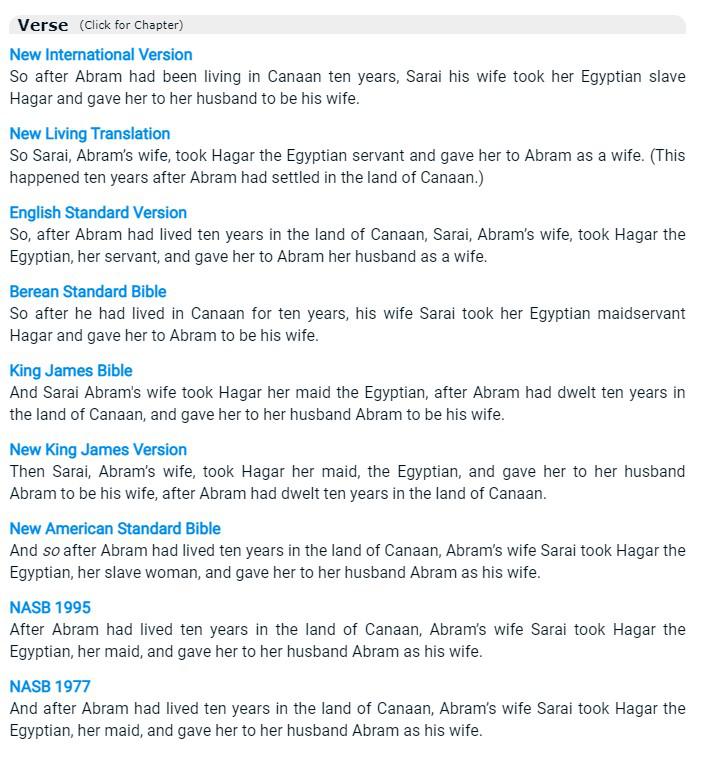
MISHNA: If a man married a woman and stayed with her for ten years and she did not give birth, he is no longer permitted to neglect the mitzva to be fruitful and multiply. Consequently, he must either divorce her and marry someone else, or take another wife while still married to her. If he divorced her she is permitted to marry another man, as it is not necessarily on her account that she and her first husband did not have children, and the second husband is permitted to stay with her for ten years. And if she had a miscarriage, he counts the ten years from the time of the miscarriage. GEMARA: The Sages taught: If a man married a woman and stayed with her for ten years and she did not give birth, he should divorce her and pay her marriage contract, because perhaps he did not merit to be built, i.e., to have children, from her. It is not certain that their failure to have children is due to her, as it is possible that they are not a suitable match for bearing children. Although there is no explicit proof for the matter that one must take another wife if he has not had children after ten years of marriage, there is an allusion to the matter, as the verse states: “And Sarai, Abram’s wife, took Hagar…after Abram had dwelled ten years in the land of Canaan, and gave her to Abram her husband to be his wife” (Genesis 16:3). Incidentally, this verse also comes to teach you that the years spent dwelling outside of Eretz Yisrael do not count as part of his tally. Consequently, if he was sick during this period or she was sick, or if one of the two of them was imprisoned in jail, it does not count as part of his tally.
(י) נשא אשה ושהתה עמו י' שנים ולא ילדה יוציא ויתן כתובה או ישא אשה הראויה לילד
ואם לא רצה כופין אותו עד שיוציא ואם אמר איני בועלה והריני שוכן עמה בפני עדים כדי שלא אתייחד עמה בין שאמרה היא בין שאמר הוא אין שומעין לו אלא יוציא וישא אשה הראויה ללדת:
הגה י"א דכ"ז דלא הוליד כלל אבל אם הוליד זרע קיימא אע"פ שלא קיים עדיין פריה ורביה אין כופין להוציא (ריב"ש סי' ט"ו וע"ל סי' א')
דבזמן הזה אין נוהגין לכוף כלל
נאמן האיש לומר שיודע בעצמו שאינו מוליד ואין כופין אותו לישא אשה (נ"י פרק הבא על יבמתו):
(10) If a man married a woman and stayed with her for ten years and did not produce children, he must divorce her and give her Ketubah, or marry another woman who can bear children. If he is unwilling, we force him to divorce. If he said, "I will not have intercourse with her. I will live with her with witnesses so that I will not be secluded with her." Whether she said this, or he said it, we do not listen; instead we require him to divorce or marry a child bearing woman. Rem"a: Some authorities say that this is true if they had no children at all. If, however, she birthed a viable child, even though he has not yet fulfilled obligation to be fruitful, we do not force him to divorce her. See (Shulchan Arukh, Even HaEzer 1), that these days we never force a divorce. A man is believed to say that he knows himself to be sterile, and we do not force him to marry a woman.
In the Talmudic era, this halacha was meticulously observed. In fact, a man who did not divorce his wife after ten years of childlessness would be forced by the Beit Din to do so.[4]Others explain that the Beit Din didn’t literally force a man to divorce his wife for this reason, but rather, they would simply pester him to take the initiative to do so.[5] Nowadays, however, the Beit Din does not get involved in such matters.[6]
Some authorities are of the opinion that the requirement to divorce one's wife after ten years of marriage includes one who had a number of children that all died, and one’s wife is unable to have additional children. The halacha, however, is not in accordance with this view. Indeed, a man one who has just one child is not truly required to divorce his wife even though he has technically not fulfilled the mitzva of "to be fruitful and multiply."[7] One only fulfills the mitzva of "to be fruitful and multiply” after having at least one son and one daughter.[8]
It is noted, of course, that the patriarch Yitzchak and his wife Rivka were childless for twenty years before having their first child.[9] There is no mention anywhere of Yitzchak and Rivka having considered divorce due to their childlessness. This seems to contradict the teaching that the patriarchs observed the entire Torah! Some explain that Yitzchak did not divorce Rivka because he somehow knew that he was the infertile partner. As such, it would have made no sense for him to divorce Rivka in order to marry someone else.[10] So too, he knew that he was to be one of the Patriarchs of the Jewish people, and therefore, he was certain that he would eventually have children.
A number of authorities are of the opinion that the obligation to divorce one’s wife if one is childless after ten years of marriage applies only in the Land of Israel.[11] Indeed, there is a tradition that Sarah only told Avraham to marry Hagar after living in the land of Israel for ten years and not having any children.[12] Furthermore, many authorities argue that this enactment no longer applies at all nowadays. In fact, a man is permitted to knowingly marry a woman incapable of having children.[13] As such, couples who have not been able to conceive are permitted to remain married should they so desire.[14] There has even been a number of great sages in recent generations who were unable to have children and yet they nevertheless remained married to their wives.[15] There are also authorities who rule that adopting children fulfills the mitzva of procreation just like having children biologically.[16] Indeed, from the Torah’s perspective, a parent’s practical, familial, and social responsibilities for adopted children are the same as for biological ones.[17]
[4] Rashi, Yevamot 65b; Rambam, Hilchot Ishut 15:7.
[5] Tosfot, Yevamot 64a.
[6] Hagahot Maimoniot, Ishut 15:4, Rema, EH 154:10.
[7] Rema, EH 154:10.
[8] Yevamot 61b; EH 1:5.
[9] Bereishit 25:20,21,26.
[10] Yevamot 64a.
[11] Hagahot Maimoniot, Hilchot Ishut 15:4; Sefer Hamiddot s.v. banim.
[12] See Rashi to Bereishit 16:3.
[13] Rivash 15.
[14] Rema, EH 154:10.
[15] Teshuvot V’hanhagot 1:790.
[16] Chochmat Shlomo, EH 1:1.
[17] Rashi, Bereishit 37:10. See CM 42, regarding inheritance.
(ב) [ב] זה היום עשה י"י נגילה ונשמחה בו (תהלים קיח:כד). א"ר אבין ואין אנו יודעין במה לשמוח, אם ביום ואם בהקב"ה, ובא שלמה ופירש נגילה ונשמחה בך, בך בתורתך, בך בישועתך. א"ר יצחק בך, בעשרים ושתים אותות שכתבת לנו בתורה, ב' תרין כ' עשרין. כידתנינן תמן נשא אשה ושהא עמה עשר שנים ולא ילדה אינו רשאי לבטל פיריה וריביה. גרשה מותרת להינשא לאחר, רשאי השיני לשהות עמה עשר שנים. אם הפילה מונה משעה שהפילה. האיש מצוה על פיריה וריביה אבל לא האשה. ר' יוחנ' בן ברוקה או' על שניהם הוא אומר ויברך אותם אלקים וג' (בראשית א:כח). מעשה בצידן באחד שנשא אשה ושהא עמה עשר שנים ולא ילדה, אתון לגבי ר' שמעו' בן יוחי למשתבקה, א' לה, כל חפץ שיש לי בתוך ביתי טלי אותו ולכי לבית אביך.
א' להם ר' שמעון בן יוחי כשם שנזדווגתם מתוך מאכל ומשקה כך אין אתם פורשין זה מזה אלא מתוך מאכל ומשקה.
מה עשת, עשת סעודה גדולה ושיכרתו יותר מדיי ורמזה לשפחתה ואמרה להון טלו אותו לבית אבא.
בחצי הלילה ניעור משנתו, א' להן, איכן אני נתון, אמרה לו, לא כך אמרתה כל חפץ שיש לי בתוך ביתי טלי אותו ולכי לבית אביך, וכדון הוא אין לי חפץ טוב ממך.
כיון ששמע ר' שמעון בן יוחי כך, נתפלל עליהם ונתפקדו. הקב"ה פוקד עקרות והצדיקים פוקדים עקרות.
In Sidon it happened that a man took a wife with whom he lived for ten years and she bore him no children.
When they came to R. Simeon bar Yohai to be divorced, the man said to his wife: “Take any precious object I have in my house—take it and go back to your father’s house.” Thereupon, R. Simeon bar Yohai said: “Even as you were wed with food and drink [being served], so you are not to separate save with food and drink [being served].” What did the wife do? She prepared a great feast, gave her husband too much to drink [so that he fell asleep], then beckoned to her menservants and maidservants saying, “Take him to my father’s house.”
At midnight he woke up from his sleep and asked, “Where am I?” She replied, “Did you not say, ‘Whatever precious object I have in my house—take it and go back to your father’s house?’ I have no object more precious than you.” When Simeon bar Yohai heard what the wife had done, he prayed on the couple’s behalf, and they were remembered with children. For, even as the Holy One remembers barren women, righteous men also have the power to remember barren women.
Both Pesikta de-Rab Kahana 22:2 and a version of this aggadic tale found in Song of Songs Rabbah 1:4 §2 end the story with a consolation text offering future comfort to all who depend on God. The following is the ending found in Song of Songs Rabbah:
And is not the lesson clear: If a woman, on saying to a mere mortal like herself, “There is nothing I care for more in the world than you,” was visited, does it not stand to reason that Israel who wait for the salvation of God every day and say “We care for nothing in the world but You,” will certainly be visited? Hence it is written: “Let us delight and rejoice in Your love” (Song of Songs 1:4).
Likkutei Sichos 15:480, printed in Shulchan Menachem 6:59
The Rebbe related the following in a letter addressed to a couple who was childless after ten years:[9] It is written in the holy Sefarim, in particular in the Sifrei Kabalah[10], that although one must do all that is necessary to fulfill the Mitzvah of Peru Urevu, there are certain cases of exception in which G-d exempts one from doing so. The reason for this is because he has a different purpose in his life [that G-d has destined for him]. The Shlah Hakadosh[11] writes in the name of Rav Shlomo Alkabetz that Hashem sends certain souls into the world for a specific Tikkun, or leadership positions, which exempts them from having children. Not only do they not need to have children, and will not get punished for not having children, but even if they have children, the children will not spiritually be considered as theirs for any purpose. This is why Ben Azaiy did not have children, as his purpose was solely for Torah learning.
The Rebbe convinces a couple to stay married:[14]
Heard from Rav S.Z. Labkowski, R.Y. of central T.T. Yeshiva N.Y, who was one of the Bochurim involved
One morning in New York, in the early the 50’s or 60’s, the Rebbe took an unexpected ride with his wife the Rebbetzin. The curious Bochurim followed the Rebbe’s car to see where it would be heading. You see, in the early years the Rebbe was accustomed to walk home after Davening, and when the Bochurim saw the Rebbe get into the car with his wife they knew that something was astray. After about 20 minutes of driving, the Rebbe’s car pulled up to a driveway in front of a home in the Williamsburg neighborhood. The Rebbe and Rebbetzin left the car and entered the house. After the passing of a considerable amount of time the Rebbe and Rebbetzin exited the house and returned to Crown Heights. The curious Bochurim, knowing no limits to help quench their curiosity, knocked on the door of the house to try to receive some hint as to what transpired in the home. A middle-aged couple answered the door and asked how they can be of help. The Bochurim replied that they wanted to know as for what purpose the Rebbe visited their home. “Which Rebbe?” asked the couple. “The Lubavitcher Rebbe”, answered the Bochurim. “You mean that the couple who just visited my home was the Lubavitcher Rebbe and Rebbetzin?” asked the couple in astonishment. “Yes indeed it was,” replied the Bochurim, “and what is it that they told you?” Please come in and have a seat and we will explain. You see my wife and I are married for over ten years and we have not merited having children. We have thus seriously considered getting divorced, as is the ruling of the Shulchan Aruch. Today this respected couple came to our door, looking like a Rabbi and Rebbetzin, and persuaded us not to get divorced. The Rabbi explained that according to Halacha there is no need to get divorced today, and that even he and his wife are married for more than ten years without children, and they still remain married despite the letter of the law. The couple convinced us not to get divorced, and now I see that it was none other than the Lubavitcher Rebbe and his wife who came to visit us. All those present were left in astonishment seeing the Rebbe’s and Rebbetzin’s care for a couple they did not know, and how they troubled themselves to meet with them to help save their marriage.
Hidden by the cliff,
Let me see your face,
Let me hear your voice;
For your voice is sweet
And your face is comely.”
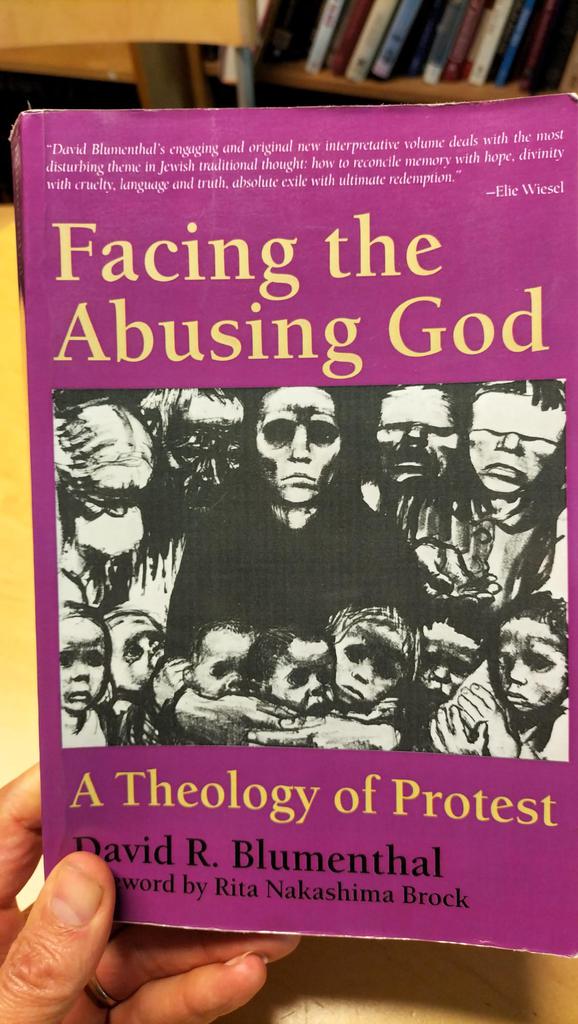
THE FIRST STEP in reconstructing a post-holocaust, abuse-sensitive faith is to face up to the truth, resistant as we are to admitting it. We must break the conspiracy of silence and tell the truth-to ourselves, and to God; it is the seal of God's being, and ours. The second step is to develop a theological stance and religious affections that can guide us in living this new-found faith which, in turn, will enable us to face God. Both must be rooted in the tradition, as well as in our experience; theology and religious affection must be inter-texts, woven from the fabric of the past, the present, and the future.
Protest and Challenge, Distrust and Suspicion as a Post-Holocaust, Abuse-Sensitive Stance
…
Although Wiesel takes up the theme of the holocaust in all of his books, he approaches the issue of God's responsibility yet again in The Trial of God This play, which is a modern re-reading of the Book of Job, is set in the mid of the Chmielnitsky (Cossack) massacres of the Jews in 1848-1849. God is put on trial by an innkeeper named Berish, three wandering Jews, and a defending attorney called Sam, abbreviated from Samael, one of the names of Satan The victims recount the horrors they have seen even as the threat against them grows. The substance of the play is the vivid debate among Berish, Sam, and the other characters concerning God's culpability in the pogrom. At the end, the three itinerants are completely taken in by Satan, that is, they accept the usual defenses of God.
The hero of The Trial of God is, as I see it, Berish, who, although resistant in the beginning to the idea of a trial of God, insists to the very end that he will hold God responsible and yet stay loyal to his Jewish identity and to God.
If He insists upon going on with His methods, let Him-but I won't say Amen Let Him crush me, I won't say Kaddish. Let Him kill me, let Him kill us all, I shall shout and shout that it's His fault. I'll use my last energy to make my protest known. Whether I live or die, I submit to Him no longer.... And they kept quiet? Too bad-then I'll speak for them. For them, too, I'll demand justice.... To you, judges, I'll shout, "Tell Him what He should not have done; tell Him to stop the bloodshed now...." I lived as a Jew, and it is as a Jew that I die-and it is as a Jew that, with my last breath, I shall shout my protest to God! And because the end is near, I shall shout louder! Because the end is near, I'll tell Him that He's more guilty than ever!
With this play, probably Wiesel's most powerful confrontation with God and the holocaust, Wiesel has explicitly adopted the way of the "theology of protest." As the paradigmatic survivor of the holocaust, Wiesel has let it be known that he, and hence we, cannot forgive God; nor can he, and hence we, be silent. He must let his voice ring out, he must protest; so must we.
The theology of protest goes back to the Bible and is present most forcefully in the Book of Job. The central figure in that text, Job, never questions God's existence, nor God's power to do what God is doing. Rather, Job ques- God's justification, God's morality, God's justice. Throughout, job rejects in the end. No pat answers; rather, the repeated assertion of his innocence and the recurrent questioning of God's justice. No easy resolutions; rather, the repeated assertion of loyalty to God and the recurrent accusation of injustice: And Job answered [the friends] saying: "How long will you aggravate me and oppress.
Between the Book of Job and Elie Wiesel, there is a long tradition of the theology of protest. It has been very well documented by Anson Laytner in Arguing With God: A Jewish Tradition. In the introduction and overview, Laytner identifies the basic form he will discuss, the lawcourt pattern of address to God, in which complaints and charges against God are allowable. Laytner, then, begins with the evidence from the Bible (chapter 1): Abraham arguing for Sodom (Genesis 18) and Moses' spirited defense of the people (Exodus 5 and 32; Numbers 14), showing the emergence, in these earliest strata of the tradition, of three basic themes: questioning of God over the issue of justice; the appeal to God to act for the merit of the ancestors, the covenant, and the sake of God's Name; and confession of guilt. Laytner then moves to Jeremiah and Psalms, where he shows the national and the personal lament as a form.10
Having cited the biblical evidence, Laytner deals with the evidence from the rabbinic sources: interpretations of biblical passages and motifs (chapters 2 and 3); special prayers (chapters 4 and 5); and the statutory liturgy
5762 - New London Synagogue
Perspectives on Hagar
Hagar is the prototype of Israel. Everything that happens to Hagar is paralleled by the story of Israel's sacred history. The liberation, the wandering in the desert, the promise from God. The unsettling nature of the story is that Sara is our mother, but Hagar is us. You sympathize with Hagar and feel uneasy about it. That is the technique of the story teller. Hagar is the double of Israel, yet so is Sara. I like the story so much because Hagar is the "other." She is the mother of the Ishmaelites and Hagarites and all the others who live wherever they want and cannot be subordinated.
Tikva Frymer-Kensky
Hagar is blind to destiny as she will be blind, later, to her dying son and to the well which is capable of reviving him. In fleeing her suffering Hagar rejects the possibility of sharing in the covenantal promise. She refuses to accept the suffering - the sojourning, enslavement and affliction - that is so much a part of the covenant with Abraham and his descendants.
Devorah Steimetz
For black women, the story of Hagar is a haunting one. It is a story of exploitation and persecution suffered an Egyptian woman at the hand of her Hebrew mistress. Even if it is not our individual story, it is certainly most of our grandmothers' story. It is as if we know it by heart. At some times in our lives, whether we are black or white, we are all Hagar's daughters. When our backs are up against a wall, when we feel abandoned, abused, betrayed and banished we are like Hagar and are in need of a woman who will 'sister' us, not exploit us.
Renita Weems
Author, Scholar, Clergy, & Public Intellectual
In addition to being a former professor at Vanderbilt Divinity School (1987-2004), Dr. Renita Weems has taught at Spelman College, Howard University Divinity School and Memphis Theological Seminary. She grew up in Atlanta, GA where she attended Atlanta public schools.
Dr. Renita Weems earned a Ph.D. degree at Princeton Theological Seminary in 1989 making her the first African-American woman to earn a doctorate in Old Testament Studies. Her dissertation was a trailblazing effort. Writing in an era when women doctoral students hesitated to take on “women’s issue” topics, and when most male faculty still felt uncertain, if not uncomfortable, advising such topics, Dr. Weems chose to study marriage imagery in the Hebrew prophets. Her work offered careful, challenging, and often painful insights into use of this metaphor; moving beyond traditional scholarship, which had all too easily looked only at the “love” side of the marriage metaphor. Weems was among the first to point to the violence associated with this biblical imagery, violence acceptable within the prophets’ cultural assumptions about marriage and all too often considered acceptable even in twentieth-century America. Dr. Weems’ 1995 volume Battered Love: Marriage, Sex, and Violence in the Hebrew Prophets brought this important work to a wide audience, with powerful hermeneutical reflection on implications for contemporary understandings of God and of marriage.
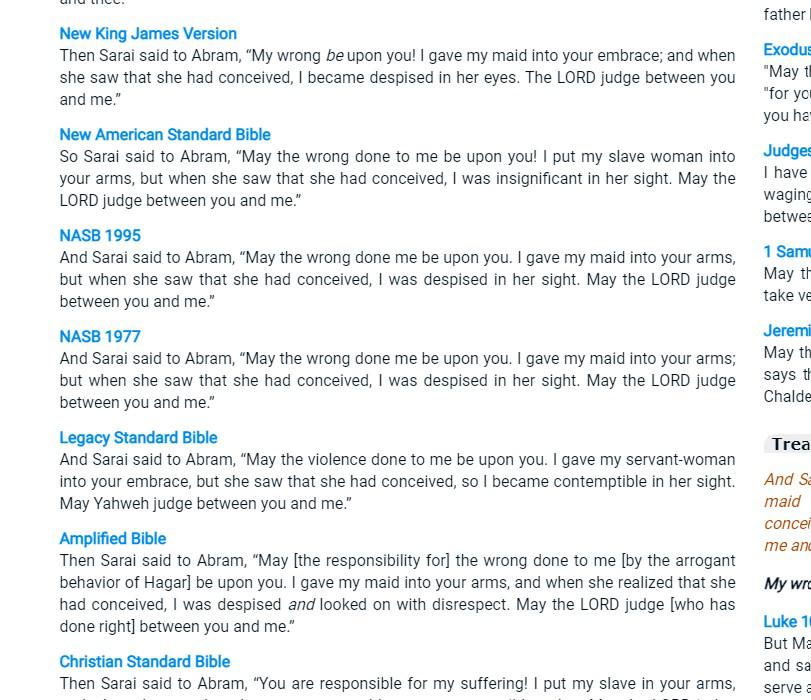
“Fear not, Abram,
I am a shield to you;
Your reward shall be very great.” (2) But Abram said, “O lord יקוק, what can You give me, seeing that I shall die childless, and the one in charge of my household is Dammesek Eliezer!” (3) Abram said further, “Since You have granted me no offspring, my steward will be my heir.” (4) The word of יקוק came to him in reply, “That one shall not be your heir; none but your very own issue shall be your heir.”

The Ladies Guild Collection is a series of paper-cuts that combine rabbinic misogyny with sexualised images of women, all on a nice paper doily. The doily is an old-fashioned, fussy way of presenting food - heaven forbid a cake or biscuit should come into contact with a naked plate. The Ladies Guild is the name given to the women's committee in the orthodox synagogue in Anglo-jewry that I grew up in. The Ladies Guild's main job was to prepare the refreshments, women not having a liturgical leadership role.
The texts in this series are selected specifically because they voice the misogynist attitudes that influence how women were, and continue to be, seen and treated in the community. Whenever I came across these texts in my learning I used to ignore them, close the book, unwilling to engage with the apologetics that tried to twist them around. I felt increasingly uncomfortable doing that, aware of my intellectual dishonesty. And so I decided to open those books, not look away, get those statements out in the open and play with them.

What starts as a positive directive to care for the vulnerable members of society ends in a concern for too much social interaction with one's wife. And other men's wives. It is often translated (by squirmy apologetics) as "do not gossip with women" as that would be degrading to them. Except the Hebrew is 'si'cha' which is a conversation. Whispering women - sexually alluring, or gossiping. Either one is an activity that distracts those poor men, and women are best kept removed from social discourse.
Racism is the force which extrapolates the one-time someone to the always everyone.
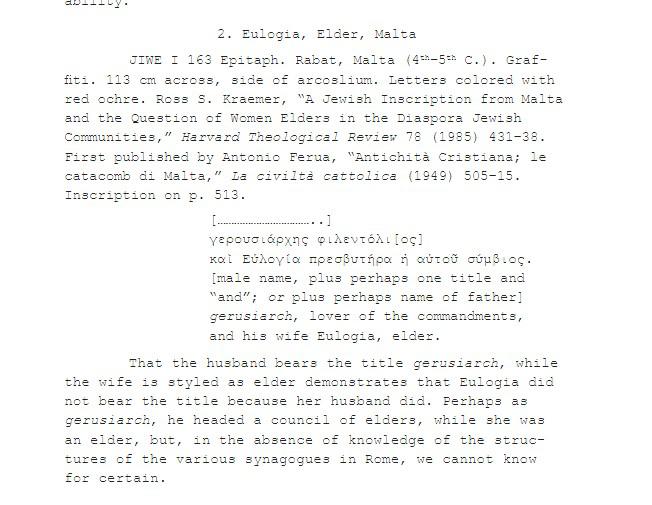
Bernadette J. Brooten
https://www.fulcrum.org/epubs/x633f3130?locale=en#page=14
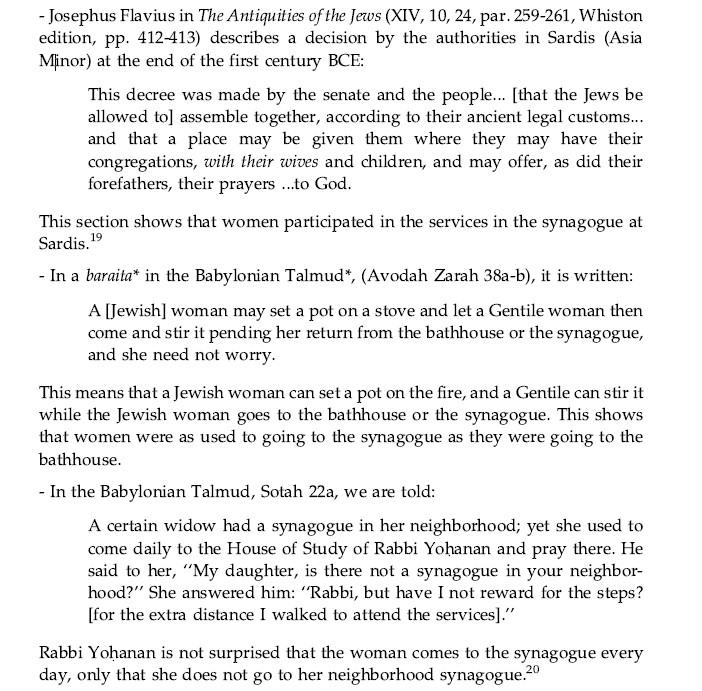
The difference between a Jew and an antisemite is that an antisemite hates all Jews, but Moishe, who lives next door isn't such a bad guy.
The Jew loves all Jews, but Moishe, who lives next door, is an utter ...
(1) בת לאה THE DAUGHTER OF LEAH — so Scripture calls her. Why not the daughter of Jacob? But just because she “went out” she is called Leah’s daughter, since she, too, was fond “of going out” (Genesis Rabbah 80:1), as it is said (30:16) “and Leah went out to meet him”. With an allusion to her they formulated the proverb: “Like mother, like daughter”.
And get attacked by a bear;
Or, upon making it indoors,
Were to lean their hand on the wall
And get bitten by a snake!
(א) כתיב ובא אל הבית וסמך ידו אל הקיר ונשכו נחש וכשבא יעקב לארץ אחוזתו שבארץ כנען נשכו הנחש ואי זה הוא הנחש זה שכם בן חמור שהיתה בתו של יעקב יושבת אוהלים ולא היתה יוצאה לחוץ מה עשה שכם בן חמור הביא נערות משחקות חוצה לו מתופפות ויצאה דינה לראות בבנות הארץ המשחקות ושללה ושכב עמה והרתה וילדה את אסנת ואמרו בני ישראל להורגה שאמרה עכשו יאמרו בכל הארץ שיש בית זנות באהלי יעקב הביא שרץ של זהב שם הקדש כתוב בו ותלה על צוארה ושלחה והלכה והכל צפוי לפני הב"ה וירד מיכאל המלאך והורידה למצרים לבית פוטיפרע שהיתה אסנת ראויה ליוסף לאשה והיתה אשתו של פוטיפרע עקרה וגדלה עמה כבת וכשירד יוסף למצרים לקחה לו לאשה שנ' ויתן לו את אסנת בת פוטיפרע
.And it is written: And went into the house and leaned his hand on the wall, And a serpent bit him. And when Yaacov arrives to his property in Eretz Canaan, the snake bit him. And how is this snake? Shchem Ben Hamor! For the daughter of Yaakov dwelled in tents and would not go outside.
What did Shchem do? He brought (female) drummers outside of her tent and when they drummed, Dina went out to see "the daughters of the land" (these drummers). It was at this moment that Shchem stole her and slept with her...
...And Dina daughter of Leah and who Jacob had given birth to, went out to see the customs of the daughters of the lands
לראות בבנות הארץ: לעיין נשי הארץ ההיא ומנהג מלבושן, כמשפט הבנות. ובס' השמרונים כתוב להראות.
Shadal
To see the daughters of the land: To look at the women of the land, and their clothing as women tend to do. And in the Samaritan Pentateuch it is written להראות (to instruct instead of to see)
וספר הכתוב שיצאה דינה בת לאה אשר ילדה ליעקב לא לספר בגנותה שהיתה יצאנית בת יצאנית כדברי רש"י כי הנה לאה צנועה היתה עד שלצניעותה לא הכירה יעקב כשבא אליה. ומה שיצאה ליעקב לאמר אלי תבא וגו' אל פתח ביתה יצאה ולשם שמים נתכונה אבל הכתוב הזה בא לספר שבחה של דינה שלא קרה לה זה להיותה יצאנית בטבעה כי היא היתה בת לאה המלומדת לשבת בית כי רחל היתה רועה את הצאן ולאה לא היתה יוצאת החוצה. גם מפאת אביה שהיתה בת יעקב יושב אוהלים ואם היה אביה צנוע כל שכן בתו וזה מורה שלא יצאה לכוונה רעה חלילה אלא לראות בבנות הארץ לא אמר באנשי העיר וגם לא בבני העיר אלא בבנות העיר ר"ל לראות בבנות העיר במלבושיהן ותכשיטיהן יען לא היה בבית יעקב שום נערה בלתה והיא רצתה ללמוד מנערות העיר כדרך הבתולות
Abarbanel on Torah, Genesis 33:18:17
The text tells us that Dinah daughter of Leah went out, not to tell us of her shame, that she was "outgoing" the daughter of an "outgoing" person as Rashi says, for Leah was actually modest - so modest that Jacob didn't even recognize her when he was intimate with her (initially!) Rather, when it says that she "went out" to Jacob she was doing so to tell him to be with her and she had intentions for the sake of Heaven. The text comes here to praise Dinah; it wasn't her nature to be someone who "went out" because she was the daughter of Leah, who would wait patiently at home- remember that Rachel was the shepherdess of the sheep while Leah did not go outside! And also she's the daughter of Jacob, a tent-dweller who did not go outside (was not a man of the field). Her father Jacob was modest, so how much the more so his daughter Dinah. She (Dinah) did not go out with any inappropriate intentions- rather, she went out to see the daughters of the land. It doesn't say she went out to see the men of the city but rather the DAUGHTERS of the city- she wanted to see the women of the city and their garments and jewelry because she was the only girl in the house of Jacob, alone, and she wanted to learn from the other women of the city about being a young maiden.
(ח) וַיְהִ֨י הַיּ֜וֹם וַיַּֽעֲבֹ֧ר אֱלִישָׁ֣ע אֶל־שׁוּנֵ֗ם וְשָׁם֙ אִשָּׁ֣ה גְדוֹלָ֔ה וַתַּחֲזֶק־בּ֖וֹ לֶאֱכׇל־לָ֑חֶם וַֽיְהִי֙ מִדֵּ֣י עׇבְר֔וֹ יָסֻ֥ר שָׁ֖מָּה לֶאֱכׇל־לָֽחֶם׃ (ט) וַתֹּ֙אמֶר֙ אֶל־אִישָׁ֔הּ הִנֵּה־נָ֣א יָדַ֔עְתִּי כִּ֛י אִ֥ישׁ אֱלֹקִ֖ים קָד֣וֹשׁ ה֑וּא עֹבֵ֥ר עָלֵ֖ינוּ תָּמִֽיד׃ (י) נַעֲשֶׂה־נָּ֤א עֲלִיַּת־קִיר֙ קְטַנָּ֔ה וְנָשִׂ֨ים ל֥וֹ שָׁ֛ם מִטָּ֥ה וְשֻׁלְחָ֖ן וְכִסֵּ֣א וּמְנוֹרָ֑ה וְהָיָ֛ה בְּבֹא֥וֹ אֵלֵ֖ינוּ יָס֥וּר שָֽׁמָּה׃ (יא) וַיְהִ֥י הַיּ֖וֹם וַיָּ֣בֹא שָׁ֑מָּה וַיָּ֥סַר אֶל־הָעֲלִיָּ֖ה וַיִּשְׁכַּב־שָֽׁמָּה׃ (יב) וַיֹּ֙אמֶר֙ אֶל־גֵּיחֲזִ֣י נַעֲר֔וֹ קְרָ֖א לַשּׁוּנַמִּ֣ית הַזֹּ֑את וַיִּ֨קְרָא־לָ֔הּ וַֽתַּעֲמֹ֖ד לְפָנָֽיו׃ (יג) וַיֹּ֣אמֶר ל֗וֹ אֱמׇר־נָ֣א אֵלֶ֘יהָ֮ הִנֵּ֣ה חָרַ֣דְתְּ ׀ אֵלֵ֘ינוּ֮ אֶת־כׇּל־הַחֲרָדָ֣ה הַזֹּאת֒ מֶ֚ה לַעֲשׂ֣וֹת לָ֔ךְ הֲיֵ֤שׁ לְדַבֶּר־לָךְ֙ אֶל־הַמֶּ֔לֶךְ א֖וֹ אֶל־שַׂ֣ר הַצָּבָ֑א וַתֹּ֕אמֶר בְּת֥וֹךְ עַמִּ֖י אָנֹכִ֥י יֹשָֽׁבֶת׃ (יד) וַיֹּ֕אמֶר וּמֶ֖ה לַעֲשׂ֣וֹת לָ֑הּ וַיֹּ֣אמֶר גֵּיחֲזִ֗י אֲבָ֛ל בֵּ֥ן אֵֽין־לָ֖הּ וְאִישָׁ֥הּ זָקֵֽן׃ (טו) וַיֹּ֖אמֶר קְרָא־לָ֑הּ וַיִּ֨קְרָא־לָ֔הּ וַֽתַּעֲמֹ֖ד בַּפָּֽתַח׃ (טז) וַיֹּ֗אמֶר לַמּוֹעֵ֤ד הַזֶּה֙ כָּעֵ֣ת חַיָּ֔ה (אתי) [אַ֖תְּ] חֹבֶ֣קֶת בֵּ֑ן וַתֹּ֗אמֶר אַל־אֲדֹנִי֙ אִ֣ישׁ הָאֱלֹקִ֔ים אַל־תְּכַזֵּ֖ב בְּשִׁפְחָתֶֽךָ׃ (יז) וַתַּ֥הַר הָאִשָּׁ֖ה וַתֵּ֣לֶד בֵּ֑ן לַמּוֹעֵ֤ד הַזֶּה֙ כָּעֵ֣ת חַיָּ֔ה אֲשֶׁר־דִּבֶּ֥ר אֵלֶ֖יהָ אֱלִישָֽׁע׃
(1) These are the rules that you shall set before them: (2) When you acquire a Hebrew slave, that person shall serve six years—and shall go free in the seventh year, without payment. (3) If [a male slave] came single, he shall leave single; if he had a wife, his wife shall leave with him. (4) If his master gave him a wife, and she has borne him children, the wife and her children shall belong to the master, and he shall leave alone. (5) But if the slave declares, “I love my master, and my wife and children: I do not wish to go free,” (6) his master shall take him before God. He shall be brought to the door or the doorpost, and his master shall pierce his ear with an awl; and he shall then remain his master’s slave for life. (7) When a parent sells a daughter as a slave, she shall not go free as other slaves do. (8) If she proves to be displeasing to her master, who designated her for himself, he must let her be redeemed; he shall not have the right to sell her to outsiders, since he broke faith with her. (9) And if the master designated her for a son, he shall deal with her as is the practice with free maidens.
This was the work of a slave. Thus she did not actually ill-treat her but made her do work unsuited to her new status.
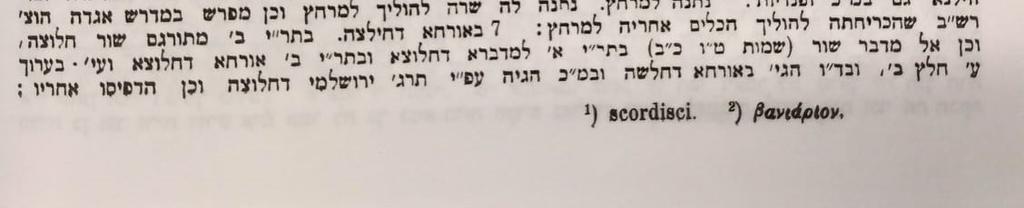
Targum Yershalmi Bet - 'Yerushalmi'

His hand against everyone,
And everyone’s hand against him;
He shall dwell alongside of all his kin.”
(ח) וַיֹּאמַ֗ר הָגָ֞ר שִׁפְחַ֥ת שָׂרַ֛י אֵֽי־מִזֶּ֥ה בָ֖את וְאָ֣נָה תֵלֵ֑כִי וַתֹּ֕אמֶר מִפְּנֵי֙ שָׂרַ֣י גְּבִרְתִּ֔י אָנֹכִ֖י בֹּרַֽחַת׃ (ט) וַיֹּ֤אמֶר לָהּ֙ מַלְאַ֣ךְ יקוק שׁ֖וּבִי אֶל־גְּבִרְתֵּ֑ךְ וְהִתְעַנִּ֖י תַּ֥חַת יָדֶֽיהָ׃
(י) וַיֹּ֤אמֶר לָהּ֙ מַלְאַ֣ךְ יקוק הַרְבָּ֥ה אַרְבֶּ֖ה אֶת־זַרְעֵ֑ךְ וְלֹ֥א יִסָּפֵ֖ר מֵרֹֽב׃ (יא) וַיֹּ֤אמֶר לָהּ֙ מַלְאַ֣ךְ יקוק הִנָּ֥ךְ הָרָ֖ה וְיֹלַ֣דְתְּ בֵּ֑ן וְקָרָ֤את שְׁמוֹ֙ יִשְׁמָעֵ֔אל כִּֽי־שָׁמַ֥ע יקוק אֶל־עׇנְיֵֽךְ׃ (יב) וְה֤וּא יִהְיֶה֙ פֶּ֣רֶא אָדָ֔ם יָד֣וֹ בַכֹּ֔ל וְיַ֥ד כֹּ֖ל בּ֑וֹ וְעַל־פְּנֵ֥י כׇל־אֶחָ֖יו יִשְׁכֹּֽן׃ (יג) וַתִּקְרָ֤א שֵׁם־יקוק הַדֹּבֵ֣ר אֵלֶ֔יהָ אַתָּ֖ה אֵ֣ל רֳאִ֑י כִּ֣י אָֽמְרָ֗ה הֲגַ֥ם הֲלֹ֛ם רָאִ֖יתִי אַחֲרֵ֥י רֹאִֽי׃
“I will greatly increase your offspring,
And they shall be too many to count.” (11) The messenger of יקוק said to her further,
“Behold, you are pregnant
And shall bear a son;
You shall call him Ishmael,
For יקוק has paid heed to your suffering.
(12) He shall be a wild ass of a person;
His hand against everyone,
And everyone’s hand against him;
He shall dwell alongside of all his kin.” (13) And she called יקוק who spoke to her, “You Are El-roi,” by which she meant, “Have I not gone on seeing after my being seen!”
(ח) וַיֶּעְתַּ֥ר מָנ֛וֹחַ אֶל־יקוק וַיֹּאמַ֑ר בִּ֣י אֲדוֹנָ֔י אִ֣ישׁ הָאֱלֹקִ֞ים אֲשֶׁ֣ר שָׁלַ֗חְתָּ יָבוֹא־נָ֥א עוֹד֙ אֵלֵ֔ינוּ וְיוֹרֵ֕נוּ מַֽה־נַּעֲשֶׂ֖ה לַנַּ֥עַר הַיּוּלָּֽד׃ (ט) וַיִּשְׁמַ֥ע הָאֱלֹקִ֖ים בְּק֣וֹל מָנ֑וֹחַ וַיָּבֹ֣א מַלְאַךְ֩ הָאֱלֹקִ֨ים ע֜וֹד אֶל־הָאִשָּׁ֗ה וְהִיא֙ יוֹשֶׁ֣בֶת בַּשָּׂדֶ֔ה וּמָנ֥וֹחַ אִישָׁ֖הּ אֵ֥ין עִמָּֽהּ׃ (י) וַתְּמַהֵר֙ הָֽאִשָּׁ֔ה וַתָּ֖רׇץ וַתַּגֵּ֣ד לְאִישָׁ֑הּ וַתֹּ֣אמֶר אֵלָ֔יו הִנֵּ֨ה נִרְאָ֤ה אֵלַי֙ הָאִ֔ישׁ אֲשֶׁר־בָּ֥א בַיּ֖וֹם אֵלָֽי׃ (יא) וַיָּ֛קׇם וַיֵּ֥לֶךְ מָנ֖וֹחַ אַחֲרֵ֣י אִשְׁתּ֑וֹ וַיָּבֹא֙ אֶל־הָאִ֔ישׁ וַיֹּ֣אמֶר ל֗וֹ הַאַתָּ֥ה הָאִ֛ישׁ אֲשֶׁר־דִּבַּ֥רְתָּ אֶל־הָאִשָּׁ֖ה וַיֹּ֥אמֶר אָֽנִי׃ (יב) וַיֹּ֣אמֶר מָנ֔וֹחַ עַתָּ֖ה יָבֹ֣א דְבָרֶ֑יךָ מַה־יִּהְיֶ֥ה מִשְׁפַּט־הַנַּ֖עַר וּמַעֲשֵֽׂהוּ׃ (יג) וַיֹּ֛אמֶר מַלְאַ֥ךְ יקוק אֶל־מָנ֑וֹחַ מִכֹּ֛ל אֲשֶׁר־אָמַ֥רְתִּי אֶל־הָאִשָּׁ֖ה תִּשָּׁמֵֽר׃ (יד) מִכֹּ֣ל אֲשֶׁר־יֵצֵא֩ מִגֶּ֨פֶן הַיַּ֜יִן לֹ֣א תֹאכַ֗ל וְיַ֤יִן וְשֵׁכָר֙ אַל־תֵּ֔שְׁתְּ וְכׇל־טֻמְאָ֖ה אַל־תֹּאכַ֑ל כֹּ֥ל אֲשֶׁר־צִוִּיתִ֖יהָ תִּשְׁמֹֽר׃ {ס} (טו) וַיֹּ֥אמֶר מָנ֖וֹחַ אֶל־מַלְאַ֣ךְ יקוק נַעְצְרָה־נָּ֣א אוֹתָ֔ךְ וְנַעֲשֶׂ֥ה לְפָנֶ֖יךָ גְּדִ֥י עִזִּֽים׃ (טז) וַיֹּ֩אמֶר֩ מַלְאַ֨ךְ יקוק אֶל־מָנ֗וֹחַ אִם־תַּעְצְרֵ֙נִי֙ לֹא־אֹכַ֣ל בְּלַחְמֶ֔ךָ וְאִם־תַּעֲשֶׂ֣ה עֹלָ֔ה לַיקוק תַּעֲלֶ֑נָּה כִּ֚י לֹא־יָדַ֣ע מָנ֔וֹחַ כִּֽי־מַלְאַ֥ךְ יקוק הֽוּא׃ (יז) וַיֹּ֧אמֶר מָנ֛וֹחַ אֶל־מַלְאַ֥ךְ יקוק מִ֣י שְׁמֶ֑ךָ כִּֽי־יָבֹ֥א (דבריך) [דְבָרְךָ֖] וְכִבַּדְנֽוּךָ׃ (יח) וַיֹּ֤אמֶר לוֹ֙ מַלְאַ֣ךְ יקוק לָ֥מָּה זֶּ֖ה תִּשְׁאַ֣ל לִשְׁמִ֑י וְהוּא־פֶֽלִאי׃ {פ}
(יט) וַיִּקַּ֨ח מָנ֜וֹחַ אֶת־גְּדִ֤י הָֽעִזִּים֙ וְאֶת־הַמִּנְחָ֔ה וַיַּ֥עַל עַל־הַצּ֖וּר לַֽיקוק וּמַפְלִ֣א לַעֲשׂ֔וֹת וּמָנ֥וֹחַ וְאִשְׁתּ֖וֹ רֹאִֽים׃ (כ) וַיְהִי֩ בַעֲל֨וֹת הַלַּ֜הַב מֵעַ֤ל הַמִּזְבֵּ֙חַ֙ הַשָּׁמַ֔יְמָה וַיַּ֥עַל מַלְאַךְ־יקוק בְּלַ֣הַב הַמִּזְבֵּ֑חַ וּמָנ֤וֹחַ וְאִשְׁתּוֹ֙ רֹאִ֔ים וַיִּפְּל֥וּ עַל־פְּנֵיהֶ֖ם אָֽרְצָה׃ (כא) וְלֹא־יָ֤סַף עוֹד֙ מַלְאַ֣ךְ יקוק לְהֵרָאֹ֖ה אֶל־מָנ֣וֹחַ וְאֶל־אִשְׁתּ֑וֹ אָ֚ז יָדַ֣ע מָנ֔וֹחַ כִּֽי־מַלְאַ֥ךְ יקוק הֽוּא׃ (כב) וַיֹּ֧אמֶר מָנ֛וֹחַ אֶל־אִשְׁתּ֖וֹ מ֣וֹת נָמ֑וּת כִּ֥י אֱלֹקִ֖ים רָאִֽינוּ׃ (כג) וַתֹּ֧אמֶר ל֣וֹ אִשְׁתּ֗וֹ לוּ֩ חָפֵ֨ץ יקוק לַהֲמִיתֵ֙נוּ֙ לֹֽא־לָקַ֤ח מִיָּדֵ֙נוּ֙ עֹלָ֣ה וּמִנְחָ֔ה וְלֹ֥א הֶרְאָ֖נוּ אֶת־כׇּל־אֵ֑לֶּה וְכָעֵ֕ת לֹ֥א הִשְׁמִיעָ֖נוּ כָּזֹֽאת׃ (כד) וַתֵּ֤לֶד הָֽאִשָּׁה֙ בֵּ֔ן וַתִּקְרָ֥א אֶת־שְׁמ֖וֹ שִׁמְשׁ֑וֹן וַיִּגְדַּ֣ל הַנַּ֔עַר וַֽיְבָרְכֵ֖הוּ יקוק׃ (כה) וַתָּ֙חֶל֙ ר֣וּחַ יקוק לְפַעֲמ֖וֹ בְּמַחֲנֵה־דָ֑ן בֵּ֥ין צׇרְעָ֖ה וּבֵ֥ין אֶשְׁתָּאֹֽל׃ {פ}
And never eats the bread of idleness.
“Behold, you are pregnant
And shall bear a son;
You shall call him Ishmael,
For יקוק has paid heed to your suffering.
His hand against everyone,
And everyone’s hand against him;
He shall dwell alongside of all his kin.”
Dogs in Islam. This idea taps into a long tradition that considers even the mere sight of a dog during prayer to have the power to nullify a pious Muslim’s supplications. Similar to many other mistakenly viewed aspects of Islamic history, today both most Muslims and non-Muslims think that Islam and dogs don’t mix.
(א) וּבִשְׁנַ֣ת שְׁתַּ֗יִם לְמַלְכוּת֙ נְבֻֽכַדְנֶצַּ֔ר חָלַ֥ם נְבֻֽכַדְנֶצַּ֖ר חֲלֹמ֑וֹת וַתִּתְפָּ֣עֶם רוּח֔וֹ וּשְׁנָת֖וֹ נִהְיְתָ֥ה עָלָֽיו׃ (ב) וַיֹּ֣אמֶר הַ֠מֶּ֠לֶךְ לִקְרֹ֨א לַֽחַרְטֻמִּ֜ים וְלָֽאַשָּׁפִ֗ים וְלַֽמְכַשְּׁפִים֙ וְלַכַּשְׂדִּ֔ים לְהַגִּ֥יד לַמֶּ֖לֶךְ חֲלֹמֹתָ֑יו וַיָּבֹ֕אוּ וַיַּֽעַמְד֖וּ לִפְנֵ֥י הַמֶּֽלֶךְ׃ (ג) וַיֹּ֧אמֶר לָהֶ֛ם הַמֶּ֖לֶךְ חֲל֣וֹם חָלָ֑מְתִּי וַתִּפָּ֣עֶם רוּחִ֔י לָדַ֖עַת אֶֽת־הַחֲלֽוֹם׃ (ד) וַֽיְדַבְּר֧וּ הַכַּשְׂדִּ֛ים לַמֶּ֖לֶךְ אֲרָמִ֑ית מַלְכָּא֙ לְעָלְמִ֣ין חֱיִ֔י אֱמַ֥ר חֶלְמָ֛א (לעבדיך) [לְעַבְדָ֖ךְ] וּפִשְׁרָ֥א נְחַוֵּֽא׃ (ה) עָנֵ֤ה מַלְכָּא֙ וְאָמַ֣ר (לכשדיא) [לְכַשְׂדָּאֵ֔י] מִלְּתָ֖ה מִנִּ֣י אַזְדָּ֑א הֵ֣ן לָ֤א תְהֽוֹדְעוּנַּ֙נִי֙ חֶלְמָ֣א וּפִשְׁרֵ֔הּ הַדָּמִין֙ תִּתְעַבְד֔וּן וּבָתֵּיכ֖וֹן נְוָלִ֥י יִתְּשָׂמֽוּן׃ (ו) וְהֵ֨ן חֶלְמָ֤א וּפִשְׁרֵהּ֙ תְּֽהַחֲוֺ֔ן מַתְּנָ֤ן וּנְבִזְבָּה֙ וִיקָ֣ר שַׂגִּ֔יא תְּקַבְּל֖וּן מִן־קֳדָמָ֑י לָהֵ֕ן חֶלְמָ֥א וּפִשְׁרֵ֖הּ הַחֲוֺֽנִי׃ (ז) עֲנ֥וֹ תִנְיָנ֖וּת וְאָמְרִ֑ין מַלְכָּ֕א חֶלְמָ֛א יֵאמַ֥ר לְעַבְד֖וֹהִי וּפִשְׁרָ֥ה נְהַחֲוֵֽה׃ (ח) עָנֵ֤ה מַלְכָּא֙ וְאָמַ֔ר מִן־יַצִּיב֙ יָדַ֣ע אֲנָ֔ה דִּ֥י עִדָּנָ֖א אַנְתּ֣וּן זָבְנִ֑ין כׇּל־קֳבֵל֙ דִּ֣י חֲזֵית֔וֹן דִּ֥י אַזְדָּ֖א מִנִּ֥י מִלְּתָֽא׃ (ט) דִּ֣י הֵן־חֶלְמָא֩ לָ֨א תְהֽוֹדְעֻנַּ֜נִי חֲדָה־הִ֣יא דָֽתְכ֗וֹן וּמִלָּ֨ה כִדְבָ֤ה וּשְׁחִיתָה֙ (הזמנתון) [הִזְדְּמִנְתּוּן֙] לְמֵאמַ֣ר קׇֽדָמַ֔י עַ֛ד דִּ֥י עִדָּנָ֖א יִשְׁתַּנֵּ֑א לָהֵ֗ן חֶלְמָא֙ אֱמַ֣רוּ לִ֔י וְֽאִנְדַּ֕ע דִּ֥י פִשְׁרֵ֖הּ תְּהַחֲוֻנַּֽנִי׃ (י) עֲנ֨וֹ (כשדיא) [כַשְׂדָּאֵ֤י] קֳדָם־מַלְכָּא֙ וְאָ֣מְרִ֔ין לָֽא־אִיתַ֤י אֱנָשׁ֙ עַל־יַבֶּשְׁתָּ֔א דִּ֚י מִלַּ֣ת מַלְכָּ֔א יוּכַ֖ל לְהַחֲוָיָ֑ה כׇּל־קֳבֵ֗ל דִּ֚י כׇּל־מֶ֙לֶךְ֙ רַ֣ב וְשַׁלִּ֔יט מִלָּ֤ה כִדְנָה֙ לָ֣א שְׁאֵ֔ל לְכׇל־חַרְטֹ֖ם וְאָשַׁ֥ף וְכַשְׂדָּֽי׃ (יא) וּמִלְּתָ֨א דִֽי־מַלְכָּ֤ה שָׁאֵל֙ יַקִּירָ֔ה וְאׇחֳרָן֙ לָ֣א אִיתַ֔י דִּ֥י יְחַוִּנַּ֖הּ קֳדָ֣ם מַלְכָּ֑א לָהֵ֣ן אֱלָקִ֔ין דִּ֚י מְדָ֣רְה֔וֹן עִם־בִּשְׂרָ֖א לָ֥א אִיתֽוֹהִי׃ (יב) כׇּל־קֳבֵ֣ל דְּנָ֔ה מַלְכָּ֕א בְּנַ֖ס וּקְצַ֣ף שַׂגִּ֑יא וַאֲמַר֙ לְה֣וֹבָדָ֔ה לְכֹ֖ל חַכִּימֵ֥י בָבֶֽל׃ (יג) וְדָתָ֣א נֶפְקַ֔ת וְחַכִּֽימַיָּ֖א מִֽתְקַטְּלִ֑ין וּבְע֛וֹ דָּנִיֵּ֥אל וְחַבְר֖וֹהִי לְהִתְקְטָלָֽה׃ {ס} (יד) בֵּאדַ֣יִן דָּנִיֵּ֗אל הֲתִיב֙ עֵטָ֣א וּטְעֵ֔ם לְאַרְי֕וֹךְ רַב־טַבָּחַיָּ֖א דִּ֣י מַלְכָּ֑א דִּ֚י נְפַ֣ק לְקַטָּלָ֔ה לְחַכִּימֵ֖י בָּבֶֽל׃ (טו) עָנֵ֣ה וְאָמַ֗ר לְאַרְיוֹךְ֙ שַׁלִּיטָ֣א דִֽי־מַלְכָּ֔א עַל־מָ֥ה דָתָ֛א מְהַחְצְפָ֖ה מִן־קֳדָ֣ם מַלְכָּ֑א אֱדַ֣יִן מִלְּתָ֔א הוֹדַ֥ע אַרְי֖וֹךְ לְדָנִיֵּֽאל׃ (טז) וְדָ֣נִיֵּ֔אל עַ֖ל וּבְעָ֣ה מִן־מַלְכָּ֑א דִּ֚י זְמָ֣ן יִנְתִּן־לֵ֔הּ וּפִשְׁרָ֖א לְהַֽחֲוָיָ֥ה לְמַלְכָּֽא׃ {ס} (יז) אֱדַ֥יִן דָּֽנִיֵּ֖אל לְבַיְתֵ֣הּ אֲזַ֑ל וְ֠לַחֲנַנְיָ֠ה מִֽישָׁאֵ֧ל וַעֲזַרְיָ֛ה חַבְר֖וֹהִי מִלְּתָ֥א הוֹדַֽע׃ (יח) וְרַחֲמִ֗ין לְמִבְעֵא֙ מִן־קֳדָם֙ אֱלָ֣הּ שְׁמַיָּ֔א עַל־רָזָ֖א דְּנָ֑ה דִּ֣י לָ֤א יְהֽוֹבְדוּן֙ דָּנִיֵּ֣אל וְחַבְר֔וֹהִי עִם־שְׁאָ֖ר חַכִּימֵ֥י בָבֶֽל׃ (יט) אֱדַ֗יִן לְדָנִיֵּ֛אל בְּחֶזְוָ֥א דִֽי־לֵילְיָ֖א רָזָ֣א גְלִ֑י אֱדַ֙יִן֙ דָּֽנִיֵּ֔אל בָּרִ֖ךְ לֶאֱלָ֥הּ שְׁמַיָּֽא׃ (כ) עָנֵ֤ה דָֽנִיֵּאל֙ וְאָמַ֔ר לֶהֱוֵ֨א שְׁמֵ֤הּ דִּֽי־אֱלָהָא֙ מְבָרַ֔ךְ מִן־עָלְמָ֖א וְעַ֣ד־עָלְמָ֑א דִּ֧י חׇכְמְתָ֛א וּגְבוּרְתָ֖א דִּ֥י לֵֽהּ־הִֽיא׃ (כא) וְ֠ה֠וּא מְהַשְׁנֵ֤א עִדָּנַיָּא֙ וְזִמְנַיָּ֔א מְהַעְדֵּ֥ה מַלְכִ֖ין וּמְהָקֵ֣ים מַלְכִ֑ין יָהֵ֤ב חׇכְמְתָא֙ לְחַכִּימִ֔ין וּמַנְדְּעָ֖א לְיָדְעֵ֥י בִינָֽה׃ (כב) ה֛וּא גָּלֵ֥א עַמִּיקָתָ֖א וּמְסַתְּרָתָ֑א יָדַע֙ מָ֣ה בַחֲשׁוֹכָ֔א (ונהירא) [וּנְהוֹרָ֖א] עִמֵּ֥הּ שְׁרֵֽא׃ (כג) לָ֣ךְ ׀ אֱלָ֣הּ אֲבָהָתִ֗י מְהוֹדֵ֤א וּמְשַׁבַּח֙ אֲנָ֔ה דִּ֧י חׇכְמְתָ֛א וּגְבוּרְתָ֖א יְהַ֣בְתְּ לִ֑י וּכְעַ֤ן הֽוֹדַעְתַּ֙נִי֙ דִּֽי־בְעֵ֣ינָא מִנָּ֔ךְ דִּֽי־מִלַּ֥ת מַלְכָּ֖א הוֹדַעְתֶּֽנָא׃ (כד) כׇּל־קֳבֵ֣ל דְּנָ֗ה דָּֽנִיֵּאל֙ עַ֣ל עַל־אַרְי֔וֹךְ דִּ֚י מַנִּ֣י מַלְכָּ֔א לְהוֹבָדָ֖ה לְחַכִּימֵ֣י בָבֶ֑ל אֲזַ֣ל ׀ וְכֵ֣ן אֲמַר־לֵ֗הּ לְחַכִּימֵ֤י בָבֶל֙ אַל־תְּהוֹבֵ֔ד הַעֵ֙לְנִי֙ קֳדָ֣ם מַלְכָּ֔א וּפִשְׁרָ֖א לְמַלְכָּ֥א אֲחַוֵּֽא׃ {ס} (כה) אֱדַ֤יִן אַרְיוֹךְ֙ בְּהִתְבְּהָלָ֔ה הַנְעֵ֥ל לְדָנִיֵּ֖אל קֳדָ֣ם מַלְכָּ֑א וְכֵ֣ן אֲמַר־לֵ֗הּ דִּֽי־הַשְׁכַּ֤חַת גְּבַר֙ מִן־בְּנֵ֤י גָֽלוּתָא֙ דִּ֣י יְה֔וּד דִּ֥י פִשְׁרָ֖א לְמַלְכָּ֥א יְהוֹדַֽע׃ (כו) עָנֵ֤ה מַלְכָּא֙ וְאָמַ֣ר לְדָנִיֵּ֔אל דִּ֥י שְׁמֵ֖הּ בֵּלְטְשַׁאצַּ֑ר (האיתיך) [הַֽאִיתָ֣ךְ] כָּהֵ֗ל לְהוֹדָעֻתַ֛נִי חֶלְמָ֥א דִֽי־חֲזֵ֖ית וּפִשְׁרֵֽהּ׃ (כז) עָנֵ֧ה דָנִיֵּ֛אל קֳדָ֥ם מַלְכָּ֖א וְאָמַ֑ר רָזָא֙ דִּֽי־מַלְכָּ֣א שָׁאֵ֔ל לָ֧א חַכִּימִ֣ין אָֽשְׁפִ֗ין חַרְטֻמִּין֙ גָּזְרִ֔ין יָכְלִ֖ין לְהַֽחֲוָיָ֥ה לְמַלְכָּֽא׃ (כח) בְּרַ֡ם אִיתַ֞י אֱלָ֤הּ בִּשְׁמַיָּא֙ גָּלֵ֣א רָזִ֔ין וְהוֹדַ֗ע לְמַלְכָּא֙ נְבֽוּכַדְנֶצַּ֔ר מָ֛ה דִּ֥י לֶהֱוֵ֖א בְּאַחֲרִ֣ית יוֹמַיָּ֑א חֶלְמָ֨ךְ וְחֶזְוֵ֥י רֵאשָׁ֛ךְ עַֽל־מִשְׁכְּבָ֖ךְ דְּנָ֥ה הֽוּא׃ {ס} (כט) (אנתה) [אַ֣נְתְּ] מַלְכָּ֗א רַעְיוֹנָךְ֙ עַל־מִשְׁכְּבָ֣ךְ סְלִ֔קוּ מָ֛ה דִּ֥י לֶהֱוֵ֖א אַחֲרֵ֣י דְנָ֑ה וְגָלֵ֧א רָזַיָּ֛א הוֹדְעָ֖ךְ מָה־דִ֥י לֶהֱוֵֽא׃ (ל) וַאֲנָ֗ה לָ֤א בְחׇכְמָה֙ דִּֽי־אִיתַ֥י בִּי֙ מִן־כׇּל־חַיַּיָּ֔א רָזָ֥א דְנָ֖ה גֱּלִ֣י לִ֑י לָהֵ֗ן עַל־דִּבְרַת֙ דִּ֤י פִשְׁרָא֙ לְמַלְכָּ֣א יְהוֹדְע֔וּן וְרַעְיוֹנֵ֥י לִבְבָ֖ךְ תִּנְדַּֽע׃ {ס} (לא) (אנתה) [אַ֣נְתְּ] מַלְכָּ֗א חָזֵ֤ה הֲוַ֙יְתָ֙ וַאֲל֨וּ צְלֵ֥ם חַד֙ שַׂגִּ֔יא צַלְמָ֨א דִּכֵּ֥ן רַ֛ב וְזִיוֵ֥הּ יַתִּ֖יר קָאֵ֣ם לְקׇבְלָ֑ךְ וְרֵוֵ֖הּ דְּחִֽיל׃ (לב) ה֣וּא צַלְמָ֗א רֵאשֵׁהּ֙ דִּֽי־דְהַ֣ב טָ֔ב חֲד֥וֹהִי וּדְרָע֖וֹהִי דִּ֣י כְסַ֑ף מְע֥וֹהִי וְיַרְכָתֵ֖הּ דִּ֥י נְחָֽשׁ׃ (לג) שָׁק֖וֹהִי דִּ֣י פַרְזֶ֑ל רַגְל֕וֹהִי (מנהון) [מִנְּהֵין֙] דִּ֣י פַרְזֶ֔ל (ומנהון) [וּמִנְּהֵ֖ין] דִּ֥י חֲסַֽף׃ (לד) חָזֵ֣ה הֲוַ֗יְתָ עַ֠ד דִּ֣י הִתְגְּזֶ֤רֶת אֶ֙בֶן֙ דִּי־לָ֣א בִידַ֔יִן וּמְחָ֤ת לְצַלְמָא֙ עַל־רַגְל֔וֹהִי דִּ֥י פַרְזְלָ֖א וְחַסְפָּ֑א וְהַדֵּ֖קֶת הִמּֽוֹן׃ (לה) בֵּאדַ֣יִן דָּ֣קוּ כַחֲדָ֡ה פַּרְזְלָא֩ חַסְפָּ֨א נְחָשָׁ֜א כַּסְפָּ֣א וְדַהֲבָ֗א וַהֲווֹ֙ כְּע֣וּר מִן־אִדְּרֵי־קַ֔יִט וּנְשָׂ֤א הִמּוֹן֙ רוּחָ֔א וְכׇל־אֲתַ֖ר לָא־הִשְׁתְּכַ֣ח לְה֑וֹן וְאַבְנָ֣א ׀ דִּֽי־מְחָ֣ת לְצַלְמָ֗א הֲוָ֛ת לְט֥וּר רַ֖ב וּמְלָ֥את כׇּל־אַרְעָֽא׃ (לו) דְּנָ֣ה חֶלְמָ֔א וּפִשְׁרֵ֖הּ נֵאמַ֥ר קֳדָם־מַלְכָּֽא׃ (לז) (אנתה) [אַ֣נְתְּ] מַלְכָּ֔א מֶ֖לֶךְ מַלְכַיָּ֑א דִּ֚י אֱלָ֣הּ שְׁמַיָּ֔א מַלְכוּתָ֥א חִסְנָ֛א וְתׇקְפָּ֥א וִֽיקָרָ֖א יְהַב־לָֽךְ׃
(לח) וּבְכׇל־דִּ֣י (דארין) [דָֽיְרִ֣ין] בְּֽנֵי־אֲ֠נָשָׁ֠א חֵיוַ֨ת בָּרָ֤א וְעוֹף־שְׁמַיָּא֙ יְהַ֣ב בִּידָ֔ךְ וְהַשְׁלְטָ֖ךְ בְּכׇלְּה֑וֹן
(אנתה) [אַ֨נְתְּ־]ה֔וּא רֵאשָׁ֖ה דִּ֥י דַהֲבָֽא׃ (לט) וּבָתְרָ֗ךְ תְּק֛וּם מַלְכ֥וּ אׇחֳרִ֖י (ארעא) [אֲרַ֣ע] מִנָּ֑ךְ וּמַלְכ֨וּ (תליתיא) [תְלִיתָאָ֤ה] אׇחֳרִי֙ דִּ֣י נְחָשָׁ֔א דִּ֥י תִשְׁלַ֖ט בְּכׇל־אַרְעָֽא׃ (מ) וּמַלְכוּ֙ (רביעיה) [רְבִ֣יעָאָ֔ה] תֶּהֱוֵ֥א תַקִּיפָ֖ה כְּפַרְזְלָ֑א כׇּל־קֳבֵ֗ל דִּ֤י פַרְזְלָא֙ מְהַדֵּ֤ק וְחָשֵׁל֙ כֹּ֔לָּא וּֽכְפַרְזְלָ֛א דִּֽי־מְרָעַ֥ע כׇּל־אִלֵּ֖ן תַּדִּ֥ק וְתֵרֹֽעַ׃ (מא) וְדִֽי־חֲזַ֜יְתָה רַגְלַיָּ֣א וְאֶצְבְּעָתָ֗א (מנהון) [מִנְּהֵ֞ן] חֲסַ֤ף דִּֽי־פֶחָר֙ (ומנהון) [וּמִנְּהֵ֣ין] פַּרְזֶ֔ל מַלְכ֤וּ פְלִיגָה֙ תֶּהֱוֵ֔ה וּמִן־נִצְבְּתָ֥א דִֽי־פַרְזְלָ֖א לֶֽהֱוֵא־בַ֑הּ כׇּל־קֳבֵל֙ דִּ֣י חֲזַ֔יְתָה פַּ֨רְזְלָ֔א מְעָרַ֖ב בַּחֲסַ֥ף טִינָֽא׃ (מב) וְאֶצְבְּעָת֙ רַגְלַיָּ֔א (מנהון) [מִנְּהֵ֥ין] פַּרְזֶ֖ל (ומנהון) [וּמִנְּהֵ֣ין] חֲסַ֑ף מִן־קְצָ֤ת מַלְכוּתָא֙ תֶּהֱוֵ֣ה תַקִּיפָ֔ה וּמִנַּ֖הּ תֶּהֱוֵ֥א תְבִירָֽה׃ (מג) (די) [וְדִ֣י] חֲזַ֗יְתָ פַּרְזְלָא֙ מְעָרַב֙ בַּחֲסַ֣ף טִינָ֔א מִתְעָרְבִ֤ין לֶהֱוֺן֙ בִּזְרַ֣ע אֲנָשָׁ֔א וְלָֽא־לֶהֱוֺ֥ן דָּבְקִ֖ין דְּנָ֣ה עִם־דְּנָ֑ה הֵֽא־כְדִ֣י פַרְזְלָ֔א לָ֥א מִתְעָרַ֖ב עִם־חַסְפָּֽא׃ (מד) וּֽבְיוֹמֵיה֞וֹן דִּ֧י מַלְכַיָּ֣א אִנּ֗וּן יְקִים֩ אֱלָ֨הּ שְׁמַיָּ֤א מַלְכוּ֙ דִּ֤י לְעָלְמִין֙ לָ֣א תִתְחַבַּ֔ל וּמַ֨לְכוּתָ֔ה לְעַ֥ם אׇחֳרָ֖ן לָ֣א תִשְׁתְּבִ֑ק תַּדִּ֤ק וְתָסֵיף֙ כׇּל־אִלֵּ֣ין מַלְכְוָתָ֔א וְהִ֖יא תְּק֥וּם לְעָלְמַיָּֽא׃ (מה) כׇּל־קֳבֵ֣ל דִּֽי־חֲזַ֡יְתָ דִּ֣י מִטּוּרָא֩ אִתְגְּזֶ֨רֶת אֶ֜בֶן דִּי־לָ֣א בִידַ֗יִן וְ֠הַדֵּ֠קֶת פַּרְזְלָ֨א נְחָשָׁ֤א חַסְפָּא֙ כַּסְפָּ֣א וְדַהֲבָ֔א אֱלָ֥הּ רַב֙ הוֹדַ֣ע לְמַלְכָּ֔א מָ֛ה דִּ֥י לֶהֱוֵ֖א אַחֲרֵ֣י דְנָ֑ה וְיַצִּ֥יב חֶלְמָ֖א וּמְהֵימַ֥ן פִּשְׁרֵֽהּ׃ {ס} (מו) בֵּ֠אדַ֠יִן מַלְכָּ֤א נְבֽוּכַדְנֶצַּר֙ נְפַ֣ל עַל־אַנְפּ֔וֹהִי וּלְדָנִיֵּ֖אל סְגִ֑ד וּמִנְחָה֙ וְנִ֣יחֹחִ֔ין אֲמַ֖ר לְנַסָּ֥כָה לֵֽהּ׃ (מז) עָנֵה֩ מַלְכָּ֨א לְדָנִיֵּ֜אל וְאָמַ֗ר מִן־קְשֹׁט֙ דִּ֣י אֱלָהֲכ֗וֹן ה֣וּא אֱלָ֧הּ אֱלָקִ֛ין וּמָרֵ֥א מַלְכִ֖ין וְגָלֵ֣ה רָזִ֑ין דִּ֣י יְכֵ֔לְתָּ לְמִגְלֵ֖א רָזָ֥א דְנָֽה׃ (מח) אֱדַ֨יִן מַלְכָּ֜א לְדָנִיֵּ֣אל רַבִּ֗י וּמַתְּנָ֨ן רַבְרְבָ֤ן שַׂגִּיאָן֙ יְהַב־לֵ֔הּ וְהַ֨שְׁלְטֵ֔הּ עַ֖ל כׇּל־מְדִינַ֣ת בָּבֶ֑ל וְרַ֨ב־סִגְנִ֔ין עַ֖ל כׇּל־חַכִּימֵ֥י בָבֶֽל׃ (מט) וְדָנִיֵּאל֙ בְּעָ֣א מִן־מַלְכָּ֔א וּמַנִּ֗י עַ֤ל עֲבִֽידְתָּא֙ דִּ֚י מְדִינַ֣ת בָּבֶ֔ל לְשַׁדְרַ֥ךְ מֵישַׁ֖ךְ וַעֲבֵ֣ד נְג֑וֹ וְדָנִיֵּ֖אל בִּתְרַ֥ע מַלְכָּֽא׃ {פ}
(1) In the second year of the reign of Nebuchadnezzar, Nebuchadnezzar had a dream; his spirit was agitated, yet he was overcome by-a sleep. (2) The king ordered the magicians, exorcists, sorcerers, and Chaldeans to be summoned in order to tell the king what he had dreamed. They came and stood before the king, (3) and the king said to them, “I have had a dream and I am full of anxiety to know what I have dreamed.” (4) The Chaldeans spoke to the king in Aramaic, “O king, live forever! Relate the dream to your servants, and we will tell its meaning.” (5) The king said in reply to the Chaldeans, “I hereby decree: If you will not make the dream and its meaning known to me, you shall be torn limb from limb and your houses confiscated. (6) But if you tell the dream and its meaning, you shall receive from me gifts, presents, and great honor; therefore, tell me the dream and its meaning.” (7) Once again they answered, “Let the king relate the dream to his servants, and we will tell its meaning.” (8) The king said in reply, “It is clear to me that you are playing for time, since you see that I have decreed (9) that if you do not make the dream known to me, there is but one verdict for you. You have conspired to tell me something false and fraudulent until circumstances change; so relate the dream to me, and I will then know that you can tell its meaning.” (10) The Chaldeans said in reply to the king, “There is no one on earth who can satisfy the king’s demand,-c for great king or ruler—none has ever asked such a thing of any magician, exorcist, or Chaldean. (11) The thing asked by the king is difficult; there is no one who can tell it to the king except the gods whose abode is not among mortals.” (12) Whereupon the king flew into a violent rage, and gave an order to do away with all the wise men of Babylon. (13) The decree condemning the wise men to death was issued. Daniel and his companions were about to be put to death (14) when Daniel remonstrated with Arioch, the captain of the royal guard who had set out to put the wise men of Babylon to death. (15) He spoke up and said to Arioch, the royal officer, “Why is the decree of the king so urgent?” Thereupon Arioch informed Daniel of the matter. (16) So Daniel went to ask the king for time, that he might tell the meaning to the king. (17) Then Daniel went to his house and informed his companions, Hananiah, Mishael, and Azariah, of the matter, (18) that they might implore the God of Heaven for help regarding this mystery, so that Daniel and his colleagues would not be put to death together with the other wise men of Babylon. (19) The mystery was revealed to Daniel in a night vision; then Daniel blessed the God of Heaven. (20) Daniel spoke up and said:
“Let the name of God be blessed forever and ever,
For wisdom and power are His. (21) He changes times and seasons,
Removes kings and installs kings;
He gives the wise their wisdom
And knowledge to those who know. (22) He reveals deep and hidden things,
Knows what is in the darkness,
And light dwells with Him. (23) I acknowledge and praise You,
O God of my fathers,
You who have given me wisdom and power,
For now You have let me know what we asked of You;
You have let us know what concerns the king.” (24) Thereupon Daniel went to Arioch, whom the king had appointed to do away with the wise men of Babylon; he came and said to him as follows, “Do not do away with the wise men of Babylon; bring me to the king and I will tell the king the meaning!” (25) So Arioch rushed Daniel into the king’s presence and said to him, “I have found among the exiles of Judah a man who can make the meaning known to the king!” (26) The king said in reply to Daniel (who was called Belteshazzar), “Can you really make known to me the dream that I saw and its meaning?” (27) Daniel answered the king and said, “The mystery about which the king has inquired—wise men, exorcists, magicians, and diviners cannot tell to the king. (28) But there is a God in heaven who reveals mysteries, and He has made known to King Nebuchadnezzar what is to be at the end of days. This is your dream and the vision that entered your mind in bed: (29) O king, the thoughts that came to your mind in your bed are about future events; He who reveals mysteries has let you know what is to happen. (30) Not because my wisdom is greater than that of other creatures has this mystery been revealed to me, but in order that the meaning should be made known to the king, and that you may know the thoughts of your mind. (31) “O king, as you looked on, there appeared a great statue. This statue, which was huge and its brightness surpassing, stood before you, and its appearance was awesome. (32) The head of that statue was of fine gold; its breast and arms were of silver; its belly and thighs, of bronze; (33) its legs were of iron, and its feet part iron and part clay. (34) As you looked on, a stone was hewn out, not by hands, and struck the statue on its feet of iron and clay and crushed them. (35) All at once, the iron, clay, bronze, silver, and gold were crushed, and became like chaff of the threshing floors of summer; a wind carried them off until no trace of them was left. But the stone that struck the statue became a great mountain and filled the whole earth. (36) “Such was the dream, and we will now tell the king its meaning. (37) You, O king—king of kings, to whom the God of Heaven has given kingdom, power, might, and glory; (38) into whose hands He has given men, wild beasts, and the fowl of heaven, wherever they may dwell; and to whom He has given dominion over them all—you are the head of gold. (39) But another kingdom will arise after you, inferior to yours; then yet a third kingdom, of bronze, which will rule over the whole earth. (40) But the fourth kingdom will be as strong as iron; just as iron crushes and shatters everything—and like iron that smashes—so will it crush and smash all these. (41) You saw the feet and the toes, part potter’s clay and part iron; that means it will be a divided kingdom; it will have only some of the stability of iron, inasmuch as you saw iron mixed with common clay. (42) And the toes were part iron and part clay; that [means] the kingdom will be in part strong and in part brittle. (43) You saw iron mixed with common clay; that means: they shall intermingle with the offspring of men,-e but shall not hold together, just as iron does not mix with clay. (44) And in the time of those kings, the God of Heaven will establish a kingdom that shall never be destroyed, a kingdom that shall not be transferred to another people. It will crush and wipe out all these kingdoms, but shall itself last forever— (45) just as you saw how a stone was hewn from the mountain, not by hands, and crushed the iron, bronze, clay, silver, and gold. The great God has made known to the king what will happen in the future. The dream is sure and its interpretation reliable.” (46) Then King Nebuchadnezzar prostrated himself and paid homage to Daniel and ordered that a meal offering and pleasing offerings be made to him. (47) The king said in reply to Daniel, “Truly your God must be the God of gods and Lord of kings and the revealer of mysteries to have enabled you to reveal this mystery.” (48) The king then elevated Daniel and gave him very many gifts, and made him governor of the whole province of Babylon and chief prefect of all the wise men of Babylon. (49) At Daniel’s request, the king appointed Shadrach, Meshach, and Abed-nego to administer the province of Babylon; while Daniel himself was at the king’s court.
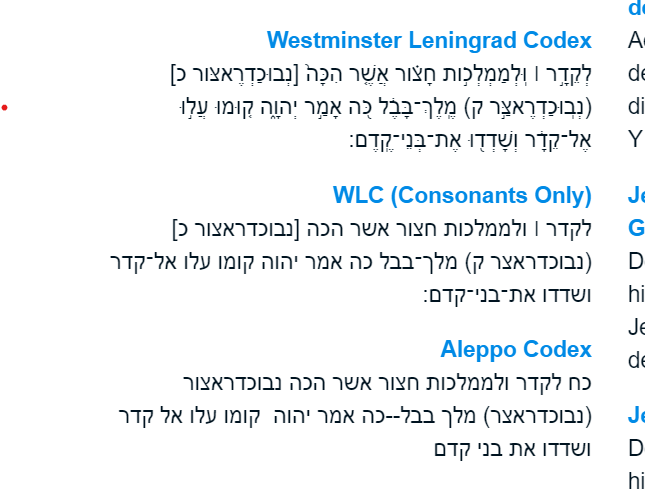
Thus said GOD:
Arise, march against Kedar,
And ravage the Kedemites!
The Qedarites were a largely nomadic ancient Arab tribal confederation centred in the Wādī Sirḥān in the Syrian Desert. Attested from the 9th century BC, the Qedarites formed a powerful polity which expanded its territory over the course of the 9th to 7th centuries BC to cover a large area in northern Arabia stretching from Transjordan in the west to the western borders of Babylonia in the east, before later moving westwards during the 6th to 5th centuries BC to consolidate into a kingdom stretching from the eastern limits of the Nile Delta in the west till Transjordan in the east and covering much of southern Palestine, the Sinai Peninsula and the Negev.[3][4]
The Qedarites played an important role in the history of the Levant and of North Arabia, where they enjoyed close relations with the nearby Canaanite and Aramaean states, and became important participants in the trade of spices and aromatics imported into the Fertile Crescent and the Mediterranean world from South Arabia. Having engaged in both friendly ties and hostilities with the Mesopotamian powers such as the Neo-Assyrian and Neo-Babylonian empires, the Qedarites eventually became integrated within the structure of the Persian Achaemenid Empire.[5] Closely associated with the Nabataeans,[6] the Qedarites might have eventually been absorbed by them.[7]
The Qedarites also feature within the scriptures of Abrahamic religions, where they appear in the Hebrew and Christian Bible and the Qurʾān as the eponymous descendants of Qēḏār/Qaydār, the second son of Yīšmāʿēʾl/ʾIsmāʿīl, himself the son of ʾAḇrāhām/Ibrāhīm.[6][8][7] Within Islamic tradition, some scholars claim that the Islamic prophet Muḥammad was descended from ʾIsmāʿīl through Qaydār.[9]
(יב) וְה֤וּא יִהְיֶה֙ פֶּ֣רֶא אָדָ֔ם יָד֣וֹ בַכֹּ֔ל וְיַ֥ד כֹּ֖ל בּ֑וֹ וְעַל־פְּנֵ֥י כׇל־אֶחָ֖יו יִשְׁכֹּֽן׃
His hand against everyone,
And everyone’s hand against him;
He shall dwell alongside of all his kin.”
(טז) אֵ֣לֶּה הֵ֞ם בְּנֵ֤י יִשְׁמָעֵאל֙ וְאֵ֣לֶּה שְׁמֹתָ֔ם בְּחַצְרֵיהֶ֖ם וּבְטִֽירֹתָ֑ם שְׁנֵים־עָשָׂ֥ר נְשִׂיאִ֖ם לְאֻמֹּתָֽם׃ (יז) וְאֵ֗לֶּה שְׁנֵי֙ חַיֵּ֣י יִשְׁמָעֵ֔אל מְאַ֥ת שָׁנָ֛ה וּשְׁלֹשִׁ֥ים שָׁנָ֖ה וְשֶׁ֣בַע שָׁנִ֑ים וַיִּגְוַ֣ע וַיָּ֔מׇת וַיֵּאָ֖סֶף אֶל־עַמָּֽיו׃ (יח) וַיִּשְׁכְּנ֨וּ מֵֽחֲוִילָ֜ה עַד־שׁ֗וּר אֲשֶׁר֙ עַל־פְּנֵ֣י מִצְרַ֔יִם בֹּאֲכָ֖ה אַשּׁ֑וּרָה עַל־פְּנֵ֥י כׇל־אֶחָ֖יו נָפָֽל׃ {פ}
(16) These are the sons of Ishmael and these are their names by their villages and by their encampments: twelve chieftains of as many tribes.— (17) These were the years of the life of Ishmael: one hundred and thirty-seven years; then he breathed his last and died, and was gathered to his kin.— (18) They dwelt from Havilah, by Shur, which is close to Egypt, all the way to Asshur; they camped alongside all their kin.
Ishmael’s descendants occupied the region from Havilah to Shur, which is east of Egypt in the direction of Asshur. There they lived in open hostility toward all their relatives.
English Standard Version
They settled from Havilah to Shur, which is opposite Egypt in the direction of Assyria. He settled over against all his kinsmen.
Berean Standard Bible
Ishmael’s descendants settled from Havilah to Shur, which is near the border of Egypt as you go toward Asshur. And they lived in hostility toward all their brothers.
King James Bible
And they dwelt from Havilah unto Shur, that is before Egypt, as thou goest toward Assyria: and he died in the presence of all his brethren.
New King James Version
(They dwelt from Havilah as far as Shur, which is east of Egypt as you go toward Assyria.) He died in the presence of all his brethren
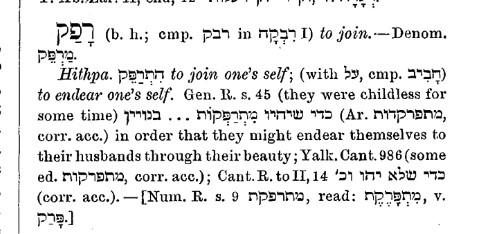
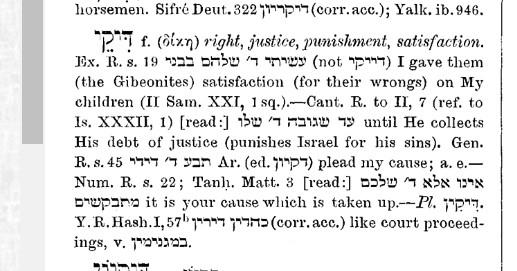
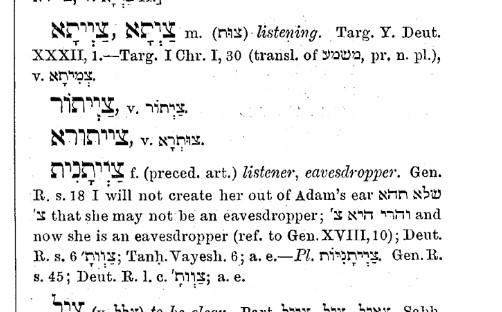
Nif. - נִזְקַק (cmp. זָוַג Nithpa.) 1) to join, meet; to be engaged in. Gen. R. s. 20 מעולם לא נ׳ וכ׳ the Lord never engaged in communication with woman. Gen. R. s. 42; Pesik. R. s. 5; a. e. נ׳ המלך וכ׳ the king was attached to, took an interest in the affairs of the country. Sabb. 12ᵇ אין מ"ה נִזְקָקִין לו the angels do not attend to his prayers.—[ 2) (in a hostile sense) to attack. Gen. R. l. c. באו ברברים לִיוָּקֵק לו (Pesik. R. l. c.; Ruth R. introd., a. e. להִזְדַּוֵּוג) Barbarians came to attack him.] —3) to live with; to be coupled. Ruth R. to IV, 3 ע"מ שלא אֶזָּקֵק לה with the condition that I will not live with her. Gen. R. s. 20 איני נִזְקֶקֶת וכ׳ I shall never again live with &c.—Pesik. R. s. 15; Pesik. Haḥod., p. 43ᵇ שיהא אדם נִזְקָק לביתו in order that man be attached to his house (love his wife); Yalk. Ps. 738; a. e.
Hif. - הִזְקִיק to oblige. Succ. 28ᵃ הִזְקַקְתּוּנִי וכ׳ will you force me to say &c.?
Hof. - הוּזְקָק to be made dependent on, to obligate one’s self, to be obliged to regard. B. Bath. 170ᵃ אם הוּזְקָקוּ וכ׳ Ms. M. (ed. אם כתוב בו הוּזְקַקְנוּ) if they (the parties to the deed) bound themselves to depend on the signatures of witnesses, &c. (ed. if it was written in the document, we obligate ourselves &c.).
Nithpa. - נִזְדַּקֵּק 1) to be engaged in, to care. Tanḥ. Korah 6 לא נִזְדַּקְּקוּ להשיבו (Yalk. Num. 750 נִזְקָקוּ) they did not care to answer him. —2) to attach one’s self to, to make love to. Num. R. s. 9. —3) (in an evil sense) to get at, to harm. Num. R. s. 5 בקש להִזְדּקֵּק להם wanted to harm them.
Pi. - זִיקֵּק (b. h.) to smelt, refine, distil. Lev. R. s. 31 עד שמְזַקְּקוֹ until he has refined the gold.—Part. pass. מְזוּקָּק, f. מְזוּקֶּקֶת. Pesik. R. s. 14 התורה … ומז׳ וכ׳ the Torah is clarified and distilled in forty nine ways.—2) to chain, tie, connect.—Part. pass. as ab. Y. Ḥag. III, beg. 78ᵈ במז׳ לקדש it treats of an object which is tied (has been made subject) to the law regulating sacred matter, i.e. treated as if it were sacred matter, v. טָהֳרָה.
“Two nations are in your womb,
Two separate peoples shall issue from your body;
One people shall be mightier than the other,
And the older shall serve the younger.”
“I will greatly increase your offspring,
And they shall be too many to count.” (11) The messenger of יקוק said to her further,
“Behold, you are pregnant
And shall bear a son;
You shall call him Ishmael,
For יקוק has paid heed to your suffering.
(12) He shall be a wild ass of a person;
His hand against everyone,
And everyone’s hand against him;
He shall dwell alongside of all his kin.” (13) And she called יקוק who spoke to her, “You Are El-roi,” by which she meant, “Have I not gone on seeing after my being seen!” (14) Therefore the well was called Beer-lahai-roi; it is between Kadesh and Bered.— (15) Hagar bore a son to Abram, and Abram gave the son that Hagar bore him the name Ishmael. (16) Abram was eighty-six years old when Hagar bore Ishmael to Abram.
(יג) וַתִּקְרָ֤א שֵׁם־יקוק הַדֹּבֵ֣ר אֵלֶ֔יהָ אַתָּ֖ה אֵ֣ל רֳאִ֑י כִּ֣י אָֽמְרָ֗ה הֲגַ֥ם הֲלֹ֛ם רָאִ֖יתִי אַחֲרֵ֥י רֹאִֽי׃ (יד) עַל־כֵּן֙ קָרָ֣א לַבְּאֵ֔ר בְּאֵ֥ר לַחַ֖י רֹאִ֑י הִנֵּ֥ה בֵין־קָדֵ֖שׁ וּבֵ֥ין בָּֽרֶד׃ (טו) וַתֵּ֧לֶד הָגָ֛ר לְאַבְרָ֖ם בֵּ֑ן וַיִּקְרָ֨א אַבְרָ֧ם שֶׁם־בְּנ֛וֹ אֲשֶׁר־יָלְדָ֥ה הָגָ֖ר יִשְׁמָעֵֽאל׃
(יא) וּלְמִן־הַיּ֗וֹם אֲשֶׁ֨ר צִוִּ֤יתִי שֹֽׁפְטִים֙ עַל־עַמִּ֣י יִשְׂרָאֵ֔ל וַהֲנִיחֹ֥תִי לְךָ֖ מִכׇּל־אֹיְבֶ֑יךָ וְהִגִּ֤יד לְךָ֙ יקוק כִּי־בַ֖יִת יַעֲשֶׂה־לְּךָ֥ יקוק׃ (יב) כִּ֣י ׀ יִמְלְא֣וּ יָמֶ֗יךָ וְשָֽׁכַבְתָּ֙ אֶת־אֲבֹתֶ֔יךָ וַהֲקִימֹתִ֤י אֶֽת־זַרְעֲךָ֙ אַחֲרֶ֔יךָ אֲשֶׁ֥ר יֵצֵ֖א מִמֵּעֶ֑יךָ וַהֲכִינֹתִ֖י אֶת־מַמְלַכְתּֽוֹ׃ (יג) ה֥וּא יִבְנֶה־בַּ֖יִת לִשְׁמִ֑י וְכֹנַנְתִּ֛י אֶת־כִּסֵּ֥א מַמְלַכְתּ֖וֹ עַד־עוֹלָֽם׃ (יד) אֲנִי֙ אֶֽהְיֶה־לּ֣וֹ לְאָ֔ב וְה֖וּא יִֽהְיֶה־לִּ֣י לְבֵ֑ן אֲשֶׁר֙ בְּהַ֣עֲוֺת֔וֹ וְהֹֽכַחְתִּיו֙ בְּשֵׁ֣בֶט אֲנָשִׁ֔ים וּבְנִגְעֵ֖י בְּנֵ֥י אָדָֽם׃ (טו) וְחַסְדִּ֖י לֹא־יָס֣וּר מִמֶּ֑נּוּ כַּאֲשֶׁ֤ר הֲסִרֹ֙תִי֙ מֵעִ֣ם שָׁא֔וּל אֲשֶׁ֥ר הֲסִרֹ֖תִי מִלְּפָנֶֽיךָ׃ (טז) וְנֶאְמַ֨ן בֵּיתְךָ֧ וּמַֽמְלַכְתְּךָ֛ עַד־עוֹלָ֖ם לְפָנֶ֑יךָ כִּֽסְאֲךָ֔ יִהְיֶ֥ה נָכ֖וֹן עַד־עוֹלָֽם׃ (יז) כְּכֹל֙ הַדְּבָרִ֣ים הָאֵ֔לֶּה וּכְכֹ֖ל הַחִזָּי֣וֹן הַזֶּ֑ה כֵּ֛ן דִּבֶּ֥ר נָתָ֖ן אֶל־דָּוִֽד׃ {פ}
(יח) וַיָּבֹא֙ הַמֶּ֣לֶךְ דָּוִ֔ד וַיֵּ֖שֶׁב לִפְנֵ֣י יקוק וַיֹּ֗אמֶר מִ֣י אָנֹכִ֞י אדושם יקוק וּמִ֣י בֵיתִ֔י כִּ֥י הֲבִאֹתַ֖נִי עַד־הֲלֹֽם׃ (יט) וַתִּקְטַן֩ ע֨וֹד זֹ֤את בְּעֵינֶ֙יךָ֙ אדושם יקוק וַתְּדַבֵּ֛ר גַּ֥ם אֶל־בֵּֽית־עַבְדְּךָ֖ לְמֵרָח֑וֹק וְזֹ֛את תּוֹרַ֥ת הָאָדָ֖ם אדושם יקוק׃
“The LORD declares to you that He, the LORD, will establish a house for you. (12) When your days are done and you lie with your fathers, I will raise up your offspring after you, one of your own issue, and I will establish his kingship. (13) He shall build a house for My name, and I will establish his royal throne forever. (14) I will be a father to him, and he shall be a son to Me. When he does wrong, I will chastise him with the rod of men and the affliction of mortals;-d (15) but I will never withdraw My favor from him as I withdrew it from Saul, whom I removed to make room for you.-e (16) Your house and your kingship shall ever be secure before you; your throne shall be established forever.” (17) Nathan spoke to David in accordance with all these words and all this prophecy. (18) Then King David came and sat before the LORD, and he said, “What am I, O Lord GOD, and what is my family, that You have brought me thus far? (19) Yet even this, O Lord GOD, has seemed too little to You; for You have spoken of Your servant’s house also for the future. May that be the law for the people,-g O Lord GOD.