


(יט) וְעַתָּ֗ה כִּתְב֤וּ לָכֶם֙ אֶת־הַשִּׁירָ֣ה הַזֹּ֔את וְלַמְּדָ֥הּ אֶת־בְּנֵי־יִשְׂרָאֵ֖ל שִׂימָ֣הּ בְּפִיהֶ֑ם לְמַ֨עַן תִּהְיֶה־לִּ֜י הַשִּׁירָ֥ה הַזֹּ֛את לְעֵ֖ד בִּבְנֵ֥י יִשְׂרָאֵֽל׃
(19) Therefore, write down this poem and teach it to the people of Israel; put it in their mouths, in order that this poem may be My witness against the people of Israel.
(1) את השירה הזאת [NOW THEREFORE WRITE YE] THIS SONG — i.e. the text “Give ear, O ye heavens”, till “and make expiation for his ground, and his people” (Deuteronomy 32:1—43).
The Gemara cites an additional verse: “Now therefore write this song for you, and teach it the children of Israel” (Deuteronomy 31:19). Apparently, Moses was commanded to teach the Torah to the Jewish people. The Gemara answers: The verse is referring to the song of Ha’azinu (Deuteronomy 31) alone and not to the rest of the Torah. The Gemara asks: But the continuation of that cited verse: “That this song may be a witness for Me among the children of Israel” (Deuteronomy 31:19), indicates that the reference is to the entire Torah, in which the mitzvot are written.
(1) That is that He commanded us that every man among us should write a Torah scroll for himself. And if he writes it with his hand, Scripture accounts it to him as if he received it at Mount Sinai. But if it is impossible for him to write it, he should buy it or hire someone to write it for him. And this is His saying, "write for yourselves this song " (Deuteronomy 31:19). ... And the language of the Gemara (Sanhedrin 21b) is, "Rabbah said, 'Even if his ancestors left him a Torah scroll, it is a commandment to write a scroll of his own, as it is stated, "write for yourselves."'
(3) ולמדה, שימה בפיהם, "and teach it and place it in their mouths." G'd commanded three separate commandments here. 1) To write down the song; 2) to teach it to the children of Israel so that they would understand it. [as one has to teach any poem. Ed.] 3) To "place it in their mouths," i.e. to teach them how to read it correctly. (4) Moses carried out all three instructions as the Torah recorded (verse 23) "Moses wrote the song. 2) He taught it to the children of Israel. 3) Moses said in the hearing of the entire congregation the words of the song (verse 30)." He read it to them in such a way that they would know how to read it properly in the future. This is the meaning of the words שימה בפיהם.
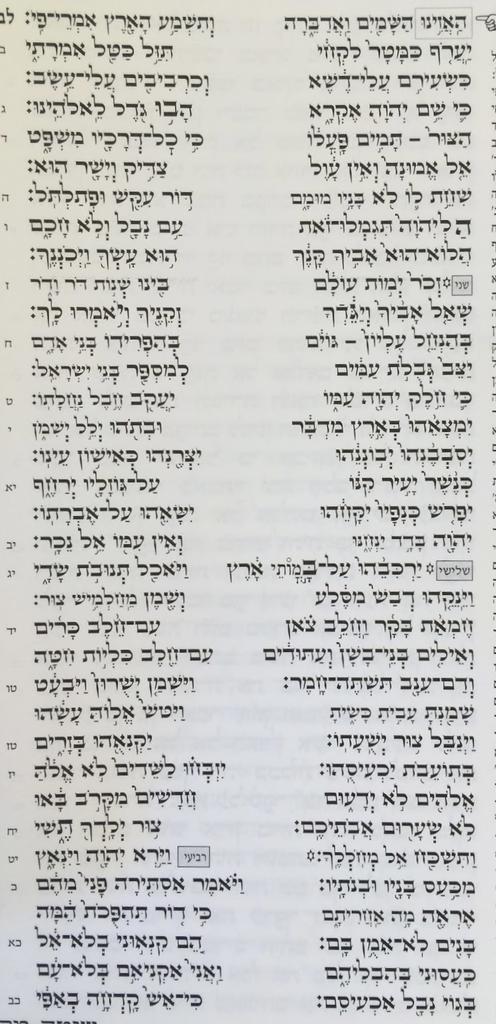
(1) AND NOW WRITE YE THIS SONG. It is called Song because Israel would recite it with song and psalm. It was also written [in the Torah] in the style of a song, since songs are written with interruptions [empty spaces] indicating the places of chanting.
From Greater Good magazine: Where Music and Empathy Converge in the Brain
Music seems to be a social glue. Think of how love songs enhance our romantic feelings, how marching bands intensify our affinity for the home team, or how huge rock concerts make us feel one with a crowd of thousands. Music has some special power to increase our sense of connection and help us affiliate with others.
But why? What’s happening in our brains that makes an isolated set of sounds resonate in these ways? A new neuroscience study aimed to find out.
In the study, researchers scanned twenty college students’ brains using fMRI technology while they listened to very short clips of music—some familiar and some unfamiliar to them, and some they might like or dislike, according to what the researchers could gather about their musical tastes. The idea was to see how people’s brains responded to these different kinds of music and then to compare those neural patterns.
Afterward, people rated the music they heard and reported on how empathic they were in everyday life—meaning, how much they tended to feel sympathy for others in distress and were able to take someone else’s perspective . The researchers suspected that empathy—an important factor in developing social relationships, which creates a distinct pattern in the brain when people are experiencing it—might influence how we process music.
Analyzing the brain scans revealed some interesting patterns. Highly empathic people tended to have significantly higher activation in their brains overall and, specifically, in the reward centers of the brain when listening to familiar music they liked—meaning, they seemed to find music listening more pleasurable than people low in empathy. They also had higher activation in the parts of the brain implicated in processing social information—like when you try to understand another person’s perspective or what they might be feeling.
From the translation of Robert Alter:

Rabbinic sources on the reasons for the commandments, per Jason Aronson, Mitzvot: A Sourcebook for the 613 Commandments:
1. To make us better people
2. To make a better world
3. To establish our national identity
4. To beautify us and make us worthy of G-d's love
Tali Loewenthal
[T]he Midrash ... says that the first word of the Ten Commandments is in the Egyptian language. What does this mean?
[T]his first word Anokhi is Egyptian, because G-d wanted to speak with us in the language we had learnt while we were in Egypt. This tells us something about the nature of Torah and of being a Jew.
G-d does not want to relate to us only on the sacred, spiritual level of our lives, represented by Hebrew, the holy language. [G-d] wants to reach the earthly "Egyptian" dimension as well.
We should not try to pretend that we do not have this lower aspect. Rather, we should try to control it, then elevate it and ultimately transform it into something holy.
G-d helps us in this task: there are Jewish teachings about every aspect of life, including the most basic. The mitzvot (commandments) connect us to G-d on every level of our being. For this reason Anokhi, the first word of the Ten Commandments, is in Egyptian: it reaches down to the "Egyptian" person inside us and transforms him or her into a Jew.
Sefat Emet on Ki Tetzei, trans. by Arthur Green:
The purpose of all the commandments, both positive and negative, that were given to Israel, is so that every person of Israel be free. That is why the liberation from Egypt comes first [before the giving of the Torah]. Torah then teaches the soul how to maintain its freedom, by not becoming attached to material things. These are 613 “counsels.” Every mitzvah in which the liberation from Egypt is mentioned is to tell us yet again that by means of this mitzvah one may cling to freedom. In the commandments regarding [the gifts to the poor of] leftover gleanings, the corners of the fields, and forgotten sheaves, the Torah says: "Remember that you were a slave (Dt. 24:22). In this way your food will have no waste, and you will not become overly attached to wealth. That is why the Torah commanded such things as tithes and gifts to the poor, these guard one from (overattachment to) wealth…
This is the purpose of the entire Torah. That is why they read “engraved on the tablets” (Ex. 32:16), as though it said “freedom on the tablets” [harut/herut]. “The only free person,” they added, “is the one who is engaged in Torah,” for Torah teaches a person the way of freedom.
Rabbi Sacks:
The 613th command, to make the Torah new in every generation, symbolises the fact that though the Torah was given once, it must be received many times, as each of us, through our study and practice, strives to recapture the pristine voice heard at Mount Sinai. That requires emotion, not just intellect. It means treating Torah not just as words read, but also as a melody sung. The Torah is God’s libretto, and we, the Jewish people, are His choir, the performers of His choral symphony. And though when Jews speak they often argue, when they sing, they sing in harmony, as the Israelites did at the Red Sea, because music is the language of the soul, and at the level of the soul Jews enter the unity of the Divine which transcends the oppositions of lower worlds.
The Torah is God’s song, and we collectively are its singers.
(1) AND MOSES WENT. Moses went to each tribe and tribe to inform them that he was about to die and that they should not fear. He strengthened them with his words to Joshua... I believe that he then blessed the tribes. This is so even though the blessings are recorded later.
(א) וילך משה. כתב הרמב"ן לאחר שעברו בברית והלכו מלפניו איש לאהלו הלך הוא ממחנה לוייה למחנה ישראל לכבודם כמי שרוצה ליפטר מחברו ובא ליטול רשות ממנו. ואמר להם בן מאה ועשרים שנה אנכי היום לנחמם על עניינו כלו' כבר זקנתי ואין לכם עוד תועלת ממני ועוד כי השם ציווני שלא אעבור ואל תפחדו כי השם יעבור עמכם במקומי. ואע"פי שמשה היה בתוקפו כאשר הכתוב מעיד לא נס לחה אמר כן כדי לנחמם. ורבותי' אמרו שנסתתמו ממנו מעיינות החכמה והיה זה דרך נס שלא ידאג על שלקח יהושע גדולה בפניו: