12 Tishrei 5776 | September 25, 2015
Parshat Ha’azinu
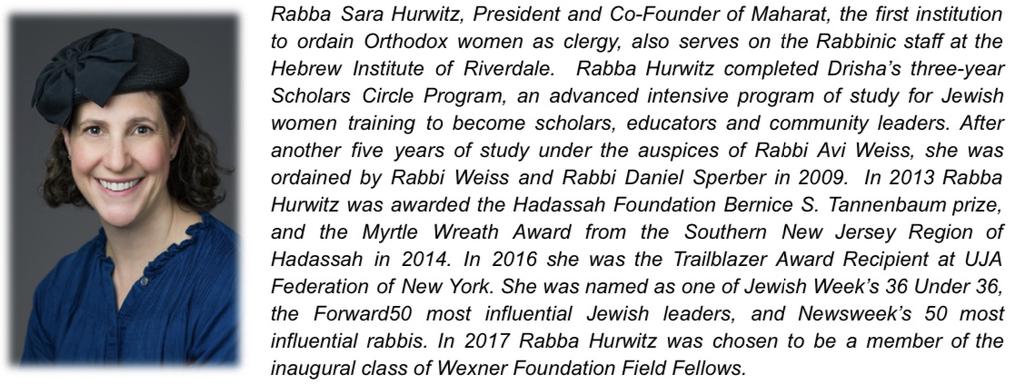
Rabba Sara Hurwitz
President and Co-Founder
בֶּן בַּג בַּג אוֹמֵר, הֲפֹךְ בָּהּ וַהֲפֹךְ בָּהּ, דְּכֹלָּא בָהּ. וּבָהּ תֶּחֱזֵי, וְסִיב וּבְלֵה בָהּ,
Ben Bag Bag said: Turn it over and over for everything is contained within it. Delve into it, grow old and frail in it.
The greatness of Torah, according to Ben Bag Bag is the fact that “everything is contained within it”. A child can listen and be thrilled by its narratives and a philosopher of advanced age can ponder it and become inspired by the deep insights contained in it. The Torah is multi-faceted, and speaks to individuals in variable and unique ways.
Parshat Ha’azinu highlights this insight. The opening pasuk in the Torah portion says:
(א) הַאֲזִ֥ינוּ הַשָּׁמַ֖יִם וַאֲדַבֵּ֑רָה וְתִשְׁמַ֥ע הָאָ֖רֶץ אִמְרֵי־פִֽי׃
Listen, O heavens, and I will speak! And let the earth hear the words of my mouth!
The Torah uses two distinct words for listening (הַאֲזִינוּ) and hearing (תִשְׁמַע) to highlight that everyone approaches the world in different ways—some people hear and others listen. Some relate more to the word h’azeinu others can only relate to the word tishma and, therefore, the Torah gives us two words asking people to listen and hear the words of Moshe, in the hopes that more people can access the words and messages of the Torah.
Rashi makes this point in understanding the pasuk:
(יא) כְּנֶ֙שֶׁר֙ יָעִ֣יר קִנּ֔וֹ
Just like eagle stirs up its young
Just like an eagle stirs up or awakens its children in different ways, so too, when God gave the Torah to B’nei Yisrael, God appeared to them “not from one direction, but from four different directions(ibid).” God understood that there is not only one way, one direction to approach God and learn Torah, but God offers multi-entry point to access the lessons of our Torah.
Even the Torah itself is made up of different ways of learning. Some parts of the Torah are laws, some are narrative, and some are songs, such as Ha’azinu itself. Neither mode is superior. King David, a musician by nature, believed that each part is as important as the other. In fact, in Tehillim 119, he sings about the chukim:
זְ֭מִרוֹת הָיוּ־לִ֥י חֻקֶּ֗יךָ
Your laws are like a song, and strengthen me!
He was strengthened by singing the Chukim, the laws. He saw the Torah, even the parts that are harsher, as soft as a song. As opposed, for example, to Rabba who teaches in Mesechet Sotah (35a) that King David’s singing may dilute the Torah by downgrading it into a song.
In truth, Rabba’s viewpoint is no more correct than King David. Song and narrative, law and poetry are fundamental to understanding our Torah. This is the message of Ha’azinu: some people need to relate to the laws and stories of the Torah by singing, while others believe that singing the Torah makes the laws and stories less important. Perhaps Rabba had to learn by reading and King David related to the Torah through the prism of song.
In the end, just as Ben Bag Bag said, turn the Torah over and over, for everything is contained within it. All approaches—songs, laws, and stories, are relevant and necessary to help us each learn and grow in our own way
Rabbi Epstein who was a great Lithuanian rabbi in the 19th century thought the multiple meanings of Torah create a wonderful kind of symphony of notes all needing to be brought into harmony. He says: “this is the splendor of our holy and pure Torah; the entire Torah is called shira, and the splendor of a song occurs when it contains different voices.”
The Psukim in Ha'azinu repeat the same idea twice knowing that people learn differently. The very idea of a poem allows for multiple ideas and interpretations. Having different ways of approaching any topic, be it God or Torah, opens us up to different ideas, in the end, it doesn’t matter how you get there. As long as you are flying like the eagle, learning and thinking, you will keep soaring higher and higher.
- With thanks to Yakira Bergman for contributing to this piece