12 Iyyar 5782 | Friday, May 13, 2022
Parshat Emor
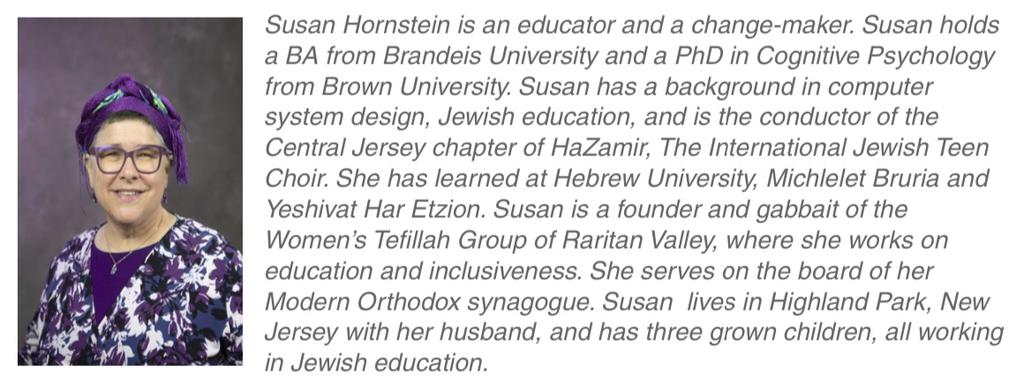
Susan Hornstein
Class of 2025
There was a little boy in my childrens’ preschool; we’ll call him Charlie. Charlie was the most beautiful child you had ever seen. His blond curls tumbled down to his shoulders, his smile could light up a room. Everyone agreed: he looked like a cherub. A cherub, those angels whose representation sat upon the aron, the ark in the Holy of Holies. This was all good for those of us who had only to admire Charlie’s beauty, and did not have to deal with his diapers, his nighttime fevers, his afternoon tantrums, the things that make a toddler a human, not an angel.
So it was with the Kohanim who served in the Beit HaMikdash. Our parasha tells us:
The Torah goes on to enumerate the defects that disqualify the Kohen. Each blemish is external: limbs that were uneven in length, skin conditions, even weird eyebrows. Unlike the blemishes that make an animal non-Kosher, these are not life-threatening conditions. A Kohen could have a heart defect, asthma, or even a fever, as long as he had no external differences. How unusual this must have been! In a pre-modern society, without prenatal care or modern medicines, surely nearly everyone had something! Moreover, it is exactly these types of characteristics that distinguish us from one another. The angle of the eyes, the distinctive gait, these are the ways we recognize each other. The Kohen who was qualified to bring sacrifices didn’t even look like himself. He wasn’t there for us to look at and see ourselves in him. He looked like no one in particular, like a template of a human being, like an angel.
The Kohanim had many jobs. During their twice-yearly shifts in the Beit HaMikdash, the Kohanim lit the Menorah, carried the wood, swept the ashes from the altar, and performed other vital tasks around the facility. The rest of the year they were teachers, advisors, diagnosers of tzara’at, experts in all manner of Torah law. It was only the small subset of Kohanim who performed the actual sacrificial service who were held to this superhuman standard of external “perfection.”
Rabbi Jonathan Sacks, in his essay on our Parsha, “Eternity and Mortality,” in his collection Covenant and Conversation, explains that the Mishkan and later the Beit HaMikdash were the point of contact between God, the Eternal One, and mankind, mortals. He defines this interface as Kedusha, holiness. He theorizes that the many restrictions associated with the sacrificial service are in place to protect this potentially dangerous interface:
And so, while we are all mortal, and all Kohanim are mortal, the Kohanim who could perform the sacrifices needed to be free of conditions that would remind us of that mortality. Things we could see. They were more a template of a human than a human itself. At that moment, they were liminal - not quite human and not quite God - much like the angels.
And the service they performed was also on that cusp. God is the Only One who is the Master of life and death. But the Kohen slaughtered a live animal and placed its body parts on the altar. The animals, too, had to be angelic, free from external blemishes. Then the Kohen inflicts the ultimate blemish, the knife stroke that slaughters. The perfect looking Kohen is splattered with blood, and the illusion of immortality is broken. All are mortal there in the Beit Hamikdash, the Kohen who took control of the life of the animal, and the animal itself. The contrast between the external perfection and the mortality all around could not have been greater.
Our lives are imbued with this contrast. Our bodies are mortal. We are all vaguely asymmetrical. We walk a little differently. We recognize each other by these “imperfections.” These are the things that make us individuals. And inside each one of us is the breath of the Immortal. The Image of God. At the exact time of the interface between man and God, the moment of the sacrificial service, it was important to remove all this individuality and, for a split second, have a Kohen who was seemingly immortal. But in our everyday lives, it is the alchemy between our mortal selves and the breath of the Immortal that makes us special. How each one of us takes our talents, our challenges, our individuality and combines it with the Image of God that resides in us - that’s what makes life here on earth interesting, vital, and mortal.