17 Elul 5777 | September 8, 2017
Parshat Ki Tavo
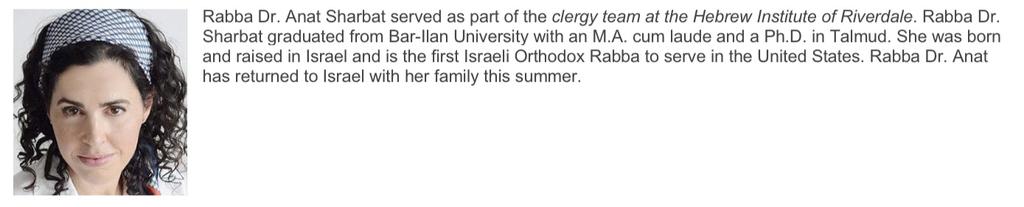
Rabba Dr. Anat Sharbat
Class of 2015
The moment has arrived – for the first time in B'nei Yisrael’s history they stand on the threshold of the Land of Israel. Entering the Land however, requires a brit, a covenant, as we read towards the end of the parsha:
These are the words of the brit which God commanded Moses to make with the Children of Israel in the Land of Moav; in addition to the brit that God made with them at Chorev.
Following the brit at Chorev – the one enacted on Mount Sinai with all those who left Egypt, God now demands a further covenant – the brit of Arvot Moav - the Plains of Moav.
But why do we need another brit and what is its connection to the Land of Israel?
I believe the brit Bnei Yisrael entered on the brink of the Land of Israel has some critical lessons for us today, as we get ready to enter the High Holidays and a New Year, reflecting on our relationship to each other and Medinat Yisrael.
The brit at Arvot Moav, similar to that at Sinai, is similar to the third brit at Mount Eival and Mount Grizim in next week's parsha – Parshat Nitzavim. Each one of the covenants involves a re-enactment of the brit of arvut hadadit- the mutual responsibility borne by each and every member of Am Yisrael for his or her fellow, and for the Land of Israel.
I believe the key to understanding the brit of Arvot Moav is the expression repeated three times in that brit, the words "היום הזה – this day". This term first appears in Devarim, verse 16 in Chapter 26:
This day God commands you to do these statutes and ordinances; you shall therefore observe and do them with all your heart, and with all your soul.
The medieval commentator Ibn Ezra explains that it was on "this day" that Moses transmitted the Torah, the brit, commanding the People to fulfill it in the Land of Israel. In other words, the renewal of the covenant is in its fulfillment in the Land of Israel. In a similar manner, Haim ben Attar – the 'Or HaChaim' – stresses that the brit was made in order to emphasize the mitzvot that can only be observed in the Land of Israel, such as bikkurim - the bringing of the first fruit, and ma'asrot - tithing - the details of which had been taught to the People, and now, with their transition into the Promised Land, are becoming practical commandments. So the first key point of this new brit is the focus on our inseverable tie to Eretz Yisrael.
Rabbi Shimshon Raphael Hirsch interprets "this day" as an expression of mutual responsibility. According to him, the statutes in this verse delineate the moral aspects of our private lives, and the ordinances "regularize a person's life vis-à-vis his fellow (wo)man." This brit incorporates the responsibility both for our own personal morals, and also being moral individuals connected to others. Together we comprise the cultural texture of a nation based on a socio-legal order. This is the second key point of this new brit.
The next verse in which the expression "Ha-Yom Ha-Zeh" appears is in the following chapter of Devarim verse 9:
And Moses and the priestly Levites spoke to all of Israel, saying: 'Keep silence, and hear, Israel; this day you become a people for the LORD your God.'
One of the unique features of this brit in contrast to the one made at Sinai is the use of the singular language. Both the curses and the blessings appear in singular. In contrast to those in Parshat Bechukotai, which are in plural. I want to suggest that the singular language used here is an indication of unity. No more ‘every man for himself’ – as the midrash in Vayikra Rabba teaches us in the name of Rabbi Shimon bar Yochai:
מָשָׁל לִבְנֵי אָדָם שֶׁהָיוּ יוֹשְׁבִין בִּסְפִינָה נָטַל אֶחָד מֵהֶן מַקְדֵּחַ וְהִתְחִיל קוֹדֵחַ תַּחְתָּיו, אָמְרוּ לוֹ חֲבֵרָיו מַה אַתָּה יוֹשֵׁב וְעוֹשֶׂה, אָמַר לָהֶם מָה אִכְפַּת לָכֶם לֹא תַחְתִּי אֲנִי קוֹדֵחַ, אָמְרוּ לוֹ שֶׁהַמַּיִם עוֹלִין וּמְצִיפִין עָלֵינוּ אֶת הַסְּפִינָה.
It is an allegory to people on a ship, and one of them took a drill and began drilling a hole beneath him. His friends said: 'why are you doing this?' and he replied: 'what do you care? I am drilling underneath me.' They said to him: 'because you are flooding the whole boat'.
It is out of the sense of reciprocal cause and effect that we bear responsibility for the mitzvot and averot of our People. Our accountability is not individual but rather, communal. This provides food for thought during a period of the year in which we strive towards tshuva. An individual no longer has the privilege to manage only his personal account in 'splendid isolation' but is obligated to mend their ways out of a sense of communal obligation.
The brit is as valid "on this day" - today - as it was at Arvot Moav. Wherever we are, the Jewish People bear mutual responsibility for each other, unconditionally, without distinctions between individual identities. It is imperative that we remember that this responsibility is derived from the brit to which we committed.
We bear a similar responsibility for the Land and State of Israel and its peace, wellbeing and image – we are its ambassadors. We do not have the privilege of indifference.
As Jews, we must dedicate ourselves daily, in the spirit of “hayom hazeh” - this day to this brit. It is not only relevant today as it was thousands of years ago, but it is as urgent, if not even more urgent today than it was ever before. Our people is comprised of individuals, and we must understand that each one of us counts, each one of us has an influence. With the challenges the State of Israel faces today we all share the power to influence the image and future of the State of Israel. The brit initiated at Sinai and reaffirmed at Arvot Moav calls for just this responsibility!
The brit also calls for our responsibility to our brothers and sisters in Houston, and I would even take it further, the responsibility we developed can be expended to all human beings around the world.
To conclude in the words of Alexander the Great: 'Remember - upon the conduct of each, depends the fate of all.'