24 Adar 5780 | March 20, 2020
Parshat Vayakhel-Pekudei
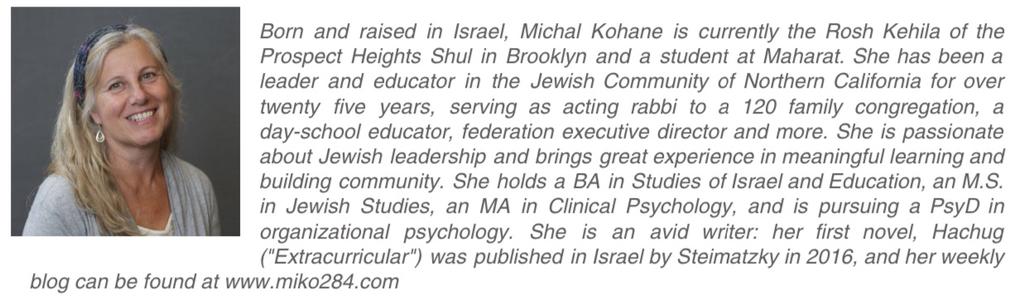
Rabbanit Michal Kohane
Class of 2020
What does one write about during ‘these times’? “Just Torah” as if nothing is going on, or fully address the current “situation” because it’s so hard to focus on anything else? I’d like to try to do a little of both here, especially when this week we’re reading about, no doubt, the greatest miracle in the Torah! I’m guessing you’re now wondering if you received the correct bulletin or email. After all, what miracle is there in the Torah portions of Vayakhel-Pekudei? Not enough we already spent two whole Torah portions talking about every little detail in the Tabernacle and now we start all over again to talk about how it was actually built? Why the repetition? What’s the big deal? Our People built a lovely worship-tent! Great. Can we move on now?
But we can’t.
This indeed, is the greatest miracle in the Torah!
I know, I know: what about the Sea splitting? The Bush burning? The Plagues, the Exodus?
But that’s exactly it: everything that is done by God can’t quite be considered a miracle, because God by definition can do absolutely anything, with no difference in effort. As for us, well, that’s a different story.
Imagine: We’re invited to bring whatever we happen to have, whatever we feel like giving – gold, silver, cloth, wood, you name it. We look around our tents and we find things. And we bring it. All of us. Each and every one of us is an active participator. Even generously. And, then, when we put it all together, it makes exactly this amazing, previously described structure! Nothing is missing and there’s no leftovers. How is that possible? Yes, that is a miracle.
What’s more, it seems that this project was not planned initially at all – we were supposed to just leave Egypt and go to the Land! I can relate to such delays and changes in the original plan… Indeed, especially after the painful episode of the Golden Calf, much healing is needed.
Further: our reading does not open with the expected: ‘And God spoke to Moses, saying, gather the people’… but with Moses “gathering” the People. Who told him to do so? Who told them to come? But then as now, at times, there is a need to be together, in whatever form is available to us, and the whole Israelite community assembled (Exodus 35:1) so they will all together, jointly, create a space for God in their midst. Thus, the Book which began in slavery, with working for another, ruthless, self-centered master, ends in “free collaboration”, working together willingly to bring more of the presence of the One God.
In the long list of those actively working on the mishkan, we find this (Exodus 35:26):
(26) And all the women whose heart lifted them in wisdom, spun the goats.
Most translations will resist the original Hebrew and add the word “hair”, making it a more “make sense” sentence, so it will say: and the women... spun the goats’ hair, but that’s not what it says. It says, spun the goats. Period.
The women – spun – the goats.
Rashi explains based on the Talmud that “spun the goats” required extraordinary skill, for they spun the goat’s hair from off the backs of the goats, while it was still on the living animals.
Here it is from the Talmud itself:
Our Sages taught: The bottom curtains in the Tabernacle were made of sky blue wool, and of purple wool, and of scarlet wool, and of fine linen; and the top curtains were made of goat hair, even though that material is considered to be inferior and common. However, the wisdom that was stated with regard to the top curtains was greater than that which was stated with regard to the bottom ones. This is because, with regard to the bottom curtains, it is written: “And every wise-hearted woman spun with her hands, and they brought that which they had spun, the blue, and the purple, the scarlet, and the linen” (Exodus 35:25); while with regard to the top curtains, it is written: “And all of the women whose hearts inspired them with wisdom spun the goats” (Exodus 35:26). The phrase “whose hearts inspired them” suggests a greater degree of wisdom. Apparently, spinning the goat’s hair curtains required greater skill than spinning the various kinds of wool. And on a similar note, it was taught in a baraita in the name of Rabbi Neḥemya: The hair was rinsed on the goats, and it was even spun from the goats, which required a great deal of skill.
The phrase “whose hearts inspired them” suggests a greater degree of wisdom. Apparently, spinning the goat’s hair curtains required greater skill than spinning the various kinds of wool. And on a similar note, it was taught in a baraita in the name of Rabbi Neḥemya: The hair was rinsed on the goats, and it was even spun from the goats, which required a great deal of skill ( Bavli Shabbat 99a).
So the women sit there, weaving heaven and earth to complete the mishkan; the colors of heaven – are closer to the ground, while the hairs of the earthy goats – up high. The word for goats is – עיזים izim, sharing its root with עוז oz, power, courage, strength.
The same women who began this book by quietly saving the people and their leader from slavery, now leave their mark at its end. Is it coincidental that the women “switch” the priorities and put the colors symbolic of that which is materialistic up high, making it less visible from below, while the heavenly colors are placed below? Is it a hint that at times, we need to switch priorities? Is there a need to place that which seemed “urgent” away for a while, and that which we often forget, less visible, postponed, a little closer?
B’sorot Tovot (praying for good news) & Shabbat Shalom.