


The Book of Joshua is considered part of the Deuteronomic history that begins in Deuteronomy (in the Torah) and ends with the second Book of Kings (in Prophets). These books tell the story of the Israelites from the wandering in the desert to the establishment of a monarchy in the Land of Israel.
Joshua begins immediately after the book of Deuteronomy, when the Israelites leave Moses on Mt Horeb to continue into the land of Canaan. Joshua son of Nun has been named Moses' successor and essentially becomes Israel's lead general in the conquest of the land.
After the death of Moses the servant of God, God said to Joshua son of Nun, Moses’ attendant: “My servant Moses is dead. Prepare to cross the Jordan, together with all this people, into the land that I am giving to the Israelites. Every spot on which your foot treads I give to you, as I promised Moses. Your territory shall extend from the wilderness and the Lebanon to the Great River, the River Euphrates [on the east]—the whole Hittite country—and up to the Mediterranean Sea on the west. No one shall be able to resist you as long as you live. As I was with Moses, so I will be with you; I will not fail you or forsake you....Let not this Book of the Teaching cease from your lips, but recite it day and night, so that you may observe faithfully all that is written in it. Only then will you prosper in your undertakings and only then will you be successful. “I charge you: Be strong and resolute; do not be terrified or dismayed, for the Adonai your God is with you wherever you go.”
How is Joshua's legacy tied to Moses from the very beginning? Why might this be significant or intentional?
The book of Joshua contains many similarities to the story of Moses:
- Moses leads the Israelites out of Egypt. Joshua leads them into Canaan.
- Moses leads Israelites miraculously across Red Sea. Joshua leads them miraculously across the Jordan River.
- Moses sends out spies into Canaan. Joshua sends out two spies to Jericho.
- Moses allocates land on the east side of the Jordan. Joshua allocates land on the west side of the Jordan.
- And finally, Moses gives a prolonged address before dying, as does Joshua. This farewell address at the end of the book brings the parallelism between the two leaders full circle.
1 The history of the conquest
2 the allocation of the land, and
3 Joshua’s farewell speech.
Aside from its clean chronological order, the book also follows a geographical logic, from the east to west crossing into Canaan, to the circular conquest of the native tribes. First the Israelites conquer the nations in the center, then the south, and finally the northern and peripheral nations.
(1) Joshua son of Nun secretly sent two spies from Shittim, saying, “Go, reconnoiter the region of Jericho.” So they set out, and they came to the house of a prostitute named Rahab and lodged there.
The king of Jericho was told, “Some men have come here tonight, Israelites, to spy out the country.” The king of Jericho thereupon sent orders to Rahab: “Produce the men who came to you and entered your house, for they have come to spy out the whole country.”
The woman, however, had taken the two men and hidden them. “It is true,” she said, “the men did come to me, but I didn’t know where they were from. And at dark, when the gate was about to be closed, the men left; and I don’t know where the men went. Quick, go after them, for you can overtake them.”
Now she had taken them up to the roof and hidden them under some stalks of flax which she had lying on the roof.— So the men pursued them in the direction of the Jordan down to the fords; and no sooner had the pursuers gone out than the gate was shut behind them. The spies had not yet gone to sleep when she came up to them on the roof.
She said to the men, “I know that the Eternal has given the country to you, because dread of you has fallen upon us, and all the inhabitants of the land are quaking before you....for the Eternal your God is the only God in heaven above and on earth below. Now, since I have shown loyalty to you, swear to me by the Eternal that you in turn will show loyalty to my family. Provide me with a reliable sign that you will spare the lives of my father and mother, my brothers and sisters, and all who belong to them, and save us from death.”
The men answered her, “Our persons are pledged for yours, even to death! If you do not disclose this mission of ours, we will show you true loyalty when the Eternal gives us the land.” She let them down by a rope through the window—for her dwelling was at the outer side of the city wall and she lived in the actual wall. She said to them, “Make for the hills, so that the pursuers may not come upon you. Stay there in hiding three days, until the pursuers return; then go your way.”
"Rahab is a familiar anti-type in folklore, the prostitute with the heart of gold. She has faith in God's might, adopts the Israelites as her own, and rescues them. But from the beginning, Rahab is a triply marginalized woman. From Israel's point of view, she is an outsider; from Canaan's point of view, she is a woman; and even from the Canaanite woman's point of view, she is a prostitute, outside normal family life. Rahab is smart, proactive, tricky, and unafraid to disobey and deceive her king. ...Rahab [is] acting as the "midwife" of the embryonic Israel." [Rahab's name can mean "to open the womb]
Frymer-Kensky also calls Rahab an oracle: "I know that the Eternal has given you this land...for the Eternal your God is God in heaven above and on earth below."
Where else do we find righteous, non Israelite/Hebrew midwives who secure the continued existence of the Israelite people? (hint: they also defy the highest authority and have a connection to Moses!)
How is Rahab's dialogue and response to the king direct, courageous, surprising?
Do you agree with Frymer-Kensky that Rahab is an oracle?
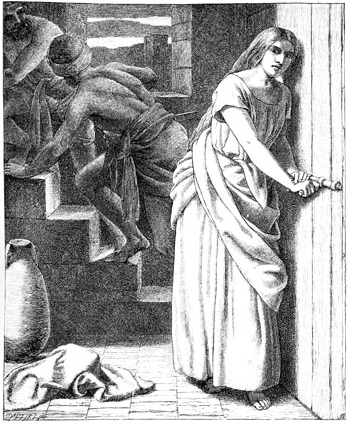
Rahab Receiveth and Concealeth the Spies by Frederick Richard Pickersgill (1881)

1860 woodcut by Julius Schnorr von Karolsfeld
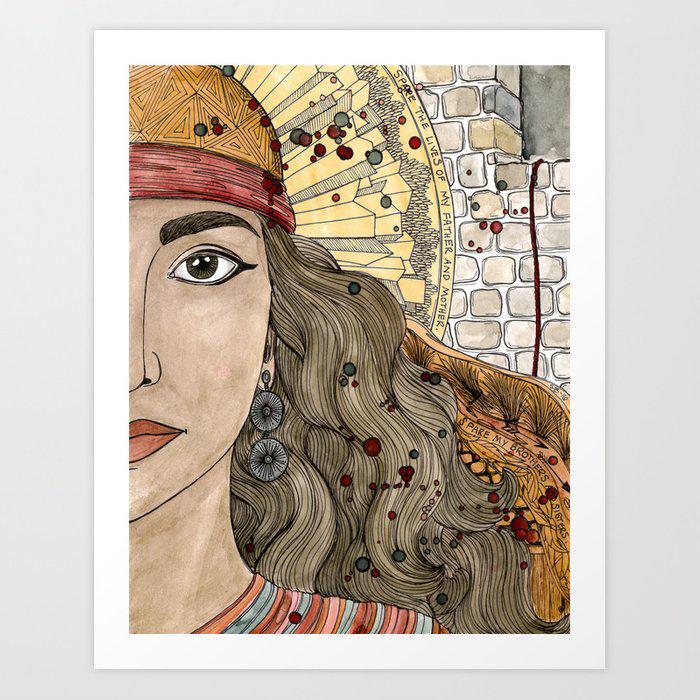
Rahab by Sarah Beth Baca
God said to Joshua, “This day, for the first time, I will exalt you in the sight of all Israel, so that they shall know that I will be with you as I was with Moses. For your part, command the priests who carry the Ark of the Covenant as follows: When you reach the edge of the waters of the Jordan, make a halt in the Jordan.” And Joshua said to the Israelites, “Come closer and listen to the words of Adonai your God. By this,” Joshua continued, “you shall know that a living God is among you, and that He will dispossess for you the Canaanites, Hittites, Hivites, Perizzites, Girgashites, Amorites, and Jebusites: the Ark of the Covenant of the Sovereign of all the earth is advancing before you into the Jordan. Now select twelve men from the tribes of Israel, one man from each tribe. When the feet of the priests bearing the Ark of God, the Sovereign of all the earth, come to rest in the waters of the Jordan, the waters of the Jordan—the water coming from upstream—will be cut off and will stand in a single heap.” When the people set out from their encampment to cross the Jordan, the priests bearing the Ark of the Covenant were at the head of the people.
Now the Jordan keeps flowing over its entire bed throughout the harvest season. But as soon as the bearers of the Ark reached the Jordan, and the feet of the priests bearing the Ark dipped into the water at its edge, the waters coming down from upstream piled up in a single heap a great way off, at Adam, the town next to Zarethan; and those flowing away downstream to the Sea of the Arabah (the Dead Sea) ran out completely. So the people crossed near Jericho. The priests who bore the Ark of God's Covenant stood on dry land exactly in the middle of the Jordan, while all Israel crossed over on dry land, until the entire nation had finished crossing the Jordan.
(1) When all the kings of the Amorites on the western side of the Jordan, and all the kings of the Canaanites near the Sea, heard how God had dried up the waters of the Jordan for the sake of the Israelites until they crossed over, they lost heart, and no spirit was left in them because of the Israelites. (2) At that time God said to Joshua, “Make flint knives and proceed with a second circumcision of the Israelites.” (3) So Joshua had flint knives made, and the Israelites were circumcised at Gibeath-haaraloth. (4) This is the reason why Joshua had the circumcision performed: All the people who had come out of Egypt, all the males of military age, had died during the desert wanderings after leaving Egypt. (5) Now, whereas all the people who came out of Egypt had been circumcised, none of the people born after the exodus, during the desert wanderings, had been circumcised. (6) For the Israelites had traveled in the wilderness forty years, until the entire nation—the men of military age who had left Egypt—had perished; because they had not obeyed God, and God had sworn never to let them see the land that God had sworn to their fathers to assign to us, a land flowing with milk and honey. (7) But God had raised up their sons in their stead; and it was these that Joshua circumcised, for they were uncircumcised, not having been circumcised on the way. (8)
After the circumcising of the whole nation was completed, they remained where they were, in the camp, until they recovered. (9) And God said to Joshua, “Today I have rolled away from you the disgrace of Egypt.” So that place was called Gilgal, as it still is. (10) Encamped at Gilgal, in the steppes of Jericho, the Israelites offered the passover sacrifice on the fourteenth day of the month, toward evening. (11)
On the day after the passover offering, on that very day, they ate of the produce of the country, unleavened bread and parched grain. (12) On that same day, when they ate of the produce of the land, the manna ceased. The Israelites got no more manna; that year they ate of the yield of the land of Canaan.
Why are all the Israelites circumcised upon entering Jericho? Why do you think they did this now rather than before crossing the sea?
How does this signify a change in the Israelites' status?
How might the gendered aspect of it be problematic for us today?
Once, when Joshua was near Jericho, he looked up and saw a man standing before him, drawn sword in hand. Joshua went up to him and asked him, “Are you one of us or of our enemies?” He replied, “No, I am captain of God's host. Now I have come!” Joshua threw himself face down to the ground and, prostrating himself, said to him, “What does my lord command his servant?” The captain of God's host answered Joshua, “Remove your sandals from your feet, for the place where you stand is holy.” And Joshua did so.
Why do you think it might be important for the narrators to consistently remind the reader that God is on the side of Joshua and the Israelites?
What might be problematic or uncomfortable for us about it today?
(1) Now Jericho was shut up tight because of the Israelites; no one could leave or enter. (2) God said to Joshua, “See, I will deliver Jericho and her king [and her] warriors into your hands. (3) Let all your troops march around the city and complete one circuit of the city. Do this six days, (4) with seven priests carrying seven ram’s horns preceding the Ark. On the seventh day, march around the city seven times, with the priests blowing the horns. (5) And when a long blast is sounded on the horn—as soon as you hear that sound of the horn—all the people shall give a mighty shout. Thereupon the city wall will collapse, and the people shall advance, every man straight ahead.” (6)
[these events occur verses 7-15]
On the seventh day, they rose at daybreak and marched around the city, in the same manner, seven times; that was the only day that they marched around the city seven times. (16) On the seventh round, as the priests blew the horns, Joshua commanded the people, “Shout! For God has given you the city. (17) The city and everything in it are to be proscribed for God; only Rahav the harlot is to be spared, and all who are with her in the house, because she hid the messengers we sent. (18) But you must beware of that which is proscribed, or else you will be proscribed: if you take anything from that which is proscribed, you will cause the camp of Israel to be proscribed; you will bring calamity upon it. (19) All the silver and gold and objects of copper and iron are consecrated to God; they must go into the treasury of God.” (20)
So the people shouted when the horns were sounded. When the people heard the sound of the horns, the people raised a mighty shout and the wall collapsed. The people rushed into the city, every man straight in front of him, and they captured the city. (21) They exterminated everything in the city with the sword: man and woman, young and old, ox and sheep and donkey. (22)
But Joshua bade the two men who had spied out the land, “Go into the harlot’s house and bring out the woman and all that belong to her, as you swore to her.” (23) So the young spies went in and brought out Rahav, her father and her mother, her brothers and all that belonged to her—they brought out her whole family and left them outside the camp of Israel. (24) They burned down the city and everything in it. But the silver and gold and the objects of copper and iron were deposited in the treasury of the House of God. (25) Only Rahav the harlot and her father’s family were spared by Joshua, along with all that belonged to her, and she dwelt among the Israelites—as is still the case. For she had hidden the messengers that Joshua sent to spy out Jericho. (26) At that time Joshua pronounced this oath: “Cursed of God be the person who shall undertake to fortify this city of Jericho: he shall lay its foundations at the cost of his first-born, and set up its gates at the cost of his youngest.” (27) God was with Joshua, and his fame spread throughout the land.
What do you think about the methods of Joshua's conquest? What is surprising or different than how you might have imagined it?
How does this passage bring Rahab's story full circle?
- What is inspiring about her integration into the peoplehood of Israel?
- What might be problematic considering the rest of the city?
(10) God threw them [the armies of five Amorite kings] into a panic before Israel: [Joshua] inflicted a crushing defeat on them at Gibeon, pursued them in the direction of the Beth-horon ascent, and harried them all the way to Azekah and Makkedah. (11) While they were fleeing before Israel down the descent from Beth-horon, God hurled huge stones on them from the sky, all the way to Azekah, and they perished; more perished from the hailstones than were killed by the Israelite weapons. (12)
On that occasion, when God routed the Amorites before the Israelites, Joshua addressed God; he said in the presence of the Israelites:
“Stand still, O sun, at Gibeon,
O moon, in the Valley of Aijalon!” (13)
And the sun stood still And the moon halted, While a nation wreaked judgment on its foes —as is written in the Book of Yashar. Thus the sun halted in midheaven, and did not press on to set, for a whole day; (14) for God fought for Israel. Neither before nor since has there ever been such a day, when God acted on words spoken by a man. (15) Then Joshua together with all Israel returned to the camp at Gilgal.
From The Jewish Study Bible
"Stand still" opens an ancient mythic poem, using language similar to that used for the Divine Warrior in Canaanite mythology (in Judges 5:20 and Habbakuk 3) and signifying God's miraculous and direct involvement in human affairs...the purpose of this action is for the Israelites to have sufficient time to kill the enemy before the sun set.
How does this passage strike you? What feels "mythological" about it? How is it similar or different to other instances when God is directly involved in human affairs?
At that time, Joshua went and wiped out the Anakites from the hill country, from Hebron, Debir, and Anab, from the entire hill country of Judah, and from the entire hill country of Israel; Joshua proscribed them and their towns. No Anakites remained in the land of the Israelites; but some remained in Gaza, Gath, and Ashdod. Thus Joshua conquered the whole country, just as God had promised Moses; and Joshua assigned it to Israel to share according to their tribal divisions. And the land had rest from war.
Joshua was now old, advanced in years. God said to him, “You have grown old, you are advanced in years; and very much of the land still remains to be taken possession of. This is the territory that remains: all the districts of the Philistines and all [those of] the Geshurites, from the Shihor, which is close to Egypt, to the territory of Ekron on the north, are accounted Canaanite, namely, those of the five lords of the Philistines....
Much later, after the Eternal had given Israel rest from all the enemies around them, and when Joshua was old and well advanced in years, Joshua summoned all Israel... and said to them: “I have grown old and am advanced in years. You have seen all that the Eternal your God has done to all those nations on your account, for it was the Ternal your God who fought for you. See, I have allotted to you, by your tribes, [the territory of] these nations that still remain, and that of all the nations that I have destroyed, from the Jordan to the Mediterranean Sea in the west.
The Eternal your God will thrust them out on your account and drive them out to make way for you, and you shall possess their land as the Eternal your God promised you. “But be most resolute to observe faithfully all that is written in the Book of the Teaching of Moses, without ever deviating from it to the right or to the left, and without intermingling with these nations that are left among you. Do not utter the names of their gods or swear by them; do not serve them or bow down to them. But hold fast to the Eternal your God as you have done to this day.
How does Joshua's farewell mirror God's first speech to him at the beginning of the book?
Why do you think Joshua emphasizes how Israel must behave? Is there perhaps some foreshadowing going on here?
After these events, Joshua son of Nun, the servant of God, died at the age of one hundred and ten years. They buried him on his own property, at Timnat-serah in the hill country of Ephraim, north of Mount Gaash. Israel served God during the lifetime of Joshua and the lifetime of the elders who lived on after Joshua, and who had experienced all the deeds that God had wrought for Israel.
Joshua died when he was 110 years old. Only one other patriarchal figure lived exactly to 110–Joseph. And the Book of Joshua connects these two leaders in the final lines of the book. After Joshua has already passed away, we find this: “The bones of Joseph, which the Israelites had brought up from Egypt, were buried at Shehem” (24:32).
Joseph was responsible for bringing the Israelites down to Egypt. But Joshua has led the people back to the Land of Canaan, officially ending the exile and opening a new chapter in Israelite history in which the people inherit their homeland.
(32) The bones of Joseph, which the Israelites had brought up from Egypt, were buried at Shechem, in the piece of ground which Jacob had bought for a hundred kesitahs from the children of Hamor, Shechem’s father, and which had become a heritage of the Josephites. Eleazar son of Aaron also died, and they buried him on the hill of his son Phinehas, which had been assigned to him in the hill country of Ephraim.