


Born in Lodz, Poland. Died in Berlin, Germany.
"The Three Who Ate"
Three people who ate….they did not eat on any regular day of the week, but on Yom Kippur. And not just on any Yom Kippur, but on Yom Kippur that fell on Shabbat. They didn’t eat in secret, but in front of everyone gathered in the Great Synagogue. They weren’t simple people or boors. These three were not frivolous. Rather they were the princes of the community and their most important leaders, none other than the rabbi of the city and the two Dayanim [rabbinic judges] who stood with him…It was the afternoon of Yom Kippur. The rabbi stood bent over on the Bima…Even now my eyes can picture that incredible sight, as I stood there in the congregation of the synagogue. The rabbi stood on the Bima, his dark eyes shining out from his pale face and white beard. The Mussaf service was almost over and the congregation stood silently waiting to hear something from this man of G-d...Suddenly my ears heard a sound but I could not understand exactly what it was. I heard the sounds but my heart could not comprehend. “With the permission of G-d and with the permission of the community, we hereby permit people to eat and to drink today.” The beadle came forward and the Rabbi whispered a few things into his ear. Then he spoke with the two Dayanim who were next to him. They nodded as if to approve of what he had said. As this was happening the beadle brought a cup of wine and some cake from the rabbi’s home. If I am lucky to live for many more years I will never forget that incredible day and that awesome sight. If I close my eyes for a moment I can still see them: the three who ate! The three shepherds of Israel standing on the Bima in the synagogue, eating in front of everyone, on Yom Kippur.

וְאִם־מָאֵ֥ן אַתָּ֖ה לְשַׁלֵּ֑חַ הִנֵּ֣ה אָנֹכִ֗י נֹגֵ֛ף אֶת־כָּל־גְּבוּלְךָ֖ בַּֽצְפַרְדְּעִֽים׃
If you refuse to let them go, then I will plague your whole country with frogs.
(ג) הִנֵּ֨ה יַד־ה' הוֹיָ֗ה בְּמִקְנְךָ֙ אֲשֶׁ֣ר בַּשָּׂדֶ֔ה בַּסּוּסִ֤ים בַּֽחֲמֹרִים֙ בַּגְּמַלִּ֔ים בַּבָּקָ֖ר וּבַצֹּ֑אן דֶּ֖בֶר כָּבֵ֥ד מְאֹֽד׃
(3) then the hand of the LORD will strike your livestock in the fields—the horses, the asses, the camels, the cattle, and the sheep—with a very severe pestilence.
(יב) וְעָבַרְתִּ֣י בְאֶֽרֶץ־מִצְרַיִם֮ בַּלַּ֣יְלָה הַזֶּה֒ וְהִכֵּיתִ֤י כָל־בְּכוֹר֙ בְּאֶ֣רֶץ מִצְרַ֔יִם מֵאָדָ֖ם וְעַד־בְּהֵמָ֑ה וּבְכָל־אֱלֹקֵ֥י מִצְרַ֛יִם אֶֽעֱשֶׂ֥ה שְׁפָטִ֖ים אֲנִ֥י ה'׃ (יג) וְהָיָה֩ הַדָּ֨ם לָכֶ֜ם לְאֹ֗ת עַ֤ל הַבָּתִּים֙ אֲשֶׁ֣ר אַתֶּ֣ם שָׁ֔ם וְרָאִ֙יתִי֙ אֶת־הַדָּ֔ם וּפָסַחְתִּ֖י עֲלֵכֶ֑ם וְלֹֽא־יִֽהְיֶ֨ה בָכֶ֥ם נֶ֙גֶף֙ לְמַשְׁחִ֔ית בְּהַכֹּתִ֖י בְּאֶ֥רֶץ מִצְרָֽיִם׃ (יד) וְהָיָה֩ הַיּ֨וֹם הַזֶּ֤ה לָכֶם֙ לְזִכָּר֔וֹן וְחַגֹּתֶ֥ם אֹת֖וֹ חַ֣ג לַֽה' לְדֹרֹ֣תֵיכֶ֔ם חֻקַּ֥ת עוֹלָ֖ם תְּחָגֻּֽהוּ׃
(12) For that night I will go through the land of Egypt and strike down every first-born in the land of Egypt, both man and beast; and I will mete out punishments to all the gods of Egypt, I the LORD. (13) And the blood on the houses where you are staying shall be a sign for you: when I see the blood I will pass over you, so that no plague will destroy you when I strike the land of Egypt. (14) This day shall be to you one of remembrance: you shall celebrate it as a festival to the LORD throughout the ages; you shall celebrate it as an institution for all time.
(יב) כִּ֣י תִשָּׂ֞א אֶת־רֹ֥אשׁ בְּנֵֽי־יִשְׂרָאֵ֘ל לִפְקֻדֵיהֶם֒ וְנָ֨תְנ֜וּ אִ֣ישׁ כֹּ֧פֶר נַפְשׁ֛וֹ לַה' בִּפְקֹ֣ד אֹתָ֑ם וְלֹא־יִהְיֶ֥ה בָהֶ֛ם נֶ֖גֶף בִּפְקֹ֥ד אֹתָֽם׃
(12) When you take a census of the Israelite people according to their enrollment, each shall pay the LORD a ransom for himself on being enrolled, that no plague may come upon them through their being enrolled.
(יד) כִּ֣י ׀ בַּפַּ֣עַם הַזֹּ֗את אֲנִ֨י שֹׁלֵ֜חַ אֶת־כָּל־מַגֵּפֹתַי֙ אֶֽל־לִבְּךָ֔ וּבַעֲבָדֶ֖יךָ וּבְעַמֶּ֑ךָ בַּעֲב֣וּר תֵּדַ֔ע כִּ֛י אֵ֥ין כָּמֹ֖נִי בְּכָל־הָאָֽרֶץ׃
(14) For this time I will send all My plagues upon your person, and your courtiers, and your people, in order that you may know that there is none like Me in all the world.
(לז) וַיָּמֻ֙תוּ֙ הָֽאֲנָשִׁ֔ים מוֹצִאֵ֥י דִבַּת־הָאָ֖רֶץ רָעָ֑ה בַּמַּגֵּפָ֖ה לִפְנֵ֥י ה'׃
(37) those who spread such calumnies about the land died of plague, by the will of the LORD.
(יב) וְזֹ֣את ׀ תִּֽהְיֶ֣ה הַמַּגֵּפָ֗ה אֲשֶׁ֨ר יִגֹּ֤ף ה' אֶת־כָּל־הָ֣עַמִּ֔ים אֲשֶׁ֥ר צָבְא֖וּ עַל־יְרוּשָׁלִָ֑ם הָמֵ֣ק ׀ בְּשָׂר֗וֹ וְהוּא֙ עֹמֵ֣ד עַל־רַגְלָ֔יו וְעֵינָיו֙ תִּמַּ֣קְנָה בְחֹֽרֵיהֶ֔ן וּלְשׁוֹנ֖וֹ תִּמַּ֥ק בְּפִיהֶֽם׃
(12) As for those peoples that warred against Jerusalem, the LORD will smite them with this plague: Their flesh shall rot away while they stand on their feet; their eyes shall rot away in their sockets; and their tongues shall rot away in their mouths.
(12) And a man cannot even know his time. As fishes are enmeshed in a fatal net, and as birds are trapped in a snare, so men are caught at the time of calamity, when it comes upon them without warning.
1954-present Born Gyula, Hungary
...all normal expectations went by the board and one’s daily habits were disrupted by a sense of ever-spreading all-consuming chaos which rendered the future unpredictable, the past unrecallable and ordinary life so haphazard that people simply assumed that whatever could be imagined might come to pass, that if there were only one door in a building it would no longer open, that wheat would grow head downwards into the earth not out of it, and that, since one could only note the symptoms of disintegration, the reasons for it remaining unfathomable and inconceivable, there was nothing anyone could do except to get a tenacious grip on anything that was still tangible…
אל תצר צרת מחר כי לא תדע מה ילד יום שמא מחר בא ואיננו נמצא מצטער על העולם שאין שלו מנע רבים מתוך ביתך ולא הכל תביא ביתך רבים יהיו דורשי שלומך גלה סוד לאחד מאלף
The Gemara quotes additional statements from the book of Ben Sira: Do not suffer from tomorrow’s trouble, that is, do not worry about problems that might arise in the future, as you do not know what a day will bring. Perhaps when tomorrow comes, the individual who was so worried will not be among the living, and he was consequently upset over a world that is not his. Prevent a crowd from inside your house, do not let many people enter, and do not even bring all your friends into your house. Make sure, however, that a crowd seeks your welfare, and that you have many allies. Reveal a secret to only one in a thousand, since most people are unable to keep a secret.
(ח) שִׁבְעָה מִינֵי פֻרְעָנֻיּוֹת בָּאִין לָעוֹלָם עַל שִׁבְעָה גוּפֵי עֲבֵרָה. מִקְצָתָן מְעַשְּׂרִין וּמִקְצָתָן אֵינָן מְעַשְּׂרִין, רָעָב שֶׁל בַּצֹּרֶת בָּאָה, מִקְצָתָן רְעֵבִים וּמִקְצָתָן שְׂבֵעִים. גָּמְרוּ שֶׁלֹּא לְעַשֵּׂר, רָעָב שֶׁל מְהוּמָה וְשֶׁל בַּצֹּרֶת בָּאָה. וְשֶׁלֹּא לִטֹּל אֶת הַחַלָּה, רָעָב שֶׁל כְּלָיָה בָאָה. דֶּבֶר בָּא לָעוֹלָם עַל מִיתוֹת הָאֲמוּרוֹת בַּתּוֹרָה שֶׁלֹּא נִמְסְרוּ לְבֵית דִּין, וְעַל פֵּרוֹת שְׁבִיעִית. חֶרֶב בָּאָה לָעוֹלָם עַל עִנּוּי הַדִּין, וְעַל עִוּוּת הַדִּין, וְעַל הַמּוֹרִים בַּתּוֹרָה שֶׁלֹּא כַהֲלָכָה:
(ט) חַיָּה רָעָה בָאָה לָעוֹלָם עַל שְׁבוּעַת שָׁוְא, וְעַל חִלּוּל הַשֵּׁם. גָּלוּת בָּאָה לָעוֹלָם עַל עוֹבְדֵי עֲבוֹדָה זָרָה, וְעַל גִלּוּי עֲרָיוֹת, וְעַל שְׁפִיכוּת דָּמִים, וְעַל הַשְׁמָטַת הָאָרֶץ. בְּאַרְבָּעָה פְרָקִים הַדֶּבֶר מִתְרַבֶּה, בָּרְבִיעִית, וּבַשְּׁבִיעִית, וּבְמוֹצָאֵי שְׁבִיעִית, וּבְמוֹצָאֵי הֶחָג שֶׁבְּכָל שָׁנָה וְשָׁנָה. בָּרְבִיעִית, מִפְּנֵי מַעְשַׂר עָנִי שֶׁבַּשְּׁלִישִׁית. בַּשְּׁבִיעִית, מִפְּנֵי מַעְשַׂר עָנִי שֶׁבַּשִּׁשִּׁית. וּבְמוֹצָאֵי שְׁבִיעִית, מִפְּנֵי פֵרוֹת שְׁבִיעִית. וּבְמוֹצָאֵי הֶחָג שֶׁבְּכָל שָׁנָה וְשָׁנָה, מִפְּנֵי גֶזֶל מַתְּנוֹת עֲנִיִּים:
(8) Seven kinds of punishment come to the world for seven categories of transgression: When some of them give tithes, and others do not give tithes, a famine from drought comes some go hungry, and others are satisfied. When they have all decided not to give tithes, a famine from tumult and drought comes; [When they have, in addition, decided] not to set apart the dough-offering, an all-consuming famine comes. Pestilence comes to the world for sins punishable by death according to the Torah, but which have not been referred to the court, and for neglect of the law regarding the fruits of the sabbatical year. The sword comes to the world for the delay of judgment, and for the perversion of judgment, and because of those who teach the Torah not in accordance with the accepted law.
(9) Wild beasts come to the world for swearing in vain, and for the profanation of the Name. Exile comes to the world for idolatry, for sexual sins and for bloodshed, and for [transgressing the commandment of] the [year of the] release of the land. At four times pestilence increases: in the fourth year, in the seventh year and at the conclusion of the seventh year, and at the conclusion of the Feast [of Tabernacles] in every year. In the fourth year, on account of the tithe of the poor which is due in the third year. In the seventh year, on account of the tithe of the poor which is due in the sixth year; At the conclusion of the seventh year, on account of the produce of the seventh year; And at the conclusion of the Feast [of Tabernacles] in every year, for robbing the gifts to the poor.
(1579-1654) Born in Wallerstein, Germany. Died in Krakow, Poland.
Chief Rabbi of Prague (1627-1629)
(ב) מִתְרַבֶּה. שֶׁכַּאֲשֶׁר יִקְרֶה שֶׁיִּהְיֶה דֶּבֶר בְּאֵלּוּ הַפְּרָקִים יִתְרַבֶּה אָז בְּעָוֹן אֵלּוּ, לְפִי שֶׁיִּקְרֶה בָּהֶם תָּמִיד הֶעָוֹן אֵצֶל קְצָת הָאֲנָשִׁים, וְהִנֵּה הוּא מִדָּה כְּנֶגֶד מִדָּה, כִּי הֶחְסִיר חַיּוּת הֶעָנִי וְגַם חָשַׁשׁ שֶׁכְּשֶׁיִּתֵּן שֶׁיֶּחְסַר לוֹ לַחְמוֹ כְּשֶׁיַּאֲרִיכוּ לוֹ חַיָּיו, לְכָךְ יַחְסְרוּ חַיָּיו וְתִשָּׁאֵר תְּבוּאָתוֹ לַאֲחֵרִים. וּמֵעַתָּה לֹא קָשְׁיָא עַל הַמִּשְׁנָה הַקּוֹדֶמֶת. מִדְרַשׁ שְׁמוּאֵל:
(2) become more widespread, etc.: As when it happens that there is pestilence in those periods of time, it becomes more widespread then, due to the sin of these [people]; as [this] sin always happens in these [time periods] with some people. And behold, it is poetic justice; as [such a man] took away from the life of the poor person and also was concerned that if he would give, it would take away from his [own] bread if his life is lengthened. Hence, his life will be taken from, and his produce will remain for others. And from now, there is no objection at all from the previous mishnah - Midrash Shmuel.
ר' שמעון בן מנסיא אומר (שמות לא, טז) ושמרו בני ישראל את השבת אמרה תורה חלל עליו שבת אחת כדי שישמור שבתות הרבה א"ר יהודה אמר שמואל אי הואי התם הוה אמינא דידי עדיפא מדידהו (ויקרא יח, ה) וחי בהם ולא שימות בהם
Rabbi Shimon ben Menasya said: It is stated: “And the children of Israel shall keep Shabbat, to observe Shabbat” (Exodus 31:16).The Torah said: Desecrate one Shabbat on his behalf so he will observe many Shabbatot. Rav Yehuda said that Shmuel said: If I would have been there among those Sages who debated this question, I would have said that my proof is preferable to theirs, as it states: “You shall keep My statutes and My ordinances, which a person shall do and live by them” (Leviticus 18:5), and not that he should die by them.
אי זו היא דבר עיר המוציאה חמש מאות רגלי כו': ת"ר עיר המוציאה חמש מאות ואלף רגלי כגון כפר עכו ויצאו הימנה תשעה מתים בשלשה ימים זה אחר זה הרי זה דבר
ביום אחד או בד' ימים אין זה דבר ועיר המוציאה חמש מאות רגלי כגון כפר עמיקו ויצאו ממנה שלשה מתים בג' ימים זה אחר זה הרי זה דבר
§ The mishna taught: What is considered a plague of pestilence? If it is a city that sends out five hundred infantrymen, and three dead are removed from it on three consecutive days, one dead per day, this is a plague of pestilence. The Sages taught: If a city that sends out fifteen hundred infantrymen, i.e., one that has a population of at least fifteen hundred men, e.g., the village of Akko, and nine dead are removed from it on three consecutive days, i.e., three dead per day, this is considered a plague of pestilence.
If all nine died on a single day, while none died on the other days, or if the nine died over a period of four days, this is not a plague of pestilence. And a city that sends out five hundred infantrymen, for example, the village of Amiko, and three dead are removed from it on three consecutive days, this is a plague of pestilence.
Rabbi Yoḥanan would announce: Be careful of the flies found on those afflicted with ra’atan, as they are carriers of the disease. Rabbi Zeira would not sit in a spot where the wind blew from the direction of someone afflicted with ra’atan. Rabbi Elazar would not enter the tent of one afflicted with ra’atan, and Rabbi Ami and Rabbi Asi would not eat eggs from an alley in which someone afflicted with ra’atan lived. Conversely, Rabbi Yehoshua ben Levi would attach himself to them and study Torah, saying as justification the verse: “The Torah is a loving hind and a graceful doe” (Proverbs 5:19). If it bestows grace on those who learn it, does it not protect them from illness?
בַּעֲוֹן עִינּוּי הַדִּין, וְעִיוּוּת הַדִּין, וְקִלְקוּל הַדִּין, וּבִיטּוּל תּוֹרָה — חֶרֶב וּבִיזָּה רָבָה, וְדֶבֶר וּבַצּוֹרֶת בָּא
Furthermore, the Sages said that due to the sin of delay of justice, i.e., judges delay issuing their rulings due to personal considerations, and for distortion of justice, i.e., judges intentionally distort their verdicts, and for miscarriage of justice that results from negligence, and for dereliction in the study of Torah, violence and looting abound in the world, and pestilence and famine come.
אָמַר אַבָּיֵי: לָא לֵימָא אִינָשׁ הָכִי, דְּתָנֵי דְּבֵי רַבִּי יִשְׁמָעֵאל ״וְרַפֹּא יְרַפֵּא״ — מִכָּאן שֶׁנִּיתְּנָה רְשׁוּת לָרוֹפֵא לְרַפּאוֹת.
Abaye responded and said: One should not say this, as it was taught in the school of Rabbi Yishmael that from the verse, “And shall cause him to be thoroughly healed” (Exodus 21:19), from here we derive that permission is granted to a doctor to heal. The practice of medicine is in accordance with the will of G-d.
And it is taught in a baraita: A Torah scholar is not permitted to reside in any city that does not have these ten things: A court that has the authority to flog and punish transgressors; and a charity fund for which monies are collected by two people and distributed by three, as required by halakha. This leads to a requirement for another three people in the city. And a synagogue; and a bathhouse; and a public bathroom; a doctor; and a bloodletter; and a scribe [velavlar] to write sacred scrolls and necessary documents; and a ritual slaughterer; and a teacher of young children. With these additional requirements there are a minimum of 120 men who must be residents of the city. They said in the name of Rabbi Akiva: The city must also have varieties of fruit, because varieties of fruit illuminate the eyes.
§ The Sages taught: If there is plague in the city, gather your feet, i.e., limit the time you spend out of the house, as it is stated in the verse: “And none of you shall go out of the opening of his house until the morning.” And it says in another verse: “Come, my people, enter into your chambers, and shut your doors behind you; hide yourself for a little moment, until the anger has passed by” (Isaiah 26:20). And it says: “Outside the sword will bereave, and in the chambers terror” (Deuteronomy 32:25).
At a time when there was a plague, Rava would close the windows of his house, as it is written: “For death is come up into our windows” (Jeremiah 9:20).
And if you would say that this matter applies only where there is no fear inside, which explains why it is preferable to remain indoors, but where there is fear inside, one might think that when he goes out and sits among people in general company it is better, therefore, the Gemara introduces the third verse and says: Come and hear: “Outside the sword will bereave, and in the chambers terror.” This means that although there is terror in the chambers, outside the sword will bereave, so it is safer to remain indoors.
שנים עשר אלף זוגים תלמידים היו לו לרבי עקיבא מגבת עד אנטיפרס וכולן מתו בפרק אחד מפני שלא נהגו כבוד זה לזה...כולם מתו מיתה רעה מאי היא א"ר נחמן אסכרה
Rabbi Akiva had twelve thousand pairs of students in an area of land that stretched from Gevat to Antipatris in Judea, and they all died in one period of time, because they did not treat each other with respect...They all died a bad death. The Gemara inquires: What is it that is called a bad death? Rav Naḥman said: Diphtheria.
(1135/8-1204) Born in Cordoba, Spain. Died in Cairo, Egypt)
מִצְוַת עֲשֵׂה מִן הַתּוֹרָה לִזְעֹק וּלְהָרִיעַ בַּחֲצוֹצְרוֹת עַל כָּל צָרָה שֶׁתָּבוֹא עַל הַצִּבּוּר. שֶׁנֶּאֱמַר (במדבר י ט) "עַל הַצַּר הַצֹּרֵר אֶתְכֶם וַהֲרֵעֹתֶם בַּחֲצֹצְרוֹת". כְּלוֹמַר כָּל דָּבָר שֶׁיָּצֵר לָכֶם כְּגוֹן בַּצֹּרֶת וְדֶבֶר וְאַרְבֶּה וְכַיּוֹצֵא בָּהֶן זַעֲקוּ עֲלֵיהֶן וְהָרִיעוּ:
It is a positive commandment from the Torah to cry out and to sound trumpets for all troubles that come upon the community; as it is stated (Numbers 10:9), "upon an enemy who attacks you and you sound trumpets." That is to say, [with] every matter that troubles you — such as famine, a plague, locusts and that which is similar to them — cry out about them, and sound the trumpets.
וְעַל הַדֶּבֶר. אֵי זוֹ הִיא דֶּבֶר עִיר שֶׁיֵּשׁ בָּהּ חֲמֵשׁ מֵאוֹת רַגְלִי וְיָצְאוּ מִמֶּנָּה שְׁלֹשָׁה מֵתִים בִּשְׁלֹשָׁה יָמִים זֶה אַחַר זֶה הֲרֵי זֶה דֶּבֶר. יָצְאוּ בְּיוֹם אֶחָד אוֹ בְּאַרְבָּעָה יָמִים אֵין זֶה דֶּבֶר. הָיוּ בָּהּ אֶלֶף וְיָצְאוּ מִמֶּנָּה שִׁשָּׁה מֵתִים בִּשְׁלֹשָׁה יָמִים זֶה אַחַר זֶה דֶּבֶר. יָצְאוּ בְּיוֹם אֶחָד אוֹ בְּאַרְבָּעָה אֵין זֶה דֶּבֶר. וְכֵן לְפִי חֶשְׁבּוֹן זֶה. וְאֵין הַנָּשִׁים וְהַקְּטַנִּים וְהַזְּקֵנִים שֶׁשָּׁבְתוּ מִמְּלָאכָה בִּכְלַל מִנְיַן אַנְשֵׁי הַמְּדִינָה לְעִנְיָן זֶה:
About a plague — how is this? What is a plague? A city that has five hundred footmen and three of them are eliminated and died in three days — one after [the other] — this is surely a plague. If they were eliminated in one day or in four days, it is not a plague. If there were a thousand and six of them were eliminated in three days — one after [the other — this is] a plague. If they were eliminated in one day or in four days, it is not a plague. And so forth, according to this calculation. And women, minors and old men that have stopped from working are not in the count of the people of the province regarding this matter.
(1269-1343) Born in Cologne, Germany. Died in Toledo, Spain.
(א) וירחץ בנקיון כפיו ויברך בא"י אמ"ה אקב"ו על נטילת ידים וידקדק לערות עליהם שלשה פעמים מפני שרוח רעה שורה על הידים קודם נטילה ואינה סרה עד שיערה עליהם ג"פ ועל כן צריך למנוע מהגיע בידו קודם נטילה לפה ולחוטם ולאזנים ולעינים מפני שרוח רעה שורה עליהם ואם אין לו מים יקנח ידיו בצרור או בכל מידי דמנקי ויברך על נקיות ידים:
(1) 4. He should wash his hands clean and recite the blessing ‘Blessed are you, Lord our G-d, king of the universe, who sanctified us with His mitzvot and commanded us concerning hand washing.’ He should be exacting in pouring over them three times on account of the evil spirit alighting upon the hands prior to washing, which is not vitiated until he has poured over them three times. Therefore, he needs to refrain from touching with his hand, prior to washing, to the mouth, to the nose, and to the ears and to the eyes, on account of the evil spirit alighting upon them. But if he has no water, he should wipe his hands with a stone chip or with any type of wiping implement and recite the blessing ‘concerning the cleaning of the hands.’
'Kesef Mishneh' (on Rambam's Mishneh Torah)
(1488-1575) Born in Toledo, Spain. Died in Safed, Israel.
Moshe Isserles 'Rema' 'HaMapah'
(1530-1572) Krakow, Poland
Introduction of the Rema to his book Mechir Yayin on Megillat Esther, where he writes that he fled from his home town of Krakow to Shidlov because of pollution and illness in the air.
One must refrain from putting coins in one's mouth, lest it is covered with dried saliva of those afflicted with boils. He should not put the palm of his hand in his arm pit, lest his hand touched a metzorah or a harmful poison. He should not put a loaf of bread under his armpit, because of the sweat. He should not put a cooked item or drinks under the bed, since an evil spirit rests on them. He should not stick a knife in an esrog or a radish, lest one fall on its edge and die. Hagah: Similarly, he should be careful of all things that cause danger, because danger is stricter than transgressions, and one should be more careful with an uncertain danger than with an uncertain issur. They also prohibited to go in a dangerous place, such as under a leaning wall, or alone at night. They also prohibited to drink water from rivers at night or to put one's mouth on a stream of water and drink, because these matters have a concern of danger. It is the widespread custom not to drink water during the equinox, and the early ones wrote this and it is not to be changed. They also wrote to flee from the city when a plague is in the city, and one should leave at the beginning of the plague and not at the end. And all of these things are because of the danger, and a person who guards his soul will distance himself from them and it is prohibited to rely on a miracle in all of these matters.
The following things require washing the hands in water [after them]: One who rises from bed, goes out of the bathroom, or of the bath house, one who cuts his nails, takes off his shoes, touches his feet, or washes his head, some say: also one who goes among the dead, or touched the dead, one who cleanses his clothes of lice, has sexual intercourse, touches a louse, or touches his body with his hand. Anyone doing any of these and not washing his hands, if he is a scholar, his studies are forgotten, and if he is not a scholar, he goes out of his mind.
Solomon ben Simon Duran (c. 1400-1467) Algiers
During a plague one must be exceedingly careful, especially to wash themselves, not eat excessively, and eat small amounts of food that are high quality, and rest a lot while avoiding strenuous work, avoiding frustration while increasing joy. All of this to an extreme and not just a little bit.
One who has medications, and another person is sick and needs them, it is forbidden to raise their prices beyond what is appropriate.
Professor H.H. Ben Sasson, A History of the Jewish People, p. 486
(1914-1977) Born in Volozhyn, Belarus. Died in Jerusalem, Israel.
Animosity and persecution reached their peak during the Black Death, in the massacres of 1348-1349. This plague descended upon Europe… In many places more than half of the population perished within a brief period. Rational explanations of the catastrophe were unknown…
In those days scapegoats were sought… The Jews were accused of poisoning the wells in order to destroy the whole of Christendom. In Switzerland, Jews were tortured until they produced the demanded confession. News of the guilt of the Jews was broadcast so rapidly that in some places Jews were exterminated even before the plague arrived.

Rabbi Dr. Yaakov Tzahalon (1630-1693), Rome, Italy
And because the people were not able to attend synagogue, therefore on the Shabbat of Parshat Toldot Yitzchak, 2 Kislev, the Rabbi of Rome Yaakov Tzahalon ventured to Catalani Street and spoke on the parsha and the community members opened their windows to hear the drasha.
And another time, I went to Toscani Road and stood in the window of the synagogue to sermonize (liDrosh Drasha) and the people in the street stood to listen.
Normally, the people were not permitted to leave their homes and stand in the road but the doctors permitted it only at an appointed hour and only for a brief period of time. This was true in other places where rabbis would sermonize from windows and people would only be allowed outside for short amounts of time to tend to their affairs and immediately return home. If somebody was found outside after dark, they were taken to a specific location for punishment.
After nine months, G-d had mercy on us due to the merit of our ancestors and ended the plague (Kulah ha'Dever). At that moment, people rejoiced and reentered their synagogues to pray and give praise to G-d.
Rabbi Akiva Eiger (1761-1837) Born in Eisenstadt, Austria. Died in Posen, Poland.
Penned a number of letters during the Second Cholera Pandemic (1829-1837)
His honor’s letter has reached me, regarding prayer in the synagogue. In my view, it is true that gathering in a small space is inappropriate, but it is possible to pray in groups, each one very small, about fifteen people. Prayer should begin at first light, with the next group following after. Furthermore, each one should have a designated time to come pray there. The same for mincha.… And they should be careful that people beyond the aforementioned quota not push their way into the synagogue. Perhaps a guard from the police should oversee this. Once they have reached the number (15), they should not allow others to enter until that group is finished. Set this request before the magistrate, and that I have written this instruction for you. And if they refuse, it would be good to arrange it with the local authorities. You will certainly succeed if you mention my name, that I have instructed you not to have large gatherings in the synagogue in a small space, and that I have advised you of these arrangements, and have cautioned you to recite Tehillim and pray for the king as well, may G-d protect him.
Follow the various behavioral recommendations of the doctors at the time to be careful of the cold, to eat healthy food, to care for personal hygiene, to walk in fresh air and avoid sadness.
I have constantly warned that one’s eating and drinking should be just as their doctor orders them, and they should avoid everything else like the distance of a bow shot, as if they are forbidden foods, and not violate the doctor’s orders even a tad. One must observe each and every one of their doctor’s orders, such as not leaving their home in the morning without eating something and the need to drink warm drinks. One who violates the doctors' orders sins greatly to G-d, since we say that “gadol sakanta m’isurra,” particularly in a place of danger to oneself and to others which could cause a spread of the disease in the city, G-d forbid, and their sin will be too much to bear.
והנה מצאה החקירה מקום לנוח, מאחר שהשם ממית ומחיה, מה יתן ומה יוסיף הרופא, הלוא אם נגזר עליו שימות, אם יעמדו כל רופאים שבעולם לא יוכלו להציל ממות נפשו, ועל זה אמרו, טעות הרופא, רצון הבורא. ואין מידו מציל, ואם נגזר עליו שיחיה בלי רופא, הקדוש ברוך הוא מגלגל גלגולים ומביא לו רפואתו, כי הרבה אפנים למקום והרבה עמו פדות והוא ישלח דברו וירפאם. אבל התשובה לזה ולהרבה חקירות כאלה הוא, ששלשה מיני גזרות יש, אם הוא גברא דאית לה זכות תולה, ואלימא זכותה ובריא מזלה, אפלו אם לא יהיה לו רופא ויעשה דברים נגדיים לחליו, לא ימות אלא חיה יחיה. ויש שנגזרה עליו מיתה רחמנא לצלן, אם ישמר את עצמו בכל שמירות שבעולם, שוא שקד שומר והרופאים לא יועילו ולא יצילו. אבלי יש שמחמת עונותיו מניחין אותו תחת הטבע, אם ישמר ויתנהג ברפואות על פי הטבע, חיה יחיה, ואם לאו, ימות, ועל כגון זה נאמר (משלי יג כג) ויש נספה בלא משפט:
And thus we find that an [interesting] inquiry arises. Since it is G-d who determines death and life - what will the doctor add [by aiding to heal the patient]? Is it not so that if it was decreed [in Heaven] that one will die, even if all the doctors in the world arose to heal him, they would not be able to save him from death?And thus [we can better understand] our sages statement "the error / malpractice of the doctor is the will of the Creator" and it is not in his power to save. And if it was decreed upon the person that he should live, even without a doctor, the Holy One Blessed Be He, will turn over [worlds] and cure him. For Hashem has many ways and with Him there is much deliverance and He will stretch out his word [other version "hand"] and heal him. However, the answer to this inquiry and to many others like it is that there are three different types of decrees - 1) If he is one that holds a special merit and his merit is strong and his fate is salutary - even if he doesn't have a doctor and he does things that will worsen his condition, he will not die and "live he will live". 2) And there are those, upon whom death is decreed - that is to say, even if he guarded himself with all protection in the world, his persistence of protecting himself is all in vain, and doctors will be of no help and he will not be saved. 3) However, there are those who, due to their sins, place themselves under the influence of "nature": - if they protect themselves and act with the proper cures according to nature - "live he will live" - he will surely live. - and if not they will die and on this type of person it is said "and there is death without judgment."
Indeed, the illness we refer to as “choli ra” (cholera), once it has appeared in some people we recognize that the air has been damaged, even if not many people have died, but since many people become ill we see that the air has changed and damaged.
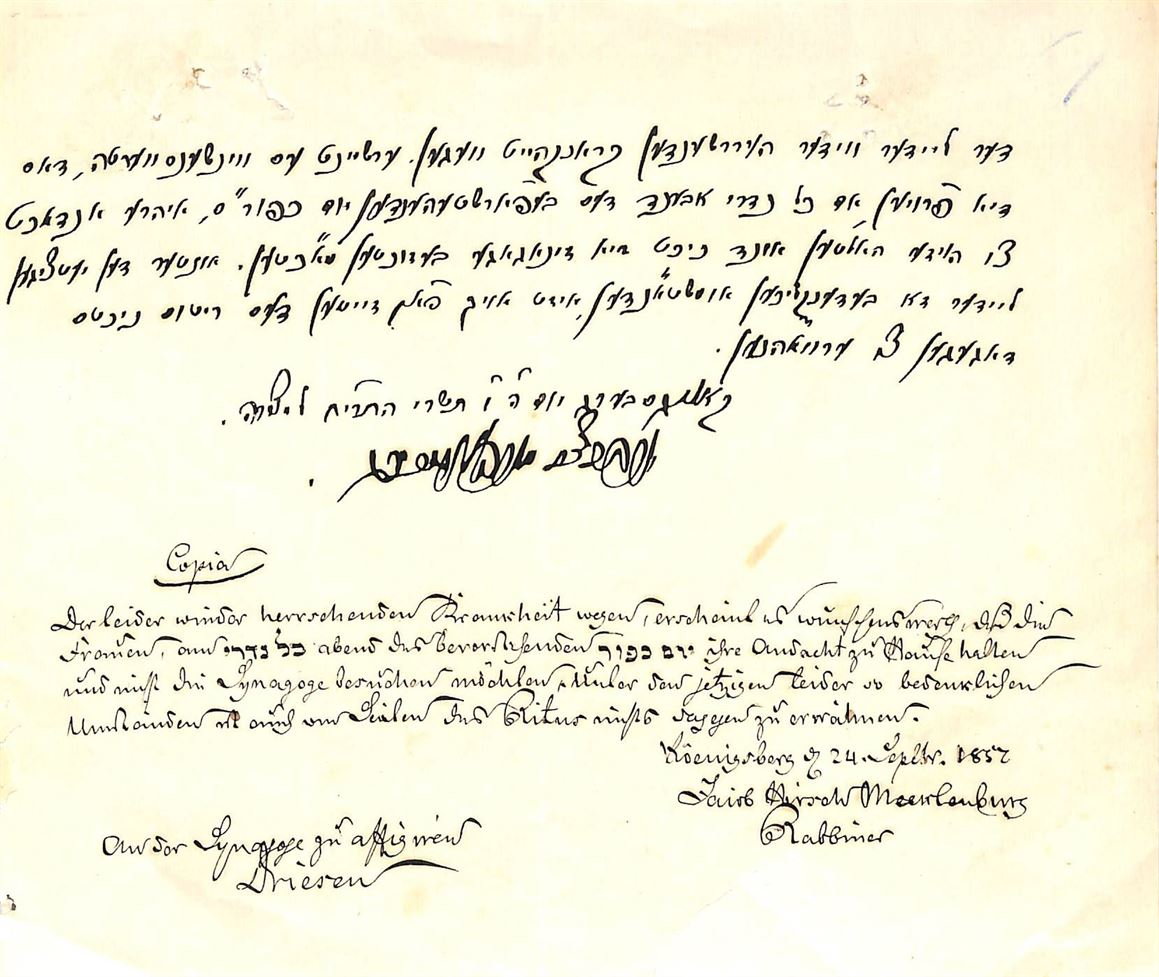
(1785-1865) Born in Posen, Poland. Died in Konigsberg.
Der leider wieder herrschenden Krankheit wegen erscheint es wünschenswert dass die Frauen am Kol Nidre abend zum bevorstehenden Yom Kippur ihre Andacht zu Hause halten und nicht die Synagoge besuchen moechten, unklar der jetzigen leider so bedenklichen Umstaenden ist auch von Seiten des Ritus nichts dagegen zu erwaehnen.
Because of the unfortunately prevailing illness, it seems desirable that the women on Kol Nidre evening for the upcoming Yom Kippur hold their prayer at home and do not visit the synagogue.

Yisrael ben Ze'ev Wolf Lipkin (1809-1883)
Born in Zagare, Lithuana. Died in Konigsberg.
Now that this disease is abroad in the land – Heaven deliver us, here also – this is the teaching for man, and the way of common sense: not to fear it at all, for what is man’s life in all its aspects, for who knows if one’s path is proper? One must also heed the instructions of the physicians, in light of whose words we shall walk, even by law [the Torah], and to establish the life of this world for good and for betterment. For experience has taught us that in days past, when the disease spread greatly, that whoever took upon himself the burden of the doctor’s orders in his diet, etc… was free of the signs of the disease – may Heaven protect us. And… one is not to worry and to complain about the precious soul which has been relieved of its suffering in this life of vanity, in order to go on the straightforward path to its haven.
It is my obligation to make it known for all generations this great matter—that for three successive years greater than 12,000 men and women who fasted [on Yom Kippur during the cholera epidemic] throughout our lands and no ill befell any of them—and this was known to virtually the entire world at the time.
I would like to tell you about an event that is told about R' Yisroel Salanter, that during a cholera epidemic he made kiddish on Yom Kippur in the Great Synagogue of Vilna. He did this to show the community that they should not fast, and he did this over the protests of the Dayanim [rabbinic judges] of Vilna. This famous story has entered Jewish literature, and is presented as a fact. But it is really only a legend. I once had a conversation with Rabbi Shimon Shtarshun of Vilna, who was an eyewitness in the Vilna Shul. He told me the story was as follows. On the eve of Yom Kippur, with the permission of the leading rabbis, Rabbi Salanter posted announcements in all the shuls that because of the cholera epidemic they would not say the additional parts of the prayers [piyutim], and that instead people should spend time outdoor breathing fresh air. In the courtyard of all the shuls they set up tables with pieces of cake that contained less than the prohibited amount of food that may be eaten. The food was there for those who needed to eat. Reb Yisroel [Salanter] got up on at Shacharit [the morning service] on Yom Kippur and announced that if a person felt weak there was no need to consult with a doctor, but instead they may go into the courtyard and eat. But it is preferable only to eat a small amount at a time and to pause between mouthfuls, so as not to violate the Biblical prohibition of eating on Yom Kippur. Reb Yisroel made the announcement and came down from the Bimah, but immediately Rabbi Bezael [HaCohen, a leading rabbi of the city] protested about what had been said that there was no need to consult a doctor. In reality Reb Yisroel tasted nothing.
לֵ֤ךְ עַמִּי֙ בֹּ֣א בַחֲדָרֶ֔יךָ וּֽסְגֹ֥ר דלתיך [דְּלָתְךָ֖] בַּעֲדֶ֑ךָ חֲבִ֥י כִמְעַט־רֶ֖גַע עַד־יעבור־[יַעֲבָר־] זָֽעַם׃
Go, my people, enter your chambers, And lock your doors behind you. Hide but a little moment, Until the indignation passes.
(1040-1105) Troyes, France
Go, my people, enter your chambers:... enter your houses of prayer and study. Another interpretation: reflect upon your behavior in the chambers of your heart. So explained Rabbi Tanchuma.
וסגור. דלתך בעדך ת"י עביד לך עובדין טבין דיגנון עלך ורבי תנחומא דרש סגור דלתי פיך שלא תהרהר אחר מדת הדין:
And lock your doors behind you: Targum Yonatan (explains): Do good deeds that will protect you. Rabbi Tanchuma taught: Close the doors of your mouth; do not question (G-d's) measure of justice.