


The Sequel to Chanukah "on one foot":
The story of Chanukah is fairly well-known. What comes afterwards bridges the gap between the Maccabees and (spoiler alert!) the Romans. The rulers are known as the Hasmonean dynasty because Josephus said that Mattathias was the son of Hasmon (War of the Jews 1:1:3).
The story of Chanukah is fairly well-known. What comes afterwards bridges the gap between the Maccabees and (spoiler alert!) the Romans. The rulers are known as the Hasmonean dynasty because Josephus said that Mattathias was the son of Hasmon (War of the Jews 1:1:3).
Here is the story of Chanukah itself: Chanukah: The Complicated Version | Sefaria
This brings us to everything after the death of Simon, the last of the Maccabean brothers, in 135 BCE.
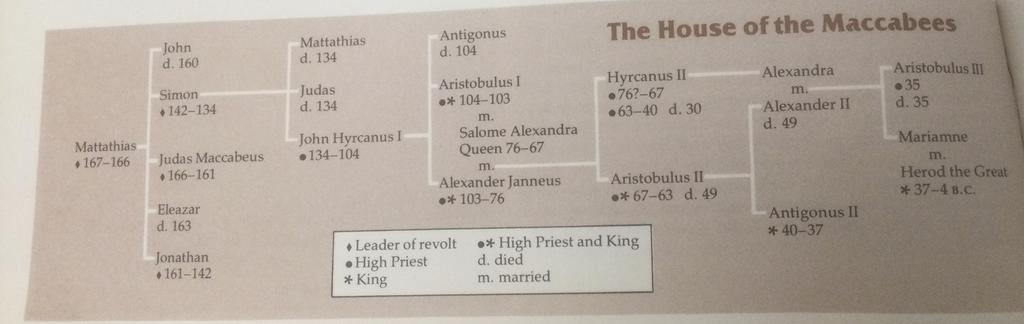
This family tree shows from the first to the last of the Maccabees / Hasmoneans. It is from Atlas of the Bible by John Gardner.
The Short Version
- John Hyrcanus I (135-104 BCE) enlarged the kingdom.
- His son Judah Aristobulus (104 BCE) took the title of King and died of sickness within a year.
- John's other son and Judah's brother Alexander Jannai (104-76 BCE) didn't like the Pharisees and killed 800 of them.
- Alexander's widow Salome Alexandra (76-67 BCE) liked the Pharisees.
- Alexander and Salome's sons Hyrcanus II and Aristobulus II had a civil war over who would be in charge, leading to the Romans taking over.
- His son Judah Aristobulus (104 BCE) took the title of King and died of sickness within a year.
- John's other son and Judah's brother Alexander Jannai (104-76 BCE) didn't like the Pharisees and killed 800 of them.
- Alexander's widow Salome Alexandra (76-67 BCE) liked the Pharisees.
- Alexander and Salome's sons Hyrcanus II and Aristobulus II had a civil war over who would be in charge, leading to the Romans taking over.
The Long Version
John Hyrcanus I (135-104 BCE)
- The Maccabean brothers, including the last one (Simon), were priests and they avoided taking on the title of "King", merely taking the role of "High Priest".
- Simon and two of his sons were killed by Simon’s son-in-law Abubus at a meal. This was at the order of Antiochus VII in 135 BCE.
- Simon's son John Hyrcanus I, who had been away at Gezer (west of Jerusalem) during the assassination, returned to Jerusalem where he was acknowledged as the next leader. Yet he also avoided the title of "King".
- He was besieged in Jerusalem by Antiochus VII for a year; while the city didn’t surrender thanks to Roman intervention, he had to pay tribute to the Seleucids for Jaffa and Gazara. It was the goal of the Romans to weaken their rivals, and at this point that meant the Seleucids.
- Antiochus VII also forced Hyrcanus to give up all port cities except for Jaffa. The goal was to cut off Judea from as much trade as possible without provoking a rebellion -— if Judea were prosperous, it wouldn’t want to pay tribute to Syria.
- As part of the deal with the Seleucids, John Hyrcanus raised a large army to aid Antiochus VII against the Parthians. He and his troops returned home before the winter and therefore were absent during the Parthian victory at Ecbatana, where Antiochus was killed.
- After Antiochus VII was killed in battle in 129 BCE, John Hyrcanus I renounced his allegiance to Syria and rebuilt the walls of Jerusalem that Antiochus had destroyed during the siege. He also renewed his treaty of friendship with Rome.
- He created a mint in Jerusalem, indicating political sovereignty. Coins didn't have human faces on them, because the 2nd commandment of the Ten Commandments said not to have graven images of G-d and humans were made in the image of G-d. Instead of faces, words were used to say who was the ruler. (https://www.youtube.com/watch?v=_qg3wgHg--E&t=1560s)
- John issued coins saying, “Yochanan the high priest and the congregation of the Jews”, suggesting that he governed with a council rather than as an autocrat. See here for an example of the first Jewish coins: https://www.kinzercoins.com/shop/p/first-jewish-coin-bronze-of-king-john-hyrcanus-i-135-bce-founder-of-the-hasmonean-dynasty-in-the-second-temple-period
- He took advantage of Seleucid military weakness and waged military campaigns in Samaria and Idumea / Edom, thus protecting the southern approaches that the Seleucids had used repeatedly for attacking Judea. The Ideumeans were converted to Judaism, including the ancestors of Herod the Great. By 125 BCE, all of Idumea and part of Samaria were annexed to Judea. Besides protecting the entrance to Judea, one of the trade routes between northeastern Asia and Egypt passed through Idumea. After the period of the Hasmoneans, the approach of forcibly converting people to Judaism was dropped.
- He worked to regain control of the port cities and commercial highways so that Judea wouldn’t sink into weakness and insignificance.
- Among his victories was establishing additional connections to the Mediterranean Sea at Jamnia and Azotus.
- John Hyrcanus I also successfully besieged Medeba, a city on the King’s Highway between the Red Sea and Damascus -— this provided economic advantages.
- Additionally, he got Pella, Dion, Gadera, and Hippos, all east of the Jordan River, to give tribute to Judea, though they didn’t have to convert.
- In 108 BCE, Hyrcanus finished annexing Samaria, taking Shechem and the city of Samaria, home of the Samaritans.
- He created an independent Jewish kingdom as large as that of David and Solomon.
- A number of groups of Judeans approved of John Hyrcanus's activities: 1. Men of wealth and aristocrats, who could take advantage of new commercial opportunities and would be most likely appointed to new political positions. 2. Men who weren't yet wealthy, but hoped to be some day. 3. People who liked their nation expanding for "national glory" reasons 4. People who worried that their neighbors would destroy them if they weren't conquered first.
- Others opposed John Hyrcanus's activities: 1. Ordinary people (shopkeepers, artisans, farmers, etc) who had to supply their sons for the fighting and their money for higher taxes to support the fighting. 2. Those who wanted to live in peace with their neighbors and focus on religious or everyday matters. 3. Those who were annoyed that the rich were getting richer while everybody else was not. Those opposed to the activities were represented in the royal council by the scribes.
- Eventually, those opposed became known as the Pharisees, while those in favor became known as the Sadducees. "Pharisee" is said to have come from "paros", meaning "separate", while "Sadducee" is said to come from "Zadok", the High Priest under King Solomon. The Sadducees weren't just the priests but also the aristocrats who thought they should be in charge just like in Rome and Syria.
- The Pharisees thought that religion had saved the Maccabees, while the Sadducees thought that national might had saved the Maccabees. The Pharisees thought that the nation was a way of saving their religion, while the Sadducees thought that religion was a way of uniting their nation.
- The Sadducees thought that the Torah should be strictly interpreted -- absolute adherence, but no more than what it said (think "Originalist" interpretation of the US Constitution). The Pharisees thought that the Torah gave principles that could then be extended into every aspect of life.
- The beginnings of the division between the Sadducees and the Pharisees happened toward the end of John Hyrcanus's reign. Hyrcanus himself was well-liked by everybody and the division wasn't to serious a split while he was alive. He was brought up during the Maccabean struggles for independence and the Pharisees had no objections with his personal actions.
- His sons, however, grew up in a palace only knowing independence, wealth, and victory, and being trained for military expansion. They thought that the Pharisee approach was to be stamped out, and the Pharisees regarded them with fear and dislike.
- In his will, John Hyracanus I tried to patch things up between the Pharisees and Sadducees by removing secular power from the High Priest -— he made his oldest son, Aristobulus, the High Priest, and had Hyrcanus’s wife be the ruler in charge of the state.
- Simon and two of his sons were killed by Simon’s son-in-law Abubus at a meal. This was at the order of Antiochus VII in 135 BCE.
- Simon's son John Hyrcanus I, who had been away at Gezer (west of Jerusalem) during the assassination, returned to Jerusalem where he was acknowledged as the next leader. Yet he also avoided the title of "King".
- He was besieged in Jerusalem by Antiochus VII for a year; while the city didn’t surrender thanks to Roman intervention, he had to pay tribute to the Seleucids for Jaffa and Gazara. It was the goal of the Romans to weaken their rivals, and at this point that meant the Seleucids.
- Antiochus VII also forced Hyrcanus to give up all port cities except for Jaffa. The goal was to cut off Judea from as much trade as possible without provoking a rebellion -— if Judea were prosperous, it wouldn’t want to pay tribute to Syria.
- As part of the deal with the Seleucids, John Hyrcanus raised a large army to aid Antiochus VII against the Parthians. He and his troops returned home before the winter and therefore were absent during the Parthian victory at Ecbatana, where Antiochus was killed.
- After Antiochus VII was killed in battle in 129 BCE, John Hyrcanus I renounced his allegiance to Syria and rebuilt the walls of Jerusalem that Antiochus had destroyed during the siege. He also renewed his treaty of friendship with Rome.
- He created a mint in Jerusalem, indicating political sovereignty. Coins didn't have human faces on them, because the 2nd commandment of the Ten Commandments said not to have graven images of G-d and humans were made in the image of G-d. Instead of faces, words were used to say who was the ruler. (https://www.youtube.com/watch?v=_qg3wgHg--E&t=1560s)
- John issued coins saying, “Yochanan the high priest and the congregation of the Jews”, suggesting that he governed with a council rather than as an autocrat. See here for an example of the first Jewish coins: https://www.kinzercoins.com/shop/p/first-jewish-coin-bronze-of-king-john-hyrcanus-i-135-bce-founder-of-the-hasmonean-dynasty-in-the-second-temple-period
- He took advantage of Seleucid military weakness and waged military campaigns in Samaria and Idumea / Edom, thus protecting the southern approaches that the Seleucids had used repeatedly for attacking Judea. The Ideumeans were converted to Judaism, including the ancestors of Herod the Great. By 125 BCE, all of Idumea and part of Samaria were annexed to Judea. Besides protecting the entrance to Judea, one of the trade routes between northeastern Asia and Egypt passed through Idumea. After the period of the Hasmoneans, the approach of forcibly converting people to Judaism was dropped.
- He worked to regain control of the port cities and commercial highways so that Judea wouldn’t sink into weakness and insignificance.
- Among his victories was establishing additional connections to the Mediterranean Sea at Jamnia and Azotus.
- John Hyrcanus I also successfully besieged Medeba, a city on the King’s Highway between the Red Sea and Damascus -— this provided economic advantages.
- Additionally, he got Pella, Dion, Gadera, and Hippos, all east of the Jordan River, to give tribute to Judea, though they didn’t have to convert.
- In 108 BCE, Hyrcanus finished annexing Samaria, taking Shechem and the city of Samaria, home of the Samaritans.
- He created an independent Jewish kingdom as large as that of David and Solomon.
- A number of groups of Judeans approved of John Hyrcanus's activities: 1. Men of wealth and aristocrats, who could take advantage of new commercial opportunities and would be most likely appointed to new political positions. 2. Men who weren't yet wealthy, but hoped to be some day. 3. People who liked their nation expanding for "national glory" reasons 4. People who worried that their neighbors would destroy them if they weren't conquered first.
- Others opposed John Hyrcanus's activities: 1. Ordinary people (shopkeepers, artisans, farmers, etc) who had to supply their sons for the fighting and their money for higher taxes to support the fighting. 2. Those who wanted to live in peace with their neighbors and focus on religious or everyday matters. 3. Those who were annoyed that the rich were getting richer while everybody else was not. Those opposed to the activities were represented in the royal council by the scribes.
- Eventually, those opposed became known as the Pharisees, while those in favor became known as the Sadducees. "Pharisee" is said to have come from "paros", meaning "separate", while "Sadducee" is said to come from "Zadok", the High Priest under King Solomon. The Sadducees weren't just the priests but also the aristocrats who thought they should be in charge just like in Rome and Syria.
- The Pharisees thought that religion had saved the Maccabees, while the Sadducees thought that national might had saved the Maccabees. The Pharisees thought that the nation was a way of saving their religion, while the Sadducees thought that religion was a way of uniting their nation.
- The Sadducees thought that the Torah should be strictly interpreted -- absolute adherence, but no more than what it said (think "Originalist" interpretation of the US Constitution). The Pharisees thought that the Torah gave principles that could then be extended into every aspect of life.
- The beginnings of the division between the Sadducees and the Pharisees happened toward the end of John Hyrcanus's reign. Hyrcanus himself was well-liked by everybody and the division wasn't to serious a split while he was alive. He was brought up during the Maccabean struggles for independence and the Pharisees had no objections with his personal actions.
- His sons, however, grew up in a palace only knowing independence, wealth, and victory, and being trained for military expansion. They thought that the Pharisee approach was to be stamped out, and the Pharisees regarded them with fear and dislike.
- In his will, John Hyracanus I tried to patch things up between the Pharisees and Sadducees by removing secular power from the High Priest -— he made his oldest son, Aristobulus, the High Priest, and had Hyrcanus’s wife be the ruler in charge of the state.
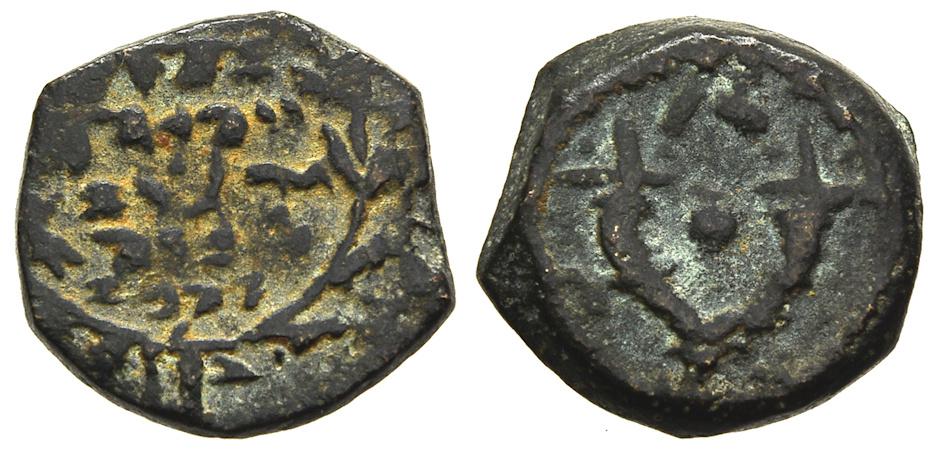
This is a bronze prutah that says “Yochanan the High Priest and the Council of the Jews” (in Paleo-Hebrew) surrounded by an olive branch. On the back side are 2 cornucopias adorned with ribbons with a pomegranate between them. This dates to the 129-104 BCE period. Other coins of his had a palm branch (lulav). A prutah was worth 2 lepta, and a loaf of bread was 10 prutahs (https://learn.apmex.com/answers/what-was-a-judean-prutah/). There were also shekels and half-shekels during this time.: https://www.wildwinds.com/coins/greece/judaea/john_hyrcanus_I/t.html and https://www.forumancientcoins.com/catalog/roman-and-greek-coins.asp?vpar=922 and https://www.cngcoins.com/Coin.aspx?CoinID=56001 (and https://uasvbible.org/2025/10/31/the-hasmonean-coins-c-160-142-b-c-e/, which has a Christian perspective but still useful things about Hasmonean coins).
Judah Aristobulus (104 BCE)
- After John Hyrcanus I died, his son Judah Aristobulus became the High Priest.
- He promptly put his mother in prison, where she starved to death, making him the leader of the state.
- Even though he had the Hebrew name "Judah", he preferred to go by "Aristobulus", showing his preference for Greek ways of running a country.
- Aristobulus was the first to take on the title of King since the Babylonian Exile in 586 BCE. The Pharisees objected because he wasn’t a descendent of King David, but he didn’t care that much, only making sure not to take the Hebrew term "Melech" and to only have Hebrew inscriptions on his coins. They also thought that the High Priest shouldn’t consolidate secular power as well.sz
- According to Josephus, he had most of his brothers imprisoned and his wife conspired with "evil men" to get Aristobulus' favored brother Antigonus killed (War of the Jews 1:3:1-6). While this thing was regular fare for neighboring empires, it was shocking and disgusting to the Jews.
- Aristobulus conquered the Galilee and Judaicized the region. It had been Jewish until the Assyrians removed the Israelites in 722 BCE and brought in other settlers. The area remained pagan until 104 BCE (https://en.wikipedia.org/wiki/Galilee#Hellenistic_period).
- He was sickly when his father died, and after much drinking he died within a year. By this point, all of the mountain and hill country west of the Jordan River was in Jewish hands.
- After John Hyrcanus I died, his son Judah Aristobulus became the High Priest.
- He promptly put his mother in prison, where she starved to death, making him the leader of the state.
- Even though he had the Hebrew name "Judah", he preferred to go by "Aristobulus", showing his preference for Greek ways of running a country.
- Aristobulus was the first to take on the title of King since the Babylonian Exile in 586 BCE. The Pharisees objected because he wasn’t a descendent of King David, but he didn’t care that much, only making sure not to take the Hebrew term "Melech" and to only have Hebrew inscriptions on his coins. They also thought that the High Priest shouldn’t consolidate secular power as well.sz
- According to Josephus, he had most of his brothers imprisoned and his wife conspired with "evil men" to get Aristobulus' favored brother Antigonus killed (War of the Jews 1:3:1-6). While this thing was regular fare for neighboring empires, it was shocking and disgusting to the Jews.
- Aristobulus conquered the Galilee and Judaicized the region. It had been Jewish until the Assyrians removed the Israelites in 722 BCE and brought in other settlers. The area remained pagan until 104 BCE (https://en.wikipedia.org/wiki/Galilee#Hellenistic_period).
- He was sickly when his father died, and after much drinking he died within a year. By this point, all of the mountain and hill country west of the Jordan River was in Jewish hands.
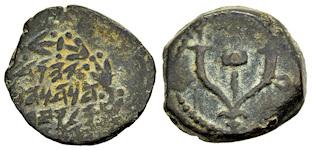
Similar coins to that of his father, except instead of saying “Yochanan the High Priest” it says “Yehudah the High Priest and the Council of the Jews”. This dates to 104 BCE. There are 2 different styles of coins from his time, indicating that there might have been a change in the technology or people at the mint in the middle of 104 BCE. See https://www.forumancientcoins.com/catalog/roman-and-greek-coins.asp?vpar=1062 and https://en.numista.com/94008 and https://www.youtube.com/watch?v=_qg3wgHg--E&t=1560s.
Alexander Jannai (104-76 BCE)
- He was the brother of Judah Aristobulus and the son of John Hyrcanus I. He married his brother’s widow, Salome Alexandra.
- Alexander Jannai also called himself a king and minted coins that said "Alexander the King" in Greek on one side and "Yonatan ha-Melech" (same thing) in Hebrew on the other side. A set of these were found in 2024 during Chanukah: https://www.timesofisrael.com/miracle-hoard-of-hasmonean-coins-discovered-during-hanukkah-in-jordan-valley-dig/
- Some coins show disapproval of this -- they say "Yonatan Cohen Gadol" ("Jonathan the High Priest") but somebody has tried to rub off the Hebrew inscription of "Jonathan the King". These were made by rogue employees of the Jerusalem Mint.
- Jannai tried to besiege Ptolemais (modern Akko / Acre), but Ptolemy IX Lathyrus, who had been kicked out of Egypt by his mother Cleopatra, came from Cyprus and attacked him. Ptolemy then rampaged down the coast, but when he got to Egypt his mother attacked him by land and sea. Next Cleopatra made an alliance with Alexander and nullified all of Ptolemy’s conquests. She then went back to Egypt. Alexander stayed on good terms with Cleopatra, both because of her own armies and because she could summon the Romans if she felt threatened.
- After some fighting east of the Jordan River, Alexander returned to the coast and by 96 BCE it was in Jewish hands from Mt. Carmel (south of Ptolemais / Akko / Acre) to the border with Egypt.
- Next, Alexander Jannai turned his attention to the area around the Dead Sea, then called Lake Asphaltitis, and secured the entire area around it. This included Zo’ar, where Lot and his daughters fled after the destruction of Sodom and Gomorrah.
- It is during this time that the divisions of Sadducees and Pharisees truly developed. At this point, Sadducees were more of the aristocratic class -- they only followed the Written Torah, and were primarily connected with the Second Temple (thus disappearing with the destruction of the Temple by the Romans in 70 CE). Pharisees were more of the common class -- they developed the Oral Torah as they sought to apply the Written Torah to their contemporary lives, and they became the Rabbis who reinvented Judaism after the destruction of the Temple by the Romans in 70 CE. For more on this division, see https://www.jewishvirtuallibrary.org/pharisees-sadducees-and-essenes.
- The Pharisees were upset with Alexander / Jonathan / Jannai / Janneus for taking on the title of "King", taking on Hellenistic trappings, and abandoning his religious responsibilities.
- In 93 BCE, after a defeat by the Nabateans at Gadara, Alexander Jannai returned to Jerusalem to officiate the Temple ritual for Sukkot. He chose to pour the water libation on his feet instead of on the alter (perhaps because the Sadducee priests he was allied with didn't support this non-Biblical custom that the Pharisee priests had) and since his army was significantly reduced the people pelted him with etrogs (Sukkah 48b:2). Alexander Jannai then had his mercenaries kill hundreds of defenseless Jews at the Temple. The Pharisees asked the Seleucid King Demetrius III Eukairos of Syria to attack. The Seleucids won at Shechem, killing Alexander's mercenaries and forcing Alexander to seek refuge in the mountains. Then many of the Jews switched sides to Alexander because they felt bad for him, so the Seleucids went home.
- Alexander Jannai then ordered 800 Pharisees to be crucified in the middle of Jerusalem, the first time that this form of execution was used by Jews. First, though, he had their wives and children killed in front of them, and he watched this while drinking and lying with his concubines (Josephus, War of the Jews, 1:4:6).
- The remaining Pharisees fled to Egypt, including Judah ben Tabai and Shimon ben Shetach, the queen's brother.
- Once this was settled in 84 BCE, Alexander Jannai turned his attention to the Sea of Galilee and secured the area around it, protecting its fishing industry.
- His kingdom had 5 internal divisions ruled by civil governors: Judea, Idumea, Samaria, Galilee, and Perea (that one was north of the Dead Sea and east of the Jordan River).
- There were also military fortresses, such as Masada, Machaerus (guarding the southeastern border), Hyrcania (in the Wilderness of Judea), and Alexandrium (controlling traffic in the Jordan valley). In part this was because the Nabateans continued to raid and threaten Judea.
- Alexander Jannai died in 76 BCE due to heavy drinking. On his deathbed he urged his wife to make peace with the Pharisees and turn over much of the kingdom’s internal affairs to them.
- He was the brother of Judah Aristobulus and the son of John Hyrcanus I. He married his brother’s widow, Salome Alexandra.
- Alexander Jannai also called himself a king and minted coins that said "Alexander the King" in Greek on one side and "Yonatan ha-Melech" (same thing) in Hebrew on the other side. A set of these were found in 2024 during Chanukah: https://www.timesofisrael.com/miracle-hoard-of-hasmonean-coins-discovered-during-hanukkah-in-jordan-valley-dig/
- Some coins show disapproval of this -- they say "Yonatan Cohen Gadol" ("Jonathan the High Priest") but somebody has tried to rub off the Hebrew inscription of "Jonathan the King". These were made by rogue employees of the Jerusalem Mint.
- Jannai tried to besiege Ptolemais (modern Akko / Acre), but Ptolemy IX Lathyrus, who had been kicked out of Egypt by his mother Cleopatra, came from Cyprus and attacked him. Ptolemy then rampaged down the coast, but when he got to Egypt his mother attacked him by land and sea. Next Cleopatra made an alliance with Alexander and nullified all of Ptolemy’s conquests. She then went back to Egypt. Alexander stayed on good terms with Cleopatra, both because of her own armies and because she could summon the Romans if she felt threatened.
- After some fighting east of the Jordan River, Alexander returned to the coast and by 96 BCE it was in Jewish hands from Mt. Carmel (south of Ptolemais / Akko / Acre) to the border with Egypt.
- Next, Alexander Jannai turned his attention to the area around the Dead Sea, then called Lake Asphaltitis, and secured the entire area around it. This included Zo’ar, where Lot and his daughters fled after the destruction of Sodom and Gomorrah.
- It is during this time that the divisions of Sadducees and Pharisees truly developed. At this point, Sadducees were more of the aristocratic class -- they only followed the Written Torah, and were primarily connected with the Second Temple (thus disappearing with the destruction of the Temple by the Romans in 70 CE). Pharisees were more of the common class -- they developed the Oral Torah as they sought to apply the Written Torah to their contemporary lives, and they became the Rabbis who reinvented Judaism after the destruction of the Temple by the Romans in 70 CE. For more on this division, see https://www.jewishvirtuallibrary.org/pharisees-sadducees-and-essenes.
- The Pharisees were upset with Alexander / Jonathan / Jannai / Janneus for taking on the title of "King", taking on Hellenistic trappings, and abandoning his religious responsibilities.
- In 93 BCE, after a defeat by the Nabateans at Gadara, Alexander Jannai returned to Jerusalem to officiate the Temple ritual for Sukkot. He chose to pour the water libation on his feet instead of on the alter (perhaps because the Sadducee priests he was allied with didn't support this non-Biblical custom that the Pharisee priests had) and since his army was significantly reduced the people pelted him with etrogs (Sukkah 48b:2). Alexander Jannai then had his mercenaries kill hundreds of defenseless Jews at the Temple. The Pharisees asked the Seleucid King Demetrius III Eukairos of Syria to attack. The Seleucids won at Shechem, killing Alexander's mercenaries and forcing Alexander to seek refuge in the mountains. Then many of the Jews switched sides to Alexander because they felt bad for him, so the Seleucids went home.
- Alexander Jannai then ordered 800 Pharisees to be crucified in the middle of Jerusalem, the first time that this form of execution was used by Jews. First, though, he had their wives and children killed in front of them, and he watched this while drinking and lying with his concubines (Josephus, War of the Jews, 1:4:6).
- The remaining Pharisees fled to Egypt, including Judah ben Tabai and Shimon ben Shetach, the queen's brother.
- Once this was settled in 84 BCE, Alexander Jannai turned his attention to the Sea of Galilee and secured the area around it, protecting its fishing industry.
- His kingdom had 5 internal divisions ruled by civil governors: Judea, Idumea, Samaria, Galilee, and Perea (that one was north of the Dead Sea and east of the Jordan River).
- There were also military fortresses, such as Masada, Machaerus (guarding the southeastern border), Hyrcania (in the Wilderness of Judea), and Alexandrium (controlling traffic in the Jordan valley). In part this was because the Nabateans continued to raid and threaten Judea.
- Alexander Jannai died in 76 BCE due to heavy drinking. On his deathbed he urged his wife to make peace with the Pharisees and turn over much of the kingdom’s internal affairs to them.
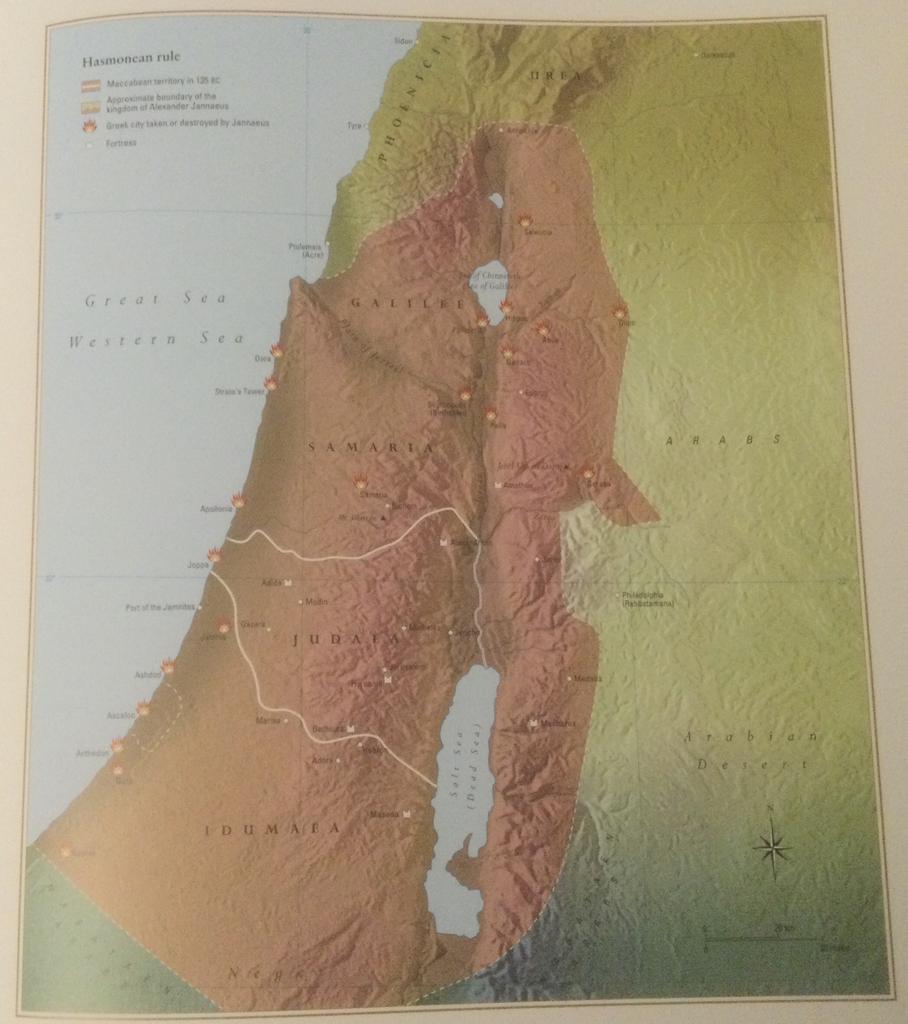
A map showing the expansion of the kingdom from 135 BCE (when Simon died) to 76 BCE (after John Hyrcanus I, Aristobulus I, and Alexander Jannai). This is from The Historical Atlas of the Bible, by Dr. Ian Barnes.
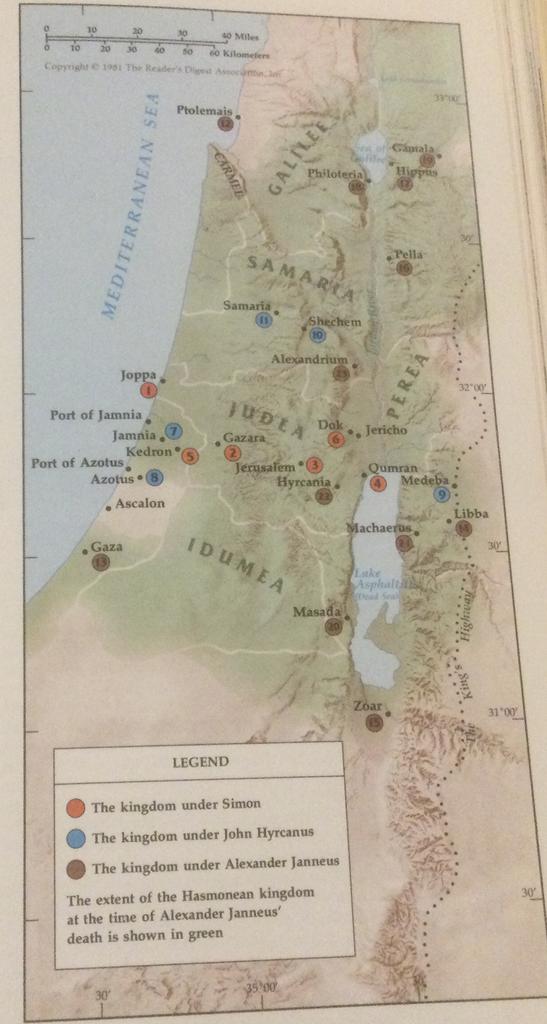
Map of the expansion of the Hasmonean kingdom, from Atlas of the Bible by John Gardner.
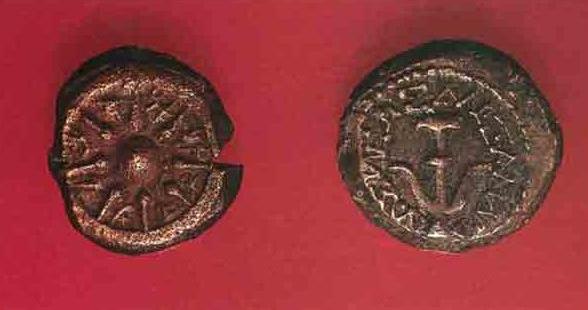
Coins of Alexander Jannai. They say “King Alexander” in Hebrew on one side and Greek on the other. Other coins from his reign follow the example of the previous “High Priest” rulers and may have resulted from people at the Jerusalem mint disobeying orders. The majority of the Hasmonean coins are from Alexander Jannai’s time, and the biggest find was at Gamla. He minted prutahs. https://www.ins.org.il/files/files/alexander%20jannaeus%20coins.pdf And https://cojs.org/coin_of_alexander_jannaeus-_103-76_bce/ and https://en-academic.com/dic.nsf/enwiki/11559252 and https://www.forumancientcoins.com/catalog/roman-and-greek-coins.asp?vpar=923&pos=0#Hasmonean-Dynasty and
Salome Alexandra (76-67 BCE)
- When Alexander Jannai died, his wife Salome Alexandra ("Shalom Tziyon" in Hebrew), who was in her 60s at the time, became the next ruler.
- The Pharisees regained royal favor and returned from exile.
- Since the queen could not preside over the Sanhedrin, she appointed her brother, Shimon ben Shetach, to do so.
- Shimon ben Shetach instituted a School Law that every village, town, and city have the equivalent of an elementary school.
- Salome appointed her pro-Pharisee son, Hyrcanus II, as high priest.
- There were no territorial changes -— the Seleucids (in Syria) and Ptolemies (in Egypt) were weak and she lived at peace with her neighbors.
- Salome had much popular support because of her support of the Pharisees. For instance, she filled vacancies on the Sanhedrin with Pharisees instead of Sadducees.
- Judea thrived and exported wheat, olive oil, balsam, figs, and wine.
- There were no coins issued in her name, but there might have been some only inscribed with “Council of the Jews” or with her as the regent for her son Hyrcanus II. (https://www.forumancientcoins.com/catalog/roman-and-greek-coins.asp?vpar=2021)
- Recognizing that a strong military can deter attacks, Salome Alexandra increased the mercenary force but staffed it with Jewish officers to ensure loyalty.
- However, many of these officers wanted expansionist policies that would mean more for them to do. They had Sadducee leanings and thought that it was best to support Alexandra’s second son, Aristobulus II, instead of her first son, Hyrcanus II (who was supported by the Pharisees).
- Aristobulus II asked his mother for command of the fortresses since his brother was High Priest. She gave it to him, not realizing that he was planning a rebellion against his brother.
- When she became ill, Aristobulus II put his plan into action, supported by the army officers, and soon had 22 Judean fortresses on his side even though his brother was the designated heir.
- In recognition of her accomplishments, there is a "Queen Shlomziyon Street" in Jerusalem near where Jaffa Street meets the New Gate.
- There is also more information about her here: https://etc.worldhistory.org/interviews/the-forgotten-ancient-queen-salome-alexandra-of-judea/ and https://bibleinterp.arizona.edu/articles/atk368018
- When Alexander Jannai died, his wife Salome Alexandra ("Shalom Tziyon" in Hebrew), who was in her 60s at the time, became the next ruler.
- The Pharisees regained royal favor and returned from exile.
- Since the queen could not preside over the Sanhedrin, she appointed her brother, Shimon ben Shetach, to do so.
- Shimon ben Shetach instituted a School Law that every village, town, and city have the equivalent of an elementary school.
- Salome appointed her pro-Pharisee son, Hyrcanus II, as high priest.
- There were no territorial changes -— the Seleucids (in Syria) and Ptolemies (in Egypt) were weak and she lived at peace with her neighbors.
- Salome had much popular support because of her support of the Pharisees. For instance, she filled vacancies on the Sanhedrin with Pharisees instead of Sadducees.
- Judea thrived and exported wheat, olive oil, balsam, figs, and wine.
- There were no coins issued in her name, but there might have been some only inscribed with “Council of the Jews” or with her as the regent for her son Hyrcanus II. (https://www.forumancientcoins.com/catalog/roman-and-greek-coins.asp?vpar=2021)
- Recognizing that a strong military can deter attacks, Salome Alexandra increased the mercenary force but staffed it with Jewish officers to ensure loyalty.
- However, many of these officers wanted expansionist policies that would mean more for them to do. They had Sadducee leanings and thought that it was best to support Alexandra’s second son, Aristobulus II, instead of her first son, Hyrcanus II (who was supported by the Pharisees).
- Aristobulus II asked his mother for command of the fortresses since his brother was High Priest. She gave it to him, not realizing that he was planning a rebellion against his brother.
- When she became ill, Aristobulus II put his plan into action, supported by the army officers, and soon had 22 Judean fortresses on his side even though his brother was the designated heir.
- In recognition of her accomplishments, there is a "Queen Shlomziyon Street" in Jerusalem near where Jaffa Street meets the New Gate.
- There is also more information about her here: https://etc.worldhistory.org/interviews/the-forgotten-ancient-queen-salome-alexandra-of-judea/ and https://bibleinterp.arizona.edu/articles/atk368018
Hasmonean Civil War (67 BCE)
- When Salome Alexander died in 67 BCE, her hot-headed and pro-Sadducee son, Aristobulus II, declared war on his brother.
- Aristobulus II beat Hyrcanus II at Jericho and chased him back to Jerusalem. There, Hyrcanus surrendered the throne and the High Priesthood to Aristobulus and just asked to be left alone.
- As a sign of the peace between the brothers, Hyrcanus II's daughter Alexandra married Antigonus II's son Alexander. Their children were Mariamne and Antigonus III.
- At this point, Hyrcanus’s Idumean (or Edomite) advisor Antipater intervened (had he not, things would have turned out massively different). Antipater was the son of the governor Alexander Jannai put in place in Idumea. Antipater convinced many leading Jews that Aristobulus had no right to the throne and in 65 BCE got Hyrcanus (and himself) a safe spot in Petra. Petra was the capital of the Nabatean king Aretas. The Nabateans wanted to expand their power to the northwest so they could get control of trade routes through there.
- Hyrcanus promised Aretas 12 cities to the south and east of the Dead Sea in return for an army to fight Aristobulus. With this army, Hyrcanus cornered Aristobulus in the fortified Temple Mount, which was not easy to attack. Aristobulus’s mercenaries and the general population switched sides to Hyrcanus, leaving only the priestly Sadducees as loyal to Aristobulus.
- At this point, there were three centers of power -— Aristobulus and the Sadducees on the Temple Mount, Hyrcanus and the Nabateans outside the walls, and the Pharisees who wanted to get rid of both Hasmoneans.
- Meanwhile, in 64 BCE the Roman general Pompey conquered Syria, trying to equal Julius Caesar's record of conquest so the people would support him taking over Rome.
- His general Aemilius Marcus Scaurus stayed in Damascus, where he heard of unrest in Judea.
- At that point, Aristobulus II was on the Temple Mount, besieged by his brother.
- Scaurus moved his troops south and alerted Pompey that Judea was not united and could be conquered.
- Delegations from both brothers came to Scaurus and asked for his support. Scaurus decided to support Aristobulus. He ordered the Nabateans to lift their siege or face the wrath of the Romans. The Nabateans did, Aristobulus led his forces off the Temple Mount, and then he attacked and defeated the Nabateans at Papyron near the mouth of the Jordan River.
- Aristobulus sent Pompey a golden vine worth half a million dollars (eventually placed in the temple of Jupiter Capitolinus in Rome so Romans would like Pompey) to get his favor, but Antipater came forward on behalf of Hyrcanus, offering eventual Roman control of Judea and another conquest for Pompey. Pompey ordered both brothers to come to him in Damascus.
- Another delegation of Pharisees (not the ones supporting Hyrancus) also showed up in Damascus, asking the Romans to do away with the kings altogether and just let the priests be in charge like in the time from Ezra through the Maccabees. Pompey decided to delay his decision until he conquered the Nabateans.
- In 63 BCE, while the Romans were at Petra, Aristobulus left for the fortress of Alexandrium. Pompey worried that this meant a rebellion against the Romans, so he gave up on the Nabateans and chased Aristobulus. (Scaurus tried again against the Nabateans in 62 BCE, but ran out of supplies and had to lift the siege -— Hyrcanus II was sent as an intermediary to help establish the peace where the Nabateans kept everything but became a vassal state.)
- After negotiations, Aristobulus left Alexandrium and headed to Jerusalem, followed by Pompey and the army. On the way, Aristobulus surrendered at Jericho, but Aristobulus’s supporters in Jerusalem barred the city gates anyway, probably because of the threat to the Temple.
- Hyrcanus II heeded the advice of Antipater and surrendered, opening the city gates to the Romans.
- The Romans took three months to fight their way to the Temple Mount and then killed all of Aristobulus's supporters (along with the priests offering the daily sacrifices) in 63 BCE.
- Reportedly, Pompey looked in the Holy of Holies and was puzzled that it was just a small empty room. Violating the Holy of Holies was something not even the Seleucids ever did.
- When Salome Alexander died in 67 BCE, her hot-headed and pro-Sadducee son, Aristobulus II, declared war on his brother.
- Aristobulus II beat Hyrcanus II at Jericho and chased him back to Jerusalem. There, Hyrcanus surrendered the throne and the High Priesthood to Aristobulus and just asked to be left alone.
- As a sign of the peace between the brothers, Hyrcanus II's daughter Alexandra married Antigonus II's son Alexander. Their children were Mariamne and Antigonus III.
- At this point, Hyrcanus’s Idumean (or Edomite) advisor Antipater intervened (had he not, things would have turned out massively different). Antipater was the son of the governor Alexander Jannai put in place in Idumea. Antipater convinced many leading Jews that Aristobulus had no right to the throne and in 65 BCE got Hyrcanus (and himself) a safe spot in Petra. Petra was the capital of the Nabatean king Aretas. The Nabateans wanted to expand their power to the northwest so they could get control of trade routes through there.
- Hyrcanus promised Aretas 12 cities to the south and east of the Dead Sea in return for an army to fight Aristobulus. With this army, Hyrcanus cornered Aristobulus in the fortified Temple Mount, which was not easy to attack. Aristobulus’s mercenaries and the general population switched sides to Hyrcanus, leaving only the priestly Sadducees as loyal to Aristobulus.
- At this point, there were three centers of power -— Aristobulus and the Sadducees on the Temple Mount, Hyrcanus and the Nabateans outside the walls, and the Pharisees who wanted to get rid of both Hasmoneans.
- Meanwhile, in 64 BCE the Roman general Pompey conquered Syria, trying to equal Julius Caesar's record of conquest so the people would support him taking over Rome.
- His general Aemilius Marcus Scaurus stayed in Damascus, where he heard of unrest in Judea.
- At that point, Aristobulus II was on the Temple Mount, besieged by his brother.
- Scaurus moved his troops south and alerted Pompey that Judea was not united and could be conquered.
- Delegations from both brothers came to Scaurus and asked for his support. Scaurus decided to support Aristobulus. He ordered the Nabateans to lift their siege or face the wrath of the Romans. The Nabateans did, Aristobulus led his forces off the Temple Mount, and then he attacked and defeated the Nabateans at Papyron near the mouth of the Jordan River.
- Aristobulus sent Pompey a golden vine worth half a million dollars (eventually placed in the temple of Jupiter Capitolinus in Rome so Romans would like Pompey) to get his favor, but Antipater came forward on behalf of Hyrcanus, offering eventual Roman control of Judea and another conquest for Pompey. Pompey ordered both brothers to come to him in Damascus.
- Another delegation of Pharisees (not the ones supporting Hyrancus) also showed up in Damascus, asking the Romans to do away with the kings altogether and just let the priests be in charge like in the time from Ezra through the Maccabees. Pompey decided to delay his decision until he conquered the Nabateans.
- In 63 BCE, while the Romans were at Petra, Aristobulus left for the fortress of Alexandrium. Pompey worried that this meant a rebellion against the Romans, so he gave up on the Nabateans and chased Aristobulus. (Scaurus tried again against the Nabateans in 62 BCE, but ran out of supplies and had to lift the siege -— Hyrcanus II was sent as an intermediary to help establish the peace where the Nabateans kept everything but became a vassal state.)
- After negotiations, Aristobulus left Alexandrium and headed to Jerusalem, followed by Pompey and the army. On the way, Aristobulus surrendered at Jericho, but Aristobulus’s supporters in Jerusalem barred the city gates anyway, probably because of the threat to the Temple.
- Hyrcanus II heeded the advice of Antipater and surrendered, opening the city gates to the Romans.
- The Romans took three months to fight their way to the Temple Mount and then killed all of Aristobulus's supporters (along with the priests offering the daily sacrifices) in 63 BCE.
- Reportedly, Pompey looked in the Holy of Holies and was puzzled that it was just a small empty room. Violating the Holy of Holies was something not even the Seleucids ever did.
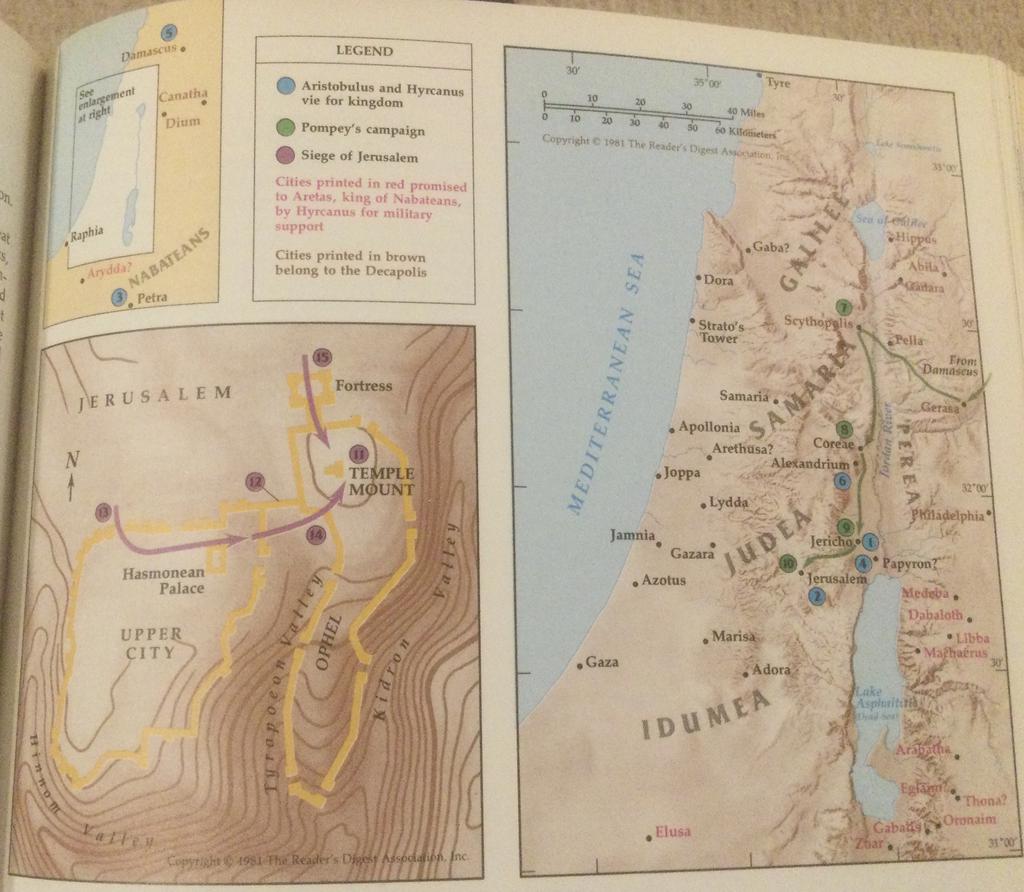
From Atlas of the Bible by John Gardner.
- Pompey reinstated Hyrcanus II as High Priest and a puppet king, under the supervision of Scaurus and the occupying Roman troops. Aristobulus was considered to care too much about an independent Judea.
- Pompey undid all of the territorial gains of John Hyrcanus I and Alexander Jannai so that Hyrcanus II would be very little of a threat. Judea was now absorbed into the Roman province of Syria.
- Aristobulus and his 2 sons were taken as prisoners to Rome (again to impress the Roman population), but managed to escape en route.
- In 60 BCE, the First Triumvirate was formed in Rome between Pompey, Crassus, and Julius Caesar.
- In 57 BCE Aristobulus and his sons set off a new uprising around Jerusalem.
- Antipater and the Roman troops (including Mark Antony's first military command) crushed the uprising, putting Hyrcanus II back on the throne and imprisoning Antigonus II. However, the Roman governor in Syria, Gabinius, reorganized Judea into 5 districts to try to disunity the people, and took away Hyrcanus’s political power.
- In 56 BCE, Aristobulus escaped from Rome and raised more troops (both Pharisees and Sadducees resented the Romans), but again had to surrender to Roman forces.
- In 55 BCE, Crassus came to Syria to get rich and acquire glory fighting the Parthians. He robbed the Temple in Jerusalem of the sacred golden vessels and 2,000 talents (worth $54,456,000, per https://catholicbiblestudent.com/2022/01/two-ways-to-calculate-the-value-of-a-talent.html), but Antipater and Hyrcanus prevented the Jews from rebelling against the Romans. Then Crassus died fighting the Parthians.
- In the Roman civil war between Julius Caesar and Pompey, Antipater backed Pompey because Pompey had been his sponsor and was also the stronger force in the eastern part of the Roman territory.
-In 49 BCE Julius Caesar set Antigonus II free to advance Caesar's interests in Judaea, giving him money for an army and the promise of his own independent kingdom, but Antipater had Antigonus poisoned en route in Greece and his son Alexander killed in case he was planning on joining.
- Pompey was defeated by Caesar at Pharsalus in 48 BCE and fled to Egypt where he was assassinated.
- Caesar got into a tough situation in Egypt and Antipater switched allegiances, bringing him 3,000 reinforcements.
- Caesar was grateful, championing Jewish rights in Judea and elsewhere. Antipater was put in charge of province of Judea, which got back the port of Jaffa, while Hyrcanus II got to be the High Priest.
- Antipater made his older son, Phasael, the governor of Jerusalem, and his younger son, Herod, governor of Galilee.
- Caesar was assassinated in 44 BCE, and one of his killers, Cassius, came to Syria and imposed heavy taxes on Judea. Cities that couldn’t meet it had their male citizens sold into slavery. Antipater and his sons worked to collect the heavy tribute, further reducing their popularity with the people.
- When Antipater was killed by poisoning in 43 BCE, possibly in response to the killing of Antigonus II, his sons Phasael and Herod (the Great) inherited the province together.
- Cassius (and Brutus) died in the Battle of Philippi in 42 BCE. A delegation of Jews went to meet with the one of the victors, Mark Antony, to ask for the removal of Herod. Herod also came and argued that the Jews didn’t like Herod or the Romans, so the Romans should stick with him. They did, and the Jewish delegation was executed.
- In response to all this turmoil, the Psalms of Solomon (not the Biblical Book of Psalms) was written, arguing that the Hasmoneans hadn’t been their best selves and deserved their misfortunes, but that the Romans had been invited in as friends (the gates of Jerusalem were opened to them) and cruelly betrayed that invitation (desecrating the Temple and enslaving the Jews).
- Sadducees and others who didn’t like the High Priest Hyrcanus II and Herod sought an alternative Hasmonean king. They chose (Mattathias) Antigonus II, son of Aristobulus II and nephew of Hyrcanus II. It seemed like a good time for this because the Mark Antony was busy with Cleopatra, so the Romans weren’t shoring up Herod.
- Herod drove out Antigonus II and his followers from Jerusalem. In reward, and since Herod wanted legitimacy for his rule, he married Miriam / Mariamne, the granddaughter of Hyrcanus II and niece of Antigonus. Since Herod was already married, he banished his wife Doris and son Antipater.
- Phasael was killed when Antigonus II recaptured Jerusalem in 40 BCE with the help of the Parthians, among whom Antigonus had sought refuge. It didn’t help that Phasael and Herod’s rule was unpopular. Hyrcanus II was mutilated so that he couldn’t serve as High Priest, and sent to Babylon.
- Herod fled to Rome, leaving his wife, her brother, and their mother in a fortress near the Dead Sea. There, he asked for an army from Syria to drive out Antigonus II.
- Mark Antony thought that rather than have Herod be the power behind the throne of his brother-in-law (Antigonus III, the grandson of Hyrcanus II), Herod had proven himself loyal to the Romans so he should be the king. Octavian agreed, so the Roman Senate appointed him King of Judea in 39 BCE.
- Pompey undid all of the territorial gains of John Hyrcanus I and Alexander Jannai so that Hyrcanus II would be very little of a threat. Judea was now absorbed into the Roman province of Syria.
- Aristobulus and his 2 sons were taken as prisoners to Rome (again to impress the Roman population), but managed to escape en route.
- In 60 BCE, the First Triumvirate was formed in Rome between Pompey, Crassus, and Julius Caesar.
- In 57 BCE Aristobulus and his sons set off a new uprising around Jerusalem.
- Antipater and the Roman troops (including Mark Antony's first military command) crushed the uprising, putting Hyrcanus II back on the throne and imprisoning Antigonus II. However, the Roman governor in Syria, Gabinius, reorganized Judea into 5 districts to try to disunity the people, and took away Hyrcanus’s political power.
- In 56 BCE, Aristobulus escaped from Rome and raised more troops (both Pharisees and Sadducees resented the Romans), but again had to surrender to Roman forces.
- In 55 BCE, Crassus came to Syria to get rich and acquire glory fighting the Parthians. He robbed the Temple in Jerusalem of the sacred golden vessels and 2,000 talents (worth $54,456,000, per https://catholicbiblestudent.com/2022/01/two-ways-to-calculate-the-value-of-a-talent.html), but Antipater and Hyrcanus prevented the Jews from rebelling against the Romans. Then Crassus died fighting the Parthians.
- In the Roman civil war between Julius Caesar and Pompey, Antipater backed Pompey because Pompey had been his sponsor and was also the stronger force in the eastern part of the Roman territory.
-In 49 BCE Julius Caesar set Antigonus II free to advance Caesar's interests in Judaea, giving him money for an army and the promise of his own independent kingdom, but Antipater had Antigonus poisoned en route in Greece and his son Alexander killed in case he was planning on joining.
- Pompey was defeated by Caesar at Pharsalus in 48 BCE and fled to Egypt where he was assassinated.
- Caesar got into a tough situation in Egypt and Antipater switched allegiances, bringing him 3,000 reinforcements.
- Caesar was grateful, championing Jewish rights in Judea and elsewhere. Antipater was put in charge of province of Judea, which got back the port of Jaffa, while Hyrcanus II got to be the High Priest.
- Antipater made his older son, Phasael, the governor of Jerusalem, and his younger son, Herod, governor of Galilee.
- Caesar was assassinated in 44 BCE, and one of his killers, Cassius, came to Syria and imposed heavy taxes on Judea. Cities that couldn’t meet it had their male citizens sold into slavery. Antipater and his sons worked to collect the heavy tribute, further reducing their popularity with the people.
- When Antipater was killed by poisoning in 43 BCE, possibly in response to the killing of Antigonus II, his sons Phasael and Herod (the Great) inherited the province together.
- Cassius (and Brutus) died in the Battle of Philippi in 42 BCE. A delegation of Jews went to meet with the one of the victors, Mark Antony, to ask for the removal of Herod. Herod also came and argued that the Jews didn’t like Herod or the Romans, so the Romans should stick with him. They did, and the Jewish delegation was executed.
- In response to all this turmoil, the Psalms of Solomon (not the Biblical Book of Psalms) was written, arguing that the Hasmoneans hadn’t been their best selves and deserved their misfortunes, but that the Romans had been invited in as friends (the gates of Jerusalem were opened to them) and cruelly betrayed that invitation (desecrating the Temple and enslaving the Jews).
- Sadducees and others who didn’t like the High Priest Hyrcanus II and Herod sought an alternative Hasmonean king. They chose (Mattathias) Antigonus II, son of Aristobulus II and nephew of Hyrcanus II. It seemed like a good time for this because the Mark Antony was busy with Cleopatra, so the Romans weren’t shoring up Herod.
- Herod drove out Antigonus II and his followers from Jerusalem. In reward, and since Herod wanted legitimacy for his rule, he married Miriam / Mariamne, the granddaughter of Hyrcanus II and niece of Antigonus. Since Herod was already married, he banished his wife Doris and son Antipater.
- Phasael was killed when Antigonus II recaptured Jerusalem in 40 BCE with the help of the Parthians, among whom Antigonus had sought refuge. It didn’t help that Phasael and Herod’s rule was unpopular. Hyrcanus II was mutilated so that he couldn’t serve as High Priest, and sent to Babylon.
- Herod fled to Rome, leaving his wife, her brother, and their mother in a fortress near the Dead Sea. There, he asked for an army from Syria to drive out Antigonus II.
- Mark Antony thought that rather than have Herod be the power behind the throne of his brother-in-law (Antigonus III, the grandson of Hyrcanus II), Herod had proven himself loyal to the Romans so he should be the king. Octavian agreed, so the Roman Senate appointed him King of Judea in 39 BCE.
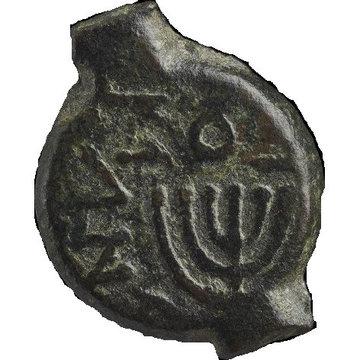
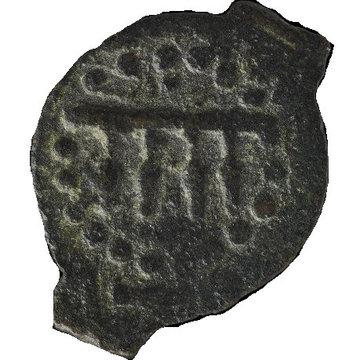
Coins minted by Antigonus II between 40 and 37 BCE. They show the Temple menorah on one side and the Temple showbread on the other. They also say “King Antigonus” in Greek. Other coins from his reign say "Mattathias High Priest and Council of the Jews" in Hebrew. He minted prutahs. https://en.numista.com/94657 And https://www.ins.org.il/files/files/Mattathias%20Antigonus%20coins-the%20last%20king%20of%20the%20Hasmonean%20%20%20.pdf and https://www.wildwinds.com/coins/greece/judaea/mattathias_antigonus/i.html and https://www.littletoncoin.com/shop/40-37-bc-mattathias-antigonus-bronze-prutah-a173-wc and https://coinreplicas.com/product/mattathias-antigonus-40-37-bc-ae-prutah-biblical-judaea/ and https://www.coinarchives.com/a/results.php?search=mattathias and https://www.forumancientcoins.com/catalog/roman-and-greek-coins.asp?vpar=1063&pos=0#Hasmonean-Dynasty
- Herod and his Roman-supplied army took 2.5 years to recapture Judaea, finally succeeding in 37 BCE. Herod sent Antigonus II to Mark Antony to be executed. Herod also had Hyrcanus II brought back to Jerusalem.
- In 37 BCE, the Romans left Jerusalem, leaving Herod in charge of Hyrcanus II’s old kingdom (Judea, Galilee, and Perea north of the Dead Sea), plus what the Roman Senate had given him (Samaria and Idumea). Herod’s patron, Mark Antony, wanted to make Cleopatra VII happy, and she wanted to bring back the old Ptolemaic kingdom by getting Judea and the Nabatean kingdom. Antony gave her some Nabatean territory and the coastline, cutting Herod off from the sea.
- In 36 BCE, Herod appoints his brother-in-law Antigonus III as High Priest, ensuring that he won’t be considered as King by the Jews. A year later, Herod has him “accidentally” drowned at a party, just to make sure.
- In 32 BCE, civil war broke out between Antony and Octavian (later Caesar Augustus). Herod offered to help Antony, but was told to go fight the Nabateans. He was defeated at Canatha, but then defeated them at Philadelphia.
- Shortly after this, in 31 BCE Antony was defeated by Octavian at Actium. Herod was told to present himself to Octavian, but before he went he had Hyrcanus II killed so that the Hasmonean dynasty couldn’t be revived.
- Octavian realized Herod’s value and gave him back the coastal regions plus more.
- Herod was paranoid about his rule, and he eventually murdered his wife and her mother in 29 BCE (he remarried and had more sons), followed by murdering by his sons with Mariamne I in 7 BCE, thus ending the Hasmonean dynasty.
- In 37 BCE, the Romans left Jerusalem, leaving Herod in charge of Hyrcanus II’s old kingdom (Judea, Galilee, and Perea north of the Dead Sea), plus what the Roman Senate had given him (Samaria and Idumea). Herod’s patron, Mark Antony, wanted to make Cleopatra VII happy, and she wanted to bring back the old Ptolemaic kingdom by getting Judea and the Nabatean kingdom. Antony gave her some Nabatean territory and the coastline, cutting Herod off from the sea.
- In 36 BCE, Herod appoints his brother-in-law Antigonus III as High Priest, ensuring that he won’t be considered as King by the Jews. A year later, Herod has him “accidentally” drowned at a party, just to make sure.
- In 32 BCE, civil war broke out between Antony and Octavian (later Caesar Augustus). Herod offered to help Antony, but was told to go fight the Nabateans. He was defeated at Canatha, but then defeated them at Philadelphia.
- Shortly after this, in 31 BCE Antony was defeated by Octavian at Actium. Herod was told to present himself to Octavian, but before he went he had Hyrcanus II killed so that the Hasmonean dynasty couldn’t be revived.
- Octavian realized Herod’s value and gave him back the coastal regions plus more.
- Herod was paranoid about his rule, and he eventually murdered his wife and her mother in 29 BCE (he remarried and had more sons), followed by murdering by his sons with Mariamne I in 7 BCE, thus ending the Hasmonean dynasty.
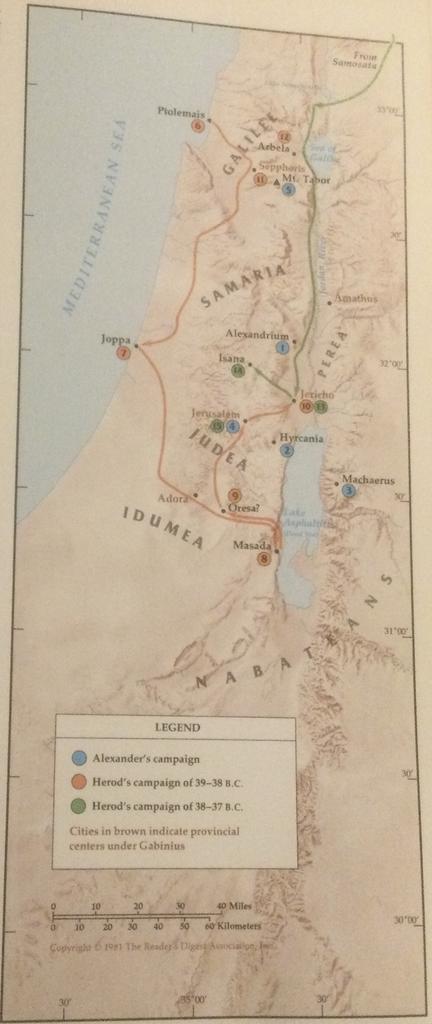
From The Atlas of the Bible by John Gardner.
With appreciation to: The Bible as History by Ian Wilson, The Atlas of the Bible by John Gardner, The Historical Atlas of The Bible by Dr. Ian Barnes, A History of the Jews by Solomon Grayzel, https://en.wikipedia.org/wiki/Judean_Civil_War, https://en.wikipedia.org/wiki/Herod_the_Great