


“Prayer is not a miracle. It is a tool, man’s paintbrush in the art of life. Prayer is man’s weapon to defend himself in the struggle of life. It is a reality. A fact of life.”
(Rabbi Avrohom Chaim Feuer)
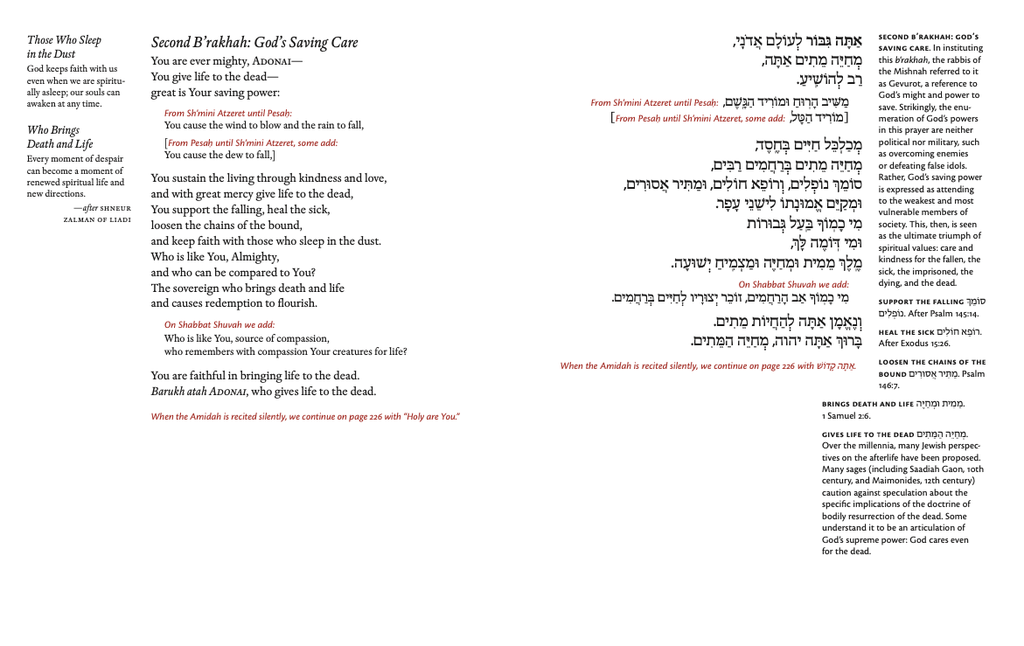
What themes do you identify in this blessing?
God's Greatness
- The first blessing focuses on the past, God's relationship with our ancestors
- "You are forever mighty"
- The second blessing focuses on the present and what we expect of God in the future (Hauptman)
- We focus on God's strength before we make any requests
"Mehayeh HaMeytim"
- This blessing corresponds to Yitzchak (Isaac), who, according to the Midrashic texts of Pirkei d’Rebbi Eliezer and Midrash HaGadol, experienced a form of resurrection at the Akeidah, when his soul was returned to him after it had left his body.
4 Mentions of Bringing Death
The second blessing of the Amidah is a praise of G-d’s power. Four times, it mentions the concept “techiat hametim,” “Who gives life to the dead.” Each of the four references is to a different kind of “resurrection.”
The first refers to the revitalization of the land because of life giving rain. It comes right before the prayer for rain/dew.
The second is related to the healing power of G-d, who can help us recover even from the most serious illnesses. It is followed immediately by recognizing G-d as the One who supports the fallen.
The third is similar to the idea “out of sight, out of mind.” It’s talking about the experience of seeing someone that you have not seen for a very long time. It is followed by a reference to G-d as the one who causes redemption to happen, when all the lost will be reunited.
And the final reference is to the ultimate “resurrection,” the idea that somehow, in ways we do not comprehend, the dead will be brought back to life. Originally, this referred to an actual corporeal, bodily resurrection. Over the course of time, this obviously difficult concept became rarified, so that it came to refer to the ongoing life of our souls. Obviously, it is a concept shrouded in mystery. (https://bnaitikvah.org/prayer-lesson-17-the-amidahs-second-blessing power/#:~:text=The%20second%20blessing%20of%20the,because%20of%20life%20giving%20rain.)
Resurrection
What does it mean to praise God for the resurrection of the dead?
“The school of R. Yannai said: One who wakes from sleep must say: Blessed are You, YHVH, who gives life to the dead.” (Jerusalem Talmud Berakhot 33a).
וַיַּפֵּל יהוה אֱלֹהִים תַּרְדֵּמָה (בראשית ב, כא), רַבִּי יְהוֹשֻׁעַ דְּסִכְנִין בְּשֵׁם רַבִּי לֵוִי אָמַר תְּחִלַּת מַפָּלָה שֵׁנָה, דָּמַךְ לֵיהּ וְלָא לָעֵי בְּאוֹרַיְתָא, וְלָא עָבֵיד עֲבִידְתָּא. רַב אָמַר שָׁלשׁ תַּרְדֵמוֹת הֵן, תַּרְדֵּמַת שֵׁנָה, וְתַרְדֵּמַת נְבוּאָה, וְתַרְדֵּמַת מַרְמִיטָה. תַּרְדֵּמַת שֵׁנָה וַיַּפֵּל יהוה אֱלֹהִים תַּרְדֵּמָה עַל הָאָדָם וַיִּישָׁן. תַּרְדֵּמַת נְבוּאָה (בראשית טו, יב): וַיְהִי הַשֶּׁמֶשׁ לָבוֹא וְתַרְדֵּמָה נָפְלָה עַל אַבְרָם. תַּרְדֵּמַת מַרְמִיטָה (שמואל א כו, יב): אֵין רֹאֶה וְאֵין יוֹדֵעַ וְאֵין מֵקִיץ כִּי כֻלָּם יְשֵׁנִים כִּי תַּרְדֵּמַת יהוה נָפְלָה עֲלֵיהֶם. רַבָּנָן אָמְרֵי אַף תַּרְדֵּמָה שֶׁל שְׁטוּת, דִּכְתִיב (ישעיה כט, י): כִּי נָסַךְ עֲלֵיכֶם יהוה רוּחַ תַּרְדֵּמָה. רַבִּי חֲנִינָא בַּר יִצְחָק אָמַר שָׁלשׁ נוֹבְלוֹת הֵן, נוֹבֶלֶת מִיתָה, שֵׁנָה. נוֹבֶלֶת נְבוּאָה, חֲלוֹם. נוֹבֶלֶת הָעוֹלָם הַבָּא, שַׁבָּת. רַבִּי אָבִין מוֹסִיף עוֹד תַּרְתֵּין, נוֹבֶלֶת אוֹרָה שֶׁל מַעְלָה, גַּלְגַּל חַמָּה. נוֹבֶלֶת חָכְמָה שֶׁל מַעְלָה, תּוֹרָה.
“The Lord God cast a deep slumber upon the man, and he slept. He took one of his sides, and He closed it with flesh in its place [taḥtena]” (Genesis 2:21). “The Lord God cast [hipil] a deep slumber” – Rabbi Yehoshua of Sikhnin said in the name of Rabbi Levi: The beginning of downfall [mapala] is sleep. When a person sleeps, he does not toil in Torah and does not do any work. Rav said: There are three slumbers: the slumber of sleep, the slumber of prophecy, and the slumber of a trance. The slumber of sleep – “the Lord God cast a deep slumber upon the man, and he slept.” The slumber of prophecy – “it was when the sun was setting, and a deep slumber fell upon Abram” (Genesis 15:12). The slumber of a trance – “No one saw, and no one knew, and no one awoke, as they were all asleep, because a deep slumber from the Lord had fallen upon them” (I Samuel 26:12). The Rabbis said: There is also the slumber of foolishness, as it is written: “For the Lord poured upon you a spirit of deep slumber” (Isaiah 29:10). Rabbi Ḥanina bar Yitzḥak said: There are three microcosms; sleep is a microcosm of death; a dream is a microcosm of prophecy; Shabbat is a microcosm of the World to Come. Rabbi Avin adds another two: The orb of the sun is a microcosm of the supernal light; Torah is a microcosm of the supernal wisdom.
“One should wake up with energy from his sleep, for he was renewed and made into another person, who was worthy to be born.” (Tzava’at HaRibash, Brooklyn, 1998, p. 9)
יהוה מֵמִ֣ית וּמְחַיֶּ֑ה מוֹרִ֥יד שְׁא֖וֹל וַיָּֽעַל׃
The LORD deals death and gives life, Casts down into Sheol and raises up.
"The prophet Samuel’s mother, Hannah, is the paradigmatic example of a woman who for many years could not give birth and then was granted a child. In her prayer of gratitude, Hannah calls God the one who “causes death and gives life.” Having been barren and unable to give life, she has been transformed into a mother.
The original biblical context of this phrase is thus not about a physical resurrection of a dead body, but about the body of a child. The blessing then is about being able to give life to a new person. Hannah is in some ways created anew in this transformation and given new life."
https://www.myjewishlearning.com/article/mechayeh-hameitim-rethinking-the-resurrection-blessing/
Two different interpretations of life after death
- the whole person dies and then is resurrected in some future time
- only the body dies and the soil lives on until it is rejoined with the body at the time of the resurrection
- "who gives life to the dead" - is purposely ambiguous, so it could fit with either interpretation
- Divrei Shalom suggests that when we pray we are able to activate the creative divine power residing in the letters and words of the prayer, In just this way, we are able to bring those whos eem to be hopelessly lost, spiritually dead, "back to life." (People's Prayerbook)
- Medieval halakhist Roke'ach: "it is a special merit that we continue to believe in resurrection, the one point of faith to which, by definition, no one can ever attest."
- Maimonides believed in a disembodied world-to-come for the soul's acquired intellect...our soul goes there immediately after we die (People's Prayerbook 81)
- Abbudarhman (14th c) - "The whole point of the service is the affirmation of matters of faith that no one has ever seen."
Change of Liturgy
- Rejected the belief in bodily resurrection
- replaced it with faith in the immortality of the soul
"You support the fallen, heal the sick, free the captive..."
- This blessing identifies many things that are out of our control, and we put them in the hands of God.
- Overcoming these things are forms of resurrection
- A reminder that we are supposed to imitate God (Doctors, medicine, teachers, etc)
- The Chofetz Chaim cites the Talmud (Ta’anit 2a), which teaches that there are three “keys” that G-d does not entrust to God's angels, due to their intrinsic importance. They are: the key of rain (livelihood), the key of childbirth, and the key for the resurrection of the dead. Angels, not being a part of the Divine system that includes the attribute of mercy, can evaluate a person’s merits only according to the strict attribute of judgment, which, by definition, would mean that most people would not deserve a livelihood, children or to be resurrected at the End of Days. Therefore, G-d keeps these essential aspects to Godself to use at God's discretion.
Free the Captive
- can refer to redeeming a captive or prisoner
- same words are used in the morning after you have woken up from sleep to thank God for allowing us to get out of our bed
- can also be a blessing offered after an experience of being bedridden
- metaphorically - releasing the psychological bonds or prejudice toward another