


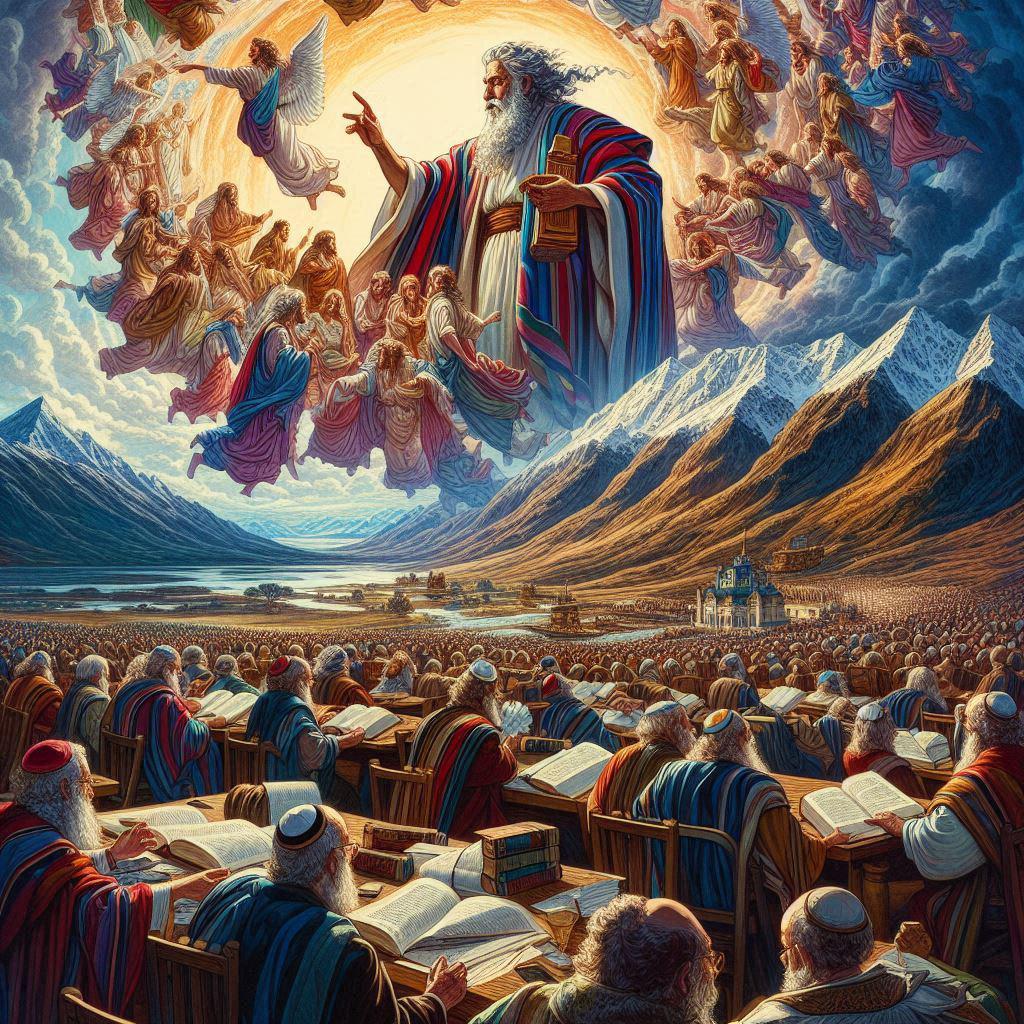
[A] משֶׁה קִבֵּל תּוֹרָה מִסִּינַי, וּמְסָרָהּ לִיהוֹשֻׁעַ, וִיהוֹשֻׁעַ לִזְקֵנִים, וּזְקֵנִים לִנְבִיאִים, וּנְבִיאִים מְסָרוּהָ לְאַנְשֵׁי כְנֶסֶת הַגְּדוֹלָה.
(הֵם אָמְרוּ שְׁלשָׁה דְבָרִים),
[B] הֱווּ מְתוּנִים בַּדִּין,
[C] וְהַעֲמִידוּ תַלְמִידִים הַרְבֵּה,
[D] וַעֲשׂוּ סְיָג לַתּוֹרָה:
[A] Moses received the Torah at Sinai and transmitted it to Joshua, Joshua to the elders, and the elders to the prophets, and the prophets to the Men of the Great Assembly.
(They said three things:)
[B] Be patient in [the administration of] justice,
[C] raise many disciples and
[D] make a fence round the Torah.
This Mishnah deals with the tradition of transmitting the Torah throughout Jewish history, beginning, specifically the part A. With this grounding passage, the sages distance themselves from the image of a wanderer who, despite being able to see, aimlessly roams through the darkness of night. This is why they turn to our historical tradition, letting it guide them as if it were the brightest star shining in the night sky. In divinatory arts in general, and astrology in particular, the pattern formed in the sky is not a destiny, nevertheless an indication. In this sense, just as the good traveller interprets the movement of the firmament, Jewish tradition is consulted in view of a path that is both chosen and traversed by the individual himself. Therefore, the sages traverse our historical tradition in view of its overcoming, even if it is probably in no way intentional. And, paradoxically, it is this overcoming that keeps such tradition alive, inasmuch as the past is not given as dead. Although it does not directly address this issue, with Between Past and Future (1961), Hannah Arendt (20th century) initiated a reflection on the philosophy of history in the work He (1920) by Franz Kafka (20th century). In an adaptation of the Kafkaesque work, the sages of the Mishnah, in their present, are necessarily torn by an adversary before them and another after them. While the first, representing the past, pushes Homus est hic et nunc against the second, which represents the future... and, at the same time, also engages in this struggle, bringing about an implosion in that Homus est hic et nunc. It is interesting to note that, in Arendt, Kafka’s parable is understood as a subjective construct, which most certainly alludes to the way his novels express the spirit of modernity. When a past that no longer exists is placed in between a future that may or may not exist, the Kafkaesque man’s sensation is one of suffocation when inside it, and disorientation when outside it. Precisely because, while Arendt rereads Kafka, I too reread the sages of the Mishnah through Kafka, the experience of this historical tension is not confined to the time and moment in which it is lived. Historicity here also proves this: the sages experienced it, Kafka described it, and Arendt mentioned it. In The Human Condition (1958), Arendt agrees with the continuity of historical tradition, albeit not according to a closed determinism, as in Karl Marx (19th-20th century), whom she criticised. In a way, even though she is not religious, nor a scholar of rabbinic tradition, Arendt seems to agree with the Mishnah, even if unintentionally. In order not to succumb to the mortality inherent in all that is alive, the ancestors bequeath their present to the present of the man of the future. And just as in the religions originating in Africa, the positivity with which future generations respond to the tradition passed down to them is a way in which the ancestors remain alive. Similarly, Arendt concludes, quoting Georg W. F. Hegel (18th-19th century), that the continuity of historical tradition is a way of reconciling with the Zeitgeist. However, even if there is no reconciliation in the typical Hegelian dialectic, that is where, returning to Kafka, the agony of fighting against the souls of the dead of the past, who wish to remain alive, and the souls that will be born in the future, who demand a return to their roots.