


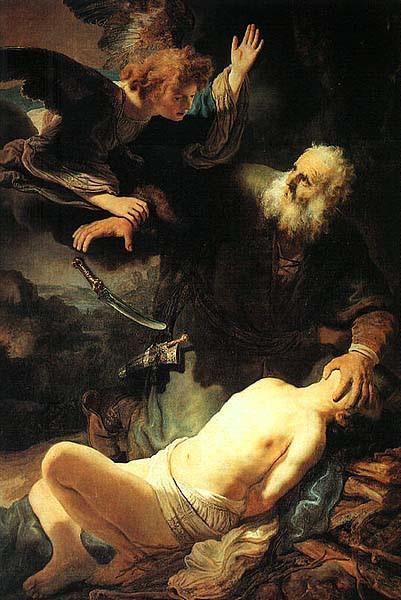
Rembrandt van Rijn, "The Sacrifice of Isaac" (1635)
(1) Some time afterward, God put Abraham to the test, saying to him, “Abraham.” He answered, “Here I am.” (2) “Take your son, your favorite one, Isaac, whom you love, and go to the land of Moriah, and offer him there as a burnt offering on one of the heights that I will point out to you.” (3) So early next morning, Abraham saddled his donkey and took with him two of his servants and his son Isaac. He split the wood for the burnt offering, and he set out for the place of which God had told him.
Abraham should have replied to this supposedly divine voice: "That I ought not kill my good child is quite certain. But that you, this apparition, are God — of that I am not certain, and never can be, not even if this voice rings down to me from visible heaven."
Immanuel Kant, The Conflict of the Faculties (1798)
(4) On the third day Abraham looked up and saw the place from afar. (5) Then Abraham said to his servants, “You stay here with the donkey. The boy and I will go up there; we will worship and we will return to you.” (6) Abraham took the wood for the burnt offering and put it on his son Isaac. He himself took the firestone and the knife; and the two walked off together. (7) Then Isaac said to his father Abraham, “Father!” And he answered, “Yes, my son.” And he said, “Here are the firestone and the wood; but where is the sheep for the burnt offering?” (8) And Abraham said, “It is God who will see to the sheep for this burnt offering, my son.” And the two of them walked on together.
Abraham answered: “My son, you are the offering.”
Suddenly Abraham’s face paled, saying: "I am old and he is a youth. Perhaps he will run away, and then what will become of me?"
Said Isaac to his father: "Abba, don’t fear. May it be God’s will that a quart of my blood will be received on the altar, but just in case, bind me up tightly, so that I won’t flinch. And when you return to my mother Sarah, don’t tell her immediately so that she doesn’t harm herself, [don’t tell her] when she is standing on the roof – for she might fall and die, or by the well – for she might throw herself in, or if she’s holding a knife – for she will take her own life..."
At that moment Isaac was agreeing with his mouth, but in his heart he said: "Who will save me from my father? God must help me!"
And the angels declared: "Come and see these two righteous ones! A slaughtering father and a son to the slaughter – and neither is holding the other back."
Avot DeRabbi Natan (5th c.)
(9) They arrived at the place of which God had told him. Abraham built an altar there; he laid out the wood; he bound his son Isaac; he laid him on the altar, on top of the wood. (10) And Abraham picked up the knife to slay his son. (11) Then a messenger of God called to him from heaven: “Abraham! Abraham!” And he answered, “Here I am.” (12) “Do not raise your hand against the boy, or do anything to him. For now I know that you fear God, since you have not withheld your son, your favorite one, from Me.” (13) When Abraham looked up, his eye fell upon a ram, caught in the thicket by its horns. So Abraham went and took the ram and offered it up as a burnt offering in place of his son. (14) And Abraham named that site Adonai-yireh, whence the present saying, “On the mountain of God there is vision.”
And took the fire with him, and a knife.
And as they sojourned both of them together,
Isaac the first-born spake and said, My Father,
Behold the preparations, fire and iron,
But where the lamb for this burnt-offering?
Then Abram bound the youth with belts and straps
and builded parapets and trenches there,
And stretchèd forth the knife to slay his son.
When lo! an angel called him out of heaven,
Saying, Lay not thy hand upon the lad,
Neither do anything to him, thy son.
Behold! Caught in a thicket by its horns,
A Ram. Offer the Ram of Pride instead.
But the old man would not so, but slew his son,
And half the seed of Europe, one by one.
Wilfred Owen, "The Parable of the Old Man and the Young" (1917)
Avraham had three sons: Yishmael, Yitzchak, and Yivkeh.
No one has ever heard of Yivkeh, for he was the youngest
And the most beloved, who was sacrificed on Har Hamoriah.
Yishmael was saved by his mother, Hagar; Yitzchak saved by the angel.
But Yivkeh was not saved by anyone. When he was young,
His father would call him, lovingly: Yivkeh, Yivk, little Yevk
My sweetie. But he sacrificed him in the Akedah.
And in the Torah it says a ram, but it was Yivkeh.
Yishmael never again heard about God, the rest of his life.
Yitzchak never again laughed, the rest of his life.
And Sarah only laughed once, and never again.
Avraham had three sons,
Yishma, Yitzchak, Yivkeh
Yishmael, Yitzchakel, Yivke-el.
Yehuda Amichai, from Patuach Sagur Patuach (1998)
(15) The messenger of God called to Abraham a second time from heaven, (16) and said, “By Myself I swear, God declares: Because you have done this and have not withheld your son, your favorite one, (17) I will bestow My blessing upon you and make your descendants as numerous as the stars of heaven and the sands on the seashore; and your descendants shall seize the gates of their foes. (18) All the nations of the earth shall bless themselves by your descendants, because you have obeyed My command.” (19) Abraham then returned to his servants, and they departed together for Beer-sheba; and Abraham stayed in Beer-sheba.
Isaac represents defiance. He defied death. Logically, he should have pursued oblivion. Instead he settled on his land, married, had children, refusing to let fate turn him into a bitter man.
He felt neither hatred nor anger toward his contemporaries who did not share his experience. On the contrary, he liked them and showed concern for their well-being. After Moriah, he devoted his life and his right to immortality to the defense of his people. He will be entitled to say anything he likes to God, ask anything of Him.
Because he suffered? No. Suffering confers no privileges. Rather Isaac knew how to transform his suffering into prayer and love rather than into rancor and malediction. This is what gives him rights and powers no other man possesses.
And as the first survivor, he had to teach us, the future survivors of Jewish history, that it is possible to suffer and despair an entire lifetime and still not give up the art of laughter.
Elie Wiesel, Messengers of God (1985)