


(1) יהוה spoke to Moses, saying: (2) Speak to Aaron and say to him, “When you mount the lamps, let the seven lamps give light at the front of the lampstand.” (3) Aaron did so; he mounted the lamps at the front of the lampstand, as יהוה had commanded Moses.— (4) Now this is how the lampstand was made: it was hammered work of gold, hammered from base to petal. According to the pattern that יהוה had shown Moses, so was the lampstand made.
Author: Joseph Gikatilla
Composed: Middle-Age Spain, c.1260 – c.1300 CE
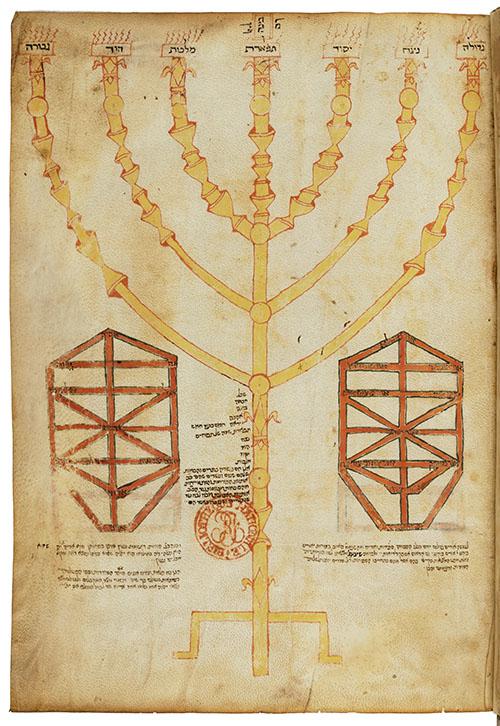
Sha'arei Orah, or Sefer HaOrah, (שערי אורה) is Joseph Gikatilla's most influential work. It discusses 300 names of God and is organized into ten chapters, one for each sefirah. Each sefirah has one main name but may have many others. Some names are associated with more than one sefirah. The Arizal called it "a key to understanding the mystical studies." The Vilna Gaon and Zundel Salant recommended that their students study it.
Composed: Talmudic Israel/Babylon, c.150 – c.750 CE
“Tanchuma Buber” refers to a version of Midrash Tanchuma published by Solomon Buber in 1885, based primarily on a manuscript that he discovered. Buber claimed that this version was the earliest extant midrash, though later scholars largely disputed that claim. Buber’s version differs significantly from the printed Tanchuma on the books of Genesis and Exodus, but his version of midrash on Leviticus, Numbers, and Deuteronomy largely resembles the printed version.
ר' לוי אמר מנורה טהורה ירדה מן השמים, למה שאמר לו הקב"ה למשה ועשית מנורת זהב טהור (שמות כה לא), א"ל כיצד נעשה, א"ל קשה תעשה המנורה (שם), אעפ"כ נתקשה משה, וירד ושכח מעשיה, עלה ואמר רבש"ע שכחתי, א"ל ראה ועשה, שנטל מטבע של אש, והראה לו עשייתה, ועוד נתקשה על משה, א"ל הקב"ה לך אצל בצלאל והוא יעשה אותה, ירד משה ואמר לבצלאל, מיד עשאה, התחיל משה תמיה, ואמר אני כמה פעמים הראה לי הקב"ה ונתקשיתי לעשותה, ואתה שלא ראית עשית מדעתך, בצלאל שמא בצל אל היית עומד כשהראה לי הקב"ה...
<LET THE SEVEN LAMPS> GIVE THEIR LIGHT IN FRONT OF THE MENORAH (Numbers 8:2) R. Levi said: A pure menorah descended from the heavens. Why? Because the Holy One said to Moses (in Exod. 25:31): YOU SHALL ALSO MAKE A MENORAH OF PURE GOLD. He said to him: How shall we make it? He said to him (ibid. cont.): OF HAMMERED WORK SHALL THE MENORAH BE MADE. Nevertheless Moses had difficulty; for when he descended he had forgotten its construction. He went up and said: Sovereign of the World I have forgotten it. He said to him (in Exod. 25:40): OBSERVE AND MAKE IT. Thus he took a pattern of fire and showed him its construction, but it was still difficult for Moses. The Holy One said to him: Go to Bezalel and he will make it. So Moses went down to talk to Bezalel, and he made it immediately. Moses began to be wonder and say: In my case, how many times did the Holy one show it to me; yet I had difficulty in making it. Now without seeing it you have made it from your own knowledge. Bezalel (BTsL'L), were you perhaps standing in (B) the shadow (TsL) of God ('L) when the Holy One showed it to me? ...
Author: Levi Yitzchak of Berditchev
Composed: Berdychiv, Ukraine, c.1772 – c.1798 CE
One of the chasidic classics, reputedly endowed with special sanctity due to the famous righteousness of the author.
The menorah per se symbolizes a visual impact of the largesse transferred by G’d from His celestial treasure house to the terrestrial part of the universe. This largesse is in constant motion between the celestial and the terrestrial domains of the universe.
When we love G’d in this manner -- by doing mitzvot --, we succeed in helping the “sparks” to return to their original habitat as part of the Sh’chinah.
It is not permissible for us to ever claim that there exist phenomena in our universe that are totally apart from their origin, from their holy roots. It is up to us to try and find behind phenomena that appear totally divorced from their holy roots, the point of contact through which such a thread, however slender, still exists. According to our author, the פנימיות, inner essence, of any phenomenon, is a reflection of this “love.” In order to serve the Lord properly, the worshipper must get hold of this “love” and use it as the vehicle with which he relates to his Creator. He considers that other מדות, attributes, virtues, must be used in a similar manner. He claims that there are a total of seven such מדות, virtues, and that the seven arms of the lampstand, or candlestick in the Tabernacle, symbolized these seven virtues. He considers Numbers 8,2 as the key phrase in the Torah referring to this concept, when the Torah writes: בהעלותך את הנרות אל מול פני המנורה יאירו שבעת הנרות, “when you elevate the lights of the lampstand they shall be focused on the center shaft so that all seven lamps will be providing light.” The “center shaft” symbolizes the Sh’chinah, presence of G’d.
At that point the Torah continues with the words: וזה מעשה המנורה מקשה, “and this is the essential ingredient of this lampstand, it is hammered out of a single piece (of gold)”. This verse teaches that true Judaism when it is practiced with all the required virtues, will result in a completely unified, harmonious personality of the worshipper. It is our task in this multifaceted material universe, to reflect the unity of the Creator by emulating His virtues to the best of our knowledge and ability.
