


וְאַל־תִּ֝טֹּ֗שׁ תּוֹרַ֥ת אִמֶּֽךָ׃
Do not forsake your mother’s Torah.
Blu Greenberg, p.79
It is difficult to generalize about the condition of the Jewish woman throughout history, considering the different societies and lifestyles to which she adapted herself. The enormous range of circumstances in which she lived makes it difficult to define accurately her true condition in history. Adding to this confusion is the disparity between laws pertaining to women and the historical reality reflected in the same tradition.
Proto-Rabbinic Figures of the Talmud
אימא שלום דביתהו דר"א אחתיה דר"ג הואי מההוא מעשה ואילך לא הוה שבקה ליה לר"א למיפל על אפיה ההוא יומא ריש ירחא הוה ואיחלף לה בין מלא לחסר איכא דאמרי אתא עניא וקאי אבבא אפיקא ליה ריפתא אשכחתיה דנפל על אנפיה אמרה ליה קום קטלית לאחי אדהכי נפק שיפורא מבית רבן גמליאל דשכיב אמר לה מנא ידעת אמרה ליה כך מקובלני מבית אבי אבא כל השערים ננעלים חוץ משערי אונאה תנו רבנן המאנה את הגר עובר בשלשה לאוין והלוחצו עובר בשנים...
The Gemara further relates: Imma Shalom, the wife of Rabbi Eliezer, was the sister of Rabban Gamliel. From that incident forward, she would not allow Rabbi Eliezer to lower his head. A certain day was around the day of the New Moon, and she inadvertently substituted a full thirty-day month for a deficient twenty-nine-day month. Some say that a pauper came and stood at the door, and she took bread out to him. She found him and saw that he had lowered his head in prayer. She said to him: Arise, you already killed my brother. Meanwhile, the sound of a shofar emerged from the house of Rabban Gamliel to announce that the Nasi had died. Rabbi Eliezer said to her: From where did you know? She said to him: This is the tradition that I received from the house of the father of my father: All the gates are locked, except for the gates of mistreatment. § The Sages taught: One who mistreats the convert violates three prohibitions, and one who oppresses him in other ways violates two...
(ג) קלוסטרא רבי טרפון מטמא וחכמים מטהרין וברוריא אומרת שומטה מן הפתח זה ותולה בחבירו בשבת כשנאמרו דברים לפני ר' יהושע אמר יפה אמרה ברוריא.
(3) Regarding a "klustra" (door bolt): Rabbi Tarfon declares it impure, but the Sages declare it pure. Beruriah says, "[One may] remove it from this doorway and hang it on the neighboring doorway on Shabbat." When these words were spoken before Rabbi Joshua, he said, "Beruriah has spoken well (i.e., correctly)."
Rabbi Meir arose, fled, and arrived in Babylonia. There are those who say that he fled because of this incident, and there are those who say that he fled due to the Beruriah incident.
Scribes
Rigler, Baskin, p.10
Given the highly gendered nature of education in medieval Jewish society, the existence of professional women scribes may seem surprising. While Jewish boys were taught to read sufficient Hebrew to enable them to participate in worship (though not necessarily to understand the prayers) and perhaps also to study Jewish texts, at least on an elementary level, girls and women were infrequently encouraged to pursue Hebrew studies and the complexities of traditional Jewish learning. For the majority of Jewish girls, their education consisted of being taught the domestic, ritual, and economic skills essential for
their lives. However, this does not mean that they were illiterate; many women engaged in business activities, mainly money-lending, that required maintaining records, and so they often acquired some facility in writing, as well as significant calculation skills. For economic purposes, then, medieval Jewish women in Europe were taught to use Hebrew letters to write in the vernacular languages of their regions, most often some form of French, Italian, German or Yiddish. As we shall see below, many women also could read Hebrew characters well enough to use a prayer book, in Hebrew or in the vernacular.
15th-16th Century Scribe
San'a, Yemen
From a family of scribes
"Please be indulgent of the shortcomings of this volume; I copied it while nursing a baby."
(In Nicknames as Family Names, p.518; colophon of "an exactly and beautifully written codex of the Pentateuch".)
13th Century
Rome
From a family of scribes
May the Writer Be Strong
Riegler & Baskin, pp.12-14:
[In 1288, Pola copied a book of Bible commentaries, at the end of which she recorded the following details:]
This completes the work on the commentary to the Prophets, by me, Pola, daughter of R. Abraham the scribe, the son of R. Joab, may his righteousness protect us, among the descendants of R. Jehiel, the father of Rabbenu Nathan, author of the ‘Arukh, and the wife of R. Jehiel ben R. Solomon. On Monday, the fourth day of the month of Adar, in the five thousand and forty-eighth year from the creation of the world [1288], in the city of Rome, which sits on the Tiber River. May the Omnipresent entitle him to study it—I, my descendants, and my descendants’ descendants, until the end of all generations. May the verse be fulfilled for me: “He shall come as redeemer to Zion . . . and this shall be my covenant with them . . . for all time” (Isa. 59:20–21).
[Five years later, in 1293, Pola inscribed a colophon in another book she had copied for one of her relatives, this time a halakhic tome. The especially lengthy colophon reveals additional details of her life and the circumstances that led her to engage in copying:]
“I will recount the kind acts of the Lord” (Isa. 63:7), for all His acts of kindness and mercy to me, Pola the daughter of Abraham the scribe, the son of R. Joab, from the holy seed of Rabbenu Jehiel, the father of Rabbenu Nathan, author of the ‘Arukh. “I had scarcely finished praying in my heart” (Gen. 24:42), and behold, Menahem b. R. Benjamin the righteous, may the memory of the righteous live forever, my relative, came to me, persuaded me, compelled me and urged me to write for him this holy book, the rulings of the Order of Mo‘ed, by R. Isaiah Di Trani, with the rulings of [the tractate of] Makkot, and with part of Sefer hamakhri‘a. I was aided by the Helper, the Lord, and I labored over this work, which was completed, with His help, may His name be exalted forever, on Wednesday, the second day of the first month [Nisan], in the year 5053 from the creation of the world [March 18, 1293]. I say, speak and completely praise God,
may He be blessed, who guided me in this great work, the completion of which he entitled me to see. May He, in His mercy, enable me to see His and our glory, and bring us forth from the great darkness in which we find ourselves and which arose in our time. May it be granted to the abovementioned R. Menahem, the commissioner of this book, to study and to teach, to inherit and to hand down, he and his seed after him, until the end of all time; and may he be enabled to fulfill the verse: “And this shall be My
covenant . . . it shall not be absent from your mouth . . . and may all Israel
be included in this blessing” [Isa. 59:21].
[Another surviving Hebrew book that Pola copied, in 1306, is a prayer book following the custom of the Roman Jews, intended for her son Solomon. She concludes it as follows:]
Completed on Friday, on the eighth day of the sixth month in the year five thousand and sixty-six from the creation of the world, by Pola daughter of Abraham the scribe, the son of R. Joab, the righteous is an everlasting foundation. I wrote this for my son Solomon, the son of my esteemed teacher, the pious R. Solomon of blessed memory, the son of Moses b. Jekuthiel, may he rest in peace. May the One who enabled me to write it enable me to see him outstanding in Torah, wisdom and fear of the Lord, with male sons who engage in the study of the Torah and observe the commandments of Israel. May he merit to study and teach, to observe, to practice and to keep, as it is written, “Let not [this Book of the Teaching] cease [from your lips, but recite it day and night . . .] then will you be successful” [Josh. 1:8].
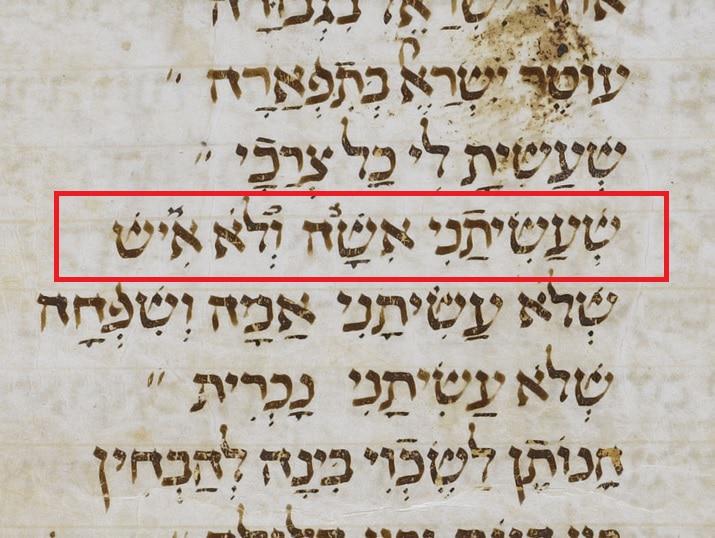
Blessed are You, LORD our God and sovereign of the universe, that You made me a woman and not a man.
Prayer Leaders
רבנית הדרשנית
Women prayer leaders (for other women)
Most famous being the Maiden of Ludmir (Hannah Rochel Verbermacher, 1815–1888), "the Ludmirer Rebbe".
Blu Greenberg, pp.87-88
Some people cite Jewish mysticism of the medieval period as a wedge in the male oriented structures of Judaism. The Kabbalist literature does contain some elements of a feminine theology; the Shehinah, the Divine presence, is described in feminine terms. Mysticism, however, had little bearing on the real status of women under Jewish law. Hasidism undermined somewhat the image of the male-oriented house of study as the central locus of Judaism; but the bulk of Hasidic tales involving women still centered around the home and family. Only one woman rose to great heights in Hasidic hierarchy — the Maid of Ludomir. She became a rebbe, leader of a Hasidic sect, and held court behind a curtain.
Taitz, Henry, Talan, p.101
Evidence of women who functioned as prayer leaders first appeared in the Rhineland (Germany) in the twelfth century, although it does not seem to have been an official post until much later. The earliest example of a woman who held this informal position is Dolce of Worms. Several others are known from records or tombstones, including Urania of Worms (d. 1275), Richenza of Nurnberg, and Guta bat Natan (d. 1306). Guta is remembered as "the important young woman who prayed for the women with gentle prayers".
13th Century Prayer Leader
This stone was first erected for this woman:
The lady Urania, the important, chosen, young woman,
Daughter of the initiated Rabbi Avraham, head of the singers, whose prayer [was] as beauty,
In the glory of his voice, for the sake of his nation, in the melody of a plea,
Whereas she too, with the sound of song, would sing for women:
Prayer-poems and, as a plea for her, she would become guarded.
But on the sixth day of Adar, on the first day, her soul was consumed, and on the seventh day of this, she was buried.
In Eden is her rest; she shall be remembered for good.
Prayer Writers
Chava Weissler (1998), p.4; p.6
There does exist ... a rich array of sources for writing the religious history of women of at least one period - the Ashkenazic world of the Netherlands, the Germanic lands, Poland, and Russia from the sixteenth through nineteenth century.
...
Written for a wide variety of occasions, these prayers structured women's devotional lives by defining a range of topics considered suitable for women and by establishing a realm of discourse for addressing these topics. Women chanted these prayers from small books or little booklets, often at home, sometimes with other women in the synagogue of cemetery. ... Each individual tkhine begins with a heading directing when and sometimes how it should be recited: "A pretty tkhine to say on the Sabbath with great devotion"; ... "When she comes out of the ritual bath"; ... "What one says on the Eve of Yom Kippur in the cemetery" ...
This [the woman] says when she puts the loaf of berkhes into the oven:
Lord of all the world, in your hand is all blessing. I come now to revere your holiness, and I prayer you to bestow your blessing on the baked goods. Send an angel to guard the baking, so that all will be well baked, will rise nicely, and will not burn, to honor the holy Sabbath (which you have chosen so that Israel your children may rest thereon) and over which one recites the holy blessing - as you blessed the dough of Sarah and Rebecca our mothers. My Lord God, listen to my voice; you are the God who hears the voices of those who call upon you wholeheartedly. May you be praised to eternity.
16th Century
Krakow
Printer, Teacher, Poet
Prefaced a translation of Psalms into Yiddish with her own poem, 1586:
Sing to God a new song, sing to God all the land, sing to God, praise His name, show forth His ready help from day to day. ... The field and all thereon shall show great joy; they will sing with all their leaves, the trees of the wood and the grove, before the Lord God who will come to judge the earth far and near. He judgeth the earth with righteousness and the nations with truth.
(Found in Jewish Literature and Other Essays, p. 120)
15th Century
Spain
Liturgical poet
Blessed, Majestic And Terrible
You established the Torah in Israel,
Happy are they who seek your shelter,
They do not forget the L-rd’s Will.
Salvation is far from the evil,
Though they’ve known of your Learning and Law,
The sowers in tears will soon exult
They trust in Him who enables…
He is seen, He strikes, and then heals,
Applies the balm before what comes,
Exhausts alike the weak and the strong
And restores well-being to Israel
I will say what I must,
And tell the truth to him who taunts me.
Keep slander far away from me,
Grant peace to the people of Israel.
(Kaufman, et al. The Defiant Muse: Hebrew Feminist Poems (New York 1999) pg. 65)
Kathryn Hellerstein, p34
The device of the author's name acrostic crosses the divides between languages and genders. A contemporary of Reb Zelmelin, although halfway across the Jewish world, was a woman who is known to us only because she inserted her name into an acrostic in her Hebrew poem beginning with the line, "Blessed, majestic, and terrible," which survives in a manuscript describing the author as "a woman of virtue, the lady Merecina, the Rabbiness from Gerona." This Merecina writes in a style that alludes in almost every line to verses from the Bible - Psalms, Proverbs, Deuteronomy, Numbers, and Jeremiah. She asks God to intervene in a dispute on her behalf and frames her personal complaint within a prayer that God should remedy the plight of all the people of Israel. And, in the way of the liturgical poets, Merecina inscribes her Hebrew name into the poem in an acrostic, spelling it out in the first letter of the first line of each of the five stanzas. Writing her authorial signature into the poem's very structure, this poet writes herself into the Hebrew liturgical tradition. Without this acrostic, we would have no idea that a woman in the fifteenth century had ever written in this form and no record that Merecina had ever existed. The acrostic, then, not only links a poem with its author, but also provides evidence of the very existence of that woman.
16th Century
Prague
Scholar, teacher, poet
ספר
הקדמת הרבנית
מנקת רבקה
ויניקהו דבש מסלע
ראה ראיתי / בלבבי הגיתי
קולי הרימותי וקראתי
הנה עתה באתי / והיום יצאתי
ובאר מים מצאתי
והאבן גדולה מן הבאר גליתי
וממנו שתיתי / ועוד צמיתי
ואמרתי בלבבי / אלכה ואביא
לקרובי וקרובותי / ותגלני עצמותי
שישתו לימים אורך
לקיים מה שנאמר – שתה מים מבורך
ומברכך מבורך / וכל החוסים בצילך
שכן הבטחתני על יד נביאך
לא ימושו מפי זרע זרעך
וגם אני אמתיך / בת עבדיך
ופרשת עלי כנפיך / שלא אבוש בפיקודיך
כי גברו עלי חסדיך / לקיים אמרתיך
וגם אני אבוא אחריך / ומלאתי את דברך
ככתו' בתורתך.
כי כל טובתי בל עליך / ומשכני אחריך
ואביטה אורחותיך / כי נר לרגלי דבריך
למען תצדק בשופטיך / כי אתה קרוב לכל קוראיך
ולכל חפצים ליראתיך / יזכו לחזות בנועם פניך.
Meneket Rivkah
Translation by Ebn Leader
The Book
The preface of the Rabbanit
Meneket Rivkah (Rivka’s Nurse)
"[God] breastfed them honey from a rock"
My eyes have seen, and my heart has considered.
I raise my voice and call out –
Now I have come. I set out today
and found a well of water.
I rolled the great stone off the top of the well,
I drank from its waters and thirsted for more.
I said to myself - I will go and bring these waters
To the men and women who are close to me.
That my bones may rejoice
As they continue to drink for all time
Affirming the verse –
“Drink water from your cistern”
And those who bless you are blessed
As are all who shelter in your shade.
You have promised me in the words of your prophets – "[My Word]… will stay strong with your children’s children."
And I am your handmaid, the daughter of your servant.
Spread Your wings over me, that I not be shamed as I engage in your precepts.
With overwhelming love You have stood by your word to me.
I will follow You, and make it a reality,
As it is written in the Torah.
I desire no good but You. Take me with You
And I will follow your paths. For your words light my steps,
And Your judgment is fair. You are close to all who call out to You.
And to all who desire Your awe -
They will all get to see the sweetness of Your face.
Blu Greenberg, p.91
An eternal Judaism will integrate and grow with such changes because these changes are wholly compatible with the spirit of the fundamental principles of Judaism — that every human being is created in the image of God.
The JPS Guide to Jewish Women, Emily Taitz, Sondra Henry, Cheryl Talan (2003)
Good for: an overview of many Jewish women throughout history.
Jewish Women: Coming of Age, Blu Greenberg (1977)
Good for: a brief sketch of women's religious roles in the Middle Ages.
“May the Writer Be Strong”: Medieval Hebrew Manuscripts Copied by and for Women, Michael Riegler and Judith R. Baskin (2008)
Good for: overview of women as scribes and commissioners of scribes.
Nicknames as Family Names, S.D. Goitein (1970)
Good for: exploration of the Cairo Geniza and the development of naming conventions.
Praying Separately? Gender in Medieval Ashkenazi Synagogues, Elisheva Baumgarten (2016)
Good for: exploration of women's place in the synagogue, and their eventual segregation/separation around the 13th Century.
Voices of the Matriarchs: Listening to the Prayers of Early Modern Jewish Women, Chava Weissler (1998)
Good for: information about and interpretations of the t'khines.
Jewish Literature and Other Essays, Gustav Karpeles (1895)
The Name in the Poem: Women Yiddish Poets, Kathryn Hellerstein (2002)