


בָּרוּךְ אַתָּה ה׳, אֱלֹקֵֽינוּ מֶֽלֶךְ הָעוֹלָם, אֲשֶׁר קִדְּשָׁנוּ בְּמִצְוֹתָיו וְצִוָּנוּ עַל דִּבְרֵי תוֹרָה:
בָּרוּךְ אַתָּה ה׳ אֱלֹקֵינוּ מֶלֶך הָעוֹלָם אֲשֶׁר קִדְּשָנוּ בְּמִצְוֹתָיו וְצִוָּנוּ לַעֲסוֹק בְּדִבְרֵי תוֹרָה
בְּרוּךֶ אַתֶה חֲוָיָה שְׁכִינּוּ רוּחַ הָעוֹלָם אֲשֶׁר קִדַשְׁתַנוּ בְּמִצְוֹתֶיהֶ וְצִוְתָנוּ לַעֲסוֹק בְּדִבְרֵי תוֹרָה
בְּרוּכָה אַתְּ יָהּ אֱלֹהָתֵינוּ רוּחַ הָעוֹלָם אֲשֶׁר קֵרְבָתְנוּ לַעֲבוֹדָתָהּ וְצִוְתָנוּ לַעֲסוֹק בְּדִבְרֵי תוֹרָה
Blessings for learning and studying Torah
Edot HaMizrach
Barukh atah Adonai Eloheinu melekh ha’olam asher kid’shanu b’mitzvotav v’tzivanu al divreiTorah
Ashkenaz
Barukh atah Adonai Eloheinu melekh ha’olam asher kid’shanu b’mitzvotav v’tzivanu la’asok b’divrei Torah
Nonbinary Hebrew Project:
B’rucheh ateh Khavayah Shekhinu ruach ha’olam asher kidash’tanu b’mitzvotei’he v’tziv’tanu la’asok b’divrei Torah
Feminine God Language:
Brukhah at Ya Elohateinu ruach ha’olam asher keir’vat’nu la’avodatah v’tziv’tavnu la’asok b’divrei Torah
What does it mean to bring a gift to Hashem?
What does it mean to bring a gift with a Nediv Lev?
What does it mean to bring a gift towards building the mishkan?
What are your specific gifts?
How/when do you give with Nediv Lev?
(1) יקוק spoke to Moses, saying: (2) Tell the Israelite people to bring Me gifts; you shall accept gifts for Me from every person whose heart is so moved. (3) And these are the gifts that you shall accept from them: gold, silver, and copper; (4) blue, purple, and crimson yarns, fine linen, goats’ hair; (5) tanned ram skins,*tanned ram skins Others “rams’ skins dyed red.” dolphin*dolphin Or “dugong”; meaning of Hebrew taḥash uncertain (unicorn!?). skins, and acacia wood; (6) oil for lighting, spices for the anointing oil and for the aromatic incense; (7) lapis lazuli*lapis lazuli Cf. Gen. 2.12 and note. and other stones for setting, for the ephod and for the breastpiece. (8) And let them make Me a sanctuary that I may dwell among them.
Pinchas H. Peli wrote of the command to bring gifts for the sanctuary:
"Besides the immediate purpose of the campaign, to collect materials for the building of a sanctuary, it also serves an educational purpose: to convert the people from passive participants in their relationship with the Lord, as constant recipients of His gifts, into active partners.
"The in-dwelling of God among the people cannot take place as long as the people are passive and do nothing to help bring the sacred into the world. "And let them make me a sanctuary—that I may dwell among them." My dwelling among them is on the condition that they make the sanctuary. . . . Man must start out on the path towards God . . . in order for God to meet him half-way as his partner in the act of sanctification."
As magnificent as some of our sanctuaries are, and as inspiring as our places of worship are, we still understand that it is not the place where we find God that is of primary importance. The physical space is but one tool, one means of reaching the sacred. We all know people who claim that they find God in nature rather than within the walls of any building. Our tradition recognizes this as well, especially in the alternate reading of a verse from Malbim (Rabbi Meir Leibush ben Yechiel Michel, a 19th Century commentator). He chose to read v'shachanti b'tocham, "I will dwell among them" as "I will dwell within them." He wrote: ". . . in them, the people, not in it, the sanctuary. We are each to build a Tabernacle in our own heart for God to dwell in."2
- What do you think is the purpose of human contribution to the mishkan?
- What would this mean today? FOR YOU?
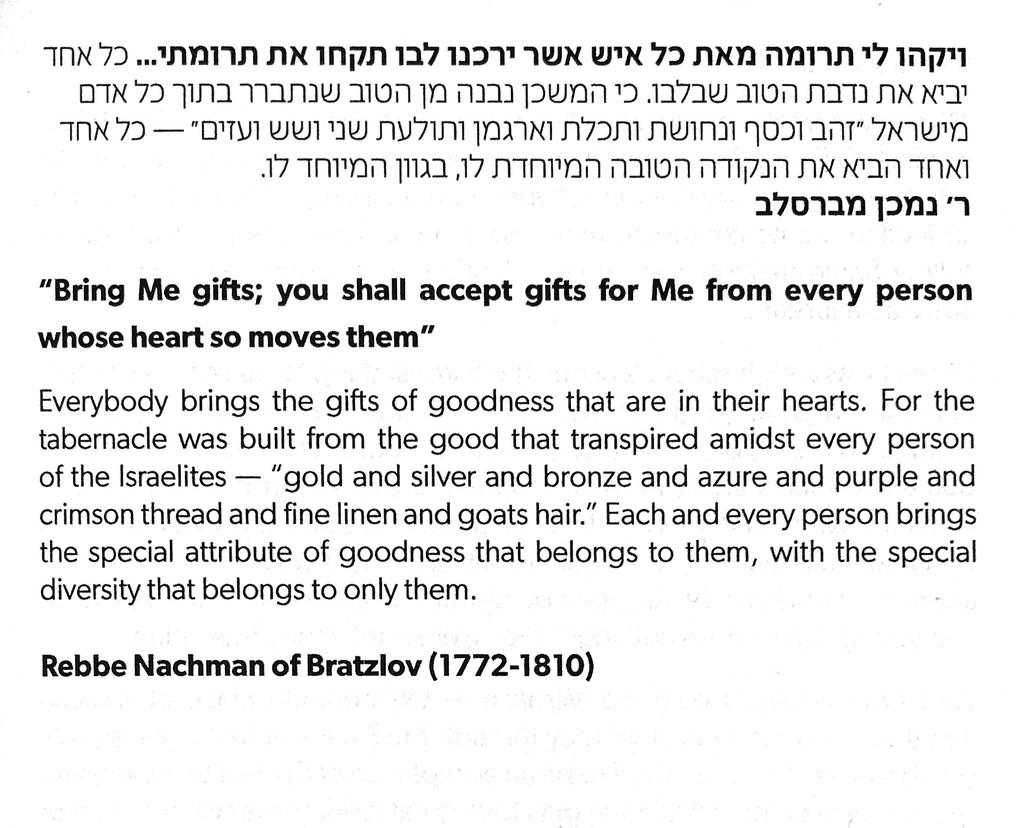
- What are your particular attributes of goodness?
- How do/can you contribute those to building mishkan?
The Jewish tradition distinguishes between two types of genorosity.
The first is the giving that comes becuase your heart is so moved that without even the flicker of a thought, you hand rushes to dig into your pocket to give. In the Torah, this generosity is called t'rumah, which means "gift." Generosity of this sort comes neither from obligation nor rational thought nor guilt but out of an irresistible feeling that stirs up deep wihin. It's a movement of the soul and it generates an open-handed response.
The other kind of generosity, called tzedakah, is obligated giving, such as tithing and other acts that come from committement, whether or not the heart is moved to act in that way.
- How do you understand the distinction between these two things in your life?
- How understand them in relation to other people?
The concept of generous and spontaneous giving from the heart appears in the Torah in the section where the where the Israelites underatke to build a sanctuary so that God might dwell among them. Rabbi Meir Leibush commented that the verse actually meanst hat God would dwell not literally in the sanctuary but among the people. He conclues that each person is to build a tabernacle in his or her own heart for God to dwell in. The Torah wants us to see that the way we do this inner construction work is by perfecting spontaneous generosity.
- How do you understand Leibush's teaching here? What would it mean for you?
- How do you cultivate this kind of spontaneous generosity?
The portion of Terumah begins with the invitation to explore and discern the true generosity of our hearts. For the Mishkan cannot be built solely out of a sense of duty, obligation or debt. Only the willing and generous heart can participate in this endeavor. The willing and generous heart is fueled by love and carries the motivation needed for spiritual practice.
What makes the artist choose one color over another? What inspires the composer to create a song that can open the heart? Where does the sculptor get her vision of the form that lies buried inside the block of marble? What moves the writer to express the inexpressible? Here is the blessing of Terumah: When the heart is willing and there is a commitment to the work, then the Divine Spirit will show us the pattern, the blueprint, the plan, the inspiration that births beauty into the world. And that beauty is designed to send us back to the Source of its inspiration.
- What is Shefa describing here? have you experienced this before?
- How does or could this appear in your spiritual practice?