
Save "חישובי קיצין"
חישובי קיצין
מאז תחילת האמונה בשובו של מלך מבית דוד, רבים ניסו לנחש ללא הצלחה את מועד בואו המובטח. סיפור הכשלונות לחיזוי מועד הקץ ארוך כאורכה של הגלות, ומפעים במעגליותו. פעם אחר פעם חזו תנאים, אמוראים, גאונים ורבנים מכל הדורות את זמן הגאולה העתידי, ובכל פעם מחדש כשלונם נחשף לעין כל, באופן מביך ביותר.
ספר דניאל שנכתב סביב 167 לפני הספירה, הינו הספר המשפיע ביותר על חישובי הקיצין הללו. כבר יוסף בן מתתיהו הזכיר והרחיב אודותיו, ומאז החישובים והפרשנויות רק התרחבו והתעדכנו ככל שההיסטוריה המשיכה להיכתב.
הפסוקים המסתוריים ביותר נראים כצופן שתעתע ברבים שוב ושוב, וגרם לניסיונות חוזרים ונשנים לחישובי הקץ המובטח.

וּמִלִּ֗ין לְצַ֤ד (עליא) [עִלָּאָה֙] יְמַלִּ֔ל וּלְקַדִּישֵׁ֥י עֶלְיוֹנִ֖ין יְבַלֵּ֑א וְיִסְבַּ֗ר לְהַשְׁנָיָה֙ זִמְנִ֣ין וְדָ֔ת וְיִתְיַהֲב֣וּן בִּידֵ֔הּ עַד־עִדָּ֥ן וְעִדָּנִ֖ין וּפְלַ֥ג עִדָּֽן׃

He will speak words against the Most High, and will harass the holy ones of the Most High. He will think of changing times and laws, and they will be delivered into his power for a time, times, and half a time.-c

וָאֶשְׁמְעָה אֶחָד־קָדוֹשׁ מְדַבֵּר. וַיֹּאמֶר אֶחָד קָדוֹשׁ לַפַּלְמוֹנִי הַמְדַבֵּר: עַד־מָתַי הֶחָזוֹן הַתָּמִיד וְהַפֶּשַׁע שֹׁמֵם תֵּת וְקֹדֶשׁ וְצָבָא מִרְמָס? וַיֹּאמֶר אֵלַי: עַד עֶרֶב בֹּקֶר אַלְפַּיִם וּשְׁלֹשׁ מֵאוֹת וְנִצְדַּק קֹדֶשׁ.

An army was arrayed iniquitously against the regular offering;-a it hurled truth to the ground and prospered in what it did. Then I heard a holy being speaking, and another holy being said to whoever it was who was speaking, “How long will [what was seen in] the vision last—the regular offering be forsaken because of transgression; the sanctuary be surrendered and the [heavenly] host be trampled?”-a He answered me, “For twenty-three hundred evenings and mornings; then the sanctuary shall be cleansed.”

וְרָאִיתִי אֲנִי דָנִיֵּאל וְהִנֵּה שְׁנַיִם אֲחֵרִים עֹמְדִים אֶחָד הֵנָּה לִשְׂפַת הַיְאֹר וְאֶחָד הֵנָּה לִשְׂפַת הַיְאֹר׃ וַיֹּאמֶר לָאִישׁ לְבוּשׁ הַבַּדִּים אֲשֶׁר מִמַּעַל לְמֵימֵי הַיְאֹר עַד־מָתַי קֵץ הַפְּלָאוֹת׃ וָאֶשְׁמַע אֶת־הָאִישׁ  לְבוּשׁ הַבַּדִּים אֲשֶׁר מִמַּעַל לְמֵימֵי הַיְאֹר וַיָּרֶם יְמִינוֹ וּשְׂמֹאלוֹ אֶל־הַשָּׁמַיִם וַיִּשָּׁבַע בְּחֵי הָעוֹלָם כִּי לְמוֹעֵד מוֹעֲדִים וָחֵצִי וּכְכַלּוֹת נַפֵּץ יַד־עַם־קֹדֶשׁ תִּכְלֶינָה כׇל־אֵלֶּה׃

וַאֲנִי שָׁמַעְתִּי וְלֹא אָבִין וָאֹמְרָה אֲדֹנִי מָה אַחֲרִית אֵלֶּה׃ וַיֹּאמֶר לֵךְ דָּנִיֵּאל כִּי־סְתֻמִים וַחֲתֻמִים הַדְּבָרִים עַד־עֵת קֵץ׃ יִתְבָּרְרוּ וְיִתְלַבְּנוּ וְיִצָּרְפוּ רַבִּים וְהִרְשִׁיעוּ רְשָׁעִים וְלֹא יָבִינוּ כׇּל־רְשָׁעִים וְהַמַּשְׂכִּלִים יָבִינוּ׃ וּמֵעֵת הוּסַר הַתָּמִיד וְלָתֵת שִׁקּוּץ שֹׁמֵם יָמִים אֶלֶף מָאתַיִם וְתִשְׁעִים׃ אַשְׁרֵי הַמְחַכֶּה וְיַגִּיעַ לְיָמִים אֶלֶף שְׁלֹשׁ מֵאוֹת שְׁלֹשִׁים וַחֲמִשָּׁה׃ וְאַתָּה לֵךְ לַקֵּץ וְתָנוּחַ וְתַעֲמֹד לְגֹרָלְךָ לְקֵץ הַיָּמִין׃

“But you, Daniel, keep the words secret, and seal the book until the time of the end. Many will range far and wide and knowledge will increase.” Then I, Daniel, looked and saw two others standing, one on one bank of the river, the other on the other bank of the river. One said to the man clothed in linen, who was above the water of the river, “How long until the end of these awful things?” Then I heard the man dressed in linen, who was above the water of the river, swear by the Ever-Living One as he lifted his right hand and his left hand to heaven: “For a time, times, and half a time;-a and when the breaking of the power of the holy people comes to an end, then shall all these things be fulfilled.” I heard and did not understand, so I said, “My lord, what will be the outcome of these things?” He said, “Go, Daniel, for these words are secret and sealed to the time of the end. Many will be purified and purged and refined; the wicked will act wickedly and none of the wicked will understand; but the knowledgeable will understand. (From the time the regular offering is abolished, and an appalling abomination is set up—it will be a thousand two hundred and ninety days. Happy the one who waits and reaches one thousand three hundred and thirty-five days.) But you, go on to the end; you shall rest, and arise to your destiny at the end of the days.”
מחבר ספר דניאל נותן ארבעה מספרים וצופן כפול. המספרים הם:
  1. 490
  2. 2300
  3. 1290
  4. 1335
הצופן הוא "מועד מועדים וחצי", ומופיע גם בארמית: "עידן ועידנין ופלג עידן".
מספרים אלו הפכו ליסוד מרבית חישובי הקץ בימי הביניים ואחריהם.

בתקופת התנאים, בין 70 - 200 לספירה
על ימי התנאים יש כמה רמזים בתלמוד הבבלי לחישובי קיצין שבוצעו, כגון רבי אליעזר (110), רבי יוסי הגלילי (130), רבי עקיבא (132), רבי אלעזר בן עזריה (140) ורבי יהודה הנשיא (סביב 160).

תַּנֵּי רִבִּי שִׁמְעוֹן בֶּן יוֹחַי. עֲקִיבָה רִבִּי הָיָה דוֹרֵשׁ "דָּרַךְ כּוֹכָב מִיַּעֲקֹב". דָּרַךְ כּוֹזִבָּא מִיַּעֲקֹב. רִבִּי עֲקִיבָה כַּד הֲוָה חֲמִי בַּר כּוֹזִבָּה הֲוָה אֲמַר: דֵּין הוּא מַלְכָּא מְשִׁיחָא! אָמַר לֵיהּ רִבִּי יוֹחָנָן בַּר תּוֹרְתָא: עֲקִיבָה! יַעֲלוּ עֲשָׂבִים בִּלְחָיֵיךָ [וְעַדַּיִין] בֶּן דָּוִד [לֹא] יָבֹא.

“Bettar was taken.” Rebbi used to preach 24 facts about the Eternal swallowed and showed no mercy, but Rebbi Joḥanan 60. So Rebbi Joḥanan more than Rebbi? Only since Rebbi was closer to the destruction of the Temple, there were there old men remembering, and those would cry and continuously silence him. It was stated: Rebbi Jehudah ben Rebbi Illai said, Baruch my teacher used to preach, the voice is Jacob’s voice but the hands are Esau’s hands. Jacob’s voice cries about what Esau’s hands did at Bettar. Rebbi Simeon ben Yohai stated: Aqiba my teacher used to preach, there appeared a star out of Jacob there appeared Koziba out of Jacob. When Rebbi Aqiba saw Bar Koziba he said, this is King Messias. Rebbi Joḥanan ben Torta said to him, Aqiba! Grass will grow from your jaws and still David’s son (still has to) [will not have] come. Rebbi Joḥanan said, the voice of Emperor Hadrian killing eighty thousand myriads at Bettar. Rebbi Joḥanan said, eighty [thousand] couples of horn-blowers were encircling Bettar, each of which was commanding several army units. There was Ben Koziba who had 200’000 with him missing a finger. The Sages sent, how long will you turn Israel into defective persons? He told them, how would it be possible to test them? They said to him, anyone who riding on his horse cannot uproot a cedar of Lebanon should not be enrolled in your army. He had 200’000 of either kind. When he went into battle he said, Master of the World: Do not support and do not hinder, did not you, God, neglect us, and do not go out with our armies. Three and a half years did Hadrian encircle Bettar. Rebbi Eleazar from Modiin was sitting in sackcloth and ashes, praying every day and saying, Master of the World, do not sit in judgment today, do not sit in judgment today. Hadrian wanted to go away. A Samaritan said to him, do not go away, for I am seeing what to do that the city will submit to you. He went to the city gate, entered, and found Rebbi Eleazar from Modiin standing in prayer. He showed himself as if he would whisper into his ear. The people of the city saw him and brought him to Ben Koziba. They said to him, we saw this old man turning to your uncle. He asked him, what did you say to him and what did he say to you? He answered, if I shall tell you, the king will kill me; but if I do not tell you, you will kill me. It is better that the king should kill me but not you. He told him, he said to me, I will make the town submit to the king. He came to Rebbi Eleazar from Modiin. He asked him, what did this Samaritan say to you. He answered, nothing. What did you say to him? He answered, nothing. He kicked him and killed him. Immediately there came an unembodied voice and said, woe, criminal shepherds, who abandon the flock, a sword on his arm and on his right eye. His arm shall dry up and his right eye darken. You killed Rebbi Eleazar from Modiin, the arm of Israel, and their right eye. Therefore this man’s arm shall dry up and his right eye darken. Immediately Bettar was taken and Ben Koziba killed. They came carrying his head to Hadrain. He asked them, who killed him? A Samaritan said to him, I killed him. He said to him, show me his body. He showed him his body; he found a poisonous snake wrapped around him. He said, if God had not killed him, who could kill him? He recited over him, if not that their Rock had sold them, and the Eternal handed them over. They killed them continuously until the horse was immersed in blood up to his nose. The blood was moving rocks of 40 seah loads, until the blood colored the sea for four mil. If you would say that it was close to the sea, in fact it is 40 mil distant from the sea. They said, 300 children’s brains were found on one stone, and they found three boxes of tefillin capsules of nine seah each, but some say nine of three each. It was stated, Rabban Simeon ben Gamliel says, 500 schools were in Bettar, the smallest one for not less than 500 children. They were saying, if the haters come against us we shall go out against them with these stylos and blind them. When the sins caused, they were binding each single one into his book and burning him; and of them only I remained. He recited referring to himself, my eye hurts my soul more than all daughters of my city. The evil Hadrian had a large vineyard, eighteen mil by eighteen mil, as from Tiberias to Sepphoris. He fenced it in with the slain of Bettar standing up with outstretched arms, and did not decide that they should be buried, until another king arose who decided that they should be buried.

תניא:

ר' אליעזר אומר: ימות המשיח ארבעים שנה. שנאמר: (תהלים צה, י) ארבעים שנה אקוט בדור.

רבי אלעזר בן עזריה אומר: שבעים שנה. שנאמר: והיה ביום ההוא ונשכחת צור שבעים שנה כימי מלך אחד. איזהו מלך מיוחד? הוי אומר זה משיח.

רבי אומר: שלשה דורות. שנאמר: (תהלים עב, ה) ייראוך עם שמש ולפני ירח דור דורים.

...תניא אידך:

ר' אליעזר אומר: ימות המשיח ארבעים שנה. כתיב הכא: "ויענך וירעיבך ויאכילך", וכתיב התם "שמחנו כימות עניתנו שנות ראינו רעה".

רבי דוסא אומר: ד' מאות שנה. כתיב הכא: "ועבדום וענו אותם ארבע מאות שנה", וכתיב התם: "שמחנו כימות עניתנו".

רבי אומר: ג' מאות וששים וחמש שנה, כמנין ימות החמה. שנאמר: "כי יום נקם בלבי ושנת גאולי באה".

And that is the background for the following exchange, as a certain heretic said to Rabbi Abbahu: When will the Messiah come? Rabbi Abbahu said to him: He will come when the darkness will enshroud these people, i.e., you. The heretic said to him: Are you cursing me for no reason? Rabbi Abbahu said to him, I am merely relating to you a verse that is written: “For behold, the darkness shall cover the earth, and fog the peoples; but the Lord shall shine upon you, and His glory shall be seen upon you” (Isaiah 60:2). § It is taught in a baraita: Rabbi Eliezer says: The messianic era will be forty years long, as it is stated: “Forty years will I strive with the generation” (Psalms 95:10). The forty years of strife with the gentiles will be followed by the glory days of the Messiah. Rabbi Elazar ben Azarya says: The messianic era will last seventy years, as it is stated: “And it shall come to pass on that day, that Tyre shall be forgotten seventy years, according to the days of one king” (Isaiah 23:15). In this context, one [eḥad], means unique [meyuḥad]. Which is the unique king? You must say that this is a reference to the Messiah. Rabbi Yehuda HaNasi says: The messianic era will last three generations, as it is stated: “May they fear You as long as the sun and moon endure, throughout the generations [dor dorim]” (Psalms 72:5). Dor is singular and dorim is plural, for a total of three generations. Rabbi Hillel says: There is no Messiah coming for the Jewish people, as they already ate from him, as all the prophecies relating to the Messiah were already fulfilled, during the days of Hezekiah. Rav Yosef says: May the Master forgive Rabbi Hillel for stating matters with no basis. With regard to Hezekiah, when was his reign? It was during the First Temple period. Whereas Zechariah ben Berechiah, the prophet, prophesied during the Second Temple period and said: “Rejoice greatly, daughter of Zion; shout, daughter of Jerusalem; behold, your king will come to you; he is just and victorious; lowly and riding upon a donkey and upon a colt, the foal of a donkey” (Zechariah 9:9). In the generations after Hezekiah, there are prophecies about both redemption and the coming of the Messiah. It is taught in another baraita: Rabbi Eliezer says: The messianic era will be forty years long. It is written here with regard to the forty-year sojourn of the children of Israel in the wilderness: “And He afflicted you, and suffered you to hunger and fed you with manna” (Deuteronomy 8:3); and it is written there: “Make us glad according to the days that You afflicted us, the years that we saw evil” (Psalms 90:15). Rabbi Dosa says: The messianic era will last four hundred years. It is written here with regard to the Covenant of the Pieces: “And they shall serve them, and they shall afflict them four hundred years” (Genesis 15:13); and it is written there: “Make us glad according to the days that You afflicted us.” Rabbi Yehuda HaNasi says: The messianic era will last 365 years, corresponding to the number of days of the solar year, as it is stated: “For the day of vengeance is in My heart, and the year of My redeemed is come” (Isaiah 63:4).

וכמה ימות המשיח... רבי יוסי אמר ששים שנה. שנאמר (תהלים עב ה) ולפני ירח דור דורים. דור כ' שנה, דורים מ' שנה. הרי ס'.

"For all our days have passed away in Your wrath... Rabbi Yehuda says this refers to bitterness, and the Rabbis say it refers to a youth that is cut off. We have completed our years... Our days pass away with toil and trouble... Rabbi Chanina bar Yitzchak said even his kingdom was toil and trouble, as it says 'I will recall Rahav and Babylon...' The Rabbis say it refers to harsh shearing and afflictions. Rabbi Yudan said, nevertheless, there were good deeds in it. Who knows the strength of Your anger? Rabbi Abba bar Kahana said, perhaps transgression has filled up your hand. Who knows the strength of Your anger? Rabbi Chanina bar Yitzchak said, whoever advances the Day of Judgment in this world, his sins come first. Let us calculate our years, so that we may bring wisdom to our hearts. Rabbi Eliezer said, repent one day before your death. His students asked, does a man know on which day he will die? He answered, therefore, one should repent every day, lest he die tomorrow, and thus all his days will be spent in repentance. Let us calculate our years so that we may bring wisdom to our hearts. Return, O Lord; how long will it be? Rejoice us according to the days You afflicted us, the years we have seen evil. Such are the days of the Exile in Babylonia, in Media, and in Edom. Another interpretation: such are the days of the Messiah. How many will be the days of the Messiah? Rabbi Eliezer says, a thousand years, as it is said, 'A day that is like a thousand years.' Rabbi Yehoshua says, two thousand years, as it is said, 'For the days of our life are seventy years,' and seventy times two is one hundred and forty. And the day of the Holy One, blessed be He, is one thousand years, as it is said, 'A thousand years in Your eyes are like yesterday.' Rabbi Baruchya says six hundred years, as it is said, 'The days of my people will be like the days of a tree.' And it is learned that this workshop is done in the earth for six hundred years. Rabbi Yosei says sixty years, as it is said, 'Before the moon, for generation of generations.'" Generation follows generation; one generation passes away, and another generation comes. According to Rabbi Akiva, a generation is forty years, as it says, "As the days of our years, so is our life" (Psalms 90:10), which is likened to the forty years that our ancestors spent in the wilderness, as it says, "And He afflicted you, and let you hunger" (Deuteronomy 8:3). However, the Sages say that a generation is three hundred and fifty-four years, corresponding to the number of days in the lunar year, as it says, "And the year of my redemption has come" (Isaiah 63:4). Rabbi Abbahu says that a generation is seven thousand years, corresponding to the seven days of the week, as it says, "For a young man shall marry a virgin" (Isaiah 62:5), and just as a wedding lasts seven days, so too a generation lasts seven thousand years.
הדיונים כפי שהם לפנינו נסובו על משך הזמן של ימות המשיח, דהיינו מיום ביאתו ועד תום התקופה. אולם ייתכן שבמקור נושא הדיון היה בכלל התקופה שלפני ביאת המשיח. לאחר האכזבות שונתה במעט הברייתא שעברה בעל פה, כך שתישאר רלוונטית.
ייתכן שבמקור, רבי אליעזר בן הורקנוס שחי בדור שלאחר חורבן בית שני, קבע את מועד ביאת המשיח לימיו, סביב שנת 110 לספירה, 40 שנה לאחר החורבן.
רבי יוסי הגלילי שחי בתקופת יבנה, קבע את המועד ל-60 שנה לאחר החורבן, בשנת 130 (תחילת מרד בר כוכבא). וכמוהו רבי עקיבא, שראה בבר כוזיבא משיח.
רבי אלעזר בן עזריה חי גם הוא בתקופת יבנה וקבע את מועד הקץ לימיו, לשנת 140 (מספר שנים לאחר כשלון מרד בר כוכבא).
ורבי יהודה הנשיא שחי במחצית השניה של המאה השניה, שיער שמשיח יבוא בימיו, שלושה דורות לאחר החורבן: לאחר אביו רבן שמעון בן גמליאל, ולאחר סביו רבן גמליאל דיבנה.
למעשה תלמידו של רבי יהודה הנשיא, האמורא רב, הצביע על רבו כמועמד אפשרי להיות המשיח.

אמר רב: אי מן חייא הוא - כגון רבינו הקדוש.

Rav Naḥman says: If the Messiah is among the living in this generation, he is a person such as me, who already has dominion over the Jewish people, as it is stated: “And their prince shall be of themselves, and their governor shall proceed from their midst” (Jeremiah 30:21), indicating that the redeemer is already in power. Rav says: If the Messiah is among the living in this generation, he is a person such as our saintly Rabbi Yehuda HaNasi, who was renowned for his sanctity, piety, and Torah knowledge. If the Messiah is among the dead he is a person such as Daniel, the beloved man.
מדרש נוסף ומעט סתום, בשמו של רבי נתן מתקופת אושא (132 - 160), מזכיר באופן תמוה את רבי שמלאי שחי אחריו, בדור השני של האמוראים (סביבות 240 לספירה. יוסף קלאוזנר הציע להחליף את רבי שמלאי ברבי ישמעאל). לשון הברייתא קשה וכנראה משובשת, אך ברור שהיא עוסקת בחישוב קיצין, שחלקם אכזבו.
כך לפחות קרה עם אמונתו של רבי עקיבא בבר כוזיבא.

תניא:

רבי נתן אומר: מקרא זה נוקב ויורד עד תהום: "כי עוד חזון למועד, ויפח לקץ, ולא יכזב. אם יתמהמה - חכה לו. כי בא יבא לא יאחר".

לא כרבותינו שהיו דורשין: "עד עידן עידנין ופלג עידן".

ולא כר' שמלאי שהיה דורש: "האכלתם לחם דמעה ותשקמו בדמעות שליש".

ולא כרבי עקיבא שהיה דורש: "עוד אחת מעט היא, ואני מרעיש את השמים ואת הארץ".

אלא מלכות ראשון - שבעים שנה. מלכות שניה - חמשים ושתים. ומלכות בן כוזיבא - שתי שנים ומחצה.

Rav Ḥanan bar Taḥlifa sent a message to Rav Yosef: I found one man, and in his hand there was one scroll written in Ashurit script and in the sacred tongue, Hebrew. I said to him: From where did this scroll come into your possession? He said to me: I was hired to serve in the Roman army and I found the scroll among the Roman archives. It was clear that the scroll was written by Jews, not Romans. And it is written in the scroll: After 4,291 years have elapsed from the creation of the world, the world will end; during those years there will be the wars of the sea monsters between the leviathan and the animals, and among those years there will be the wars of Gog and Magog and the remaining years of the messianic period. Then the world will be destroyed. And the Holy One, Blessed be He, will renew His world only after the passage of seven thousand years. Rav Aḥa, son of Rava, says that it was stated: After the passage of five thousand years. § It is taught in a baraita that Rabbi Natan says: This verse penetrates and descends until the depths; just as the depths are unfathomable, so too, the period depicted in the following verse is unquantifiable. “For the vision is yet for the appointed time; and it declares of the end, and does not lie; though it tarry, wait for it, because it will surely come; it will not delay” (Habakkuk 2:3). The Messiah will come not in accordance with the opinion of our Rabbis, who would interpret the verse: “For a period and periods and a half period” (Daniel 7:25), to mean that the duration of the ultimate exile will be three and a half times the duration of the period of the exile in Egypt. And the Messiah will come not in accordance with the opinion of Rabbi Simlai, who would interpret the verse: “You have fed them with the bread of tears and have given them tears to drink in great measure [shalish]” (Psalms 80:6), to mean that the duration of the ultimate exile will be three times the duration of the period of the exile in Egypt. And the Messiah will come not in accordance with the opinion of Rabbi Akiva, who would interpret the verse: “Yet once, it is a little while, and I will shake the heavens and the earth” (Haggai 2:6), to mean that the redemption would transpire soon after the destruction of the Temple. Rather, the first, great, Hasmonean monarchy ruled seventy years. The second kingdom, of Herod and his descendants, ruled fifty-two years, and the duration of the monarchy of bar Koziva, or bar Kokheva, was two and a half years. The duration of the exile that follows is unknown.
מסקנת הברייתא היא שהפסוק מדבר על שלושת המלכויות. חזון למועד - 70 שנה. ויפח לקץ - 52. ולא יכזב - 2 וחצי. מכאן בוא יבוא ולא יאחר.
לא מצאתי מדרש מתאים של "רבותינו" על הפסוק "עידן עידנין ופלג עידן".
אך קיים מדרש קשור של רבי שמלאי, על גלות אדום, היא גלות רומי.

האכלתם לחם דמעה ותשקמו בדמעות שליש... רבי אבין אמר, ואית דאמרי משמיה דרבי שמלאי: אמרה כנסת ישראל, רבון העולמים, בזכות שלש דמעות שהוריד אותו רשע השלטת אותו בכל העולם ונתת לו שלוה בעולם הזה. לכשתבוא לראות עלבון בניך, שעיניהם זולגות בכל יום ודמעתם תדירה כלחם, כענין שנאמר (תהלים מב ד) היתה לי דמעתי לחם וגו'. על אחת כמה וכמה שתמלא עליהם רחמים:

You have eaten the bread of tears, etc. Rabbi Elazar says that Esau the wicked shed three tears from his eyes. One from his right eye, one from his left eye, and the third is connected to both eyes, as it says, "And you shall wet your bread with tears, a third part thereof" (Psalms 80:6). He only says "a third," not "three." Rabbi Berachiah says, "One-third of a tear he shed." Rabbi Avin says, and some say it was in the name of Rabbi Shemlai, that the Great Assembly said before God, "Master of the Universe, because of the three tears that the wicked Esau shed, you have given him control over the entire world, and you have given him peace in this world. When you see the suffering of your children and their eyes overflowing with tears every day, just as it says, 'My tears have been my food day and night' (Psalms 42:4), have mercy on them, even if it is just a little."

תקופת האמוראים
חישובי הקיצין מתקופת התנאים ניטשטשו במהלך הדורות. אך ברייתא מכוננת אחת גרמה לזעזוע בדור הראשון של האמוראים, כזה ששינה את השקפתם של רבים מהם.
שנת 240
מדרש תנא דבי אליהו קבע את הקץ לשנת 240 שאז מתחיל האלף החמישי בספירה לבריאת העולם

תנא דבי אליהו: ששת אלפים שנה הוי עלמא. שני אלפים תוהו, שני אלפים תורה, שני אלפים ימות המשיח.

It is taught in a baraita in accordance with the opinion of Rav Ketina: Just as the Sabbatical Year abrogates debts once in seven years, so too, the world abrogates its typical existence for one thousand years in every seven thousand years, as it is stated: “And the Lord alone shall be exalted on that day,” and it states: “A psalm, a song for the Shabbat day” (Psalms 92:1), meaning a day, i.e., one thousand years, that is entirely Shabbat. And it says in explanation of the equation between one day and one thousand years: “For a thousand years in Your eyes are but like yesterday when it is past, and like a watch in the night” (Psalms 90:4). The school of Eliyahu taught: Six thousand years is the duration of the world. Two thousand of the six thousand years are characterized by chaos; two thousand years are characterized by Torah, from the era of the Patriarchs until the end of the mishnaic period; and two thousand years are the period of the coming of the Messiah. That is the course that history was to take, but due to our sins that time frame increased. The Messiah did not come after four thousand years passed, and furthermore, the years that elapsed since then, which were to have been the messianic era, have elapsed. Elijah the prophet said to Rav Yehuda, brother of Rav Sala Ḥasida: The world will exist no fewer than eighty-five Jubilee cycles, or 4,250 years. And during the final Jubilee, the son of David will come. Rav Yehuda said to Elijah: Will the Messiah come during the beginning of the Jubilee or during its end? Elijah said to Rav Yehuda: I do not know. Rav Yehuda asked: Will this last Jubilee cycle end before the Messiah comes or will it not yet end before his coming? Elijah said to him: I do not know. Rav Ashi says: This is what Elijah said to him: Until that time do not anticipate his coming; from this point forward anticipate his coming. Elijah did not inform Rav Yehuda of the date of the coming of the Messiah.
האמורא רב (175 - 247) נוכח כנראה בשנת 240 כי כל חישובי הקיצין מימי התנאים לפניו התבררו כשגויים, כולל זה של תנא דבי אליהו.

אמר רב: כלו כל הקיצין, ואין הדבר תלוי אלא בתשובה ומעשים טובים.

ושמואל אמר: דיו לאבל שיעמוד באבלו.

§ Rav says: All the ends of days that were calculated passed, and the matter depends only upon repentance and good deeds. When the Jewish people repent, they will be redeemed. And Shmuel says: It is sufficient for the mourner to endure in his mourning to bring about the coming of the Messiah. Even without repentance, they will be worthy of redemption due to the suffering they endured during the exile. The Gemara notes: This dispute is parallel to a dispute between tanna’im: Rabbi Eliezer says: If the Jewish people repent they are redeemed, and if not they are not redeemed. Rabbi Yehoshua said to him: If they do not repent, will they not be redeemed at all? Rather, the Holy One, Blessed be He, will establish a king for them whose decrees are as harsh as those issued by Haman, and the Jewish people will have no choice but to repent, and this will restore them to the right path.
באותו דור גם רבי יונתן בן אלעזר (חי בדורו של רב, בסביבות 200 - 250) הביע את אכזבתו מכליית הקץ במדרש שהפך להיות מפורסם מאוד.

מאי ויפח לקץ ולא יכזב?

א"ר שמואל בר נחמני, אמר ר' יונתן: תיפח עצמן של מחשבי קיצין. שהיו אומרים, כיון שהגיע את הקץ ולא בא - שוב אינו בא. אלא חכה לו. שנאמר: אם יתמהמה חכה לו.

The Gemara asks: What is the meaning of the phrase “And it declares [veyafe’aḥ] of the end, and does not lie”? Rabbi Shmuel bar Naḥmani says that Rabbi Yonatan says: May those who calculate the end of days be cursed [tippaḥ], as they would say once the end of days that they calculated arrived and the Messiah did not come, that he will no longer come at all. Rather, the proper behavior is to continue to wait for his coming, as it is stated: “Though it tarry, wait for it.” Lest you say we are expectantly awaiting the end of days and the Holy One, Blessed be He, is not awaiting the end of days and does not want to redeem His people, the verse states: “And therefore will the Lord wait, to be gracious to you; and therefore will He be exalted, to have mercy upon you; for the Lord is a God of judgment; happy are all they who wait for Him” (Isaiah 30:18).
רבי יהושע בן לוי שחי גם הוא באותו זמן, ניסה להסביר את האכזבות מחישוב הקץ.

אמר רבי אלכסנדרי, רבי יהושע בן לוי רמי:

כתיב (ישעיהו ס, כב) "בעתה", וכתיב "אחישנה".

זכו - "אחישנה", לא זכו - "בעתה".

§ Rabbi Alexandri says: Rabbi Yehoshua ben Levi raises a contradiction in a verse addressing God’s commitment to redeem the Jewish people. In the verse: “I the Lord in its time I will hasten it” (Isaiah 60:22), it is written: “In its time,” indicating that there is a designated time for the redemption, and it is written: “I will hasten it,” indicating that there is no set time for the redemption. Rabbi Alexandri explains: If they merit redemption through repentance and good deeds I will hasten the coming of the Messiah. If they do not merit redemption, the coming of the Messiah will be in its designated time.
מאז נהגו שוני הברייתא להוסיף הערה מאוכזבת, הכוללת את מספר השנים שיצאו מאלפיים שנות המשיח.
ובעונותינו שרבו יצאו מהם מה שיצאו
That is the course that history was to take, but due to our sins that time frame increased. The Messiah did not come after four thousand years passed, and furthermore, the years that elapsed since then, which were to have been the messianic era, have elapsed.
בתלמוד הוסיפו עצות למי ששונה את הברייתא, כיצד לדעת את השנה המעודכנת.

אמר רב פפא: אי טעי תנא, ולא ידע פרטיה כמה הוי, לישייליה לספרא כמה כתיב, וניטפי עלייהו ארבעין ותמני, ומשכח ליה לחומריה.

With regard to this baraita as well, Rav Pappa said: If a tanna meant to state that at his time such and such years were already lost from the two thousand years that are designated for the days of the Messiah, but he forgot and did not know the details of exactly how much time had passed, let him ask a scribe how many years he writes when he dates documents. And let him add forty-eight to the number, correcting for the century, and in this manner he will find his number. And your mnemonic for this is the verse:
בסביבות שנת 940 לספירה עלה המדרש על הכתב, ומניין השנים נצרב בטקסט

ובעונותינו שרבו יצאו מה שיצאו, ונכנס שיעבוד בתוך שני אלפים של ימות בן דוד (יותר מז' מאות שנה).

One thing after another, the days were created, and not one of them is the seventh day forever, according to this world six thousand years, two thousand years, two thousand Torah, two thousand years, the son of David will die, and in our seasons many will go out, what went out, and will come in to work within two thousand years of the death of the son of David (more than 100 years) as it is said God did what he planned (Lamentations 2:17) and just as we make a shemitah once every seven years, so the Almighty will make a shemitah for the world one day which is a thousand years as it is said that a thousand years are in your eyes as yesterday (Psalms 90:4). And says And there was one day (Zechariah 14:7), this is the seventh day of the world, and at evening there was light (Zechariah 14:7), this is the world to come, which is said to be every month in its month, and every Sabbath in its Sabbath (Isaiah 66:23 ) And a psalm is said for the Sabbath day to the world that is all Sabbath. Another thing is a psalm a song for the Sabbath day that shuts off from the world. Another thing is a psalm a song for the Sabbath day is the seventh day to the world. And for the evening of the Sabbath it is the world to come in which there is no death for the eternal and the eternal, and in it there is neither sin nor iniquity nor plagues And no rebellions, but each and every one rejoices with his wisdom and understanding. How do you know that he did go out and learn from the Holy One, blessed be He, who rejoices in David in this world and the glory of heaven in the next world that was said and these are David's last words and ending "The utterance of is David the son of Ishai, and he utterance of the person who stands" on the mountains of learning, who accepted upon themselves the yoke of Torah and the yoke of mitzvot. What is your payment in front of Me? That you will be called 'the anointed of the God of Yaakov, and the sweet singer of Israel'. Happy is the person who sets themselves as an ox to the yoke, and as a donkey to the burden, and sits and meditates every day in Torah, always, immediately the Spirit of God rests on them, and the their Torah gets inside them, as it is written "Ho, everyone who thirsts, come for water" (Isaiah 55:1), and any mention of water really means Torah. How so? Explanation: a person reads Torah, prophets, writings, Mishnah, Halakhot, Agadot, and Midrash; and spends much time sitting, and little time in business, immediately the spirit of God is within that person, and His message are in that person's tongue, as it is written "The spirit of Ad-nai has spoken through me, His message is on my tongue" (II Sam 23:2). Happy is the person that plays with the words of the Torah and sits and chews on them like an animal that chews the cud on the field. ...
רבינו חננאל (965 - 1055) הוסיף גם הוא בשנת 1043:

ובעונותינו שרבו ויצאו מימות המשיח תת"ג שנה עכשיו


השנים 440 - 490
לפי רב יהודה אחיו של רב סלא חסידא, העולם כולו הוא 4250 שנה, ומשיח יבוא בין 440 ל-490 לספירה.
'סתמא דגמרא' מתעניין מאוד מתי בדיוק בחמישים השנים הללו הוא יבוא, ורב אשי שחי במאה החמישית וראה שהמועד הגיע לקיצו, טורח להבהיר שזהו המועד המינימלי שממנו והלאה יש לצפות לביאת הגואל.

אמר ליה אליהו לרב יהודה אחוה דרב סלא חסידא: אין העולם פחות משמונים וחמשה יובלות, וביובל האחרון בן דוד בא!

אמר ליה: בתחילתו או בסופו?

אמר ליה: איני יודע (יש גורסים: בסופו).

כלה או אינו כלה?

אמר ליה: איני יודע.

רב אשי אמר, הכי א"ל: עד הכא לא תיסתכי ליה, מכאן ואילך איסתכי ליה.

Elijah the prophet said to Rav Yehuda, brother of Rav Sala Ḥasida: The world will exist no fewer than eighty-five Jubilee cycles, or 4,250 years. And during the final Jubilee, the son of David will come. Rav Yehuda said to Elijah: Will the Messiah come during the beginning of the Jubilee or during its end? Elijah said to Rav Yehuda: I do not know. Rav Yehuda asked: Will this last Jubilee cycle end before the Messiah comes or will it not yet end before his coming? Elijah said to him: I do not know. Rav Ashi says: This is what Elijah said to him: Until that time do not anticipate his coming; from this point forward anticipate his coming. Elijah did not inform Rav Yehuda of the date of the coming of the Messiah.
שנת 468 - 471
לדעת רבי חנינא 468 לספירה היא השנה המדויקת, והגלות תארך כמו גלות מצרים, 400 שנה. בברייתא נאמר כי זו תהיה 471 לספירה.

אמר רבי חנינא: אחר ארבע מאות לחורבן הבית, אם יאמר לך אדם, קח שדה שוה אלף דינרים בדינר אחד - לא תקח!

במתניתא תנא: אחר ארבעת אלפים ומאתים ושלשים ואחת שנה לבריאת עולם, אם יאמר לך אדם, קח לך שדה שוה אלף דינרים בדינר אחד - אל תקח!

מאי בינייהו? איכא בינייהו תלת שנין, דמתניתא טפיא תלת שני.

Rabbi Ḥanina says: After the year 400 from the destruction of the Temple, if a person says to you: Purchase a field that is worth one thousand dinars for one dinar, do not purchase it. It is not a worthwhile investment, as the redemption will soon come and all fields will revert to their original owners. It was taught in a baraita: After the year 4,231 from the creation of the world, if a person says to you: Purchase a field that is worth one thousand dinars for one dinar, do not purchase it. The Gemara asks: What is the difference between these two dates? The Gemara answers: There is a difference between them of three years, as the baraita adds three years. The year 400 from the destruction of the Temple corresponds to the year 4,228 from the creation of the world.
שנת 531
לפי מגילה שנמצאה בגנזי רומי, שנת 531 "העולם ייתום" (יגיע לקיצו).

שלח ליה רב חנן בר תחליפא לרב יוסף: מצאתי אדם אחד, ובידו מגילה אחת כתובה אשורית ולשון קדש. אמרתי לו: זו מניין לך? אמר לי: לחיילות של רומי נשכרתי, ובין גינזי רומי מצאתיה. וכתוב בה: לאחר ד' אלפים ומאתים ותשעים ואחד שנה לבריאתו של עולם העולם יתום. מהן מלחמות תנינים, מהן מלחמות גוג ומגוג, ושאר ימות המשיח. ואין הקב"ה מחדש את עולמו אלא לאחר שבעת אלפים שנה. רב אחא בריה דרבא אמר לאחר חמשת אלפים שנה איתמר.

Rav Ḥanan bar Taḥlifa sent a message to Rav Yosef: I found one man, and in his hand there was one scroll written in Ashurit script and in the sacred tongue, Hebrew. I said to him: From where did this scroll come into your possession? He said to me: I was hired to serve in the Roman army and I found the scroll among the Roman archives. It was clear that the scroll was written by Jews, not Romans. And it is written in the scroll: After 4,291 years have elapsed from the creation of the world, the world will end; during those years there will be the wars of the sea monsters between the leviathan and the animals, and among those years there will be the wars of Gog and Magog and the remaining years of the messianic period. Then the world will be destroyed. And the Holy One, Blessed be He, will renew His world only after the passage of seven thousand years. Rav Aḥa, son of Rava, says that it was stated: After the passage of five thousand years.

לאחר חתימת התלמוד
שנת 531 חלפה ועברה, ועדיין לא נושענו. אך מחשבי הקיצין לא התייאשו.
מדרש פרקי דרבי אליעזר מתוארך למאה השביעית. שם נכתב כי מלכויות אדום, יוון, פרס וישמעאל ישלטו פחות מאלף שנה (החישוב יכול להתחיל מימי אנטיוכוס לשנת 832, מתחילת בית שני לשנת 650 או מחורבנו לשנת 1070).

ר' אלעזר בן עזריה אומר, מכאן אתה למד שאין מושלן של ארבע מלכיות הללו אלא יום אחד מיומו של הב"ה.

אמר לו ר' אלעזר בן ערך: בודאי כדבריך. שנאמר: נתנני שוממה כל היום דוה. חוץ משתי ידות שעה. תדע לך שהוא כן. בא וראה: כשהחמה נוטה במערב שתי ידות, תשש אורו ואין נוגה לו. וכן עד שלא יבא העורב, ישמח אורן של ישראל. שנאמר: והיה לעת ערב יהיה אור.

Rabbi Elazar ben 'Azariah said: From this incident thou mayest learn that the rule of these four kingdoms will only last one day according to the day of the Holy One, blessed be He. Rabbi Elazar ben 'Arakh said unto him: Verily it is so, according to thy word, as it is said, "He hath made me desolate and faint all the day" (Lam. 1:13), except for two-thirds of an hour (of God). Know that it is so. Come and see, for when the sun turns to set in the west, (during) two hours its power is weakened, and it has no light, likewise whilst the evening has not yet come, the light of Israel shall arise, as it is said, "And it shall come to pass, that at evening time there shall be light" (Zech. 14:7).

ותרדמה נפלה על אברם. ...א"ר אלעזר מכאן אתה למד שממשלתן של ארבע אומות הללו אינן אלא יום אחד של הקב"ה. אמרו לו ר' אלעזר: ודאי כדבריך נתנני שוממה כל היום דוה. חוץ משתי ידות שעה. ותדע שכן הוא שהרי כשהשמש נוטה לבא במער' תשש כחו ואורו עד שיבא הערב שיצמח אורן של ישראל שנאמר לעת ערב יהיה אור.

ותרדמה נפלה על אברם, “and a deep darkness (sleep) had fallen upon Avraham. During this sleep G–d showed Avraham that his descendants would endure the enslavement to several kingdoms at different times as well as the collapse of these kingdoms (empires). When he was told to קחה לי עגלה משולשת, “take for Me a three year old calf,” (verses 8) this was a reference to the fourth (and last) of these empires, which would subjugate the Jews more cruelly and for longer than any other. This has been confirmed by a vision experienced by Daniel, (Daniel 7,7) with the words: דחילה ואמתני, “excessively terrifying and awesome.” The עז משולשת , “three year old goat,” represents the Greek empire. (Daniel, 8,5 וצפיר העזים בא מן המערב, “and the-goat came from the west across the surface of the whole earth.) The three year old ram, איל משולש, represents the empire of the Medes and Persians; mentioned in Daniel 8,8, i.e. וצפיר העזים הגדיל עד מאד, “and the he-goat grew exceedingly.” The תור, in our verse refers to the empire of the Ishmaelites. The word here has to be understood as the aramaic,תר ,שור, “ox or bull”. (The author on a Targum, unfamiliar to this editor) The גוזל in our verse refers to the Jewish people. It appears in that sense in Song of Songs, 2,14, as well as in the same Book, 6,9).
Rabbi Acha claims that the word משולש and משולשת is a metaphor for anything that is exceedingly strong. He quotes as support for his view Kohelet 4,12: והחוט המשולש לא במהרה ינתק, “and the threefold cord will not tear easily.” Rabbi Mesharshia, interpreting the word משולשים, understands the rule of the empires while the Israelites are under their domination as occurring during three different periods in history. The first time each of these empires states, or Kingdoms, dominates the Israelites on their own. unaided by other powers. The second time, two of those powers combine in subjugating the Israelites On the third occasion, during the period ushering in the messianic age, they all combine in their assault, as a result of which the Messiah will appear. He quotes Psalms 2,2; יתיצבו מלכי ארץ ורוזנים נוסדו יחד על ה' ועל משיחו, “all the kings of the earth and its regents will take a combined stand against the Lord and His messiah.” Rabbi Yoshua, in referring to the phrase: ויבתר אותם בתוך “he divided them in the middle,” understand the subject in that phrase as being the respective swords of Avraham’s opponents, thus breaking their power in half. He adds that if Avraham had not succeeded in doing this, the earth as we know it could not have continued to function. Concerning the Torah writing that Avraham did not divide the צפור, this is why that bird represents the Jewish people, and no other species of birds has ever been called tzipor, a young turtle dove. וירד העיט על הפגרים, “when the vultures tried to descend on the cadavers, (Avraham chased them away).” The word עיט here is a metaphor for David (the King) he has been compared to a coloured vulture. Compare Jeremiah 12,9: העיט צבוע נחלתי לי ,העיט סבב עליה, אספו כל חית השדה התיו לאכלה, (normal translation from beginning of that verse: “My own people acts towards Me like a bird of prey or hyena; let the birds of prey surround it, go gather the wild beasts bring them to devour.” The metaphoric interpretation our author cites and which is also mentioned by Rashi, understands the עיט, as being coloured, as it is so different from all other birds and stands out therefore. The gentile nations view the Jewish people as different and therefore cannot abide it. They gather together in order to commit genocide of the Jewish people. This enables us to understand why Avraham in his dream is described as “reviving, וישב”, the corpses of the slain Jews, so that we would have here a first hint that Jews will be resurrected in due course (as described in Ezekiel chapter 37). (Compare Psalms 147,18, where the expression yashev occurs in such a positive way.) Another explanation credited to Rabbi Eleazar, feels that our verse proves that the power of any of the aforementioned kingdoms which excel in persecuting Jews will not last for more that a single day in G–d’s calendar, as such a “day” is a thousand years in our calendar. (Compare Psalms 90,4: כי אלף שנים בעיניך כיום אתמול כי יעבור, “for one thousand years in Your eyes are as yesterday that has passed.”) A colleague of Rabbi Eleazar concurred with him, adding that additional proof could be cited from Lamentations 1,13, נתנני שוממה כל היום, “He made me desolate all day long.” The power of this last empire would gradually evaporate in the west, symbol of the day coming to an end, and the ascent of the Jewish people would commence in the evening as predicted in Zachariah 14,7: והיה לעת ערב יהיה אור, “and it will be that at evening time there will be light.” Another thing that can be predicted based on Avraham’s dream and its wording is that there will be a total of four eras of suppression of the Jewish people; the expression אימה חשיכה, refers to the suppression of the Jewish religion in the time of the Seleucids, Antiochus, who tried to eradicate us spiritually by forbidding us to practice our religion, whereas the empire following the decline of the Greeks, the Medes produced Haman who tried to eradicate us physically. The word נופלת, refers to the Babylonian empire during the heyday of which the first Temple was destroyed and most of our people (that had not been exiled when the ten tribes were exiled by the Assyrians), were exiled. The word עליו refers to the suppression of our people by the Ishmaelites, who will be overcome by the Messiah, descendant of David, as predicted in Psalms 132,18: שם אצמיח קרן לדוד, ערכתי נר למשיחי, “there I will make a horn sprout for David, I have prepared a lamp for My anointed one.” Rabbi Elazar ben Azaryah is on record as having said that these empires were created by G–d only to serve G–d as firewood to heat up the fires in hell. This is why the Torah wrote here: והנה תנור עשן ולפיד אש, “and behold there was a furnace and a flaming torch (verse 17),” and we find a reference to this phenomenon also in Isaiah 31,9: נאום ה' אשר אור לו בציון ותנור לו בירושלים, “says the Lord Who has a fire in Zion and a furnace in Jerusalem.” This is the way in which G–d illustrated to him that there is such a region we call gehinom, (hell). He also showed him the Torah and the animals used for the sacrificial service in the Temple, indicating to him that as long as his descendants would observe both, they would never have to be afraid of gehinom. Nonetheless, He showed that even the Temple would be destroyed one day, so that the sacrificial service would not be able to be performed. He asked Avraham if he preferred that his descendants descend to gehinom at a time like that, or if he preferred that they endure slavery and persecution while alive on earth. Avraham was in a quandary how to answer such a question. This is why we read in Deuteronomy 32,30, that even the gentiles came to the conclusion that the sudden and drastic decline of the fortunes of the Jewish people could only have come about because their צור, (Rock), metaphor for the patriarch Avraham in this case, had “sold them out.” (had chosen persecution and exile for his descendants rather than gehinom.) According to Pirke de Rabbi Eliezer, an ancient kabalistic text chapter 28 the word צור in Isaiah 51,1: הביטו אל צור חצבתם, “look at the tzur from which you have been hewn,” is also a reference to the patriarch Avraham. [My edition of Pirke de Rabbi Eliezer, while quoting Isaiah 31,9 in the sense that our author quoted Rabbi Eliezer ben Azaryah having done, does not refer to Isaiah 51,1 at all. Most of the other text quoted here has been taken from that chapter in Pirke de Rabbi Eliezer. Ed.] [In the event that any of my readers finds it strange that the 400 years of bondage etc. in Egypt are not referred to in Avraham’s dream at all, 1) he was told about this while awake, 2) in Egypt the Israelites had not been a people in the sense of having their own land and a political union known as “state.” This only began at the time of the Exodus, and specifically when Joshua conquered the land of Canaan. Ed.]
וכך השביעני מטטרון כי [ביום אחד ועשרים לחדש הראשון] למלאות חרבות ירושלם תשע מאות ותשעים שנה תהיה תשועת ה׳ [יבא מנחם בן עמיאל בימי ארמילוס אשר תלד הצלם]
שנת 985
רב סעדיה גאון (882 - 942) חישב שלושה קיצין מתחילת בית שני לפי ספר דניאל (350 לפנה"ס לפי 420 שנות הבית): שנת 800, שנת 940 ושנת 985.

וחקרתי ‏ומצאתי זה מסכים שנאמין, שהוא רוצה במאמר "מועדים", שני מלכות ישראל, ויהיה הקץ כשני ‏מלכותם וחציים בלי ספק. והוא שכל עתי המלכות שמנה מאות ותשעים שנה, ת"פ קודם בנין הבית, ‏ות"י בבית, וחציים תמ"ה, יהיה הכל אלף ושלש מאות ושלשים וחמש בלי תוספת ובלי חסרון. ויהיה ‏אמרו (דניאל י"ב י"א) ומעת הוסר התמיד ולתת שקוץ שומם ימים אלף מאתים ותשעים, מעת ‏מאורע שאירע בבית שני בתחלת בנינו, תהיה אחר העת אשר אמר בו המאמר הזה לדניאל, חמש ‏וארבעים שנה.

וכאשר לא הזיק בקץ הראשון השתנות שלשה זמנים, ארבע מאות, ‏וארבע משות ושלשים, ור"י, ולא הזיק בקץ השני השתנות שני זמנים, נ"ב, וע', כן לא יזיק בקץ ‏השלישי השתנות שלשה זמנים, אלף ומאה וחמשים, ואלף ור"צ, ואלף ושלש מאות ול"ה, בעבור ‏שחנן אלהים את עמו מהחכמה מה שיכירו בה הכל:‏

הרמב"ם (1138 - 1204) באיגרת תימן שנכתבה בשנת 1173, ניסה לענות על הטענות על כי הקץ של רב סעדיה גאון חלף כבר, בטענה כי אף אחד לא יודע באמת את הקץ, ורב סעדיה עשה זאת רק כדי לחזק את אנשי דורו.

אבל מה שזכרת מדבר הקצים, ומה שבאר רב סעדיה בהם. תחלת מה שיש עליך לדעת, שהקץ על דרך האמת - לא יתכן לשום אדם לדעת אותו לעולם. כמו שבאר דניאל ואמר (דניאל י"ב ט') כי סתומים וחתומים הדברים עד עת קץ. אבל רוב ציור קצת החכמים על זה, ועלה ברעיוניהם שהשיגוהו. כבר קדם הנביא להודיע ענין זה ואמר (שם שם) ישוטטו רבים ותרבה הדעת. כלומר ירבו הדעות והסברות בו. וכבר באר הקב"ה על ידי נביאיו, שקצת בני אדם יחשבו קצים למשיח, ויעברו הקצים ולא יתקיימו. ואחר כך הזהירנו מלהסתפק בעניין זה. ואמר אל יעציבו אתכם אם לא יעלה חשבונם. אבל כל מה שיוסיף להתאחר - הוסיפו בו תקוה שכן אמר (חבקוק ב' ג') כי עוד חזון למועד ויפח לקץ ולא יכזב אם יתמהמה חכה לו כי בא יבא לא יאחר...

...ולפיכך מנעונו החכמים ז"ל מלחשוב הקצים לביאת משיח לפי שיכשלו בהם ההמון ושמא יטעו בראותם שבאו הקצים ולא בא. וכן אמרו החכמים ז"ל תפח רוחם של מחשבי קצין, לפי שהם תקלה לעם. לפיכך התפללו עליהם חכמים שתפח דעתם וישחת חשבונם.

ואנו דנין את רב סעדיה לכף זכות. ונאמר שמא מה שהביאו לעניין זה ואע"פ שהיה יודע שהתורה אסרה, זה לפי שהיו בני דורו בעלי סברות רבות נשחתות, וכמעט שתאבד תורת ה' לולי הוא ע"ה. לפי שהוא גלה מן התורה מה שהיה נעלם, וחזק ממנה מה שנדלדל, והודיעו בלשונו ובכתבו וקולמוסו. וראה בכלל מה שראה בדעתו לקבץ המון העם על דרך חשבון הקצים, כדי לאמץ אותם ולהוסיף על תוחלתם. והוא התכוון בכל מעשיו לשם שמים. ואין לטעון עליו על שטעה בחשבונותיו כי כוונתו היה מה שאמרת.

In your letter you have adverted to the computations of the date of the Redemption and R. Saadia's opinion on the subject. First of all, it devolves upon you to know that no human being will ever be able to determine it precisely as Daniel has already intimated, "For the words are shut up and sealed." (Daniel 12:9). Indeed many hypotheses were advanced by scholars, who fancied that they have discovered the date, as was anticipated in Scripture, "Many will run to and fro, and opinions shall be increased." (Daniel 12:9). That is, there shall be numerous views concerning it. Furthermore we have a Divine communication through the medium of the prophets that many persons will calculate the time of the advent of the Messiah but will fail to ascertain its true date. We are cautioned against giving way to doubt and distrust because of these miscalculations. The longer the delay, the more fervently shall you hope, as it is written, "And it declareth of the end and doth not lie, though it tarry, wait for it, because it will surely come, it will not delay." (Habakkuk 2:3). Remember that even the date of the termination of the Egyptian Exile was not precisely known and gave rise to differences of opinion, although its duration was fixed in Scripture, where we read, "and they shall serve them and afflict them four hundred years" (Genesis 15:13). Some reckoned the period of four hundred years from the time of Jacob's arrival in Egypt, others dated it from the beginning of Israel's bondage, which happened seventy years later, while still others computed it from the time of the Covenant of the Pieces when this matter was Divinely predicted to Abraham. At the expiration of four hundred years after this event, and thirty years before the appearance of Moses, a band of Israelites left Egypt because they believed that exile had ended for them. They were subdued and slain by the Egyptians. The lot of the Israelites who remained was consequently aggravated as we learn from our sages, the teachers of our national traditions. David already alluded to the vanquished Israelites who miscalculated the date of the redemption in the verse, "The children of Ephraim were as archers handling the bow that turned back in the day of battle" (Psalms 78:9). In truth, the period of four hundred years commences with the birth of Isaac the seed of Abraham, par excellence, as may be gathered from the verse, "For in Isaac shall seed be called to thee" (Genesis 21:12), and the verse, "Thy seed shall be a stranger in a land that is not theirs, they shall serve them, and afflict them four hundred years" (Genesis 15:13). In exile, they would rule, enslave and maltreat them, this is the implication of this text. The four hundred years mentioned in this verse refer to the duration of the exile, and not [solely] to the Egyptian bondage. This fact was misunderstood until the great prophet (Moses) came, when it was realized that the four hundred years mentioned in this verse refer to the duration of the exile, and not [solely] to the Egyptian bondage. This fact was misunderstood until the great prophet (Moses) came, when it was realized that the four hundred years dates back precisely to the birth of Isaac. Now, if so much uncertainty prevailed in regard to the date of the emancipation from Egyptian bondage, the term of which was fixed, how much more would it be the case in respect to the date of the final redemption, the prolonged and protracted duration of which appalled and dismayed our inspired seers, so that one of them was moved to exclaim, "Wilt Thou be angry with us forever? Wilt Thou draw out Thine anger to all generations?" (Psalms 85:6). Isaiah, too, alluding to the long drawn out exile, declared: "And they shall be gathered together as prisoners are gathered in the dungeon, and shall be shut up in prison, and after many days shall they be released" (24:22). Inasmuch as Daniel has proclaimed the matter a deep secret, our sages have interdicted the calculation of the time of the future redemption, or the reckoning of the period of the advent of the Messiah, because the masses might be mystified and bewildered should the Messiah fail to appear as forecast. The rabbis invoked God to frustrate and destroy those who seek to determine precisely the advent of the Messiah, because the masses might be mystified and bewildered should the Messiah fail to appear as forecast. The rabbis invoked God to frustrate and destroy those who seek to determine precisely the advent of the Messianic era, because they are a stumbling block to the people, and that is why they uttered the imprecation "May the calculators of the final redemption come to grief" (Sanhedrin 97b). As for R. Saadia's Messianic calculations, there are extenuating circumstances for them though he knew they were disallowed. For the Jews of his time were perplexed and misguided. The Divine religion might well nigh have disappeared had he not encouraged the pusillanimous, and diffused, disseminated and propagated by word of mouth and pen a knowledge of its underlying principles. He believed, in all earnestness, that by means of the Messianic calculations, he would inspire the masses with hope for the truth. Verily all his deeds were for the sake of heaven. Consequently, in view of the probity of his motives, which we have disclosed, one must not decry him for his Messianic computations. I note that you are inclined to believe in astrology10 and in the influence of the past and future conjunctions of the planets upon human affairs. You should dismiss such notions from your thoughts. Cleanse your mind as one cleanses dirty clothes.11 Accomplished scholars whether they are religious or not, refuse to believe in the truth of this science. Its postulates can be refuted by real proofs on national grounds. But this is not the place to enter into a discussion of them. Mark well, however, what Scripture has to say about the astrologers. At the time when Moses rose to leadership the astrologers had unanimously predicted that our nation would never be freed from bondage, nor gain their independence, but fortune smiled upon Israel, for the most exquisite of human beings appeared and redeemed them at the very time which was supposedly most inauspicious for them. Furthermore, Egypt was smitten with the plagues at the very time for which the astrologers foretold an epoch of wholesome climate, abundance, and prosperity for its inhabitants. To the failure of their vaticination, Isaiah alludes when he says "Where are they then thy wise men? and let them tell thee now, and let them know what the Lord of Hosts hath purposed concerning Egypt. (Isa. 19:12). Similarly the pundits, astrologers, and prognosticators were all of one mind that the administration of Nebuchadnezzar, the wicked, marked the beginning of an era of enduring prosperity. Forsooth, his dynasty was extinguished and destroyed, as was divinely forecast by Isaiah. He derided them for pretending to fore-knowledge, and held up to scorn the state which fancied itself in possession of sapient folk versed in futurity, as we read "Let now the astrologers, the star-gazers, the monthly prognosticators, stand up and save thee" (47:13). They are likewise wrong in their predictions concerning the era of the Messiah, may he speedily come. For while the Gentiles believe that our nation will never constitute an independent state, nor will they even rise above their present condition, and all the astrologers, diviners, and augurs concur in this opinion, God will prove false their views and beliefs, and will order the advent of the Messiah. Again it is Isaiah who makes reference to this event in the verse: "That frustrate the tokens of the impostors, and maketh the diviners mad, that turneth wise men backward, and maketh their knowledge foolish, that confirmeth the word of his servant, and performeth the counsel of his messengers, that saith of Jerusalem, "She shall be inhabited, and of the cities of Judah, They shall be built, and I will raise up the waste places thereof." (44:25-26). This is the correct view that every Israelite should hold, without paying any attention to the conjunctions of the stars, of greater or smaller magnitude. I have observed your statement, that science is little cultivated, and that learning does not flourish, in your country, which you attribute to the influence of the conjunctions in the earthly trigon.12 Remember that this low state of learning and science is not peculiar too your country, but is widely prevalent in Israel today. Indeed, a Divine premonition of such a state of affairs is contained in a verse in Isaiah which reads, "Therefore, behold, I will again do a marvelous work among this people, even a marvelous work, and a wonder, and the wisdom of the wise men shall perish, and the prudence of the prudent men shall be hid." (29:14). This condition is not due to the earthly or fiery trigon, as is proven by the fact that Solomon, King of Israel, lived during the earthly trigon, and yet Scripture testifies that "he was wiser than all men." (I Kings 5:11). So did Abraham of blessed memory, who was designated the Pillar of the World, discover the First Cause of the entire universe, and demonstrated the central importance of the principle of the Unity of God for all mankind. He, Isaac and Jacob, all three of them, carry the throne of glory in their hearts, to make use of a rabbinical metaphor "The patriarchs are the chariots," (Genesis Rabbah 82:7), which in turn was suggested by the verse, "And God rose up over him." (Genesis 35:13). The meaning is that they have attained a true conception of the Deity. Now the three patriarchs lived during the earthly trigon.This matter will become clear if the following facts are borne in mind. There is first, the smaller conjunction, that is, the meeting of Saturn with Jupiter, which occurs once in approximately twenty solar years. These conjunctions continue to take place twelve times within the same trigon, covering a period of two hundred and forty years. Then conjunctions take place in the second trigon, which occur every two hundred and forty solar years. The shift to the next trigon is known as the medium conjunction. According to this calculation an interval of nine hundred and sixty years will elapse between the first and second meeting of two planets in the same point of the Zodiac.13 This is termed the great conjunction, and occurs once in nine hundred and sixty years. This is the time that must elapse between the first and second meeting of Saturn and Jupiter in the same degree of Aries. If you will calculate back, you will understand my statement above that Abraham, Isaac and Jacob as well as David lived during the earthly trigon. My purpose in going into details was to dispel any suspicion of yours that the trigon exercises any influence upon human affairs. Furthermore you write that some people have calculated the forthcoming conjunction and have determined that all the seven planets will meet in one of the constellations of the Zodiac. This forecast is untrue, for no meeting of the seven planets will occur in the next conjunction, nor in the following ones. For such an event will not happen even in ten thousand years, as is well known to those who are familiar with the astronomical law of equation. Verily this is the calculation of an ignorant person, as is evinced by other remarks of his, quoted by you, to the effect that there will be a deluge of air and of dust. It is essential for you to know that these and similar assertions are fabricated and mendacious. Do not consider a statement true because you find it in a book, for the prevaricator is as little restrained with his pen as with his tongue. For the untutored and uninstructed are convinced of the veracity of a statement by the mere fact that it is written; nevertheless its accuracy must be demonstrated in another manner. Remember that a blind person submits to an individual having power of sight for intelligent direction knowing that he lacks the vision to guide him safely; and an ailing person, unskilled in the art of medicine, and uninformed as to matters detrimental to or beneficial for his health, defers to a physician for guidance and obeys him implicitly. Just so is it indispensable for the laity to yield unswervingly to the prophets, who were men of true insight, and to confide in them in respect to matters affecting the truth or the error of a given teaching. Next in importance are the sages who have studied day and night the dogmas and doctrines of our faith and have learned to distinguish between the genuine and the spurious. After this exposition you may trust me that the statements you have previously quoted are inaccurate and this applies equally to similar views which you heard expressed in conversation or met with in books. For the author of such sayings is either ignorant, a mountebank, or seeks to destroy the law and to demolish its bulwarks. Do you perceive the brazenness of these people who assert that there will be a deluge of air, and dust, and fire, in order to deceive and delude others to believe that the Deluge in the time of Noah was merely due to a concentration of water, and was not a Divine punishment for the immorality of the time, as is explicitly stated in Scripture that guides us against error and fallacy. Similarly Sodom, and the other cities were not destroyed because of the unbelief and wickedness of their inhabitants in direct contradiction to the Bible which says, "I will go down now, and see whether they have done altogether according to the cry of it which is come to me." (Genesis 18:21). Thus whatever happens in this world through Divine intervention, they say is the inevitable consequence of the planetary conjunctions. They have affirmed the truth of their propositions in order to undermine the principles of our religion, and to give free reign to their animal instincts and passions as do the beasts and the ostriches. We were divinely admonished against those views in Scripture to the following effect: "If you rebel against Me so that I bring disaster upon you as a punishment for your misdeeds, but you ascribe your reverses to chance rather than to your guilt, then shall I increase your afflictions and make them more grievous." This is the intent of the verse in the Chapter of Admonition, If you will walk with me 'bekeri' I shall walk with you in the wrath of 'keri'" (Leviticus 26:21, 24). Now "keri" signifies chance, hazard. Scriptures means to say if you regard My chastisement as a fortuitous event, then shall I bring the most severe calamities upon you "sevenfold for your sins." (Leviticus 26:24). These foregoing remarks have made it abundantly clear that the advent of the Messiah is in no way subject to the influence of the stars. Indeed one of our keen minds in the province of Andalusia, calculated by means of astrology the date of the final redemption and predicted the coming of the Messiah in a particular year. Every one of our distinguished scholars made little of his declaration, discounted what he did and censured him sharply for it. But grim fate dealt with him more sternly than we could have. For at the very time when the Messiah was supposed to arrive, a rebel leader appeared in Maghreb who issued an order of conversion as you are well aware. The event proved to be a great debacle for the partisans of this prognosticator. Indeed the hardships experienced by our people in the diaspora are responsible for these extravagances, for a drowning man catches at a straw. Therefore, my co-religionists, "be strong and let your heart take courage, all you that wait for the Lord." (Psalms 31:25). Strengthen one another, affirm your faith in the Expected One, may he speedily appear in your midst. "Strengthen ye the weak hands and make firm the tottering knees." (Isaiah 35:3). Remember! Isaiah, the herald of Israel's redemption predicted that the prolongation of the adversities of exile will impel many of our people to believe that God has relinquished and abandoned us (far be it from Him), as we read "But Zion said: 'the Lord hath forsaken me, And the Lord hath forgotten me'." (49:14). But he was given the Divine assurance that such is not the case, to quote the following, "Can a woman forget her sucking child, that she should not have compassion on the son of her womb? Yea, these may forget, yet I will not forget thee." (49:15). In truth, this Divine promise had already been divulged by the First Prophet, who declared: "For the Lord thy God is a merciful God. He will not fail thee, neither destroy thee, nor forget the covenant of thy fathers which he swore unto them." (Deuteronomy 4:31). "Then the Lord thy God will turn thy captivity, and have compassion on thee, and will return and gather thee from all the peoples whither the Lord thy God hath scattered thee." (Deuteronomy 30:3). It is, my co-religionists, one of the fundamental articles of the faith of Israel, that the future redeemer of our people will spring only from the stock of Solomon son of David.14 He will gather our nation, assemble our exiles, redeem us from our degradation, propagate the true religion, and exterminate his opponents as is clearly stated in Scripture "I see him but not now, I behold him but not nigh, there shall step forth a star out of Jacob, and a scepter shall arise out of Israel. And shall smite through the corners of Moab, and break down all the sons of Seth. And Edom shall be a possession, Seir also, even his enemies, shall be a possession, while Israel doeth valiantly." (Numbers 24:17-18). He will be sent by God at a time of great catastrophe and dire misfortune for Israel as was predicted in the verse "There will be none remaining, shut up or left at large" (Deuteronomy 32:36). And when he appears, he will fulfill the promises made in his behalf. A later prophet too was alluding to the Messianic tribulations when he declared "But who can endure the day of his coming" (Malachi 3:2). This is the proper understanding of this article of faith. From the prophecies of Daniel and Isaiah and the statement of our sages it is clear that the advent of the Messiah will take place some time subsequent to the universal expansion of the Roman empire and Arabic rule, which is an actuality today. This fact is true beyond question or doubt. Daniel in the latter part of his vision alludes to the Kingdom of the Arabs, to the rise of Mohammed and then to the arrival of the Messiah. Similarly Isaiah intimated that the coming of the Messiah will occur after the rise of the Madman, in the verse "A man riding on an ass, a man riding on a camel, and two men riding on horses." (21:7). Now "the man riding on an ass" is a symbolical reference to the Messiah as is evident from another verse which describes him as "lowly and riding on an ass" (Zechariah 9:9). He will follow the "man riding on the camel" that is, the Arabic kingdom. The statement "two men riding on horses" refers to both empires, the Roman and the Arabian. A similar interpretation of Daniel's vision concerning the image and the beasts is correct beyond doubt. They are conclusions derived from the plain meaning of the text. The precise date of the messianic advent cannot be known. But I am in possession of an extraordinary tradition which I received from my father, who in turn received it from his father, going back to our early ancestors who were exiled from Jerusalem, and who were mentioned by the prophet in the verse, "And the exiles of Jerusalem that are in Spain" (Obadiah 20). According to this tradition there is a covert indication in the prediction of Balaam to the future restoration of prophecy in Israel. Incidentally it may be stated that there are other verses in the Torah which contain cryptic allusions in addition to their simple meaning. For example, the word "r'du" in the remark of Jacob to his sons, "r'du Shamah," "Get you down thither" (Genesis 42:2), has the numerical value of 210, and contains a hint to the length of Israel's stay in Egypt. Likewise, the statement of Moses our Teacher, "When thou shalt beget children, and children's children and ye shall have been long in the land," (Deuteronomy 4:25), embodies a reference to the duration of Israel's stay in Palestine, from the date of their arrival to the exile in the time of Jehoiakim, which was eight hundred and forty years, corresponding to the numerical value of the word NoSHaNTeM. Similarly, many other verses could be cited. To come back to Balaam's prophecy, the verse "After the lapse of time, one will tell Jacob and Israel what God hath wrought," (Numbers 23:23), contains a veiled allusion to the date of the restoration of prophecy to Israel. The statement means that after the lapse of an interval equal to the time that passed from the Six Days of Creation to Balaam's day, seers will again tell Israel what God hath wrought. Now Balaam uttered his prediction in the thirty-eighth year after the Exodus which corresponds to the year 2485 after the Creation of the World, for the Exodus took place in the beginning of the year 2448. According to the interpretation of this chronology, prophecy would be restored to Israel in the year 4976 after the creation of the world. It is doubtless true that the reappearance of prophecy in Israel is one of the signs betokening the approach of the Messianic era as is intimated in Scripture "And your sons and your daughters shall prophecy ... And I will show wonders in the heavens and in the earth ... Before the great and terrible day of the Lord come" (Joel 3:1, 3, 4). This is the most genuine tradition concerning the Messianic advent. We were admonished against, and strictly prohibited form blazening it abroad, lest some folk deem it unduly postponed. We have already apprised you concerning it, but God knows best what is true. Your statement that Jeremiah alludes to the advent of the Messiah in the verse "It is a time of trouble unto Jacob" (30:7) is incorrect, for it needs must refer to the war of Gog and Magog which will take place some time after the arrival of the Messiah. Neither the fall of Giron Gate16 nor similar omens portent the oncoming of the Messiah. Some of the supposed prophetic signs are mistakenly ascribed to the sages, while others owe their origin to figures of speech and enigmatic sayings of the rabbis, which should not be taken literally.
שנת 1216
אבל אז הרמב"ם אינו מתאפק ומוסר "קבלה" מאביו על שנת ד'תתקע"ו, 1216, שבה תחזור הנבואה, וזו תהיה תחילת הדרך לגילוי המשיח.

אבל יש אצלנו קבלה גדולה ונפלאה. קבלתי אותה מאבי, שקבל מאביו, ומאבי אביו, והוא קבל הדבר וכן הדבר עד תחלת הגלות של ירושלים. כמו שנאמר (עובדי' א' כ') וגלות החל הזה לבני ישראל אשר כנענים עד צרפת, וגלות ירושלים אשר בספרד ירשו את ערי הנגב...

...קבלנו שזה שאמר בלעם (במדבר כ"ג כ"ג) כעת יאמר ליעקב ולישראל מה פעל אל, יש בו סוד: שמן העת ההיא יש לחשב כמנין שיש מששת ימי בראשית ועד אותה העת, ותחזור הנבואה לישראל. ואז יאמרו להם הנביאיה מה פעל אל. ונבואה זו נאמרה בשנת הארבעים לצאתם מארץ מצרים, ותמצא התחלת החשבון עד אותה העת אלפים ותפ"ח שנה. שהסימן בתפ"ח גאולים.

ולפי ההקש הזה והפירוש הזה תחזור הנבואה לישראל בשנת ארבעה אלפים תתקע"ו ליצירה, ואין ספק שחזרת הנבואה היא הקדמת משיח. שנאמר (יואל ג' א') ונבאו בניכם ובנותיכם וגומר. זהו יותר אמתי מכל חשבון שנאמר בשום קץ. וזה שאמרנו שהוא אמתי, אחר שהוזהרנו עליו ומנעונו תכלית המניעה לגלותו שלא יהיה בעיני העם ברחוק.

In your letter you have adverted to the computations of the date of the Redemption and R. Saadia's opinion on the subject. First of all, it devolves upon you to know that no human being will ever be able to determine it precisely as Daniel has already intimated, "For the words are shut up and sealed." (Daniel 12:9). Indeed many hypotheses were advanced by scholars, who fancied that they have discovered the date, as was anticipated in Scripture, "Many will run to and fro, and opinions shall be increased." (Daniel 12:9). That is, there shall be numerous views concerning it. Furthermore we have a Divine communication through the medium of the prophets that many persons will calculate the time of the advent of the Messiah but will fail to ascertain its true date. We are cautioned against giving way to doubt and distrust because of these miscalculations. The longer the delay, the more fervently shall you hope, as it is written, "And it declareth of the end and doth not lie, though it tarry, wait for it, because it will surely come, it will not delay." (Habakkuk 2:3). Remember that even the date of the termination of the Egyptian Exile was not precisely known and gave rise to differences of opinion, although its duration was fixed in Scripture, where we read, "and they shall serve them and afflict them four hundred years" (Genesis 15:13). Some reckoned the period of four hundred years from the time of Jacob's arrival in Egypt, others dated it from the beginning of Israel's bondage, which happened seventy years later, while still others computed it from the time of the Covenant of the Pieces when this matter was Divinely predicted to Abraham. At the expiration of four hundred years after this event, and thirty years before the appearance of Moses, a band of Israelites left Egypt because they believed that exile had ended for them. They were subdued and slain by the Egyptians. The lot of the Israelites who remained was consequently aggravated as we learn from our sages, the teachers of our national traditions. David already alluded to the vanquished Israelites who miscalculated the date of the redemption in the verse, "The children of Ephraim were as archers handling the bow that turned back in the day of battle" (Psalms 78:9). In truth, the period of four hundred years commences with the birth of Isaac the seed of Abraham, par excellence, as may be gathered from the verse, "For in Isaac shall seed be called to thee" (Genesis 21:12), and the verse, "Thy seed shall be a stranger in a land that is not theirs, they shall serve them, and afflict them four hundred years" (Genesis 15:13). In exile, they would rule, enslave and maltreat them, this is the implication of this text. The four hundred years mentioned in this verse refer to the duration of the exile, and not [solely] to the Egyptian bondage. This fact was misunderstood until the great prophet (Moses) came, when it was realized that the four hundred years mentioned in this verse refer to the duration of the exile, and not [solely] to the Egyptian bondage. This fact was misunderstood until the great prophet (Moses) came, when it was realized that the four hundred years dates back precisely to the birth of Isaac. Now, if so much uncertainty prevailed in regard to the date of the emancipation from Egyptian bondage, the term of which was fixed, how much more would it be the case in respect to the date of the final redemption, the prolonged and protracted duration of which appalled and dismayed our inspired seers, so that one of them was moved to exclaim, "Wilt Thou be angry with us forever? Wilt Thou draw out Thine anger to all generations?" (Psalms 85:6). Isaiah, too, alluding to the long drawn out exile, declared: "And they shall be gathered together as prisoners are gathered in the dungeon, and shall be shut up in prison, and after many days shall they be released" (24:22). Inasmuch as Daniel has proclaimed the matter a deep secret, our sages have interdicted the calculation of the time of the future redemption, or the reckoning of the period of the advent of the Messiah, because the masses might be mystified and bewildered should the Messiah fail to appear as forecast. The rabbis invoked God to frustrate and destroy those who seek to determine precisely the advent of the Messiah, because the masses might be mystified and bewildered should the Messiah fail to appear as forecast. The rabbis invoked God to frustrate and destroy those who seek to determine precisely the advent of the Messianic era, because they are a stumbling block to the people, and that is why they uttered the imprecation "May the calculators of the final redemption come to grief" (Sanhedrin 97b). As for R. Saadia's Messianic calculations, there are extenuating circumstances for them though he knew they were disallowed. For the Jews of his time were perplexed and misguided. The Divine religion might well nigh have disappeared had he not encouraged the pusillanimous, and diffused, disseminated and propagated by word of mouth and pen a knowledge of its underlying principles. He believed, in all earnestness, that by means of the Messianic calculations, he would inspire the masses with hope for the truth. Verily all his deeds were for the sake of heaven. Consequently, in view of the probity of his motives, which we have disclosed, one must not decry him for his Messianic computations. I note that you are inclined to believe in astrology10 and in the influence of the past and future conjunctions of the planets upon human affairs. You should dismiss such notions from your thoughts. Cleanse your mind as one cleanses dirty clothes.11 Accomplished scholars whether they are religious or not, refuse to believe in the truth of this science. Its postulates can be refuted by real proofs on national grounds. But this is not the place to enter into a discussion of them. Mark well, however, what Scripture has to say about the astrologers. At the time when Moses rose to leadership the astrologers had unanimously predicted that our nation would never be freed from bondage, nor gain their independence, but fortune smiled upon Israel, for the most exquisite of human beings appeared and redeemed them at the very time which was supposedly most inauspicious for them. Furthermore, Egypt was smitten with the plagues at the very time for which the astrologers foretold an epoch of wholesome climate, abundance, and prosperity for its inhabitants. To the failure of their vaticination, Isaiah alludes when he says "Where are they then thy wise men? and let them tell thee now, and let them know what the Lord of Hosts hath purposed concerning Egypt. (Isa. 19:12). Similarly the pundits, astrologers, and prognosticators were all of one mind that the administration of Nebuchadnezzar, the wicked, marked the beginning of an era of enduring prosperity. Forsooth, his dynasty was extinguished and destroyed, as was divinely forecast by Isaiah. He derided them for pretending to fore-knowledge, and held up to scorn the state which fancied itself in possession of sapient folk versed in futurity, as we read "Let now the astrologers, the star-gazers, the monthly prognosticators, stand up and save thee" (47:13). They are likewise wrong in their predictions concerning the era of the Messiah, may he speedily come. For while the Gentiles believe that our nation will never constitute an independent state, nor will they even rise above their present condition, and all the astrologers, diviners, and augurs concur in this opinion, God will prove false their views and beliefs, and will order the advent of the Messiah. Again it is Isaiah who makes reference to this event in the verse: "That frustrate the tokens of the impostors, and maketh the diviners mad, that turneth wise men backward, and maketh their knowledge foolish, that confirmeth the word of his servant, and performeth the counsel of his messengers, that saith of Jerusalem, "She shall be inhabited, and of the cities of Judah, They shall be built, and I will raise up the waste places thereof." (44:25-26). This is the correct view that every Israelite should hold, without paying any attention to the conjunctions of the stars, of greater or smaller magnitude. I have observed your statement, that science is little cultivated, and that learning does not flourish, in your country, which you attribute to the influence of the conjunctions in the earthly trigon.12 Remember that this low state of learning and science is not peculiar too your country, but is widely prevalent in Israel today. Indeed, a Divine premonition of such a state of affairs is contained in a verse in Isaiah which reads, "Therefore, behold, I will again do a marvelous work among this people, even a marvelous work, and a wonder, and the wisdom of the wise men shall perish, and the prudence of the prudent men shall be hid." (29:14). This condition is not due to the earthly or fiery trigon, as is proven by the fact that Solomon, King of Israel, lived during the earthly trigon, and yet Scripture testifies that "he was wiser than all men." (I Kings 5:11). So did Abraham of blessed memory, who was designated the Pillar of the World, discover the First Cause of the entire universe, and demonstrated the central importance of the principle of the Unity of God for all mankind. He, Isaac and Jacob, all three of them, carry the throne of glory in their hearts, to make use of a rabbinical metaphor "The patriarchs are the chariots," (Genesis Rabbah 82:7), which in turn was suggested by the verse, "And God rose up over him." (Genesis 35:13). The meaning is that they have attained a true conception of the Deity. Now the three patriarchs lived during the earthly trigon.This matter will become clear if the following facts are borne in mind. There is first, the smaller conjunction, that is, the meeting of Saturn with Jupiter, which occurs once in approximately twenty solar years. These conjunctions continue to take place twelve times within the same trigon, covering a period of two hundred and forty years. Then conjunctions take place in the second trigon, which occur every two hundred and forty solar years. The shift to the next trigon is known as the medium conjunction. According to this calculation an interval of nine hundred and sixty years will elapse between the first and second meeting of two planets in the same point of the Zodiac.13 This is termed the great conjunction, and occurs once in nine hundred and sixty years. This is the time that must elapse between the first and second meeting of Saturn and Jupiter in the same degree of Aries. If you will calculate back, you will understand my statement above that Abraham, Isaac and Jacob as well as David lived during the earthly trigon. My purpose in going into details was to dispel any suspicion of yours that the trigon exercises any influence upon human affairs. Furthermore you write that some people have calculated the forthcoming conjunction and have determined that all the seven planets will meet in one of the constellations of the Zodiac. This forecast is untrue, for no meeting of the seven planets will occur in the next conjunction, nor in the following ones. For such an event will not happen even in ten thousand years, as is well known to those who are familiar with the astronomical law of equation. Verily this is the calculation of an ignorant person, as is evinced by other remarks of his, quoted by you, to the effect that there will be a deluge of air and of dust. It is essential for you to know that these and similar assertions are fabricated and mendacious. Do not consider a statement true because you find it in a book, for the prevaricator is as little restrained with his pen as with his tongue. For the untutored and uninstructed are convinced of the veracity of a statement by the mere fact that it is written; nevertheless its accuracy must be demonstrated in another manner. Remember that a blind person submits to an individual having power of sight for intelligent direction knowing that he lacks the vision to guide him safely; and an ailing person, unskilled in the art of medicine, and uninformed as to matters detrimental to or beneficial for his health, defers to a physician for guidance and obeys him implicitly. Just so is it indispensable for the laity to yield unswervingly to the prophets, who were men of true insight, and to confide in them in respect to matters affecting the truth or the error of a given teaching. Next in importance are the sages who have studied day and night the dogmas and doctrines of our faith and have learned to distinguish between the genuine and the spurious. After this exposition you may trust me that the statements you have previously quoted are inaccurate and this applies equally to similar views which you heard expressed in conversation or met with in books. For the author of such sayings is either ignorant, a mountebank, or seeks to destroy the law and to demolish its bulwarks. Do you perceive the brazenness of these people who assert that there will be a deluge of air, and dust, and fire, in order to deceive and delude others to believe that the Deluge in the time of Noah was merely due to a concentration of water, and was not a Divine punishment for the immorality of the time, as is explicitly stated in Scripture that guides us against error and fallacy. Similarly Sodom, and the other cities were not destroyed because of the unbelief and wickedness of their inhabitants in direct contradiction to the Bible which says, "I will go down now, and see whether they have done altogether according to the cry of it which is come to me." (Genesis 18:21). Thus whatever happens in this world through Divine intervention, they say is the inevitable consequence of the planetary conjunctions. They have affirmed the truth of their propositions in order to undermine the principles of our religion, and to give free reign to their animal instincts and passions as do the beasts and the ostriches. We were divinely admonished against those views in Scripture to the following effect: "If you rebel against Me so that I bring disaster upon you as a punishment for your misdeeds, but you ascribe your reverses to chance rather than to your guilt, then shall I increase your afflictions and make them more grievous." This is the intent of the verse in the Chapter of Admonition, If you will walk with me 'bekeri' I shall walk with you in the wrath of 'keri'" (Leviticus 26:21, 24). Now "keri" signifies chance, hazard. Scriptures means to say if you regard My chastisement as a fortuitous event, then shall I bring the most severe calamities upon you "sevenfold for your sins." (Leviticus 26:24). These foregoing remarks have made it abundantly clear that the advent of the Messiah is in no way subject to the influence of the stars. Indeed one of our keen minds in the province of Andalusia, calculated by means of astrology the date of the final redemption and predicted the coming of the Messiah in a particular year. Every one of our distinguished scholars made little of his declaration, discounted what he did and censured him sharply for it. But grim fate dealt with him more sternly than we could have. For at the very time when the Messiah was supposed to arrive, a rebel leader appeared in Maghreb who issued an order of conversion as you are well aware. The event proved to be a great debacle for the partisans of this prognosticator. Indeed the hardships experienced by our people in the diaspora are responsible for these extravagances, for a drowning man catches at a straw. Therefore, my co-religionists, "be strong and let your heart take courage, all you that wait for the Lord." (Psalms 31:25). Strengthen one another, affirm your faith in the Expected One, may he speedily appear in your midst. "Strengthen ye the weak hands and make firm the tottering knees." (Isaiah 35:3). Remember! Isaiah, the herald of Israel's redemption predicted that the prolongation of the adversities of exile will impel many of our people to believe that God has relinquished and abandoned us (far be it from Him), as we read "But Zion said: 'the Lord hath forsaken me, And the Lord hath forgotten me'." (49:14). But he was given the Divine assurance that such is not the case, to quote the following, "Can a woman forget her sucking child, that she should not have compassion on the son of her womb? Yea, these may forget, yet I will not forget thee." (49:15). In truth, this Divine promise had already been divulged by the First Prophet, who declared: "For the Lord thy God is a merciful God. He will not fail thee, neither destroy thee, nor forget the covenant of thy fathers which he swore unto them." (Deuteronomy 4:31). "Then the Lord thy God will turn thy captivity, and have compassion on thee, and will return and gather thee from all the peoples whither the Lord thy God hath scattered thee." (Deuteronomy 30:3). It is, my co-religionists, one of the fundamental articles of the faith of Israel, that the future redeemer of our people will spring only from the stock of Solomon son of David.14 He will gather our nation, assemble our exiles, redeem us from our degradation, propagate the true religion, and exterminate his opponents as is clearly stated in Scripture "I see him but not now, I behold him but not nigh, there shall step forth a star out of Jacob, and a scepter shall arise out of Israel. And shall smite through the corners of Moab, and break down all the sons of Seth. And Edom shall be a possession, Seir also, even his enemies, shall be a possession, while Israel doeth valiantly." (Numbers 24:17-18). He will be sent by God at a time of great catastrophe and dire misfortune for Israel as was predicted in the verse "There will be none remaining, shut up or left at large" (Deuteronomy 32:36). And when he appears, he will fulfill the promises made in his behalf. A later prophet too was alluding to the Messianic tribulations when he declared "But who can endure the day of his coming" (Malachi 3:2). This is the proper understanding of this article of faith. From the prophecies of Daniel and Isaiah and the statement of our sages it is clear that the advent of the Messiah will take place some time subsequent to the universal expansion of the Roman empire and Arabic rule, which is an actuality today. This fact is true beyond question or doubt. Daniel in the latter part of his vision alludes to the Kingdom of the Arabs, to the rise of Mohammed and then to the arrival of the Messiah. Similarly Isaiah intimated that the coming of the Messiah will occur after the rise of the Madman, in the verse "A man riding on an ass, a man riding on a camel, and two men riding on horses." (21:7). Now "the man riding on an ass" is a symbolical reference to the Messiah as is evident from another verse which describes him as "lowly and riding on an ass" (Zechariah 9:9). He will follow the "man riding on the camel" that is, the Arabic kingdom. The statement "two men riding on horses" refers to both empires, the Roman and the Arabian. A similar interpretation of Daniel's vision concerning the image and the beasts is correct beyond doubt. They are conclusions derived from the plain meaning of the text. The precise date of the messianic advent cannot be known. But I am in possession of an extraordinary tradition which I received from my father, who in turn received it from his father, going back to our early ancestors who were exiled from Jerusalem, and who were mentioned by the prophet in the verse, "And the exiles of Jerusalem that are in Spain" (Obadiah 20). According to this tradition there is a covert indication in the prediction of Balaam to the future restoration of prophecy in Israel. Incidentally it may be stated that there are other verses in the Torah which contain cryptic allusions in addition to their simple meaning. For example, the word "r'du" in the remark of Jacob to his sons, "r'du Shamah," "Get you down thither" (Genesis 42:2), has the numerical value of 210, and contains a hint to the length of Israel's stay in Egypt. Likewise, the statement of Moses our Teacher, "When thou shalt beget children, and children's children and ye shall have been long in the land," (Deuteronomy 4:25), embodies a reference to the duration of Israel's stay in Palestine, from the date of their arrival to the exile in the time of Jehoiakim, which was eight hundred and forty years, corresponding to the numerical value of the word NoSHaNTeM. Similarly, many other verses could be cited. To come back to Balaam's prophecy, the verse "After the lapse of time, one will tell Jacob and Israel what God hath wrought," (Numbers 23:23), contains a veiled allusion to the date of the restoration of prophecy to Israel. The statement means that after the lapse of an interval equal to the time that passed from the Six Days of Creation to Balaam's day, seers will again tell Israel what God hath wrought. Now Balaam uttered his prediction in the thirty-eighth year after the Exodus which corresponds to the year 2485 after the Creation of the World, for the Exodus took place in the beginning of the year 2448. According to the interpretation of this chronology, prophecy would be restored to Israel in the year 4976 after the creation of the world. It is doubtless true that the reappearance of prophecy in Israel is one of the signs betokening the approach of the Messianic era as is intimated in Scripture "And your sons and your daughters shall prophecy ... And I will show wonders in the heavens and in the earth ... Before the great and terrible day of the Lord come" (Joel 3:1, 3, 4). This is the most genuine tradition concerning the Messianic advent. We were admonished against, and strictly prohibited form blazening it abroad, lest some folk deem it unduly postponed. We have already apprised you concerning it, but God knows best what is true. Your statement that Jeremiah alludes to the advent of the Messiah in the verse "It is a time of trouble unto Jacob" (30:7) is incorrect, for it needs must refer to the war of Gog and Magog which will take place some time after the arrival of the Messiah. Neither the fall of Giron Gate16 nor similar omens portent the oncoming of the Messiah. Some of the supposed prophetic signs are mistakenly ascribed to the sages, while others owe their origin to figures of speech and enigmatic sayings of the rabbis, which should not be taken literally.
שנת 1306
הזוהר החל להתפרסם בשנות השמונים והתשעים של המאה ה-13 (1280 - 1290). חישוב הקץ של הזוהר מביא לשנת 1306 לספירה, שבה מלך המשיח יתגלה בגליל.
זהו תאריך ראשון מבין שלושת התאריכים החזויים בזוהר: ביאת המשיח, לאחר מכן תחיית המתים, ולבסוף פתיחת שערי החכמה. וראו עוד להלן.

הַהוּא זִמְנָא דְּיִתְפַּקְדוּן (ביה יעקב) יִתְפַּקְדוּן בְּרָזָא דְּוא"ו. וְאִיהוּ בְּאֶלֶף שְׁתִיתָאָה. (ואתחנן ער א) וּפְקִידָה בְּרָזָא דְוא"ו שִׁית רִגְעֵי וּפְלַג עִידָן. וּבְזִמְנָא דְּשִׁתִּין שְׁנִין לְעִבּוּרָא דְדַשָּׁא בְּאֶלֶף שְׁתִיתָאָה יָקִים אֱלָהּ שְׁמַיָא פְּקִידוּ לִבְרַתֵּיהּ דְּיַעֲקֹב. וּמֵהַהוּא זִמְנָא עַד דִּיְהֵא לָהּ זְכִירָה שִׁית שְׁנִין וּפַלְגָא. וּמֵהַהוּא זִמְנָא שִׁית שְׁנִין אָחֳרָנִין וְאִנּוּן שִׁבְעִין (ותלת) וּתְרֵין וּפַּלְגָא. בְּשִׁיתִּין וְשִׁית יִתְגְּלֵי מַלְכָּא מְשִׁיחָא בְּאַרְעָא (שמות ז ב, ט ב) דְגָלִיל.

שנת 1352
רש"י (1040 - 1105) הלך בעקבות רב סעדיה גאון, וחישב כי מועד ביאת מלך המשיח והסרת השיקוץ המשומם יהיה בשנת 1352. לאחר מכן הסתתרותו ל-45 שנה עד 1397.
כראיה לנכונות החישוב הוא מביא את שילוב שלושת המספרים בספר דניאל שמתכנסים לאותו חשבון.

עד עידן ועידנין ופלג עידן. קץ סתום הוא זה, כאשר נאמר לדניאל סתום הדברים וחתום. ודרשוהו הראשונים איש לפי דעתו, וכלו הקצים. ויש לנו לפותרו עוד, כאשר ראיתי כתוב בשם רב סעדיה, הם אלף וג' מאות ול"ה שנים האמור בסוף הספר אשרי המחכה וגו'. ופי' המועד עד עת שני עתים וחצי עת. ואמר שהעתים הם ד' מאות ופ' שמיום צאתם ממצרים עד שנבנה הבית, וד' מאות ועשר ימי מקדש ראשון הרי תת"ץ, ועוד חצי העת הזה תמ"ה. הרי אל"ף של"ה. את אלה חשוב מעת הוסר התמיד עד שוב זבח התמיד אל מקומו, והוא הוסר שש שנים לפני החורבן. ויש קצת ראיה בספר זה, ועוד יש מביאין ראיה לחשבון זה, הסתר אסתיר פני. הסתר אסתיר בגי' אלף ושל"ה:

until a time, two times, and half a time This is an obscure end, as was said to Daniel (12:4): “And you, Daniel, close up the words and seal,” and the early commentators expounded on it, each one according to his view, and the ends have passed. We can still interpret it as I saw written in the name of Rav Saadia Gaon, that they are the 1,335 years stated at the end of the Book (12:12): “Fortunate is he who waits [and reaches the days one thousand three hundred and thirty-five],” and he explains the appointed time as until the time of two times and a half time, and he [Rav Saadia Gaon] said that the times are 480 [years], which is the time from the Exodus from Egypt until the Temple was built, and 410 [years], [which are] the days of the First Temple, totaling 890, and another half of this time, 445, totaling 1, 335. Figure these from the time the daily sacrifice was discontinued until the daily sacrifice will be restored to its place; it was discontinued six years prior to the destruction, and there is somewhat of a proof in this Book. [See Rashi to 8:14.] Others bring further proof to this computation, namely that (Deut. 31:18): “And I, will hide My face” [the words] הַסְתֵּר אַסְתִּיר add up in gematria to 1,335.

עד ערב בקר אלפים ושלוש מאות. ראיתי פתר בשם רבינו סעדיה לדבר, וכבר עבר. ופתר עוד, עד ערב בקר, עד שיבוא אותו הערב שנאמר בו והיה לעת ערב יהיה אור. ובטוחים אנו כי דבר אלהינו יקום לעולם, לא יופר.

ואני אומר כי הערב והבוקר האמור כאן גמטריא הוא. ויש סמך לדבר משני טעמים: האחד שיהא חשבון זה מכוון עם חשבון אחר שבסוף הספר, והב' שאמר גבריאל לדניאל למטה בענין ומראה הערב והבקר אשר נאמר אמת היא, ואם לא רמז החשבון הוא תלוי למה חזר וכפל אותו, לומר אמת הוא. והחוזה נצטוה לסתום ולחתום הדבר, ואף הוא לא נגלה בל' סתום וחתום, ואנו נוחיל להבטחת מלכנו קץ אחר קץ. ובעבור קץ הדורש - נודע כי טעה במדרשיו, והבא אחריו יתור וידרוש דרך אחרת. יש לפתור ערב ובקר בגי' ה' מאות ושבעי' וארבע, ועוד אלפי' ושלש מאות הרי אלפים וח' מאות וע"ד:

ונצדק קדש. יכופר עון ישראל לבטל גזרות מדרסן ומרפסן, מאז גלו גלות ראשונה למצרים עד יגאלו ויושעו תשועת עולמים במלך משיחנו. וחשבון זה כלה לסוף אל"ף ור"ץ מיום הוסר התמיד. והוא שנאמר בסוף הספר, ומעת הוסר התמיד, כדי לתת שיקוץ שומ', ימים אלף ור"ץ יהיה ולא יותר. שיבא המלך משיחנו ויסיר שקוץ השומם. והתמיד הוסר ו' שנים לפני החורבן.

ב"ש והעמיד צלם בהיכל ויום י"ז בתמוז היה ששרף אפוסטמוס את התורה ובטל את התמיד והעמיד צלם בהיכל. כמו ששנינו במסכת תענית. ושש שנים שכתבתי אין בידי ראיה מפורשת, אך יש ראיה ששבוע שלם לא בטל התמיד לפני החורבן. שכן ניבא דניאל על טיטוס (לקמן ט') וחצי השבוע ישבית זבח ומנחה. כלומר, מקצת השבוע שלפני החורבן יבטלו הקרבנו', כך מפורש למטה בענין.

נחזור על הראשונו' כיצד מכוון חשבון ערב ובקר אלפי' ושלש מאות, מיום רדת ישראל למצרים - להיות כלה לסוף אלף ור"ץ ליום שהוסר התמיד. ר"י היו במצרים, ד' מאות ושמונים מיום צאתם עד ויבן הבית, ד' מאו' וי' היה הבית, וע' שנה גלות בבל, וד' מאות וך' בית שני. תן עליהם אלף ור"ץ של קץ הימים, הרי אלפים וח' מאות. צא מהן ו' שנים שהוסר התמיד לפני החורבן, שלא מנה הכתוב אלף ור"ץ אלא למעת הוסר התמיד - הרי לך חשבון ערב ובוקר ואלפים וג' מאות. עוד נוסף בחשבון אשרי המחכה ויגיע לקץ הימים מ"ה שנה יתרים על אלף ור"ץ. יש לומר על חשבון הראשון יצא המלך המשיח ויחזור ויתכסה מהם אותם מ"ה שנים.

ורבי אליעזר הקליר יסד (בסילוק יוצר של פרשת החדש) ביסוד שירו שבועים ששה הרי מ"ב, וי"ל הג' שנים שלא באו לחשבון שבוע לא מנה. ואני מצאתי כך במדרש רות שעתיד מלך המשיח להתכסות מ"ה שנים לאחר שיגלה, ומביא ראיה מן המקראות הללו:

Until evening and morning, one thousand and three hundred I saw an interpretation in the name of Rav Saadia Gaon for this matter, but it has already passed, and he interpreted further “until evening and morning,” that evening about which it says (Zech. 14:7): “and it shall come to pass that at eventide it shall be light,” and we are confident that our God’s word will stand forever; it will not be nullified. I say, however, that the עֶרֶב and בֹּקֶר stated here are a gematria, and there is support for this matter from two reasons: 1) that this computation should coincide with the other computation at the end of the Book, and 2) that Gabriel said to Daniel later on in this chapter (verse 26): “And the vision of the evening and the morning is true.” Now, if he had not hinted that the computation was doubtful, why did he repeat it to say that it was true? And the seer was commanded to close up and to seal the matter, and to him, too, the matter was revealed in a closed and sealed expression, but we will hope for the promise of our king for end after end, and when the end passes, it will be known that the expounder has erred in his interpretation, and the one who comes after him will search and expound in another manner. This can be interpreted [as follows]: namely, that עֶרֶב בֹּקֶר has the numerical value of 574, ע = 70; ר = 200; ב = 2; ב = 2; ק = 100; ר = 200. Added together, this equals 574; plus 2,300, we have 2,874. and the holy ones shall be exonerated The iniquity of Israel shall be expiated to bring an end to the decrees of their being trodden upon and crumbled since they were exiled in their first exile to Egypt, until they will be redeemed and saved with a perpetual salvation by our king Messiah, and this computation terminates at the end of 1,290 years from the day the daily sacrifice was removed, and that is what is stated at the end of the Book (12:11): “And from the time the daily sacrifice is removed, and the silent abomination placed, will be 1,290 years,” and no more, for our king Messiah will come and remove the silent abomination. The daily sacrifice was removed six years before the destruction of the Second Temple, and an image was set up in the Heichal. Now that was the seventeenth day of Tammuz, when Apostomos burned the Torah, put an end to the daily sacrifice, and set up an image in the Heichal, as we learned in Tractate Ta’anith (26b), but for the six years that I mentioned, I have no explicit proof, but there is proof that the daily sacrifice was abolished less than a complete shemittah cycle before the destruction, for so did Daniel prophesy about Titus (9:27): “...and half the week of years [shemittah cycle] he will curtail sacrifice and meal-offering,” meaning that a part of the week of years before the destruction, sacrifices will be abolished. So it is explained below in this section. Let us return to the earlier matters, how the computation of “evening and morning, two thousand and three hundred,” fits exactly with the time commencing from the descent to Egypt to terminate at the end of 1,290 years until the day that the daily sacrifice was abolished: 210 years they were in Egypt. 480 years transpired from the Exodus until the building of the Temple. 410 years the Temple existed. 70 years was the Babylonian exile. 420 years the Second Temple stood. 1,290 should be added until the end of days, totaling: 2,880. Subtract six years that the daily sacrifice was removed before the destruction, for Scripture counted 1,290 years only from the time that the daily sacrifice was removed. Here you have the computation of “evening and morning, and 2,300” added to the computation. Fortunate is he who waits and reaches the end of days 45 years over 1,290 [years]. We may say that the king Messiah will come according to the first computation, and he will subsequently be concealed from them for forty-five years. Rabbi Elazar HaKalir established (in the concluding poem of the portion dealing with the month of Nissan): in the foundation of his song: six weeks of years, totaling 42. We may say that the three years that did not total a week of years he did not count. And I found it so in Midrash Ruth that the king Messiah is destined to be concealed for forty-five years after he reveals himself, and proof is brought from these verses.
שנת 1358
רמב"ן (1194 - 1270) שילב בין שלושה מקורות והגיע למסקנה שהגואל יבוא בשנת 1358.
מקור ראשון הוא ה'תנא דבי אליהו' על ששת אלפי שנות העולם.
מקור שני הוא סיפור ששת ימי המעשה והקבלת יום לאלף שנה (הגואל יבוא לאחר 'נץ החמה' ביום / האלף השישי).
והמקור השלישי הוא ספר דניאל (1290 שנה לאחר החורבן השני בשנת 68).

והוא האלף הששי, כי בתחלתו ימשלו בו החיות הם המלכיות אשר לא ידעו את ה'. ואחרי עשיריתו כשעור הנץ החמה ליום יבא הגואל שנאמר בו (תהלים פט לז) וְכִסְאוֹ כַשֶּׁמֶשׁ נֶגְדִּי, זהו בן דוד הנעשה בצלם אלהים. כדכתיב (דניאל ז׳:י״ג יגיד) וַאֲרוּ עִם עֲנָנֵי שְׁמַיָּא כְּבַר אֱנָשׁ אָתֵה הֲוָה וְעַד עַתִּיק יוֹמַיָּא מְטָה וּקְדָמוֹהִי הַקְרְבוּהִי וְלֵהּ יְהִיב שָׁלְטָן וִיקָר וּמַלְכוּ.

ויהיה זה קי"ח אחר חמשת אלפים לכלות דבר ה' מפי דניאל (שם יב יא) וּמֵעֵת הוּסַר הַתָּמִיד וְלָתֵת שִׁקּוּץ שֹׁמֵם יָמִים אֶלֶף מָאתַיִם וְתִשְׁעִים. ונראה משנוי הימים משרץ המים והעוף לחית הארץ, כי בתחלת האלף הששי תתחדש מלכות אומה שלטת ואימתני ותקיפא יתירא ומתקרבת אל האמת יותר מן הראשונות. היום השביעי שבת, רמז לעולם הבא שכולו שבת ומנוחה לחיי העולמים והאל ישמרנו בכל הימים וישים חלקינו עם עבדיו התמימים:

WHICH G-D IN CREATING HAD MADE. The work which should have been done on the Sabbath, He did in the double work which He executed on the sixth day, as it is explained in Bereshith Rabbah. So says Rashi.
Rabbi Abraham ibn Ezra, however, explained simply that His work refers to the roots of all species to which He gave the power to make [i.e., to produce] after their own kind. [Thus the verse would translate: which G-d had created in order to make it.]
To me, the explanation appears to be that He rested from all His work which He created out of nothing; to make from it all the works mentioned on the six days. Thus the verse is stating that G-d rested from creating and forming — from the creation He created on the first day, and from the formation He formed on the rest of the days. And it is possible that the word la’asoth (to make) is connected with the expression above in the verse, that in it He rested from all His work which He created from making, [thus making the word la’asoth to be understood as mila’asoth (from making)]. So also are the verses: Until he ceased ‘lispor’ (to count), which means milispor (until he left off counting); And they ceased ‘livnoth’ (to build) the city, which means milivnoth; Take heed to yourselves, that ye go not up into the mount; And they departed not ‘mitzvath’ (the commandment of the king, which should be understood as mimitzvath (from the commandment); and thus in many other cases.
Know that in the word la’asoth (to make, to do) is also included a hint that the six days of creation represent all the days of the world, i.e., that its existence will be six thousand years. For this reason the Rabbis have said: “A day of the Holy One, blessed be He, is a thousand years.” Thus on the first two days the world was all water, and nothing was perfected during them. They allude to the first two thousand years when there was no one to call on the name of the Eternal. And so the Rabbis said: “The first two thousand years there was desolation.” However, there was the creation of light on the first day corresponding to the thousand years of Adam who was the light of the world and who recognized his Creator. Perhaps Enosh did not worship idols until the death of the first man.
On the second day G-d said, ‘Let there be a firmament… and let it divide,’ for on that “day” [i.e., the second thousand-year period] Noah and his sons — the righteous ones — were separated from the wicked, who were punished in water.
On the third day, the dry land appeared; plants and trees began growing, and fruits ripened. This corresponds to the third thousand-year period which begins when Abraham was forty-eight years old, for then he began to call the name of the Eternal. A righteous shoot did then spring forth in the world for he attracted many people to know the Eternal, just as the Rabbis interpreted the verse: And the souls that they had gotten in Haran — and he commanded his household and his children after him, and they shall keep the way of the Eternal, to do righteousness and judgment. This course continued until his descendants received the Torah on Sinai and the House of G-d was also built on that “day,” and then all commandments — which are “the fruits” of the world — were affirmed.
Know that from the time twilight falls it is already considered as the following day. Therefore, the subject of every “day” begins somewhat before it, just as Abraham was born at the end of the second thousand years. And you will see similar examples for each and every day.
On the fourth day the luminaries — the large and the small and the stars — were created. Its “day,” in the fourth thousand-year period, began seventy-two years after the First Sanctuary was built and continued until one hundred seventy-two years after the destruction of the Second Sanctuary. Now on this “day,” the children of Israel had light, for the glory of the Eternal filled the house of the Eternal, and the light of Israel became the fire upon the altar in the Sanctuary, resting there like a lion consuming the offerings. Afterwards their light diminished and they were exiled to Babylon just as the light of the moon disappears before the birth of the new moon. Then the moon shone for them all the days of the Second Sanctuary, and the fire upon the altar rested on it like a dog. And then the two luminaries disappeared towards eventide and the Sanctuary was destroyed.
On the fifth day the waters swarmed with living creatures and fowl flying above the earth. This was a reference to the fifth thousand-year period which began one hundred seventy-two years after the destruction of the Second Sanctuary since, during this millennium, the nations will have dominion, and man will be made as the fishes of the sea, as the creeping things, that have no ruler over them; they take up all of them with the angle, catch them in their net and gather in their drag, and no one seeks the Eternal.
On the sixth day in the morning, G-d said: ‘Let the earth bring forth the living creature after its kind, cattle and creeping thing, and beast of the earth after its kind.’ Their creation took place before sunrise, even as it is written, The sun ariseth, they withdraw, and crouch in their dens. Then man was created in the image of G-d, and this is the time of his dominion, as it is written, Man goeth forth unto his work and to his labor until the evening. All this is an indication of the sixth thousand-year period in the beginning of which the “beasts,” symbolizing the kingdoms that knew not the Eternal, will rule, but after a tenth thereof — in the proportion of the time from the first sparklings of the sun to the beginning of the day — the redeemer will come, as it is said concerning him, And his throne is as the sun before Me. This is the son of David, who was formed in the image of G-d, as it is written, And behold, there came with the clouds of heaven, one like unto a son of man, and he came even to the Ancient One of days, and he was brought near before Him. And there was given him dominion, and glory, and a kingdom. This will take place one hundred eighteen years after the completion of five thousand years, that the word of the Eternal by the mouth of Daniel might be accomplished: And from the time that the continual burnt-offering shall be taken away, and the detestable thing that causeth appalment set up, there shall be a thousand two hundred and ninety days.
It would appear from the change of days — from the swarms of the waters and the fowl created on the fifth day to the beasts of the earth created on the sixth day — that in the beginning of the sixth thousand-year period a new ruling kingdom will arise, dreadful and terrible, and strong exceedingly, and approaching the truth more than the preceding ones.
The seventh day which is the Sabbath alludes to the World to Come, “which will be wholly a Sabbath and will bring rest for life everlasting.”
And may G-d guard us during all the days and set our portion with His servants, the blameless ones.
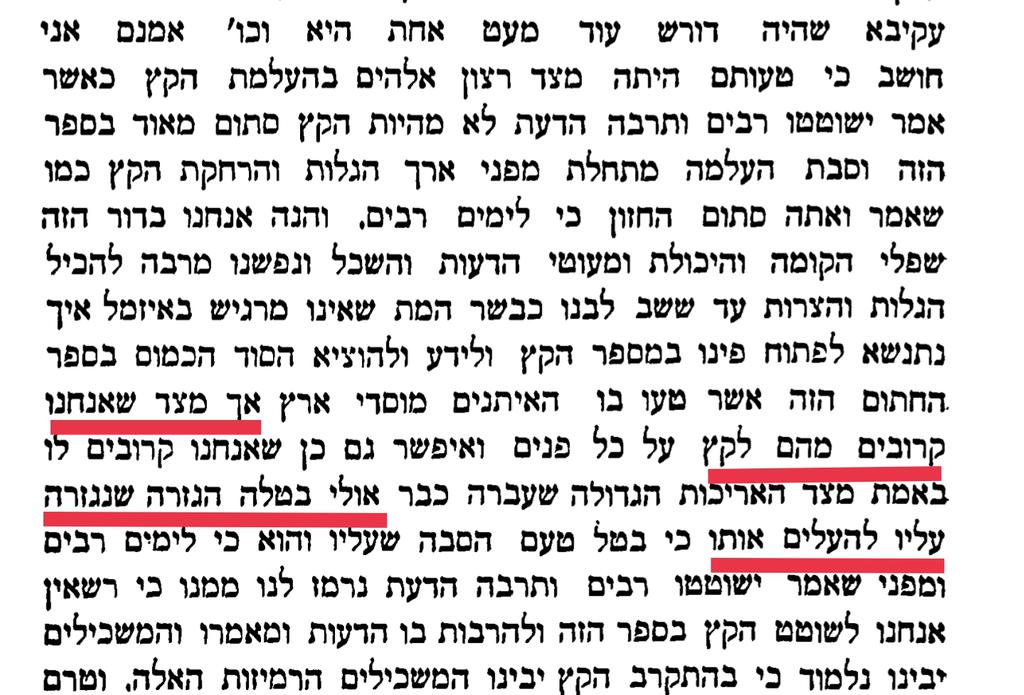
הרמב"ן בספר הגאולה עמ' כט תירץ את חישוביו בכך שאולי אנו קרובים באמת לקץ.
שנת 1403
רבינו בחיי בן אשר (1255 - 1340) הלך בעקבות הרמב"ן וקבע את שנת ה'קס"ג, 1403, כשנה האחרונה שאחריה אי אפשר להתרחק יותר.

כך יבא המשיח לבקרו של אלף הששי אחר עשירית האלף כשיעור נץ החמה ליום. וזהו משיח בן דוד שכתוב בו (תהלים פט לז) וכסאו כשמש נגדי, והוא הנעשה בצלם אלהים כענין שכתוב (דניאל ז יג) וארו עם ענני שמיא כבר אנש אתי הוה, ויהיה זה לזמן קי"ח שנה אחר האלף החמישי להשלים חזון דניאל שאמר (דניאל יב) ימים אלף מאתים ותשעים.

וזהו החשבון בכוון, ידוע כי קע"ב שנה אחר חורבן הבית נשלמו ד' אלפים ליצירה. תצרף קע"ב עם קי"ח - יהיו מאתים ותשעים. והוא כוון החשבון. ומ"ש לאחריו (שם) אשרי המחכה ויגיע לימים אלף שלש מאות שלשים וחמשה, הם מ"ה שנים אחר קי"ח, שאז יהיו כל המלחמות וכל הקנאות עוברות, וע"כ תלה הדבר באשרי כי יש בין גאולת הנדחים וגאולת הנפוצים מ"ה שנים. וכן מצינו בבית שני, י"ח שנה בין הפקידה ובין בנין הבית. וכן מגאולת מצרים עד שנכנסו לארץ ארבעים שנה.

ומ"ה שנה אלו אחר קי"ח יבא לך לחשבון קס"ג, והוא החשבון הארוך והרחוק יותר אי אפשר להתרחק בשום פנים מקס"ג ואילך. לפי שימי הגאולה לישראל תתל"ז שנים.

You must appreciate that the first seven days (including the Sabbath) of creation are intended to acquaint us both with what happened once and with what will happen again. They are symbolic of the six thousand years the universe will endure in its present form and the one thousand years during which it will undergo a total transformation. Bereshit Rabbah 8,2 states that in G-d’s calendar one day is equivalent to a thousand years in our calendar. This insight is based on Psalms 90,4 כי אלף שנים בעיניך כיום אתמול, “for one thousand years in Your eyes are like yesterday.”
It is clear that there is an allusion to something which will occur in the future in the millennium corresponding to the report of every single day of the creation as portrayed by the Torah. The first day on which light was created alludes to the first millennium during which Adam was alive. Adam was considered the light of the terrestrial world. When you consider that in the report of the first day the Torah mentions light five times and darkness only three times, you can understand that during this millennium light, i.e. goodness and peace, gradually asserted itself over darkness and the evil which darkness symbolises. The second day of creation, on the other hand, symbolises the second millennium during which the deluge occurred. This is the reason that the word טוב does not occur in the report of that day of the creative process.This is also why we do not find the words ויהי כן, “it remained thus,” until the end of verse seven instead of immediately after the directive in verse six that a heaven should become manifest. Our sages considered the absence of the mention ”it was good” on the second day as so serious that they discouraged people from commencing major undertakings on Mondays, the second day of the week. It is not appropriate for man to commence an enterprise on a day when G-d “lost” His world to the deluge.
If you have been under the impression that our sages discouraged new undertakings on Mondays because they considered this a bad omen, please reconsider. The fact is that the evening of the second day (Sunday night) commences under the aegis of the horoscope צדק (Jupiter), whereas by day the second day of the week is under the aegis of the לבנה, the moon, both of which constellations are positive; these planets symbolise light and uprightness. It would therefore be appropriate to commence undertakings on such a day which seems to augur well for people. How then could the sages have forbidden such a thing except for man to commemorate G-d’s dismay at the need to have destroyed so many of His creatures? The third day corresponded to the third millennium; on that day the word כי טוב occurred twice. The first time the words occur they symbolise the cancellation of the decree to destroy the earth by means of a deluge; the second time these words refer to what occurred in the year 2448 when G-d revealed Himself to His people and gave them the Torah Just as G-d had given permission to earth on the third day to produce vegetation and that vegetation had remained hidden at the threshold of earth waiting to reveal itself until Adam the crown jewel of creation came into existence, so the third millennium was reserved for the Jewish people who are reported in Exodus 1,7 to have been fruitful and to have been multiplying in Egypt during that millennium. The sanctity and spiritual superiority of the Jewish people had remained hidden from the world until they received the Torah at Mount Sinai. The fourth day of creation corresponds to the fourth millennium, the period during which the Jewish people accumulated more wisdom than any other nation. The two great luminaries allude to the written and the oral Torah respectively. The “great luminary” symbolises the written Torah, whereas the “small(er) luminary”, the moon, symbolises the oral Torah. The stars which are always considered as part of the moon’s domain, represent those parts of the oral Torah which, though not necessarily the last word in halachah, nonetheless provide great moral lessons for the Jewish people. The fifth day symbolises the period during which the Jewish people were in exile amongst the nations of the world who have been compared to נפש החיה הרומשת על הארץ, ”the living creatures which crawl on earth.” This is the reason that the words ויהי כן, “it remained thus,” are absent at the conclusion of the Torah’s report of what transpired on that day. It is a hint that our exile will not go on forever, but that in the end we will experience redemption. The sixth day corresponds to the sixth millennium (which at the time of writing by our author was barely 50 years old). Just as the Torah reports at the beginning of its report of that day that the earth brought forth all manner of animals including those that creep, so the sixth millennium finds us in exile at its beginning. The various beasts were created before the “sun” shone on earth, a period when they reigned supreme on earth. This is the meaning of Psalms 104,22 תזרח השמש יאספון, “once the sun shines they will be gathered in.(to their dens). ”Adam was created after the sun had begun to shine as this was the time when he would rule. The psalmist in Psalms 104,23 again refers to this when he says יצא אדם לפעלו, “Adam will set out to do his work.” Just as Adam took control on the sixth day of creation, something alluded to in the words “let us make Adam,” so the Messiah will arrive and take control of the earth during the sixth millennium after a tenth of that millennium has passed, corresponding to the hour at which the sun rises in the morning. The reference is to the משיח בן דוד, the Messiah who is the descendant of David, the final Messiah. It has been written of this Messiah וכסאו כשמש נגדי, “and his throne is as the sun before Me.”(Psalms 89,37). It is he who is meant when the Torah spoke of Man as being made in the image of the Lord. Daniel 7,13 describes him as ארו עם ענני שמיא כבר אנש אתי הוה , “and behold! With the clouds of heaven, one like a man came.” This is presumed to occur 118 years into the sixth millennium if Daniel’s prediction in chapter 12 ,17 will prove accurate... [Seeing that the commentators obviously misunderstood Daniel’s calculation of when the Messiah would come, as the time has long passed, I have omitted explaining how our author believes that Daniel arrived at his calculation. Ed.]

תקופת האחרונים - לאחר גירוש ספרד.
שנת 1503
דון יצחק אברבנאל (1437 - 1508) חישב את הקץ בספרו מעייני הישועה (מעיין ח תמר י') לשנת ה'רס"ג, 1503.
שנת 1648
על פי הזוהר, לאחר ביאת המשיח, בשנת ה'ת"ח, 1648, תהיה תחיית המתים הגדולה.

רַבִּי אֶלְעָזָר בֶּן עֲרָךְ, הֲוָה יָתִיב, והֲוה קָא מִצְּטָעֵר בְּנַפְשׁוֹי טָפֵי עֲאל לְקָמֵיה רָבִּי יְהוֹשֻׁעַ. אָמַר לֵיהּ חֵיזוּ נְהִירוּו בּוּצִּינָא דְעֲלְמָא לָמָה חֲשׁוֹכָן. אָמַר לֵיהּ, חֵיזוּ וּדְּחִילוּ סָגִי עֲאל בֵּי, דְּהָא אֲנָא חַמֵי מָה דְאִתְעַרוּ חַבְרָנָא מָארֵי מַתְנִיתָּא, דְּשָׁארַת עֲלָיְיהוּ רוּחַ קַדִּישִׁין. וְהַהוּא דְאִתְעֲרוּ, דְּבְשְׁתִיתָאֵי יְהֵא פּוּרְקָנָא, שָׁפִּיר. אֲבָל אֲנָא חַמֵי אוֹרְכָּא יְתֵירָא עַל אִינוּן דָּיְירָא עַפְרָא, דִּבְאֶלֶף שְׁתִיתָאֵי לִזְמַן (שמות י' ע"א) אַרְבַּע מֵאוֹת וּתְמַנְיָא שְׁנִין מִנֵּיהּ, יִהְיוּ קָיְימִין כָּל דָּיְירֵי עַפְרָא בְּקִיּוּמֵיהוֹן.

וּבְגִינֵי כָּךְ אִתְעָרוּ חֲבֵירָנָא, עַל פְּסוּקָא דְּקָרָא לוֹן בְּנֵי חֵת, חֵ"ת, דְּיִתְעָרוּן לְח"ת שָׁנָה, וְהַיְינוּ דִכְתִיב, (ויקרא כ״ה:י״ג) בִּשְׁנַת הַיּוֹבֵל הַזֹּאת תָּשׁוּבוּ אִישׁ אֶל אֲחוּזָתוֹ. כְּשֶׁיִּשְׁתַּלֵּם הַזֹּא"ת, שֶׁהוּא חֲמֵשֶׁת אֲלָפִים ואַרְבַּע מֵאוֹת וּתְמַנְיָא, תָּשׁוּבוּ אִישׁ אֶל אֲחוּזָתוֹ, אֶל נִשְׁמָתוֹ, שֶׁהִיא אֲחוּזָתוֹ ונַחֲלָתוֹ.

Rabbi Elazar ben Arach was sitting and was exceedingly sad. Rabbi Yehoshua came before him and asks why the appearance of the candlelight of the world had become dark. He said, Great fear entered me, for I see how the companions versed in the Mishnah have responded on whom the spirit of saints dwells. They said that redemption will be in the sixth millennium. This was well said, but I see a longer time for the dwellers of the dust, who shall wait until the four hundred and eighth year of the sixth millennium, when they will rise. For this reason, the companions were stimulated by the verse that referred to the dwellers of the dust as the children of Chet, for Chet alludes to their rising after four hundred and eight (Heb. Chet Tav) years. As it is written, "In the year of this Jubilee you shall return every man to his possession" (Vayikra 25:13), when this (Heb. hazot) shall be finished. [The numerical value of Hazot is 5,408, as the Hei of Hazot alludes to the Hei (= 5) thousands; and Zot is 408 in numerical value]. Then, "you shall return every man to his possession," means that the body will return to its soul, which is its possession and lot.
שנת 1740
רבי חיים בן עטר (1696 - 1743) החל בפרסום פירושו על התורה בסוף שנת 1740, ובו חישוב הקץ לאותה שנה, שנת ה'ת"ק, 1740 (שהיא 1,672 שנה לאחר חורבן הבית השני ב-68 לספירה).

ובדרך רמז תרמוז כל הפרשה על גלות האחרון שאנו בו, לנחמנו מעצבון נפשנו. כי כל איש ישראל מאנה הנחם נפשו בראות אורך הגלות. נראה למי דומה, למצרים ת', לבבל ע', לשניהם יחד ת"ע, והן היום אלף ותרע"ב מה אייחל עוד. ולא גלות לבד אלא ענוי מהאומות כי כל גוי וממלכה בבני ישראל יעבודו, ואשר זה יסובב חשוב לא טוב, כי שפת אמת לא הוכרעה בכוננת והאריכה לשון שקר. ובא הצופה ומביט עד סוף כל הדורות קורא הדורות מראש והודיע למשה לזרז לישראל ובראשם בני תורה שפתי כהן אשר תורה יבקשו מפיהו אהרן ובניו להודיע לדורות את הדבר הזה.

...והודיע הכתוב כי באמצעות ב' דברים תהיה עלייתנו מיועדת בהפלגות המעולות משונות לשבח שבחים אשר לא היה ולא יהיה. וביאר עד מתי יהיו ישראל בגדר ב' דברים אלו, כל הלילה שהוא זמן הגלות הנמשל ללילה שומר מה מלילה (ישעי' כא) וכן בפסוק ליני הלילה, דרשו ז"ל על הגלות. עד הבוקר, שהוא זמן שיריק עלינו כבודו ואתא בוקר.

והזמן הוא אחר עבור ת"ק לאלף הששי, לפי מה שקדם לנו מדבריהם ז"ל (ב"ר יט), כי יומו של הקב"ה אלף שנה. ומהשכל יהיו ת"ק ראשונה מדת לילה, ות"ק שניה מדת יום. והודיע ה' כי עד הבוקר, שכשיגמר ת"ק שנה בגלות עד הבוקר שיהיה העליה. ובוקר זה אין אני יודע אם בוקר של אלף הה' או בוקרו של אלף הו'. כי באלף הד' גלה כבוד ישראל בעקב"ו, לזה גילה ה' סודו ביד עבדיו הנביאים כי הוא לבוקר ב', והוא אומרו (ישעיהו ל״ג:ב׳) הי' זרועם לבקרים לב' בקרים לבוקר ב' אם לא לבוקר א'. ולזה אמר עד הבוקר, הידוע, שהוא ב', ולא בוקר הבא ראשון בגלות.

ואולי כי לזה רמז הנביא באומרו (ישעי' כא) אמר שומר אתא בוקר וגם לילה פי' הגם שאתא בוקר ראשון לא הועיל ובא גם כן הלילה אחריו כי לא נושענו בו. ואולי כי אלו ישראל היו שלמים היו נגאלים בבוקר ראשון:

On a moral-ethical plane we may consider this whole paragraph as an allusion to our present and final exile. The paragraph is designed to console us about the depressing conditions we find ourselves in. Inasmuch as the soul of every Israelite refuses to be comforted seeing our exile appears to be interminable, we are certainly in need of some comfort. At the time of this writing the exile has already lasted far longer than our previous exiles combined, (Egypt=400 years, Babylonia=70 years, whereas already 1672 years have passed since the destruction of the Temple). How much longer do we have to wait for redemption?! Besides, we do not only suffer from mere exile but from persecution, seeing that every country which hosts Jews discriminates against them and treats them as inferior. Whenever revolutions do occur amongst the Gentile Kingdoms this does not bode the Jews any good as the gentile politicians never speak to us with sincerity and their promises are only lies. The Torah, i.e. G'd, who has foreseen all things used this paragraph to inform Moses to urge the Israelites, and foremost amongst them the Torah scholars, notably the priests whose task it is to instruct the people in morality and ethics, to inform the people for all future times of the message contained here. זאת תורת העולה, the word זאת is an exclusion. The people are to be aware that there will not be an עולה=עליה an ascent comparable to the one mentioned in this paragraph. The Torah repeats who it is that will experience this ascent, i.e. הוא העולה, a reference to Song of Songs 3,6: מי זאת עולה מן המדבר, "who is this that ascends from the desert?" על מוקדה על המזבח "the ones who were burned up on the site for burning, on the altar;" The Torah refers to two details here; 1) that we are knowledgeable in Torah, i.e. זאת תורת העולה, something that does not exist amongst the Gentiles; 2) that we have endured many afflictions both by being in exile and by being impoverished. The word מוקדה is a reference to Torah, seeing Torah is often compared to fire; young Torah scholars are described in Taanit 4 as דרתח אוריתא, "we have to make allowances for the angry young Torah scholars as it is the fire of the Torah which causes their anger." When the Torah continues על המזבח, this is a reference to exile and all that is connected with it. The afflictions the Jewish people suffer in exile achieve for us what the sacrifices achieved on the altar, i.e. atonement for our sins. We find that the Talmud in Berachot 5 uses similar language to describe the purpose of יסורים, afflictions. The Torah therefore informs us here that there are two elements which will ensure our ascent to untold heights of good fortune, honour, etc. The Torah also explains how long it will be until we will achieve this goal. We will achieve our goal in two stages, 1) כל הלילה, by means of enduring the whole night of exile; in Isaiah 21,11 the prophet already compared exile to night when he said: שומר מה מלילה שומר מה מליל. "Watchman what of the night, watchman what of the night?" as a reference to the duration of the exile. They also interpret Ruth 3,13: "stay the night until morning" in a similar vein. When "morning" arrives, G'd will pour over us His glory, etc. This time will arrive after the middle of the sixth millenium as we know from G'd's own words that 1000 years are equivalent to a "day" in His calendar (compare Bereshit Rabbah 8,2). Reason tells us that the first 500 years of that "day" are part of the "night" so that the time of the redemption will occur during the second five hundred years of that millenium. The words עד הבוקר in our verse make it plain that we cannot expect the ascent until some time during the latter 500 years of the present millenium. It was unclear from the time of the destruction of the Temple whether the "morning" referred to was the second half of the fifth millenium or the second half of the sixth millenium seeing that the Temple was destroyed in the latter half of the fourth millenium. G'd therefore revealed His secret by means of His prophets when Isaiah in chapter 33,3 spoke of "mornings." The verse reads: "Be their arm לבקרים, on mornings, also our deliverance in times of stress." Isaiah meant that if the deliverance does not occur on the first "morning," (i.e. the second half of the fifth millenium) it will surely occur during the second half of the sixth millenium. The word עד הבוקר is a reference to a "well known morning," i.e. the second one of these possible "mornings." Perhaps Isaiah even hinted in chapter 21,12 when he spoke about the morning having arrived and having been followed by another night, (without the redemption) that if Israel had been worthy it would have been redeemed already on the first of these two "mornings."

ובדרך רמז ירמוז להעיר הערה גדולה על א' המיוחד שבאומה שאליו אנו מקוים ומצפים מתי יבא והוא מלך ישראל משיחנו אשר הוא אביון, וכבר נמשל לעני כאומרו (זכרי' ט') עני ורוכב על חמור, ורמז הדבר אשר יסובבנו להיות אביון ואמר בך פירוש בסיבתך כי עונותינו האריכו קיצנו, גם רמז בתיבת בך כי הוא אביון בנו שמתאוה מתי יבא לגאלנו...

וגמר אומר מאחיך האביון פירוש מסיבת אחיך האביון הידוע שיעריך אדם בדעתו שהמעשה הוא לתכלית דבר זה של משיח ה' שמו חיים:

A moral/ethical approach to the whole paragraph sees in the words מאחד אחיך, "one of your brethren," an allusion to the one who is special amongst your brethren, the one to whose coming we all look forward to with longing, i.e. the Messiah. The Messiah has been portrayed as a poor man when the prophet Zachariah 9,9 describes him as riding on a donkey. The Torah also hints at the cause of his poverty when it says בך, "because of you," meaning that if the redemption would be orchestrated by G'd because the Israelites had attained spiritual maturity the Messiah would arrive in advance of G'd's final date for the redemption and he would be able to ride in style to show that the Israelites had qualified for redemption by their own efforts. As it is, by describing him as בך, Moses portrays him as a destitute person who waits anxiously for a handout. The story is told that when Rabbi Yehoshua ben Levi once encountered the Messiah, the latter asked him what the Israelites were doing at that time. The Rabbi replied that they were awaiting the arrival of the Messiah. Upon hearing this the Messiah let out a long wail showing his anxious desire to reveal himself and to redeem the Jewish people. The Torah alludes to this when writing מאחד אחיך, "amongst one of your brethren," meaning "amongst the unique one of your brethren, the Messiah (compare Targum Yonathan ben Uzziel on Genesis 26,10 who renders the words אחד העם, "one of the people" as "a unique one, a king"). The words באחד שעריך may be understood as "one who is unique amongst the Sanhedrin, the Supreme Court, as we know from Isaiah 11,4 that the Messiah will judge the poor fairly, not relying on external appearances. The word בארצך means that the arena for the Messiah's activities will be ארץ ישראל. We may also approach this verse from a different perspective. Zohar Chadash on Noach discussing Genesis 8,8, states in the name of Rabbi Eliezer that if the leaders of one synagogue or one entire congregation were to become true penitents the Messiah would arrive immediately. Accordingly we must understand the word אביון as anyone who yearns for אחד שעריך, "one of your congregations" becoming true penitents. When this happens the "destitute" Messiah will be able to fulfil his desire to arrive joyfully. The Torah writes בארצך "in your land," in order to define the place the Messiah yearns for "the land which the Lord your G'd is about to give you." He is anxious to find out when תפקוד העיר היונה חמדת הלבבות, "the city of the dove will be redeemed," the city to which all hearts aspire (compare Tzefaniah 3,1). G'd commands all of Israel לא תאמץ את לבבך ולא תקפץ את אחיך האביון "not to be stubborn but to do everything to help your brother, the destitute one," i.e. the Messiah to realise his ambition. The single most potent מצוה which will hasten the arrival of the Messiah is charity as we have been taught in Isaiah 54,14: בצדקה תכונני, "you shall be established through righteousness." The paragraph concludes with the words מאחיך האביון, "from your brother who is destitute," referring to the cause of why your brother the Messiah is destitute, unable to realise his mission.
שנת 1790
חתם סופר (1762 - 1839) קבע שהקץ יגיע מינימום בשנת 1790. לאחר מכן בשנת 1936, בהיותו בן 74 כתב בתשובה כי כשם שמשה, הגואל הראשון, ידע שהוא הגואל רק בגיל 80, כך גם הגואל האחרון לא בהכרח יודע כי הוא הגואל. בדבריו אלו רמז שייתכן והוא ייבחר להיות המשיח...

בעקבות משיחא אעורר על דברי רמב"ן בפ' בראשית על פסוק אשר ברא אלקי' לעשות שם האריך לגלות קץ הכמוס ומרוב חשקו ותאותו לביאת משיח קירב חשבונו להיות קרוב לזמנו ז"ל וטעה טעות גדול במח"כ הרמה ואעתיק לשוני בחי' תורה שלי פ' בראשית ונוראות נפלאתי על הרמב"ן ז"ל שכ' ביום הששי בבקר וכו' ואחרי עשיריתו כשעור הנץ החמה יבוא הגואל וכו' ויהי' זה קי"ח שנים אחרי ה' אלפי' וכו' עכ"ל ותימה רבה כי שכח היום הולך אחר הלילה ויהי ערב ויהי בקר נמצא כי ת"ק שנים הראשוני' של אלף הששי הם בבחי' הלילה שהוא הערב של יום הששי של בריאה ואח"כ הי' בריאת החיות ואם נמתין עוד עד אחר הנץ החמה לקיים כסאו כשמש נגדי והנץ הוא עשירית היום א"כ יהי' עכ"פ אחר תק"נ שנים לאלף הששי

והנה בהא דביאת בן דוד צריך אני להוציע הוצעה א', והוא: כמו שהי' משרע"ה שהי' הגואל הראשון נזדקין שמנים שנה ולא ידע ולא הרגיש בעצמו שהוא יהי' גואל ישראל. ואפי' כשאמר לו הקב"ה "לך כי אשלחך אל פרעה", מ"מ סירב ולא רצה לקבל על עצמו. כן יהי' אי"ה הגואל האחרון. ומיום שחרב בהמ"ק מיד נולד א' הראוי' בצדקתו להיות גואל. ולכשיגיע הזמן יגלה אליו השי"ת, וישלחו. ואז יערה עליו רוחו של משיח, הטמון וגנוז למעלה עד בוא. וכאשר מצינו בשאול אחר שנמשח באה עליו רוח ממשלה ורוח הקודש אשר מלפנים לא הרגיש בעצמו. כן הי' בגואל הראשון וכן יהי' בגואל האחרון. והצדיק הזה בעצמו אינו יודע. ובעונותינו כי רבו, כבר כמה וכמה מתו. ולא זכינו שיערה עליהם רוחו של משיח. גם כי הם ראוי' לכך, אבל הדור לא הי' ראוי'. אולם כשיגיע אי"ה, יגלה אליו ה', כמו למשה בסנה. וישלחהו או לישראל לבד או למלך א' כמו לפרעה לומר שלח עמי:

...פה ק"ק פ"ב מוצאי י"ט שבועות תקצ"ו לפ"ק. משה"ק סופר מפפד"מ:

שנת 1840
לאחר שהגאולה תבוא ותהיה תחיית המתים לפי הזוהר, בכל שישים שנה השכינה תתחזק עוד עד שבשנת ה'ת"ר, 1840, ייפתחו שערי החוכמה.

וְכַד יֵיתֵי אֶלֶף שְׁתִיתָאָה דְּאִיהוּ רָזָא דְּוא"ו, כְּדֵין וא"ו יוֹקִים לְה"א. בְּזִמְנָא (שמות ט ב) שִׁית זִמְנִין עֶשֶׂר שִׁתִּין נֶפֶשׁ, כְּדֵין שְׁלִימוּ וא"ו עֶשֶׂר זִמְנִין, וא"ו שִׁית זִמְנִין עֶשֶׂר, (דוא"ו) וא"ו סָלְקָא (בעשר) בְּי', וא"ו נָחֲתָא בְּה"א. אִשְׁתְּלִים וא"ו גּוֹ עֶשֶׂר שִׁית זִמְנִין, כְּדֵין הֲווּ שִׁתִּין לְאָקְמָא מֵעַפְרָא, וּבְכָל שִׁתִּין וְשִׁתִּין מֵהַהוּא אֶלֶף שְׁתִיתָאָה אִתְתַּקַּף ה"א וְסַלְקָא בְּדַרְגּוֹי לְאִתְתַּקְּפָא. וּבְשִׁית מְאָה שְׁנִין לִשְׁתִיתָאָה יִתְפַּתְּחוּן תַּרְעֵי דְחָכְמְתָא לְעֵילָא וּמַבּוּעֵי דְחָכְמְתָא לְתַתָּא, וְיִתְתַּקַּן עַלְמָא לְאָעֳלָא בִּשְׁבִיעָאָה. כְּבַר נָשׁ דְּמִתְתַּקַּן בְּיוֹמָא שְׁתִיתָאָה מֵכִי עָרַב שִׁמְשָׁא לְאֲעָלָא בְּשַׁבַּתָּא. אוּף הָכִי נָמֵי. וְסִימָנִיךְ (בראשית ז׳:י״א) בִּשְׁנַת שֵׁשׁ מֵאוֹת שָׁנָה לְחַיֵּי נֹחַ וְגו' נִבְקְעוּ כָּל מַעְיְינוֹת תְּהוֹם רַבָּה.

In the 600th year of the sixth millennium the gates of wisdom above together will the wellsprings of wisdom below will open up and the world will prepare to usher in the seventh millennium. This is symbolized by one who begins preparations for ushering in the Sabbath on the afternoon of the sixth day. In the same way, toward the end of the sixth millennium, preparations are made for entering the seventh. The hint for this is “In the 600th year of Noah’s life ... all the wellsprings of the great deep burst forth and the flood gates of the heavens were opened.
שנת 1843
רבי שניאור זלמן מלאדי (1745 - 1812), בעל ה"תניא", כתב בספר "מאמרי אדמו"ר הזקן, פרשיות התורה ומועדים כרך א" (עמ' תכ"ג) כי הקץ יגיע בשנת 1843, ה'תר"ג.
שנת 1900
זוהר חי על וירא דף קי"ט, יצחק אייזיק ספרין מקאמארנא (1806 - 1874), שנת 1900 תהיה "עת קץ", "הכל יהיה בלי שום שינוי!", ולאחר מכן כפי שכתב ה'חסד לאברהם' (ר' לעיל) בשנת ה'תש"ס, 2000, יהיה יום הדין הגדול והנורא.
שנת 1913
המלבי"ם (1809 - 1879) מתארך את הקץ לשנת 1913, כאשר בשנת 1925 יתחילו לבנות את המקדש וב-1928 יחנכו אותו.

ומוכרח שהעידן הוא ת"י שנה, כזמן עמידת בית ראשון. שלשה עדנים הם אלף ר"ל שנה. וחצי עידן הוא תרט"ו. סה"כ אלף שמונה מאות מ"ה שנה. ויגיע זמן הקץ בשנת תרע"ג, והוא מתאחד עם יתר המועדים הבאים בספר כמו שיתבאר.

וזמן זה בא שנית בסי' י"ב, שאמר המלאך לדניאל: כי למועד מועדים וחצי תכלינה כל אלה. ואחר שהזמן סתום, וזמנים הידועים בימי דניאל היו שתים ארבע מאות ות"י, לא רחוק כי לכן הוכפל הדבר להודיע שכיון על ב' הזמנים שלמועד מועדים וחצי מזמן של ארבע מאות, שהוא בשנת התרכ"ח תהיה ההתחלה, והדבר ימשך עד מועד מועדים וחצי מזמן השני הידוע, שהוא ת"י של בית ראשון, ויגיע אחרית הדבר בשנת תרע"ג.

ואם תחשוב משנת ד' ש"נ עוד אלף של"ה יגיע לשנת ה' אלפים תרפ"ה, שאז יהיה קץ הפלאות המיועד. וכבר בארנו שנאמרו עוד שני זמנים והם מועד מועדים וחצי, שמגיע זמנם לשנת ה' אלפים תרע"ג כמ"ש למעלה (ז' כ"ה), וזמן השני עד שני אלפים ושלש מאות, ונצדק קדש שנאמר לו במראה השניה כלים בשנת ה' אלפים תרפ"ח כמ"ש למעלה (ח' י"ד) הרי השלשה זמנים מתאחדים, שבשנת תרע"ג תהיה ההתחלה ותמשך י"ד שנים, שהם השני שבועים, שבוע אחד שאחז"ל שבוע שב דוד בא, ושבוע של גוג המבואר בכתוב שיבערו והסיקו באש שבע שנים, שהוא משנת תרע"ג עד שנת תרפ"ח, ובשנת תרפ"ה שהוא ג' שנים לפני תרפ"ח יתחילו בבנין המקדש וימשך ג' שנים, ובזמן תרפ"ח שהוא עד ערב בוקר אלפים ושלש מאות שנים מאותו שנה שדבר עמו המלאך, בשנת שלש לבלשאצר ונצדק קדש ויוחזר התמיד על מכונו, כי שם שאל על החזרת התמיד וע"ז השיבו כמבואר שם:

ולפי' הראשון כתב חזון ובאר על הלוחות, כי צמיחת קרן בית דוד ובנין המקדש וכל יעודי הנביאים יתקיימו בפעם אחת, ואורם תזרח מן שנת התרע"ג עד שנת התרפ"ח, שאז כבר יהיה המקדש על מכונו, ונבנתה עיר על תילה וארמון על משפטו ישב ויתקיימו כל יעודי הנביאים, והיתה לה' המלוכה והיה ה' למלך על כל הארץ:

שנת 1940
רבי יוסף אבן יחיא (1494–1539) מנבא כי שנת ה'ת"ש בערך היא הקץ, כדי שהגאולה תארך כ-300 שנה.

באופן כי בסוף החמשת אלפים ושבע מאות שנה לבריאת העולם בקירוב אם מעט קודם או מעט אחר כך יבוא קיצנו בעזרת ה׳. למען יוכלו לשבת בני ישראל בטח על אדמתם כשלש מאות שנה מהאלף הששי. למען יתראה לעין כל היות האמת אתם. ויהנו בגוף ונפש מן העולם הזה, תחת אשר נענשו בעול גלות האומות בגוף ונפש. ויהיו המאות שלשה, להיות כי בסך ההוא יפול החזקה, ויאומת הדבר היותו בלתי מקריי בהתמידו הסך ההוא.

שנת 1949
הרב יצחק אלפייה (1878 - 1955) פרסם בשנת 1928 חישוב לשנת ה'תש"ט בחודש שבט (ינואר 1949), שמאז תתחיל הגאולה. לדבריו כוחות הטומאה יתבערו בשנת ה'תש"ן, 1990.
קונטרס היחיאלי דף צח.
שנת 2000
לפי רבי אברהם אזולאי (1570 - 1643) תחיית המתים תתקיים 3 פעמים, כאשר הפעם השלישית תהיה בשנת ה'תש"ס, שנת 2000.

ודע כי שיעור המקוה הם ה' אלפים ושבע מאות וששים ביצים, וסוד הענין הוא כי לסוף ה' אלפים ותש"ס שנים יתקיים הפסוק ואת רוח הטומאה אעביר מן הארץ ויתקיים מקרא דכתיב והשבתי חיה רעה מן הארץ, דהיינו כחות הטומאה כנזכר בזוהר.

וסוד הענין הוא כי תחיית המתים עתיד להיות ג' פעמים בג' זמנים, הראשונה היא תחיית מתי ארץ ישראל, והב' היא תחיית מתי חו"ל, והג' היא תחיית הע' אומות וכל העולם, והוא זמן יום הדין הגדול, וזאת התחיה הג' זמנה לסוף ה' אלפים ז' מאות וששים ליצירה, וזמש"ל מסכ"י:

Know that in ten places, there are gates in the body corresponding to the ten categories of impurity. The gate of the head alludes to the first, the gate on the right cheek hints at the second, and the gate on the left cheek hints at the third. This corresponds to the three upper categories, which are considered as one. The gate of the right armpit hints at the fourth, and on the left cheek, it hints at the fifth. The gate on the throat and heart hints at the sixth, which is the body of the tree. The gate on the right knee hints at the seventh, and on the left, it hints at the eighth. The surroundings of the righteous hint at the ninth, and his rear hints at the tenth. These ten places serve as seats for the ten forces of impurity to take hold of if they become impure.
השנים 2040 - 2068
רבי אברהם אזולאי (1570 - 1643) מביא גם מסורת מהרמ"ק על השנים 2040 - 2068.

ותשלום זמן אחרית הימי' הוא בשנת שמנה מאות ושמנה ועשרים לאלף החמשי. ומשם ועד עתה נמשך הגלות, בעון הדורות שאינם שבים. ולא ימשך אלא עד ת"ת לאלף הששי, לתחיית המתים. ויקדם הגאולה מה שיקדם. ומי שימצא באותה שעה בלי תשובה, אוי לרוע מזלו שיתבטל הוייתו. הרמ"ק זלה"ה.

שנת 2087

ר' ישראל מראדין (1838 - 1933) בטוח שהגאולה תבוא הרבה לפני שנת 2087.

כשראש חודש וכו' - ...ויתר השנים משך רב כמעט עד שנת תתמ"ז כתובות בלוח הטור כהוגן כפי מה שנראה מפר"ח שלא הגיה עליו [אם לא שימצא עוד איזה קלקול בדפוס וכמו שראיתי בפר"ח כתוב שם על שנת תתקנ"ג סימן בח"ג והוא טה"ד וצ"ל זח"ג וכן על שנת תשמ"ג כתוב בדפוס לעמבערג בש"ז והוא טה"ד וצ"ל ז"ש כמו בטור והוא זש"ג אח"כ מצאתי כן בדפוס ישן] ואין לנו לדאוג כ"כ יותר כי בודאי בעת ההיא וגם הרבה קודם יהיה הגאולה ונקדש ע"פ הראיה:

וא"ו מרמז על אימת יתמלא היינו באלף הששי, והזמן בפרטיות באותו אלף נעלם, והיינו לאברי לא גליתי, ועל ידי מי, מרמז אות ה' דהיינו הגואל החמישי במהרה בימינו אמן.