


TRADITIONAL TEXT #2 - PRAYER
Prayer
Al Hanisim (For the miracles) is a paragraph added to the Shemoneh Esrei [=Amidah] and the Grace after the Meals [Birkat haMazon] on Purim and Chanukah. It mentions the great dangers faced by the Jews from the decrees of either Haman or Antiochus respectively, and thanks God for His miraculous deliverance. (Sefaria.org introduction)
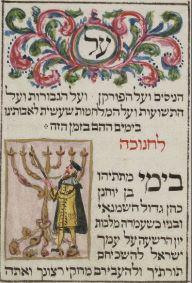
In the days of Matisyahu, son of Yochanan the High Priest, the Hasmonean and his sons, when the evil Greek kingdom rose up against Your people Israel to make them forget Your Torah and to turn them away from the statutes of Your will— You, in Your abundant mercy, stood by them in their time of distress, You defended their cause, You judged their grievances, You avenged them. You delivered the mighty into the hands of the weak, many into the hands of the few, defiled people into the hands of the undefiled, the wicked into the hands of the righteous, and insolent [sinners] into the hands of diligent students of Your Torah. And You made Yourself a great and sanctified name in Your world. And for Your people, Israel, You performed a great deliverance and redemption unto this very day. Afterwards, Your sons entered the Holy of Holies of Your Abode, cleaned Your Temple, purified Your Sanctuary, and kindled lights in the Courtyards of Your Sanctuary, and designated these eight days of Chanukah to thank and praise Your great Name.
https://www.queensjewishlink.com/index.php/torah/70-parshah/3649-chanukah-an-army-of-miracles
Chanukah: An Army Of Miracles
PARSHAH
DECEMBER 09 2020
Who would you expect to win in a battle of good vs. evil?
Based on childhoods of reading fairy tales and watching Disney movies, we would like to believe that the “good guys” are supposed to come out on top. And yet, in Al HaNisim we thank Hashem for all the miracles and wonders – including the victory of the heroes – as if it was unnatural! Certainly, rabim b’yad m’atim (the many in the hands of the few) is miraculous, as the larger army would figure to have a major advantage. But why is r’sha’im b’yad tzadikim (the wicked in the hands of the righteous) so surprising? Would we have expected evil to have the upper hand?
Rav Elchonon Wasserman Hy”d answered quite simply: Yes. By the laws of nature, the “bad guys” have a significant advantage. When a nation has no moral limitations and can use any means necessary to win, they should naturally dominate and prevail over an army that demands adherence to ethical principles. Parshas Shoftim delineates the strict religious standards of the Jewish army, including accepting only God-fearing soldiers and prohibiting the elimination of an enemy’s food supply by destroying its fruit trees (see D’varim chapter 20). Given these restrictions, it is indeed a miracle and a wonder that the Jewish army could ever be victorious over a nation that is free to employ all of the soldiers and military strategies in its arsenal!
Rav Elchonon – who would tragically meet his own demise at the hands of the evil Nazis – concluded: Just as it is unnatural that the Jewish army succeeds despite its small number of soldiers, it is equally miraculous that it triumphs in face of its religious limitations. Of course, it is not just a handicap to overcome. The Jewish nation has been, and continues to be, victorious specifically because of its de-emphasis on military might and its steadfast reliance on Hashem. “They put their trust in chariots and horses, while we invoke the name of Hashem (T’hilim 20:8).”
It was true in the days of Moshe Rabbeinu, and it was true in the days of the Chashmona’im. It was evident in the wars for Israel’s independence and survival, and it remains apparent to this day. In every generation, the Jewish people seem to be outnumbered by enemies ready to employ even the most unconscionable tactics to win. The fact that we continue to emerge victorious is a great cause to sing Al HaNisim and thank Hashem for the ongoing miracles: ba’yamim haheim, ba’zman hazeh!
Rabbi Yaakov Abramovitz is Assistant to the Rabbi at the Young Israel of Kew Gardens Hills, while also pursuing a Psy.D. in School and Clinical Child Psychology at the Ferkauf Graduate School of Psychology. He can be reached at [email protected].
Excerpt from
The Maccabees: Heroes or Fanatics?
The Maccabees triumphed over the Syrian Greeks and liberated the Temple, but their legacy is not so clear.
BY MICHELE ALPERIN
https://www.myjewishlearning.com/article/the-maccabees-heroes-or-fanatics/
Legitimization Through Zealotry
Whereas some modern sensibilities will be offended by the Maccabees’ vicious treatment of the Hellenist Jews, First Maccabees not only lauds Mattathias’ zealotry against his coreligionists, but uses that very zealotry to legitimize the Maccabean dynasty. In First Maccabees, Mattathias acts in the tradition of other zealots in the Torah by murdering a fellow Jew in Modi’in who approaches a pagan altar to offer a sacrifice when requested to do so by a royal official. When this apostate Jew steps up to the altar, Mattathias kills him as well as the government official and then tears down the altar. Mattathias declares, “Let everybody who is zealous for the law and stands by the covenant follow me” (I Maccabees 2:27). With this self-conscious echoing of the words of Moses when confronted with the Golden Calf – “Whoever is for the Lord, come here” (Exodus 32:26) – First Maccabees begins its justification of Maccabean zealotry.
First Maccabees continues by explicitly comparing Mattathias to the biblical figure Pinchas, who killed a tribal leader and his Midianite partner to stop the spread of idolatry and was rewarded by God with a “brit shalom” — covenant of peace — of eternal priesthood (Numbers 25). The implication is that Mattathias derives his political and religious authority from this very act of zealotry, this taking of the law into his own hands, based on his perception that the continued existence of the Jewish community was in danger.
Although Mattathias saw himself as acting in a situation of conflict between an earthly power and the law of God, his act might be viewed from the outside as one of political terrorism; he had committed murder for the sake of what he perceived to be a greater good. Judah continued the fight begun by Mattathias by actively attacking apostasy — destroying idolatrous altars, compelling observance of Torah by force, circumcising newborn infants, and killing apostate violators of Torah law.
Later in the story, the Maccabean self-interest also led them to reinterpret Torah law so that the Jews hiding with them in the wilderness could defend themselves from government attack on the Sabbath. By interpreting the law on their own authority, the Maccabees were setting themselves up as an opposition government, infringing on the prerogatives of the sitting High Priest.
Although the text of Maccabees views Judah as a liberator whose zealotry was necessary to preserve the Torah and the Jewish people, later rabbinic commentators frowned upon such zealotry, realizing the danger of individuals taking the law into their own hands and interpreting it in accord with their own interests. Consequently, normative Jewish law limits “legitimate” zealotry nearly to the point of nonexistence: A zealot is not allowed to act preemptively in expectation of a desecration, nor punitively after the desecration has been completed; if he does so, he is treated as a murderer. Because a zealot is considered to be acting outside the law, the desecrator has the right to kill a zealot in self-defense. In addition, rabbinical courts were forbidden to give permission to zealots to act or to teach zealotry.
In the end, the Maccabees must be judged to be both liberators and zealots. Like many figures in the Bible, these apocryphal heroes are multi-layered, and their meaning is unraveled by successive generations based on their own needs and experiences. In the world today, we may identify with the Maccabean fight to preserve Judaism in the face of assimilation and anti-Semitism, while at the same time working to mitigate religious zealotry that threatens to turn Jew against Jew.
%%%%%%%%%%%%%%%%%%%%%%%%%%%%%%
וַיַּ֜עַן וַיֹּ֤אמֶר אֵלַי֙ לֵאמֹ֔ר זֶ֚ה דְּבַר־יְהֹוָ֔ה אֶל־זְרֻבָּבֶ֖ל לֵאמֹ֑ר לֹ֤א בְחַ֙יִל֙ וְלֹ֣א בְכֹ֔חַ כִּ֣י אִם־בְּרוּחִ֔י אָמַ֖ר יְהֹוָ֥ה צְבָאֽוֹת׃
“This is the word of the LORD to Zerubbabel: Not by might, nor by power, but by My spirit—said the LORD of Hosts.
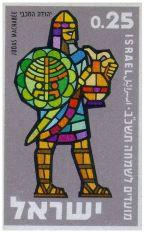
Modern Hebrew culture made of Hanukkah a celebration of the new, self-reliant Jew.
BY RABBI PERETZ RODMAN
If you have ever been amused to find that a popular Israeli beer is named “Maccabi” or wondered why the “Jewish Olympics” are called “Maccabiah,” then you have been exposed to the use in modern Hebrew culture of the image of the historical Maccabees, the heroes of the Hanukkah story.
The modern secular nationalist movement among the Jews of the late 19th and early 20th centuries looked to the past in search of heroes whose prowess was expressed through their bodies, not (or not only) through their minds — heroes whose stirring accomplishments may be recorded in books but were not limited to the writing of books.
The Maccabee Model
For modern Zionists, then, no group in Jewish history was better suited for the role of heroes than that band of irregulars whose guerrilla war against the imperial rulers (in this case, Greek-speaking Hellenists based in Syria) ended in victory and national liberation: the Maccabees.
Saul Tchernichovski, a prominent Hebrew poet of the early 20th century, captured this sense that the Maccabees are the model for the “New Jew” in a short poem (later made into a popular song) that pictures a contemporary Jew arriving in the Land of Israel, encountering the famous second-century sage Akiva, and inquiring, “Where are they, the holy ones? Where are the Maccabees?” Akiva’s reply: “All Israel is holy. You are the Maccabee!”
When Jewish sports clubs were established in central Europe, one of the first and largest networks of those clubs was called “Maccabi” (accented on the second syllable: “mah-KAH-bee”). Its successor organization, the Maccabi World Union, is the sponsor of the sports competitions for Jewish athletes from around the world. Maccabi sport clubs have been transformed into professional teams in some Israeli cities. Maccabi beer — no relation to the sports organization — is so named in order to promote a manly image for its primarily male market.
From Divine Deliverance to Self-Defense
The historical Maccabees were motivated by indignation at what they viewed as religious coercion imposed upon the Jews in their own land by the pagan rulers and their Jewish supporters and collaborators. To judge by the literary sources closest to the events, the books known as First and Second Maccabees, the Maccabees’ quest was a religious one at least as much as it was a movement for national self-determination.
Modern Zionism, on the other hand, originated with Jews who had largely strayed from the strictures of traditional religion but wanted to maintain their Jewishness in a new, secular form.
Hanukkah, which had always been a minor holiday, attained new significance and new importance in modern Hebrew culture as the celebration of the victory of the brave Judah Maccabee and his brothers. The traditional eight-branched candelabras are lit in the windows of most Jewish homes and shops in Israel each night, and large electric-bulb versions are found on public buildings and town squares. The lighting, in homes or at public events, is usually accompanied by a recitation of the traditional liturgy that speaks of divine intervention in history on behalf of the Maccabees.
Otherwise, though, we find in the songs and practices of Hanukkah in Israel a reworking — even a total reversal — of many elements of the holiday’s traditions.
Some of those changes are subtle, such as a popular song from the 1970s by the doyenne of Israeli popular music in those years, Naomi Shemer. The song begins with the first line of the medieval Hanukkah anthem Ma’oz, tzur yeshu’ati: “Stronghold, rock of my salvation, it is fitting to praise You.” The meaning of those terms shifts as the song then makes clear that the speaker is referring not to God but to a fortified military outpost on one of Israel’s borders, where he is posted to keep watch for the enemy who may approach. What was metaphor for the medieval author is used in its simple, literal sense by the modern writer, for whom the fortresses of the Jews are physical, not theological.[spiritual] https://www.myjewishlearning.com/article/a-zionist-hanukkah/