


וּלְשֵׁ֥ם יֻלַּ֖ד גַּם־ה֑וּא אֲבִי֙ כׇּל־בְּנֵי־עֵ֔בֶר אֲחִ֖י יֶ֥פֶת הַגָּדֽוֹל׃
Sons were also born to Shem, ancestor of all the descendants of Eber and older brother of Japheth.
(22) The descendants of Shem: Elam, Asshur, Arpachshad, Lud, and Aram.
(23) The descendants of Aram: Uz, Hul, Gether, and Mash.
(24) Arpachshad begot Shelah, and Shelah begot Eber.
(25) Two sons were born to Eber: the name of the first was Peleg, for in his days the earth was divided; and the name of his brother was Joktan.
(26-29) Joktan begot Almodad, Sheleph, Hazarmaveth, Jerah, Obal, Abimael, Sheba, Ophir, Havilah, and Jobab; all these were the descendants of Joktan.
(30) Their settlements extended from Mesha as far as Sephar, the hill country to the east.
(31) These are the descendants of Shem according to their clans and languages, by their lands, according to their nations.
(32) These are the groupings of Noah’s descendants, according to their origins, by their nations; and from these the nations branched out over the earth after the Flood.
NOTE: Chapter 11 begins the story of Babel.
We learn later that Eber was born well after the Flood.
Tradition positions him in post-Babel dispersion.
The line of Shem, through Eber, leads to Abraham and Sarah.
Genesis 37:1-3
(1) Now Jacob was settled in the land where his father had sojourned, the land of Canaan.
(2) This, then, is the line of Jacob: At seventeen years of age, Joseph tended the flocks with his brothers, as a helper to the sons of his father’s wives Bilhah and Zilpah. And Joseph brought bad reports of them to their father.
(3) Now Israel loved Joseph best of all his sons—he was the child of his old age;** and he had made him an ornamented tunic.
** JPS NOTE:
ben zequnim
בֶן־זְקֻנִ֥ים
“child of old age”
The expression ben zequnim is used here as a category label; it seems to denote a special, favored status.
Here's the whole portion, Vayeshev Gen 37:1 - 40:23
Rashi on Genesis 37:3:1
בן זקנים THE SON OF HIS OLD AGE — because he was a wise son to him” — all that he had learnt from Shem and Eber he taught him (Genesis Rabbah 84:8).
Genesis Rabbah 84:8
“Israel loved Joseph more than all his sons, because he was a son of his old age; he crafted him a fine tunic” (Genesis 37:3).“Israel loved Joseph” – ... Rabbi Neḥemya said: All the halakhot that Shem and Ever had transmitted to Jacob, he transmitted to him.
The "Yeshiva of Shem and Eber" is a midrashic invention. It was created to answer some questions that arise from the Torah text -- which may or may not interest us.
ISAAC
In Gen 22:18, after the near sacrifice on Mount Moriah, Abraham "returns to his young men." Many assume this pair includes Isaac and maybe Ishmael, too. But others read these as unnamed household servants and wonder where Isaac went. One answer: Abraham sent him away to learn at the Yeshiva of Shem (Genesis Rabbah, 56:11).
REBECCA
When she is pregnant, Rebecca goes to inquire of God. So, one question is: Where did she go? One answer: She went to visit Shem -- or to study at his Yeshiva (Rashi to Genesis 25:22). The Torah text itself seems clear that YHVH responds to Rebecca directly. But some commentaries, ancient and contemporary, shift the prophecy away from Rebecca and onto these male, scholarly figures, Shem and/or Eber.
JACOB
In Gen 47:8-9, Jacob reports his age as 130, but calculating based on other texts, his age at that time adds up to 116 (see B. Megillah 17a for the arithmetic). So, what about those fourteen "missing years"? One explanation is that he was studying at the Yeshiva of Shem Va’Ever.
When Jacob is called a man of "tents," plural, Gen 25:27, some midrashists say this means there were two academies and Jacob studied in BOTH the tent of Shem and the tent of Eber (Genesis Rabbah 68:10).
There is also midrash saying that it's remarkable that Jacob slept in Gen 28:11 -- the episode of the sulam/ladder/stairs -- because he did NOT sleep for 14 years while studying with Shem and Eber (Rashi for Gen 28:11).
Shem and Eber
Because of their positions in the timeline, Shem and Ever are understood as people whose Torah relates to exile, assimilation, and living in rough times.
Linguistically:
שֵׁם וְעֵבֶר
Shem = name. So some sources say the academy under Shem taught "names of God."
One meaning of the root EBR is "pregnant." So some sources say the academy under Eber taught "gestational Torah," that is, Torah before it is given at Sinai.
----------------------------------
"Yeshiva of Shem and Eber" was registered as a Chicago business until the early 1990s. (No further info -- it's dissolved now.)
"The First Beit Midrash: The Yeshivah of Shem and Eber"
by Miriam Pearl Klahr, who was then (2014) a student at Stern College
(Stern is the women's college of Yeshiva University.)
Very thorough with many citations.
"Dick Gregory and the Rabbis Under Rome,"
commentary on Vayeishev from 2017, on A Song Every Day blog
A quotation from Dick Gregory’s Bible Tales with Commentary:
Joseph found out it’s dangerous to be a dreamer. Just like Joseph’s brothers, society today has three ways of dealing with dreamers. Kill the dreamer. Throw the dreamer in jail (the contemporary “cisterns” in our society). Or sell the dreamer into slavery; purchase the dream with foundation grants or government deals, until the dreamer becomes enslaved to controlling financial or governmental interests. Society tries to buy off the dream and lull the dreamer to sleep. It’s called a “lull-a-buy.”
— Dick Gregory’s Bible Tales, p.70
Gregory (z"l, 1932-2017) goes on to say, in his 1974 publication, that this country used all three tactics on Dr. Martin Luther King, Jr., adding: “Dreamers can be killed. Dreams live on.”
Gregory then suggests: “Maybe Joseph was a Black cat. That would certainly explain his taste in clothes and the wild colors he wore.” He relates Joseph’s experience with Potiphar’s wife (Gen 39) to the many Black men in this country “falsely accused of making advances to white women” (Bible Tales, p.72).
Regarding the final story in Vayeishev, Joseph’s incarceration and interpretation of dreams for fellow inmates (Gen 40), Gregory writes:
The butler in the Joseph story symbolizes America’s treatment of Black folks. The butler used Joseph’s talent as an interpreter of dreams and he promised to tell Pharaoh about Joseph. As soon as the butler got himself comfortably back in Pharaoh’s palace, he forgot about his word to Joseph.
America was built on the sweat, toil, and talent of Black folks. But when the work was done and the talent utilized, America quickly forgot its debt to Blacks. Black folks helped lay down the railroad tracks, but they could only work as porters after the trains started running. Black slaves picked the cotton, but the garment industry belonged to white folks.— Dick Gregory’s Bible Tales, p.73
“Torah of Exile” at the Academy of Shem and Eber offers lessons on keeping the faith when the surrounding culture seems alien, even hostile. The above-quoted passages from Gregory’s Bible Tales fit this curriculum in two importantly different ways.
First, dreams and dreamers.
People from many communities — in 1974 and today — can relate to Gregory’s characterization of a system that tries to buy dreams in order to squash them. So, his comments on this offer one kind of “Torah of Exile”: comfort and instruction for exiles.
…Let’s note, before continuing, that "exile," and the suffering and peril that can accompany being othered, is a many-layered, intersectional concept ….
Second, the butler who “symbolizes America’s treatment of Black folks.”
Gregory’s notes on the butler story are more specific to a particular form of exile. It’s not that people outside the Black community cannot relate to being used. But those of us who don’t directly experience what he is describing must pause and be sure to really hear what is said about an experience we don’t share. This is a second kind of “Torah of Exile”: discomfort and instruction for those who are in relative safety with regard to a particular form of exile.
We should all, of course, seek to learn from many sources. We need all the ancient and contemporary wisdom we can find, and all that’s in between, to help us understand our own exilic circumstances and those of our neighbors. It’s essential, though, that we stay clear on the two kinds of Torah of Exile and be careful to learn about others’ suffering without mistaking it for our own.
originally posted on SongEveryDay.org, slightly adapted
Dick Gregory’s Bible Tales with Commentary:
James R. McGraw, ed. NY: Stein and Day, 1974
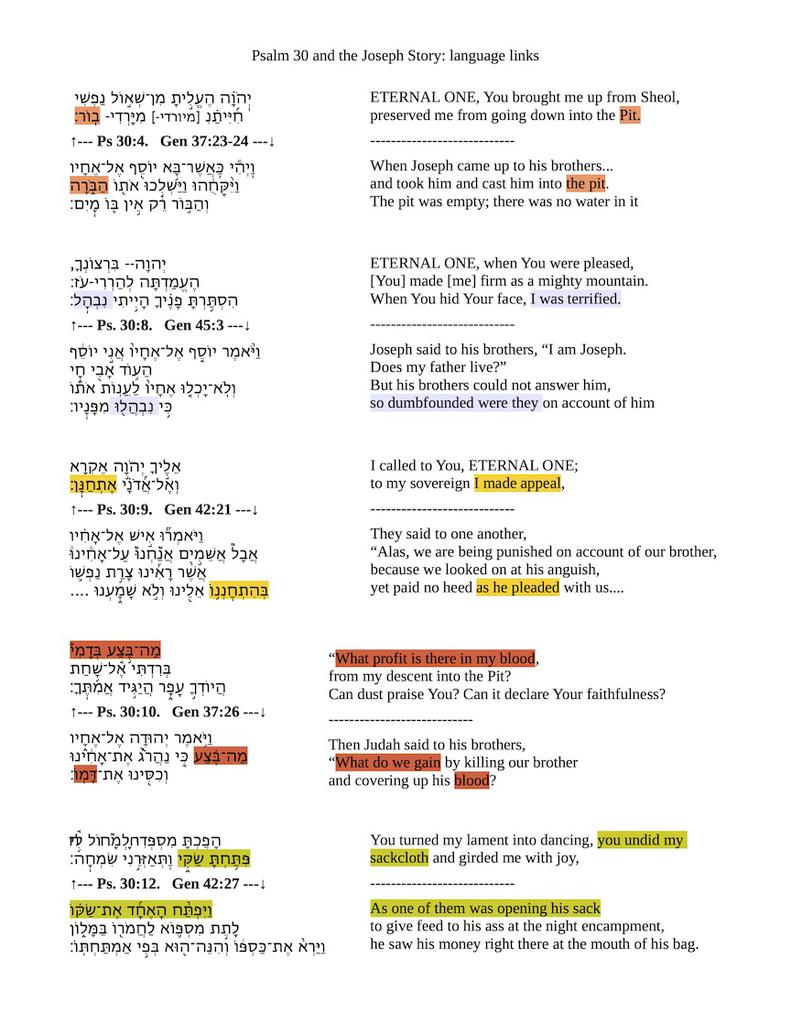
(ד) יְֽהֹוָ֗ה הֶעֱלִ֣יתָ מִן־שְׁא֣וֹל נַפְשִׁ֑י חִ֝יִּיתַ֗נִי (מיורדי) [מִיׇּֽרְדִי־]בֽוֹר׃
(4) O ETERNAL ONE, You brought me up from Sheol, preserved me from going down into the Pit.
(כג) וַֽיְהִ֕י כַּֽאֲשֶׁר־בָּ֥א יוֹסֵ֖ף אֶל־אֶחָ֑יו וַיַּפְשִׁ֤יטוּ אֶת־יוֹסֵף֙ אֶת־כֻּתׇּנְתּ֔וֹ אֶת־כְּתֹ֥נֶת הַפַּסִּ֖ים אֲשֶׁ֥ר עָלָֽיו׃ (כד) וַיִּ֨קָּחֻ֔הוּ וַיַּשְׁלִ֥כוּ אֹת֖וֹ הַבֹּ֑רָה וְהַבּ֣וֹר רֵ֔ק אֵ֥ין בּ֖וֹ מָֽיִם׃
(23) When Joseph came up to his brothers, they stripped Joseph of his tunic, the ornamented tunic that he was wearing, (24) and took him and cast him into the pit. The pit was empty; there was no water in it.
(ח) יְֽהֹוָ֗ה בִּרְצוֹנְךָ֮ הֶעֱמַ֢דְתָּה לְֽהַרְרִ֫י־עֹ֥ז הִסְתַּ֥רְתָּ פָנֶ֗יךָ הָיִ֥יתִי נִבְהָֽל׃
(8) for You, O ETERNAL ONE, when You were pleased, made [me] firm as a mighty mountain.
When You hid Your face, I was terrified.
(ג) וַיֹּ֨אמֶר יוֹסֵ֤ף אֶל־אֶחָיו֙ אֲנִ֣י יוֹסֵ֔ף הַע֥וֹד אָבִ֖י חָ֑י וְלֹֽא־יָכְל֤וּ אֶחָיו֙ לַעֲנ֣וֹת אֹת֔וֹ כִּ֥י נִבְהֲל֖וּ מִפָּנָֽיו׃ (ד) וַיֹּ֨אמֶר יוֹסֵ֧ף אֶל־אֶחָ֛יו גְּשׁוּ־נָ֥א אֵלַ֖י וַיִּגָּ֑שׁוּ וַיֹּ֗אמֶר אֲנִי֙ יוֹסֵ֣ף אֲחִיכֶ֔ם אֲשֶׁר־מְכַרְתֶּ֥ם אֹתִ֖י מִצְרָֽיְמָה׃ (ה) וְעַתָּ֣ה ׀ אַל־תֵּעָ֣צְב֗וּ וְאַל־יִ֙חַר֙ בְּעֵ֣ינֵיכֶ֔ם כִּֽי־מְכַרְתֶּ֥ם אֹתִ֖י הֵ֑נָּה כִּ֣י לְמִֽחְיָ֔ה שְׁלָחַ֥נִי אֱלֹהִ֖ים לִפְנֵיכֶֽם׃
(3) Joseph said to his brothers, “I am Joseph. Is my father still well?” But his brothers could not answer him, so dumbfounded were they on account of him. (4) Then Joseph said to his brothers, “Come forward to me.” And when they came forward, he said, “I am your brother Joseph, he whom you sold into Egypt. (5) Now, do not be distressed or reproach yourselves because you sold me hither; it was to save life that God sent me ahead of you.
(ט) אֵלֶ֣יךָ יְהֹוָ֣ה אֶקְרָ֑א וְאֶל־אֲ֝דֹנָ֗י אֶתְחַנָּֽן׃
(9) I called to You, O ETERNAL ONE; to my sovereign I made appeal,
וַיֹּאמְר֞וּ אִ֣ישׁ אֶל־אָחִ֗יו אֲבָל֮ אֲשֵׁמִ֣ים ׀ אֲנַ֘חְנוּ֮ עַל־אָחִ֒ינוּ֒ אֲשֶׁ֨ר רָאִ֜ינוּ צָרַ֥ת נַפְשׁ֛וֹ בְּהִתְחַֽנְנ֥וֹ אֵלֵ֖ינוּ וְלֹ֣א שָׁמָ֑עְנוּ עַל־כֵּן֙ בָּ֣אָה אֵלֵ֔ינוּ הַצָּרָ֖ה הַזֹּֽאת׃ וַיַּ֩עַן֩ רְאוּבֵ֨ן אֹתָ֜ם לֵאמֹ֗ר הֲלוֹא֩ אָמַ֨רְתִּי אֲלֵיכֶ֧ם ׀ לֵאמֹ֛ר אַל־תֶּחֶטְא֥וּ בַיֶּ֖לֶד וְלֹ֣א שְׁמַעְתֶּ֑ם וְגַם־דָּמ֖וֹ הִנֵּ֥ה נִדְרָֽשׁ׃
They said to one another, “Alas, we are being punished on account of our brother, because we looked on at his anguish, yet paid no heed as he pleaded with us. That is why this distress has come upon us.” Then Reuben spoke up and said to them, “Did I not tell you, ‘Do no wrong to the boy’? But you paid no heed. Now comes the reckoning for his blood.”
מַה־בֶּ֥צַע בְּדָמִי֮ בְּרִדְתִּ֢י אֶ֫ל־שָׁ֥חַת הֲיוֹדְךָ֥ עָפָ֑ר הֲיַגִּ֥יד אֲמִתֶּֽךָ׃
Psalm 30:10 and Genesis 37: 26
“What is to be gained from my death, from my descent into the Pit?Can dust praise You?Can it declare Your faithfulness?
(כה) וַיֵּשְׁבוּ֮ לֶֽאֱכׇל־לֶ֒חֶם֒ וַיִּשְׂא֤וּ עֵֽינֵיהֶם֙ וַיִּרְא֔וּ וְהִנֵּה֙ אֹרְחַ֣ת יִשְׁמְעֵאלִ֔ים בָּאָ֖ה מִגִּלְעָ֑ד וּגְמַלֵּיהֶ֣ם נֹֽשְׂאִ֗ים נְכֹאת֙ וּצְרִ֣י וָלֹ֔ט הוֹלְכִ֖ים לְהוֹרִ֥יד מִצְרָֽיְמָה׃ (כו) וַיֹּ֥אמֶר יְהוּדָ֖ה אֶל־אֶחָ֑יו מַה־בֶּ֗צַע כִּ֤י נַהֲרֹג֙ אֶת־אָחִ֔ינוּ וְכִסִּ֖ינוּ אֶת־דָּמֽוֹ׃ (כז) לְכ֞וּ וְנִמְכְּרֶ֣נּוּ לַיִּשְׁמְעֵאלִ֗ים וְיָדֵ֙נוּ֙ אַל־תְּהִי־ב֔וֹ כִּֽי־אָחִ֥ינוּ בְשָׂרֵ֖נוּ ה֑וּא וַֽיִּשְׁמְע֖וּ אֶחָֽיו׃
(25) Then they sat down to a meal. Looking up, they saw a caravan of Ishmaelites coming from Gilead, their camels bearing gum, balm, and ladanum to be taken to Egypt. (26) Then Judah said to his brothers, “What do we gain by killing our brother and covering up his blood? (27) Come, let us sell him to the Ishmaelites, but let us not do away with him ourselves. After all, he is our brother, our own flesh.” His brothers agreed.
(יב) הָפַ֣כְתָּ מִסְפְּדִי֮ לְמָח֢וֹל לִ֥֫י פִּתַּ֥חְתָּ שַׂקִּ֑י וַֽתְּאַזְּרֵ֥נִי שִׂמְחָֽה׃
Psalm 30:12 and Genesis 42:25
(12)
You turned my lament into dancing, you undid my sackcloth and girded me with joy,
(כה) וַיְצַ֣ו יוֹסֵ֗ף וַיְמַלְא֣וּ אֶת־כְּלֵיהֶם֮ בָּר֒ וּלְהָשִׁ֤יב כַּסְפֵּיהֶם֙ אִ֣ישׁ אֶל־שַׂקּ֔וֹ וְלָתֵ֥ת לָהֶ֛ם צֵדָ֖ה לַדָּ֑רֶךְ וַיַּ֥עַשׂ לָהֶ֖ם כֵּֽן׃ (כו) וַיִּשְׂא֥וּ אֶת־שִׁבְרָ֖ם עַל־חֲמֹרֵיהֶ֑ם וַיֵּלְכ֖וּ מִשָּֽׁם׃ (כז) וַיִּפְתַּ֨ח הָאֶחָ֜ד אֶת־שַׂקּ֗וֹ לָתֵ֥ת מִסְפּ֛וֹא לַחֲמֹר֖וֹ בַּמָּל֑וֹן וַיַּרְא֙ אֶת־כַּסְפּ֔וֹ וְהִנֵּה־ה֖וּא בְּפִ֥י אַמְתַּחְתּֽוֹ׃ (כח) וַיֹּ֤אמֶר אֶל־אֶחָיו֙ הוּשַׁ֣ב כַּסְפִּ֔י וְגַ֖ם הִנֵּ֣ה בְאַמְתַּחְתִּ֑י וַיֵּצֵ֣א לִבָּ֗ם וַיֶּֽחֶרְד֞וּ אִ֤ישׁ אֶל־אָחִיו֙ לֵאמֹ֔ר מַה־זֹּ֛את עָשָׂ֥ה אֱלֹקִ֖ים לָֽנוּ׃
(25) Then Joseph gave orders to fill their bags with grain, return each one’s money to his sack, and give them provisions for the journey; and this was done for them. (26) So they loaded their asses with the rations and departed from there. (27) As one of them was opening his sack to give feed to his ass at the night encampment, he saw his money right there at the mouth of his bag. (28) And he said to his brothers, “My money has been returned! It is here in my bag!” Their hearts sank; and, trembling, they turned to one another, saying, “What is this that God has done to us?”