


1) I do not really like the term 'Jewish mysticism.' The order of the words is not correct. You have to say 'mystical Judaism', because Kabbalah is first and foremost an interpretation of an aspect of the Jewish religion. … The inclusion of all mystical phenomena under the heading 'mysticism' is a mistake, because it causes people to think everything is the same—Christian mysticism, Jewish mysticism, Muslim mysticism. The Kabbalah is an interpretation of the Jewish religion, of Torah and mitzvot, of the people and the land of Israel.
– Israeli scholar and Hebrew University professor Yehuda Liebes
– Israeli scholar and Hebrew University professor Yehuda Liebes
2) On Ein Sof
The essence of divinity (עֶצֶם האֵלוֹהוּת) is found in every single thing — nothing but it exists. Since it causes every thing to be (המְהוֶה אֶת כוּלָם), no thing can live by anything else. It enlivens them; its existence exists in each existent.
Do not attribute duality to God. Let God be solely God. If you suppose that Ein Sof emanates (מתפשט) until a certain point, and that from that point on is outside of it, you have dualized. God forbid! Realize, rather, that Ein Sof exists in each existent. Do not say, “This is a stone and not God (אֶלוֹהַ).” God forbid! Rather, all existence is God, and the stone is a thing pervaded by divinity (והאבן הוא בריה שאלהותו מתפשט בה).
– Rabbi Moshe Cordovero, Shiur Qomah, translated in The Essential Kabbalah, Daniel Matt, p. 24.
The essence of divinity (עֶצֶם האֵלוֹהוּת) is found in every single thing — nothing but it exists. Since it causes every thing to be (המְהוֶה אֶת כוּלָם), no thing can live by anything else. It enlivens them; its existence exists in each existent.
Do not attribute duality to God. Let God be solely God. If you suppose that Ein Sof emanates (מתפשט) until a certain point, and that from that point on is outside of it, you have dualized. God forbid! Realize, rather, that Ein Sof exists in each existent. Do not say, “This is a stone and not God (אֶלוֹהַ).” God forbid! Rather, all existence is God, and the stone is a thing pervaded by divinity (והאבן הוא בריה שאלהותו מתפשט בה).
– Rabbi Moshe Cordovero, Shiur Qomah, translated in The Essential Kabbalah, Daniel Matt, p. 24.
3) Additional Associations of the Sefirot, Pt. 1
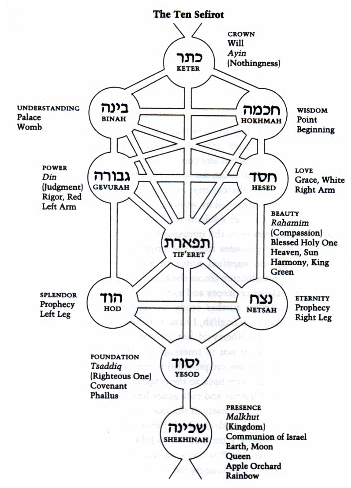
1st Triad: Primal Process, Head/Mind: Keter, Chochmah, and Binah
Keter: It is also called will/ratzon, because it represents the first stirrings of intent of the One to come into the varied life of being. It is also pure compassion, an undifferentiated state of divine openness toward all that is to be. (Art Green, Ehyeh) Ayin is a full nothing. Amazingly, so many wisdom traditions say at the root of consciousness is nothing. Tip of Letter י of the Divine name.
Chochmah: the beginning the flash of thought, the seed/primal point of all existence. The Torah that exists prior to the birth of words and letters. Father. (Green, ibid.) Right brain. Letter י of the Divine name.
Binah: the very beginnings of conceptualization from the flash of chochmah (chochmah and binah work together). Upper Mother. Teshuvah. Left brain. Letter ה of the Divine name. She gives birth to all as the cosmic womb, filled with seed from chochmah.
These upper sefirot mirror the process of thought, emerging from nothingness, which will eventually culminate with speech/malchut.
2nd Triad: The Emotions, the Heart, Seeking Inner Balance – Chesed through Tiferet
Chesed: Free-flowing love/ahavah. Abraham is the first of God’s followers. Generosity, open heartedness. In the body: suppleness, flow – yoga, tai chi (Michaelson, God in Your Body)
Gevurah: Yirah (awe/fear). Fittingly, Isaac follows chesed. Obedience, boundaries, discipline, measuring of divine love. In the body: constriction and strength – weight training (Michaelson, ibid.)
Chesed is relaxation, gevurah is work.
1st Triad: Primal Process, Head/Mind: Keter, Chochmah, and Binah
Keter: It is also called will/ratzon, because it represents the first stirrings of intent of the One to come into the varied life of being. It is also pure compassion, an undifferentiated state of divine openness toward all that is to be. (Art Green, Ehyeh) Ayin is a full nothing. Amazingly, so many wisdom traditions say at the root of consciousness is nothing. Tip of Letter י of the Divine name.
Chochmah: the beginning the flash of thought, the seed/primal point of all existence. The Torah that exists prior to the birth of words and letters. Father. (Green, ibid.) Right brain. Letter י of the Divine name.
Binah: the very beginnings of conceptualization from the flash of chochmah (chochmah and binah work together). Upper Mother. Teshuvah. Left brain. Letter ה of the Divine name. She gives birth to all as the cosmic womb, filled with seed from chochmah.
These upper sefirot mirror the process of thought, emerging from nothingness, which will eventually culminate with speech/malchut.
2nd Triad: The Emotions, the Heart, Seeking Inner Balance – Chesed through Tiferet
Chesed: Free-flowing love/ahavah. Abraham is the first of God’s followers. Generosity, open heartedness. In the body: suppleness, flow – yoga, tai chi (Michaelson, God in Your Body)
Gevurah: Yirah (awe/fear). Fittingly, Isaac follows chesed. Obedience, boundaries, discipline, measuring of divine love. In the body: constriction and strength – weight training (Michaelson, ibid.)
Chesed is relaxation, gevurah is work.
4) The Sefirot and Ein Sof—Water, Light and Colors
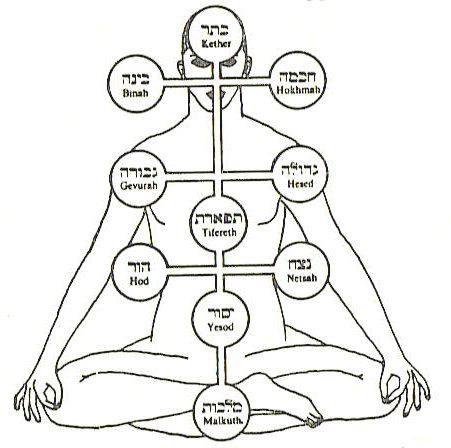
In the beginning, Ein Sof emanated (האציל) ten sefirot, which are of its essence, united with it. It and they are entirely one (אחדוּת שלמה). There is no change or division in the emanator that would justify saying it is divided into parts in these various sefirot. Division and change do not apply to it, only to the external sefirot.[1]
To help you conceive this, imagine water flowing through vessels of different colors: white, red, green and so forth. As the water spreads (יתפשט) through those vessels, it appears to change into the colors of the vessels, although the water is devoid of all color. The change in color does not affect the water itself, just our perception of the water. So it is with the sefirot. They are vessels, known, for example, as Chesed, Gevurah and Tiferet, each colored according to its function, white, red, and green, respectively, while the light of the emanator — their essence — is in the water, having no color at all. This essence does not change; it only appears to change as it flows through the vessels.
Better yet, imagine a ray of sunlight shining through a stained-glass window of ten different colors. The sunlight possesses no color at all but appears to change hue as it passes through the different colors of glass. Colored light radiates through the window. The light has not essentially changed, though so it seems to the viewer. Just so with the sefirot. The light that clothes itself (מתלבש) in the vessels (כלים) of the sefirot is the essence, like the ray of sunlight. That essence does not change color at all, neither judgment nor compassion, neither right nor left. Yet by emanating through the sefirot — the variegated stained glass — judgment or compassion prevails.
(Moshe Cordovero, Pardes Rimonim, trans. Matt in Essential Kabbalah, p. 38.)
In the beginning, Ein Sof emanated (האציל) ten sefirot, which are of its essence, united with it. It and they are entirely one (אחדוּת שלמה). There is no change or division in the emanator that would justify saying it is divided into parts in these various sefirot. Division and change do not apply to it, only to the external sefirot.[1]
To help you conceive this, imagine water flowing through vessels of different colors: white, red, green and so forth. As the water spreads (יתפשט) through those vessels, it appears to change into the colors of the vessels, although the water is devoid of all color. The change in color does not affect the water itself, just our perception of the water. So it is with the sefirot. They are vessels, known, for example, as Chesed, Gevurah and Tiferet, each colored according to its function, white, red, and green, respectively, while the light of the emanator — their essence — is in the water, having no color at all. This essence does not change; it only appears to change as it flows through the vessels.
Better yet, imagine a ray of sunlight shining through a stained-glass window of ten different colors. The sunlight possesses no color at all but appears to change hue as it passes through the different colors of glass. Colored light radiates through the window. The light has not essentially changed, though so it seems to the viewer. Just so with the sefirot. The light that clothes itself (מתלבש) in the vessels (כלים) of the sefirot is the essence, like the ray of sunlight. That essence does not change color at all, neither judgment nor compassion, neither right nor left. Yet by emanating through the sefirot — the variegated stained glass — judgment or compassion prevails.
(Moshe Cordovero, Pardes Rimonim, trans. Matt in Essential Kabbalah, p. 38.)
- What do you make of this text? What is it adding to your understanding of the sefirot? How do Cordovero’s images sit with you?
[1] Cordovero distinguishes between the essence of the sefirot and the external aspect of the sefirot, which channels this essence. Matt, The Essential Kabbalah, p. 168.