


(ד) אבל תרומת המכס וחנוכת המזבח וברכות וקללות שבהר גריזים ועיבל לא נתבאר למה כתבן בחשבון הפרשיות המשלימות לו החשבון. והנראה מדעתו שהוא לא בא למנות מצות שעה כאותן שבאו במצרים ובמעמד הר סיני וזולתם שאין להם ענין אלא לשעתן, אבל המצות שענינם קיים לנו לדורות ימנה אותן אע"פ שאינן נעשות אלא פעם אחת ולכן מנה פרשת אבנים גדולות לפי שנצטוינו (סוטה ל"ב) לכתוב בהן התורה באר היטב בשבעים לשון להיותם לנו זכר לדורות. ומנה פרשת ברכות וקללות שהיא קבלה שקבלו אבותינו עליהם ועל זרעם לדורות התורה כולה בפרט וכלל וקבלו אותה באלה ובשבועה. וכן פרשת חנוכה שמנה וכתב בפרשת משכן חנוך מזבח, ובודאי חנוך המזבח הוא מצוה לדורות כמו שכתוב בפרשת ואתה תצוה וזה אשר תעשה על המזבח שהיא מצות החנוך ומזה שנינו (מנחות מ"ט) אין מחנכין את המזבח אלא בתמיד של שחר. ונראין הדברים עוד שאף המשכן בהקמתו ובית המקדש בהבנותו צריכים חנוכה לעולם ונדבת הנשיאים היתה הוראת שעה בשיעורים ההם שעלו בדעתם אבל בחנוכה כמו חובה הוא. וכן עשה שלמה חנוכה וכן אנשי כנסת הגדולה ואף לימות המשיח וכמו שאמרו (שם מ"ה) מלואים הקריבו בימי עזרא כדרך שהקריבו בימי משה.

רַבִּי יְהוֹשֻׁעַ אוֹמֵר:.. בְּרֹאשׁ הַשָּׁנָה בָּטְלָה עֲבוֹדָה מֵאֲבוֹתֵינוּ בְּמִצְרַיִם, בְּנִיסָן נִגְאֲלוּ בְּנִיסָן עֲתִידִין לִיגָּאֵל.
וכן היה רבי יהודה אומר ג' מצות נצטוו ישראל בכניסתן לארץ להעמיד להם מלך ולהכרית זרעו של עמלק ולבנות להם בית הבחירה
(א) הבדלו מתוך העדה הזאת... ואני אומר בדרך סברא שהיה עונש על ישראל בהתאחר בנין בית הבחירה שהיה הארון הולך מאהל אל אהל כגר בארץ ואין השבטים מתעוררים לאמר נדרוש את ה' ונבנה הבית לשמו כענין שנאמר (דברים יב ה) לשכנו תדרשו ובאת שמה עד שנתעורר דוד לדבר מימים רבים ולזמן ארוך שנאמר (ש"ב ז א-ב) ויהי כי ישב המלך בביתו וה' הניח לו מסביב מכל אויביו ויאמר המלך אל נתן הנביא אנכי יושב בבית ארזים וארון האלקים יושב בתוך היריעה והנה דוד מנעו השם יתברך מפני שאמר (דברי הימים א כב ח) כי דמים רבים שפכת ארצה לפני ונתאחר עוד הבנין עד מלוך שלמה ואלו היו ישראל חפצים בדבר ונתעוררו בו מתחלה היה נעשה בימי אחד מהשופטים או בימי שאול או גם בימי דוד
(1) SEPARATE YOURSELVES FROM AMONG THIS CONGREGATION, THAT I MAY CONSUME THEM IN A MOMENT. One may ask: If [the whole people of] Israel did not sin and did not rebel against their teacher, why was [G-d’s] wrath upon them, saying, that I may consume them in a moment? And if [on the other hand] they also rebelled [against Moses] as did Korach and his company, how could Moses and Aaron say [on their behalf]: shall one man sin, and wilt Thou be wroth with all the congregation?106Verse 22. Now Rabbeinu Chananel48See (Exodus), Vol. II, p. 106, Note 45, for a brief biography of this great Rabbinic scholar. See also (Leviticus), Vol. III, p. 324, Note 286. wrote as follows: “Separate yourselves from among this congregation means the congregation of Korach, not the congregation of the children of Israel. [But Moses and Aaron, thinking that G-d referred to all the people], said: O G-d, the G-d of the spirits of all flesh, shall one man sin etc.106Verse 22. Immediately the Holy One, blessed be He, informed Moses that He did not want to destroy the whole congregation of the children of Israel, but only the congregation of Korach. Therefore He explained to him: ‘When I said, Separate yourselves from among this congregation, the meaning was: Get you up from about the dwelling of Korach, Dathan, and Abiram.107Verse 24. He told them, Get you up from about the dwelling etc., because perhaps when Korach and his company would see them going away, they might repent.”
These are his [Rabbeinu Chananel’s] words, which are not right, for it would not be correct to say about Korach, Dathan, and Abiram — three men — Separate yourselves from among ‘this congregation,’ for they were not “a congregation,” since the Israelites were not among them, and Aaron was going about108See Ezekiel 46:10. in the midst of the congregation that offered the incense! Besides, the expression separate ‘yourselves’ alludes only to Moses and Aaron, just like Get you up from among the congregation.109Further, 17:10. Thus it is clear that Moses and Aaron were to separate themselves from the whole congregation, since they were all to be punished, and not only the congregation of Korach. Similarly, that I may consume them in a moment110In Verse 21 before us. refers to a plague, which consumes a mighty and large people in a moment [and cannot therefore refer only to Korach, Dathan, and Abiram]. And [finally], far be it [from us to say] that Moses did not understand his own prophecy and made a mistake therein!
But the meaning thereof is as follows: At first the heart of the people was on the side of Moses and Aaron, but when Korach and his company took every man his censer and laid incense thereon and stood at the door of the Tent of Meeting with Moses and Aaron,111Verse 18. Korach called together all the congregation112Verse 19. and told them that he was concerned about the honor of all of them. This was pleasing to them, so they all assembled to see peradventure it will be right in the eyes of G-d,113Further, 23:27. and the service [of the offerings] will return to their firstborn, this being the meaning of the verse, And Korach assembled all the congregation against them.112Verse 19. Thus they [all] became liable to destruction because they cast aspersions on their teacher, which is like casting aspersions on the Divine Presence,114Sanhedrin 110a. See “The Commandments,” Vol. I, pp. 225-226. and they [likewise] rejected in their hearts the prophecy of a prophet, for which they were liable to death by the hand of Heaven.114Sanhedrin 110a. See “The Commandments,” Vol. I, pp. 225-226. But Moses and Aaron spoke up in their defense, saying that it was only Korach who sinned in this matter, for he was the cause of it all and it was he who incited them, therefore it was right that he alone should die, in order to publicize and make known his punishment to the [whole] community.
This is indeed the way of those who plead for mercy, for they mitigate the [severity of the] people’s sin, and put [the blame for] it upon the individual who caused it, because he at any rate is [certainly] guilty. And so did David say, Lo, I have sinned, and I have done iniquitously; but these sheep, what have they done? Let Thy hand, I pray thee, be against me, and against my father’s house.115II Samuel 24:17. And the punishment [i.e., the plague in the days of David] came upon the people as well [despite David accepting the blame himself] because of their own sin, for they should have given the [half-] shekels themselves [in order to be counted]116See (Exodus), Vol. II, pp. 510-511. — if [we say that] the punishment was on account of that sin, as our Rabbis explained it.117Berachoth 62b. For the king had not commanded them not to give the [half-] shekels, as he only wanted to know their numbers,118II Samuel 24:2. therefore their guilt and his guilt in this incident was equal. Moreover, in addition to [being punished for] the census, there was a punishment upon the people [already] at the beginning of this matter, as it is written, And again the anger of the Eternal was kindled against Israel, and He moved David against them, [saying: ‘Go, number Israel and Judah’].119Ibid., Verse 1.
Now Rashi wrote there: “I do not know why [G-d’s anger was kindled against Israel].” And I say by way of explanation that Israel was punished because of the delay in the building of the Sanctuary,120Literally: “The Chosen House,” a reference to the Temple in Jerusalem. See Deuteronomy 12:11 for the origin of this term. since the ark went from tent to tent121I Chronicles 17:5. Four hundred years had already passed since the exodus up to that period in the reign of David. as a stranger in the Land,122Jeremiah 14:8. and none of the tribes bestirred themselves to say, “Let us seek G-d and build a house to His Name, just as it is written, even unto His habitation shall ye seek, and thither thou shalt come.”123Deuteronomy 12:5. [This situation continued] until David was roused to action in this matter after many years and a long period of time [had elapsed since he had become king], as it is said, And it came to pass, when the king dwelt in his house, and the Eternal had given him rest from all his enemies round about, that the king said unto Nathan the prophet: ‘See now, I dwell in a house of cedar, but the ark of G-d dwelleth within curtains.’124II Samuel 7:1-2. Now G-d, blessed be He, prevented David [from building the Sanctuary], because He said, for thou hast shed much blood upon the earth in My sight,125I Chronicles 22:8. and thus the building was [further] delayed until the reign of Solomon. But had Israel really desired this matter [and really wanted to build the Sanctuary], and had they bestirred themselves to action from the start, it would have been done [already] in the days of one of the Judges, or in the days of Saul, or even in the days of David. For had the tribes of Israel aroused themselves in this matter, he [David] would not have been [considered] the builder, but Israel would have been the builders. But since the people did not concern themselves about it, and David was the one who was troubled about it and called for action, and it was he who prepared all the materials [for the House of G-d],126Ibid., 29:2. he was the builder. However, since he was a man of judgment, guided [in his actions] by the attribute of justice, he was not fit for [the task of building] the House of Mercy,127To my knowledge, Ramban’s use of this term “the House of Mercy” as an alternative name for the Temple in Jerusalem is the first of its kind in Rabbinic literature. It is of interest to note that a generation later, the French Rabbi Estori Haparchi (1282-1357), in his classic book of itinerary on the Land of Israel, Kaftor Va’ferach, mentions for the first time that one of the gates on the eastern side of the wall surrounding Jerusalem was called by the people Shaarei Harachamim — the “Gates of Mercy” — a name which is still used to this day. Since no definite source is known for the name given to this gate, it is possible that it is derived from this concept of the Sanctuary as “the House of Mercy,” and thus the name “Gates of Mercy” is a shortened form of “the gates of the House of Mercy.” See II Chronicles 23:19 for such usage in the Scriptures: the gates of the House of the Eternal. therefore the building [of the Sanctuary] was delayed as long as David lived due to the negligence of Israel [in not coming forth themselves to build it], and therefore the [Divine] wrath was upon them. It was for this reason that the place which the Eternal shall choose … to put His Name there123Deuteronomy 12:5. came to be known, as a result of their punishment through the plague.128In II Samuel, Chapter 24, Verses 16-25 it is related that “the angel of the Eternal was, at the moment that the plague ceased, by the treshing-floor of Aravnah the Jebusite,” and on that spot David built the altar. This is the meaning of Ramban’s statement that ‘the place which G-d shall choose’ came to be known [i.e., identified] through the punishment and plague which came upon Israel for their indolence in the pursuit of the building of the Sanctuary. But had the people bestirred themselves to action, the place would have been identified through a more pleasant way. This is Ramban’s clear intention.
Scripture alludes to all this when it says, For I have not dwelt in a house since the day that I brought up the children of Israel out of Egypt, even to this day, but have walked in a tent and in a tabernacle. In all places wherein I have walked among all the children of Israel, spoke I a word with any of the tribes of Israel, whom I commanded to feed My people Israel, saying: Why have ye not built Me a house of cedar?129Ibid., 7:6-7. Thus Scripture is blaming [the people] because the Divine Presence was walking about among all Israel from tent to tent, and from tabernacle130I Chronicles 17:5. The continuation here by Ramban [from tent to tent, and from tabernacle] is clearly based on this verse in Chronicles. In II Samuel 7:6 the reading is: in a tent and in a tabernacle. to tabernacle, and there was not one among all the Judges of Israel, who were their shepherds, that bestirred himself in this matter. Scripture also states that G-d too kept distant from them, and did not tell any one of them to build the House, but “now that you [David] have aroused yourself to do it, thou didst well that it was in thy heart,131I Kings 8:18. and I will now command that it should be built by thy son Solomon, who will be a man of peace.”
א"ר אחא זאת אומרת שב"ה עתיד להבנות קודם למלכות בית דוד.
מכתבו הגיעני וכו' וע"ד אשר בקש הסכמתי אם לגזור תענית צבור לכל המדינה ביום א' דסליחות דהאי שתא שהוא כ"ו אלול )סמוך לימי ר"ה הבעל"ט( אודות צרות המלחמות הגדולות והיקרות והרעבון הנצמח עי"ז... אבל לגזות תענית על כולם בכלל בודאי אין מהראוי עתה כנ"ל. ובפרט כי צריכין ליזהר לאשר אנו רואים כל אלו המלחמות הם חבלי משיח כפי שנראה מהכתובים ומהגמ' ומד' הזוה"ק )סוף פ' בלק( ובס' התמונה )אות ס'( ופי' שם באורך וכן בשארי ספרי קודש, ע"כ צריכין העיקר להתפלל על הגאולה שלימה ב"ב לא כן ההמון שהטעו אותם שצריכי' להתפלל עתה העיקר רק על שלום העמים ושעי"ז שיופסק המלחמה ישובו למצרים הוא הגלות המר בעוה"ר ושכינה הק' בגלותא ומאריכי' הגלות ומעכבים הגאולה עי"ז ואיך נעיז פנינו ונקשה ערפינו לבקש כזאת ממלך הכבוד אבינו ית"ש לחלל כבוד מלכות ית"ש ח"ו וכמ"ש בס' הזכרון להגאון חת"ס זצ"ל כי אם נתפלל על השלום ה"ז עיכוב הגאולה כשאחז"ל במגילה מלחמה נמי אתחלתא דגאולה הוא עי"ש דבריו
... והנה הברית הראשונה אשר בפרשה הזאת הקב"ה כרת אותה כי כן היה שמו הגדול עמנו בבית הראשון והברית השנית שבפרשה והיה כי תבא מפי משה רמז לסילוק שכינתו לגמרי שלא היה בבית שני רק כבוד שמו שנאמר (חגי א ח) וארצה בו ואכבדה ותוספת הה"א רמז לשניה שבשם הגדול וכבר דרשו בו (יומא כא) מדרש אחר גם כן רמז לחמשה דברים שהיה הבית השני חסר וכו':
The principle [of this section] is that it is the Holy One, blessed be He, Who makes this covenant, and this is the meaning of the expressions: seven for your sins;104Verses: 18, 24, 28. See my Hebrew commentary p. 187. seven according to your sins.105Verse 21. And the oaths are [thus] the oaths of the covenant, for the expressions are from the mouth of the Almighty, [speaking] in the language of the first person: ‘I’ will do;106In Verse 16 before us. and ‘I’ will chastise;100Verse 28. and ‘I’ will smite.99Verse 24. Therefore Scripture states [concerning this covenant], which the Eternal made between Him and the children of Israel,107Further, Verse 46. for He by His Great Name made this covenant. But in the Book of Deuteronomy [Scripture] states, If thou wilt not hearken unto the voice of the Eternal thy G-d, to observe to do all His commandments,108Deuteronomy 28:15. and it continually mentions there an expression of cursing, thus it starts them [the words of the covenant] with: cursed shalt thou be,109Ibid., Verse 16. since the blessing is absent from them, and it further states, the Eternal will make.110Ibid., Verse 24. It is this which is the [intention of the] saying of our Rabbis:111Megillah 31 b. “The imprecations of the Book of Leviticus were [prounounced] in plural terms [if ‘ye’ will not hearken … if ‘ye’ shall reject …], and Moses, in saying them, said them from the mouth of the Almighty [stating: “Thus did the Holy One blessed be He, say unto me, ‘If ye will not hearken unto Me’ “], but those [imprecations mentioned] in the Book of Deuteronomy were [pronounced] in the singular [if ‘thou’ wilt not hearken … which I command ‘thee'…] and Moses in saying them said them [as though they came] from his own mouth, for the Almighty made Moses a messenger between Him and between all Israel.”
Know and understand that these oaths [stated in this section] allude to the first exile [i.e., the Babylonian exile following the destruction of the First Temple], for it is with reference to the First Temple that all the words of this covenant, concerning the exile and the redemption therefrom, apply. For thus you will see in the exhortations [here] that He stated, And if ye shall reject My statutes, and if your soul abhor Mine ordinances,112Verse 15. and He further stated, that ye void My covenant,112Verse 15. mentioning among them [the rejected statutes]: the high places [on which they offered forbidden sacrifices], sun-images, and idols,113Verse 30. and it was [in the times of the First Temple] that they worshipped idols and did all evil things. It is in connection with this that He said, And I will bring your Sanctuaries unto desolation, and I will not smell the savor of your sweet odors,114Verse 31. thus warning them that He will remove from them His Sanctuary and the acceptance of the offerings which were favorable to Him in that Sanctuary, and the punishments which were to follow upon them were: the sword,115Verse 25. wild beasts,116Verse 22. pestilence,115Verse 25. famine,117Verse 26. and finally exile.118Verse 33. And all these things occurred then [at the destruction of the First Temple], as is clearly stated in the Book of Jeremiah. Of that [first] exile He stated, Then shall the Land be paid her Sabbaths;119Verse 34. As long as it lieth desolate it shall have a rest; even the rest which it had not [in your Sabbath],120Verse 35. because the years of the [Babylonian] exile were [as many] as the years in which they failed to observe [the laws of] the Sabbatical years.121See Rashi in Verse 35, who explains how the seventy years of the Babylonian exile correspond exactly to the seventy Sabbatical and Jubilee years that Israel failed to observe in the Land. So also does Scripture state concerning that exile, [that it was] To fulfill the word of the Eternal by the mouth of Jeremiah, until the Land had been paid her Sabbaths; for as long as she lay desolate she kept Sabbath, to fulfill threescore and ten years.122II Chronicles 36:21. Thus He warned them and thus it happened to them. If so, it is clear that Scripture speaks here of that [first] exile.
If you examine further the subject of the redemption from it [the Babylonian exile, you see], that He only assures [Israel] that He will remember the covenant of the fathers,123Verse 42. and of the remembrance of the Land,123Verse 42. but not that He will forgive their iniquity and their sin and that He will once again love them as of old, nor that He will gather together those of them who are dispersed. For such indeed happened when they came up from Babylon, for only [the tribes of] Judah and Benjamin returned together with a small group of Levites who were with them, and some124See Ramban’s Sefer Hage’ulah (Kithvei Haramban, Vol. I, pp. 272-4) for a full discussion of this important matter — that in the return from Babylon there were small groups from the other tribes besides Judah and Benjamin, but the main bulk of them remained in their places, and hence the words of the prophets announcing their complete return, not having been fulfilled during the Second Temple, will yet assuredly come to transpire in the future. This is the deeper significance of Ramban’s expression here: “and some of the other tribes …” — “some” but not all, and therefore the words of G-d as spoken by His prophets will still be fulfilled in the future when the ge’ulah shleimah (the perfect redemption) will take place, as the return from Babylon did not represent that final and complete redemption. It is obvious that this constitutes a major principle in our faith of Israel’s future and destiny. Ramban will touch upon this theme of the perfect redemption further on in the text. See also further, Note 154. of the [other] tribes that had been exiled to Babylon, and they returned in poverty, and in servitude to the kings of Persia.125See Ezra 9:9. Nor does He state that they will return to Him in complete repentance, but only that they shall confess their iniquity, and the iniquity of their fathers,126Verse 40. and we find that the people of the Second Temple did so, as Daniel confessed: We have sinned, we have dealt iniquitously, and have done wickedly, and have rebelled, and have turned aside from Thy commandments etc.127Daniel 9:5. O Eternal, to us belongeth confusion of face, to our kings, to our princes, and to our fathers.128Ibid., Verse 8. Thus they confessed also the sins of their fathers. The same applies to the following verses. And it is further written, because of our sins, and for the iniquities of our fathers, Jerusalem and Thy people are a reproach.129Ibid., Verse 16. And so did Nehemiah confess.130Nehemiah 1:6-7. And Ezra said, Neither have our kings, our princes, our priests, nor our fathers, kept Thy law.131Ibid., 9:34. It should be noted that Scripture there ascribes the actual confession to the Levites, and Ezra’s name is not directly mentioned. However, the implication in Chapter 8 Verse 13 is clearly that it was at Ezra’s instigation that they kept the Festival of Tabernacles and the subsequent confession following it (see ibid., 9:1). Besides, Ezra being a priest (ibid., 8:2) he was automatically of the tribe of Levi and was thus included among the Levites who recited the confession. Thus they all deduced from the Torah that they should confess their iniquity and [also] the iniquity of their fathers. All these [matters] are clear indications that this covenant does indeed allude to the first exile and the redemption therefrom.
However the covenant in the Book of Deuteronomy132Deuteronomy 28:1-69. alludes to this our [present] exile, and to the redemption by which we will be redeemed from it. Thus we observe first that there [in the second covenant] neither the end nor the duration [of the exile] are alluded to, and that He did not assure us of redemption [i.e., promising that it would take place at a certain future time as was the case with the Babylonian captivity, whose end was foretold as a definite event in our section here in Leviticus as explained above], but He made it dependent upon [our] repentance. Neither did He mention among the sins [for which they would be exiled that] they would make any Asherim and sun-images, or that they would worship any idols whatsoever. Rather, He said, But it shall come to pass, if thou wilt not hearken unto the voice of the Eternal thy G-d, to observe to do all His commandments and His statutes,108Deuteronomy 28:15. thus stating that because they will transgress some of His commandments, and will not keep and observe all of them,133I.e., they will “transgress” some of the negative commandments and “not keep and observe” the positive commandments. they would be punished. Such indeed was the case during the Second Temple, just as the Rabbis have said:134Yoma 9 b. “Why was the First Temple destroyed? Because of idolatry, immorality and bloodshed. But the Second Temple, of which we know that they [the people of that period], were engaged in the study of Torah and the practice of loving kindness, why was it destroyed? It was because of the causeless enmity which was among them.” Neither does He mention there [in the covenant in the Book of Deuteronomy] the Sanctuary, or “the pleasing odor” [of the offerings], as He mentioned here,135Verse 31. because the [Heavenly] fire did not come down and consume the offerings [that were brought] in the Second Temple, as the Rabbis testified there in Tractate Yoma.136Yoma 21 b. Thus, as it were, there never was a “pleasing odor” in the days of the Second Temple which could be removed at its destruction. And He further states there among the imprecations, The Eternal will bring a nation against thee from far, from the end of the earth, as the vulture swoops down,137Deuteronomy 28:49. alluding to the coming upon them of the Romans, who were very far from them. Thus He states there, a nation that thou hast not known;138Ibid., Verse 36. a nation whose tongue thou shalt not understand,137Deuteronomy 28:49. because of their great distance from our Land. Such is not the case concerning the words of this covenant [before us], for [it speaks of the time when] they were exiled to Babylon and Assyria, which are near to [our] Land, and they always warred with them;139Therefore, the verse in Deuteronomy 28:49 [The Eternal will bring a nation … from the end of the earth …] could not apply to the period of the First Temple, as their warring enemies were nearby. The case was far different during the Second Temple when the Romans came from far-off Italy. and the stock of Israel comes from there, and they [the Jews] knew their language, as it is said, Speak, I pray thee, to thy servants in the Aramean language, for we understand it.140II Kings 18:26. Similarly, the verse stating [there in the Book of Deuteronomy], And the Eternal shall scatter thee among all peoples, from the one end of the earth unto the other141Deuteronomy 28:64. is [a reference to] our exile today, in which we are scattered from one end of the world to the other. Again He stated [there], And the Eternal shall bring thee back into Egypt in ships,142Ibid., Verse 68. and this happened in our [present] exile, when Titus filled the ships with them [captives], as it is written in the books of the Romans.143Reference is to the book of Josippon, Chapter 95. See Vol. I, p. 604, Note 249. Similarly, that which Scripture says there, Thy sons and thy daughters shall be given unto another people and thy eyes shall see;144Deuteronomy 28:32. Thou shalt beget sons and daughters, and they shall not be thine, for they shall go into captivity145Ibid., Verse 41. Ramban’s illuminating comment on these verses (see following text) brings to light the ruthless cruelty of the Romans at the destruction of the Second Temple, when they deported all the young and only “the fathers [i.e. the old] remained in the Land.” — these are not references to the [Babylonian] exile, when both fathers and sons were exiled, but [refer] to that captivity of the sons alone [following the destruction of the Second Temple by the Romans], when the fathers remained in the Land. Such is not stated in the first covenant, because the exile [which it speaks of] was a complete one [for both fathers and sons], but it is mentioned in the second covenant, because the Romans ruled in our Land and took the sons and daughters at their will. Similarly, [the verse stating], Therefore shalt thou serve thine enemy whom the Eternal shall send against thee in hunger, and in thirst146Ibid., Verse 48. is a reference to our servitude when we were subject to the Romans in our Land, and their officers ruled over us, pressing upon us a heavy yoke and taking away our people and our wealth, as is known in the [history] books. Another proof [that the covenant in the Book of Deuteronomy refers to the exile after the destruction of the Second Temple] is that He said, The Eternal will bring thee, and thy king whom thou shalt set over thee, unto a nation that thou hast not known, thou nor thy fathers,147Ibid., Verse 36. for King Agrippa148This was Agrippa II, a loyal servant of Rome. He was the last king of Judea. During the siege of Jerusalem he was with Titus, and following the fall of the city he took part in arranging the Roman triumphal celebrations in Caesarea! He was the opposite of his father King Agrippa I, who in his genuine attachment to the Jewish people and religion won the love of all classes of the people. went to Rome at the end of the [period of the] Second Temple, and on account of his going there the Temple was destroyed.149Ramban here is referring to Josippon Chapter 65, where it is narrated that “King Agrippa went to Nero, emperor of Rome, and told him all these things [concerning the Jewish uprising against Rome], whereupon Nero sent against the Jews the Roman general etc.” This was the beginning of the war which culminated in the fall of Jerusalem. Now Scripture does not state: “the king who will rule over thee,” but it says, thy king whom ‘thou shalt set’. Thus He, blessed be He, is hinting to us that he [that ruler] was not fit to be king, since he was forbidden to be king over Israel according to the law of the Torah [as he was a descendant of King Herod, the son of Antipater the Idumean, and Scripture states, thou mayest not put a foreigner over thee, who is not thy brother],150Deuteronomy 17:15. but they “set up” him and his fathers as kings over them against the law, as is mentioned in Tractate Sotah.151Sotah 41 b.
Now all the hints such as these clearly indicate that the meaning of this matter is this our [present] exile, and the redemption [mentioned] in this second covenant, which will be a complete redemption, superior to all [preceding ones]. Thus He said, And it shall come to pass, when all these things are come upon thee, the blessing and the curse etc.;152Deuteronomy 30:1. and He promised, And He will do thee good, and multiply thee above thy fathers,153Ibid., Verse 5. this being a promise to all the tribes of Israel, not [merely] to one-sixth154I.e., the tribes of Judah and Benjamin, which constitute one-sixth of the twelve tribes. Ramban is thus stating that the redemption from the Babylonian exile was not a complete redemption, since the return consisted mainly of two tribes [with small groups of the other tribes, see above Note 124]. But the Divine promise stated in Deuteronomy 30:5 [as mentioned here in the text] refers to all tribes of Israel. Hence the coming redemption will be more complete than all preceding ones. of the people; and there He promised [also] that He would cut down and destroy those who caused our exile, as it is said, And the Eternal thy G-d will put all these curses upon thine enemies, and on them that hate thee, that persecuted thee,155Ibid., Verse 7. the expressions, thine enemies and those that hate thee alluding to the two nations156A reference to the two dominant religions in Ramban’s times — that of Edom and Ishmael — which persecuted the Jews [and still continue to do so] in countless ways. See my Hebrew commentary p. 190. that continually persecute us. Now these words [And He will do thee good, and multiply thee above thy fathers153Ibid., Verse 5.] assure us of the coming redemption with a more perfect assurance than all the visions of Daniel.
Similarly, that which He stated here, and your enemies that shall dwell therein shall be desolate in it157Further, Verse 32. constitutes a good tiding, proclaiming that during all our exiles, our Land will not accept our enemies. This also is a great proof and assurance to us, for in the whole inhabited part of the world one cannot find such a good and large Land158Exodus 3:8. which was always lived in and yet is as ruined as it is [today],159When these words were written — sometime after the middle of the thirteenth century — the Land of Israel had just experienced the Mongolian invasion (of 1259-60), which following upon the constant wars of the Crusaders, left the country in total ruin. for since the time that we left it, it has not accepted any nation or people, and they all try to settle it, but to no avail.160A clear reference to the many nations that have tried — and failed — to cultivate the Land of Israel since the Jews were driven from it by the Romans. This indubitable historical fact is, as Ramban correctly points out, “a great proof” that the Land belongs to Israel. Witness also the miraculous response of the Land since the recent return of the Jews to its borders.
Now the first covenant mentioned in this section the Holy One, blessed be He, made, for His Great Name was indeed with us in the First Temple, and the second covenant in the section of V’hayah Ki Thavo161Deuteronomy 26:1. — The covenant referred to is ibid., 28:1-68. expressed by the mouth of Moses, alludes to the removal of his Divine Presence entirely, since in the Second Temple only the Glory of His Name was present, as it is said, and I will take pleasure in it i.e., the Second Temple] ‘v’ikavdah’ (and I will be glorified).162Haggai 1:8. The additional letter hei163The word v’ikavdah is in this instance actually written without the hei at the end. Ramban however is referring to the fact that according to the Masorah it is to be read as if it had the letter at the end. Hence his language: “the ‘additional’ hei” … alludes to the second hei in the Great Name [i.e., the Tetragrammaton — which refers to the Glory of His Name].164Abusaula. — Thus the verse establishes that in the Second Temple there was the Glory of His Name. Haggai was one of the prophets who lived at the time of the building of the Second Temple. The Rabbis have also already interpreted this verse by means of another exposition,136Yoma 21 b. Thus, as it were, there never was a “pleasing odor” in the days of the Second Temple which could be removed at its destruction. [that the missing hei in the word v’ikavdah, whose numerical value is five], alludes to the five things which the Second Temple lacked etc.165“They are: the ark with the cover and the cherubim, the Divine fire on the altar, the Divine Presence, the Holy Spirit, and the Urim and Thummim” (ibid.). For Urim and Thummim see Ramban on Exodus 28:30 (Vol. II, pp. 480-4).
(טו) וּנְטַעְתִּ֖ים עַל־אַדְמָתָ֑ם וְלֹ֨א יִנָּתְשׁ֜וּ ע֗וֹד מֵעַ֤ל אַדְמָתָם֙ אֲשֶׁ֣ר נָתַ֣תִּי לָהֶ֔ם אָמַ֖ר ה' אֱלֹקֶֽיךָ׃
Nevermore to be uprooted
From the soil I have given them
—said the ETERNAL your God.
ואמר רבי אבא אין לך קץ מגולה מזה שנאמר (יחזקאל לו, ח) ואתם הרי ישראל ענפכם תתנו ופריכם תשאו לעמי ישראל וגו'
אראנו ולא עתה אשורנו ולא קרוב דרך כוכב מיעקב וקם שבט מישראל ומחץ פאתי מואב וקרקר כל בני שת.
אור החיים שם
כפל הדברים במלות שונות, גם כפל לומר דרך כוכב וגו' וקם שבט וגו', גם כפל לומר ומחץ וגו' וקרקר וגו', כל הנבואה במלך המשיח נאמרה. ויתבאר על פי דבריהם ז"ל )סנהדרין צח.( שאמרו בפסוק בעתה אחישנה, זכו אחישנה לא זכו בעתה, והוא רחוק מופלג, וזה לך האות הן אנו בתחלת מאה הששית לאלף הששי, וכנגד שני קצים אלו דבר הכתוב, כנגד אם זכו אמר אראנו, פירוש לדבר שאני עתיד לומר, אבל אינו עתה בזמן הזה אלא בזמן אחר, ויכול להיות שאינו רחוק כל כך, שאמרו ז"ל )..וכפל הענין, ושינוי הלשון, יתבאר על פי דבריהם ז"ל שאמרו )סנהדרין צח.( שאם תהיה הגאולה באמצעות זכות ישראל יהיה הדבר מופלא במעלה, ויתגלה הגואל ישראל מן השמים במופת ואות, כאמור בספר הזוהר )ח"א קיט.(, מה שאין כן כשתהיה הגאולה מצד הקץ ואין ישראל ראויים לה תהיה באופן אחר, ועליה נאמר )זכריה ט ט( שהגואל יבא עני ורוכב על החמור. והוא מה שאמר כאן, כנגד גאולת אחישנה שהיא באמצעות זכות ישראל, שרמז במאמר אראנו ולא עתה, אמר דרך כוכב, שיזרח הגואל מן השמים, גם רמז לכוכב היוצא באמצע השמים לנס מופלא, כאמור בספר הזוהר )שם(. וכנגד גאולת בעתה, שרמז במאמר אשורנו ולא קרוב, אמר וקם שבט מישראל, פירוש שיקום שבט אחד מישראל כדרך הקמים בעולם דרך הטבע, על דרך אומרו )דניאל ד יד( ושפל אנשים יקים עלה, שיבא עני ורוכב על החמור, ויקום וימלוך, ויעשה מה שנאמר בסמוך.
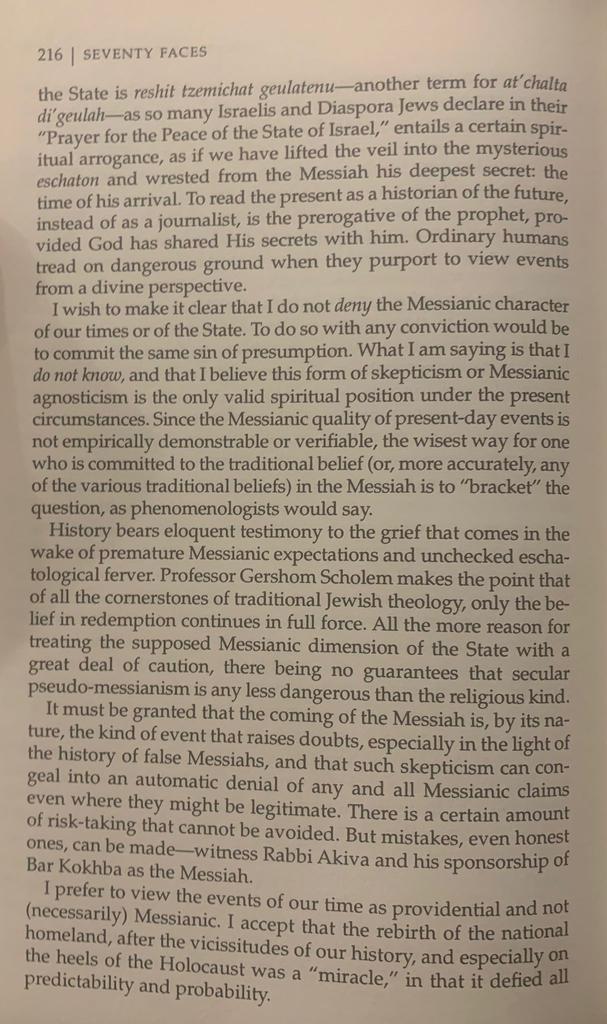
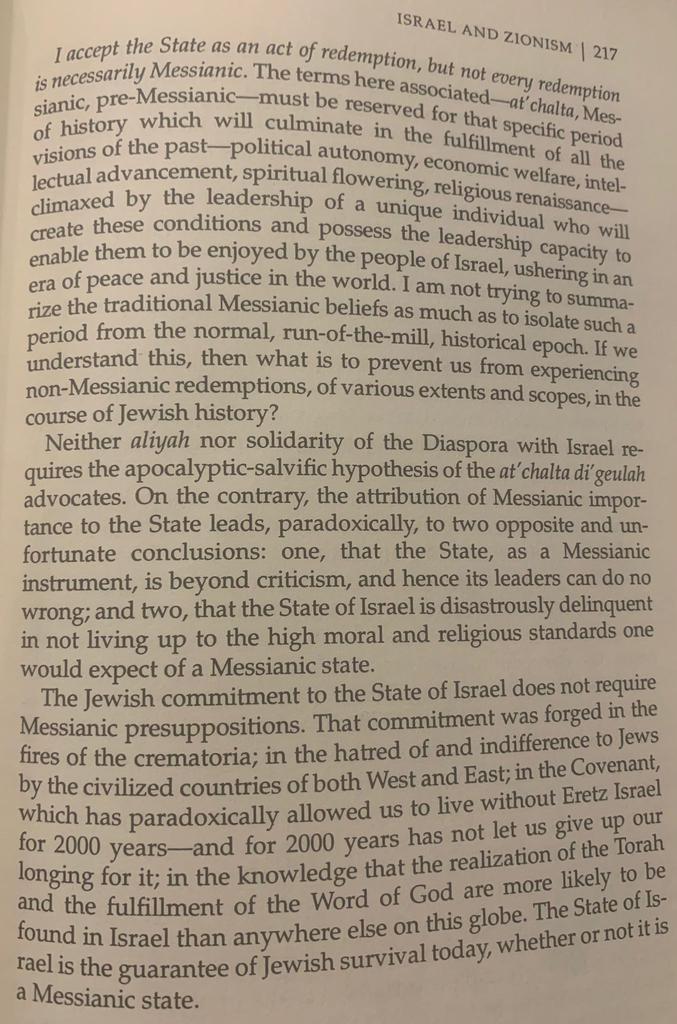
In our days those who are wise have sensed [the Messiah’s] approach, those who can hear with the inner ear have heard his footsteps, those who can see with the inner eye have perceived the first rays of his coming. And the Jewish tradition has taught us that we can, by our conduct and our actions, bring on the Messiah before his appointed time.
We are, I think, going very far astray if our two participants from Israel declare so positively and, to me, with shocking dogmatism, that we are presently in the midst of yemot hamashiach…
The answer is suggested by the Talmud (Hagigah, 5a) where Rava speaks of an intermediate stage between hester and nesiat panim, a transitional period between God being incommunicado and His full communication with Israel. Af-al-pi she’histarti panai mimenu, ba-halom adaber bo. The intermediate stage is characterized as a dream state. God does not yet call to us openly and unequivocally -- but neither is He silent; He speaks to us indirectly, as if in a dream. For this, as the Psalms taught us, is the way redemption will take place: be’shuv ha-Shem et shivat tziyon, hayyinu ke’holmim -- the reunification of Jerusalem and the return of Israel to Zion is symbolized by the dream. God addresses us, but we must make the effort to listen carefully and wisely. We are in a semi-waking state, emerging from the long night and preparing for the dawn of redemption. Our eyes have seen the silhouette of His Presence, and our ears have heard the rustles of His unfolding glory.
We must not be lulled into Messianic delusions or, alternatively, into extravagant self-confidence, and certainly not into yielding to despair. All extremes lead us to distort reality and leave us open to fatefully wrong decisions. Because history is merciless and unforgiving.
The Wandering Jew has come home. 26 years ago. That is where he belongs. And he shall not be driven out. Ever.
Eretz Israel is not something apart from the soul of the Jewish people; it is no mere national possession, serving as a means of unifying our people and buttressing its material, or even its spiritual, survival. Eretz Israel is part of the very essence of our nationhood; it is bound organically to its very life and inner being. Human reason, even at its most sublime, cannot begin to understand the unique holiness of Eretz Israel; it cannot stir the depths of love for the land that are dormant within our people. ...
To regard Eretz Israel as merely a tool for establishing our national unity—or even for sustaining our religion in the Diaspora by preserving its proper character and its faith, piety, and observances—is a sterile notion; it is unworthy of the holiness of Eretz Israel. A valid strengthening of Judaism in the Diaspora can only come from a deepened attachment to Eretz Israel. The home for the return to the Holy Land is the continuing Source of the distinctive nature of Judaism. The hope for the redemption is the force that sustains Judaism in the Diaspora; the Judaism of Eretz Israel, is the very redemption.
Despite the grave faults of which we are aware in our life in general, and in Eretz Israel in particular, we must feel that we are being reborn and that we are being created once again as at the beginning of time. Our entire spiritual heritage is presently being absorbed within its source and is reappearing in a new guise, much reduced in material extent but qualitatively very rich and luxuriant and full of vital force. We are called to a new world suffused with the highest light, to an epoch the glory of which will surpass that of all the great ages which have preceded. All of our people believes that we are in the first stage of the Final Redemption. This deep faith is the very secret of its existence; it is the divine mystery implicit in its historical experience. This ancient tradition about the Redemption bears witness to the spiritual light by which the Jew understands himself and all the events of his history to the last generation, the one that is awaiting the Redemption that is near at hand.
The State of Israel is divine…Not only can/must there be no retreat from a single kilometer of the Land of Israel, God forbid, but on the contrary, we shall conquer and liberate more and more, as much in the spiritual as in the physical sense. “The Glory of Israel does not deceive or change His mind.” [I Samuel 15:29.] We are stronger than America, stronger than Russia. With all the troubles and delays [we suffer], our position in the world, the world of history, the cosmic world, is stronger and more secure in its timelessness than theirs. There are nations that know this, and there are nations of uncircumcised heart that do not know it, but they shall gradually come to know it! Heaven protect us from weakness and timidity…In our divine, world-encompassing undertaking, there is no room for retreat.
...
There are those who speak of ‘the beginning of redemption’ in our own time. But we must perceive clearly that we area already in the midst of redemption. We are already in the throne room, not just in the antechamber. The beginning took place more than a century ago when Jewish settlement in the Land of Israel was renewed.