TRANSLITERATION
Baruch atah, Adonai Eloheinu, Melech haolam, asher kid’shanu b’mitzvotav v’tzivanu laasok b’divrei Torah.
TRANSLATION
Blessed are You, Adonai our God, Sovereign of all, who hallows us with mitzvot, commanding us to engage with words of Torah.
The End...

- The last words God speaks to Moses, vs. 4
The first words God speaks to Moses
(1) זאת הארץ אשר נשבעתי לאברהם ליצחק וליעקב לאמר: לזרעך אתננה, “this is the land concerning which I have sworn to Avraham, to Yitzchok, and to Yaakov, saying: “to your descendants I shall give it.” In this verse Moses hints that at an appropriate time the Shechinah will return to the land of Israel, the time in question being the one discussed at the end of the Book of Daniel. In Berachot 18 the sages focus on the word לאמור in the verse above; Rabbi Yonathan says there: “how do we know that the dead are in verbal communication with one another?” He answers that we derive this from the word לאמור in the above quoted verse. G’d is reported to have said to Moses: “tell Avraham, Yitzchok, and Yaakov that the oath I swore to them I have fulfilled to their children.” The Talmud therefore concluded that the dead could communicate with one another, otherwise how could Moses tell all this to the patriarchs seeing that all of them were dead? The Talmud further concludes that the dead experience pain on their bodies, proving it from a verse in Job 14,22: “He feels only the pain of his flesh, and his spirit mourns in him.” The Talmud assumed first that the dead experiences only pain inflicted upon himself but not that inflicted upon others; later on, the Talmud concludes that the dead experience even pains inflicted upon others, and that they are not only aware of what goes on in their world but also of what goes on in our world. They deduce all this from our verse, seeing that if they did not know what was going on in our world what good would it do for G’d to tell Moses to tell them what He had done on earth? The Talmud retorts that this latter argument is faulty, for if the patriarchs had known what goes on in our world why did G’d have to instruct Moses to tell them something they knew already? The Talmud answers that G’d wanted that the patriarchs give credit to Moses for having told them, although he had not told them something they had not been aware of.
(ז) קשה הוא שיובן זה הענין כפשוטו לבד שיעלהו להראות את כל הארץ כלליה ופרטיה ולסוף יאמר לו הנך רואה בעיניך ומשם לא תאכל. בעי לנחומי צעורי קא מצער ליה. וכבר התעוררו חז"ל לזה ואמרו (ספרי פ' הברכה) ויעל משה עליה היא למשה ואין ירידה למשה לומר שאין ראוי שיובן מהספור דבר שיראה ממנו אצלו רק מעלה וכבוד ומזה דרשו (ספרי שם) כל הראיות ההן לשבח. מערבות מואב מלמד שהראהו שלשלת של מלכים הראויה לעמוד מרות המואביה. אל הר נבו ראש הפסגה מה פסגה זו וכו'. אשר על פני ירחו מלמד שהראהו שלשלת ארץ ישראל מיושבת על שלותה וחזר והראהו מציקים המחזיקים בה. את הגלעד מלמד שהראהו בית המקדש מיושב בשלותו וחזר והראהו וכו'. וכן עד דן וגו' ואת כל נפתלי בכלן אמרו שהראהו הענינים המיוחדים אשר היו אחרי כן בשבטים בחלקיהם ובארצותם ביישובן ובקומתן. ואמרו עד הים האחרון אל תהי קורא עד הים האחרון אלא עד היום האחרון מלמד שהראהו כל העולם מיום שנברא עד תחיית המתים. ואמרו בקעת ירחו מלמד שהראהו גוג וכל המונו שעתידין ליפול בבקעת ירחו. עיר התמרים מלמד שהראהו גן עדן וצדיקים שבה שמשולים כתמרים וכן הוא אומר צדיק כתמר יפרח (תהילים צ״ב:י״ג). עד צוער אלו מצוקי ישראל וכו':
(7) G'd showed Moses the whole land of Gilead etc. and said: "This is the land...you have seen it with your eyes, but you will not cross over into it." (Deut 34,4) If this was intended as a consolation, why did G'd arouse Moses' grief at not having realised what he had been allowed to view? Our sages, who were keenly aware of this, interpreted the first verse in the chapter, i.e. "vaya-al, he ascended, as emphasizing that Moses, as distinct from other mortals, always ascended. Jewish history knows of many ascents and descents. The statement describing Moses as being shown the land, must be understood as a vision into time, into the future, not as a vision into space.
(1) וימת שם משה עבד ה', “Moses, the servant of the Lord, died there.” Note that Moses has not been described as a “servant of the Lord” until he died. During his lifetime he was variously described as איש האלו-הים, “the man of G’d,” (Deut. 33,1) etc., only now after he has died is he referred to as “a servant of the Lord.” This latter appellation describes Moses in his full stature and theological attainments. A “servant” is someone who is familiar with the intimate aspects of his master’s life, having access to the privacy of his bedroom, etc., performing duties there of a very intimate and private nature on an ongoing basis. We have been told explicitly in Chulin 7 that the righteous are even greater in death than they have been in life. No human being has ever been given the title “holy,” until after they have died. For instance, the words לקדושים אשר בארץ המה, “the holy ones who are in (under) the earth,” are understood by Midrash Tehillim (Psalms 16,3) as referring to the patriarchs who have already died. The Midrash concludes from that choice of words that even the patriarchs did not qualify for the compliment: “the holy ones,” until after their deaths. The reason for all this is that as long as people have an evil urge there is no guarantee that they will not give in to the temptation offered by that evil urge. This has also prompted the sages responsible for formulating our prayers to have us say in the third of the 18 benedictions of the Amidah prayer: “and holy ones praise You daily, selah.” They refer to the souls of these “holy ones” praising the Lord. This is also what David speaks of in the last of the psalms when he concludes כל הנשמה תהלל י-ה, “when it is all soul, it praises You, praise the Lord.”
Many people ask the question how it was possible that someone of the stature of Moses who became the instrument of giving the Torah to the people of Israel, died, whereas Elijah and Chanoch, both people of lesser stature, did not die? (Compare Genesis 5,24 and Kings II 2,11 respectively.) The answer is that Moses sinned at the waters of strife whereas both Chanoch and Elijah had not been guilty of sin at all. Seeing that they did not sin, they never became part of the decree of death that Adam was subjected to, and could therefore enjoy eternal life. (2) על פי ה', “at the command of the Lord.” According to the plain meaning of these words Moses died as he had been commanded by G’d to ascend the mountain and to die there (Deut. 32,3). (3) According to a Midrashic approach (Baba Batra 17) the words על פי mean: ”death by kiss (divine).” His soul could transfer directly to the world of disembodied spirits, not having to undergo any prior preparation, spiritual cleansing, etc.
(כב) ועל זה הענין רמזו ה׳חכמים׳ במות משה אהרן ומרים, ש׳שלשתם מתו בנשיקה׳ – ואמרו שאמרו: ״וימת שם משה עבד ה' בארץ מואב על פי יי״ – ״מלמד שמת בנשיקה״; וכן נאמר באהרן ״על פי ה' וימת שם״; וכן אמרו במרים ״אף היא בנשיקה מתה״ – אבל לא זכר בה ׳על פי יי׳ להיותה אשה ואין טוב לזכור זה המשל בה; – הכונה בשלשתם שמתו בענין הנאת ההשגה ההיא מרוב החשק. ונמשכו ה׳חכמים ז״ל׳ בזה המאמר על דרך מליצת השיר המפורסמת, שתקרא שם ההשגה המגעת עם חיזוק חשק האלוק ית׳ ׳נשיקה׳ – כאמרו: ״ישקני מנשיקות פיהו וגו׳״. וזה המין מן המיתה אשר הוא ההמלט מן המות על דרך האמת, לא זכרו ה׳חכמים ז״ל׳ שהגיע רק למשה ואהרן ומרים; אבל שאר הנביאים והחסידים הם למטה מזה, אך כולם תחזק השגת שכלם עם המות – כמו שנאמר: ״והלך לפניך צדקך כבוד ה' יאספך״; וישאר השכל ההוא אחר כן לנצח על ענין אחד, כי כבר הוסר המונע אשר היה מבדיל בינו ובין מושכלו בקצת העיתים, ויעמוד בהנאה הגדולה ההיא, אשר אינה ממין הנאות הגוף – כמו שבארנו בחיבורינו וביאר זולתנו לפנינו.
(22) To this state our Sages referred, when in reference to the death of Moses, Aaron, and Miriam, they said that death was in these three cases nothing but a kiss. They say thus: We learn from the words, “And Moses the servant of the Lord died there in the land of Moab by the mouth of the Lord” (Deut. 34:5), that his death was a kiss. The same expression is used of Aaron: “And Aaron the priest went up into Mount Hor . . . by the mouth of the Lord, and died there” (Num. 33:38) Our Sages said that the same was the case with Miriam; but the phrase “by the mouth of the Lord” is not employed, because it was not considered appropriate to use these words in the description of her death as she was a female. The meaning of this saying is that these three died in the midst of the pleasure derived from the knowledge of God and their great love for Him. When our Sages figuratively call the knowledge of God united with intense love for Him a kiss, they follow the well-known poetical diction, “Let him kiss me with the kisses of his mouth” (Song 1:2). This kind of death, which in truth is deliverance from death, has been ascribed by our Sages to none but to Moses, Aaron, and Miriam. The other prophets and pious men are beneath that degree: but their knowledge of God is strengthened when death approaches. Of them Scripture says, “Thy righteousness shall go before thee; the glory of the Lord shall be thy reward” (Isa. 58:8). The intellect of these men remains then constantly in the same condition, since the obstacle is removed that at times has intervened between the intellect and the object of its action: it continues for ever in that great delight, which is not like bodily pleasure. We have explained this in our work, and others have explained it before us.
Rabbenu Bahya on Deut. 34:12
-Everett Fox
And according to its simple understanding, it was necessary to begin the Torah from "In the beginning," to publicize belief in creation [ex nihilo], since it is the foundation of the entire Torah; since were we to assume that the world was pre-existent, there would be no room to accept a Torah that is predicated upon the foundation of free choice; therefore, it is required to place the foundation [meaning, the creation story] first.
Kli Yakar, R. Efraim of Luntshitz
At the outset of creation the Holy One Blessed is He saw that the world could not survive on the basis of strict judgment. So what did the Holy One Blessed is He do? He appended the name of mercy [יהו"ה] and created the world (Bereishis Rabbah 12:15; Pesikta Rabbasi, 41). Thus it states, “In the beginning God [Elokim] created” (Bereishis 1:1) — that is, with strict judgment because the name Elokim indicates the attribute of judgment. But afterwards it states, “On the day that Hashem God [יֱהֹוִ"ה Elokim] made earth and Heaven” (Bereishis 2:4).
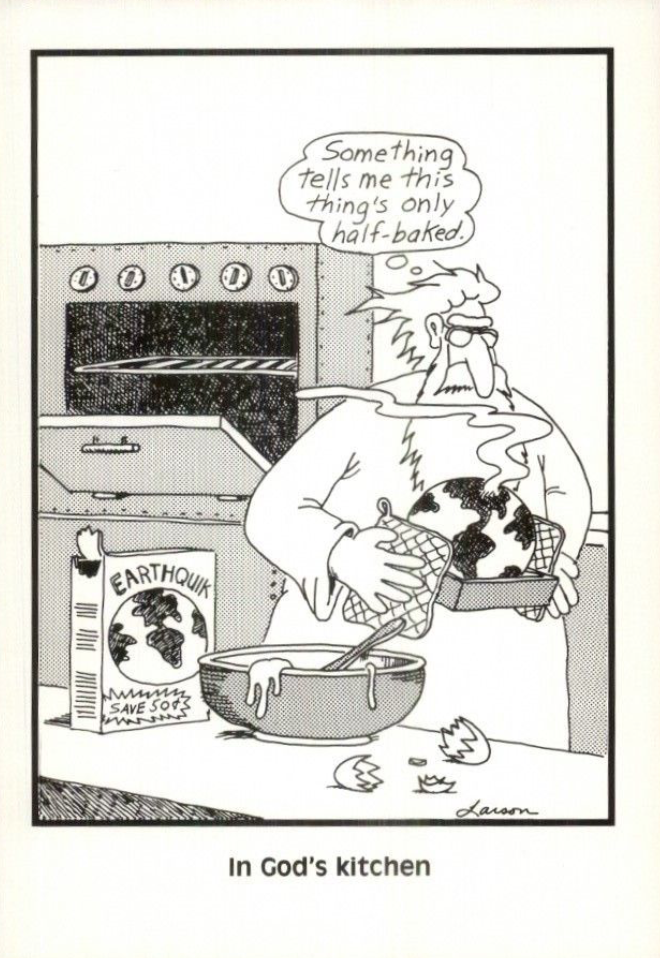
Just for a fun a few great Far Side comics on God and creation -- Gary Larson
https://www.thefarside.com