


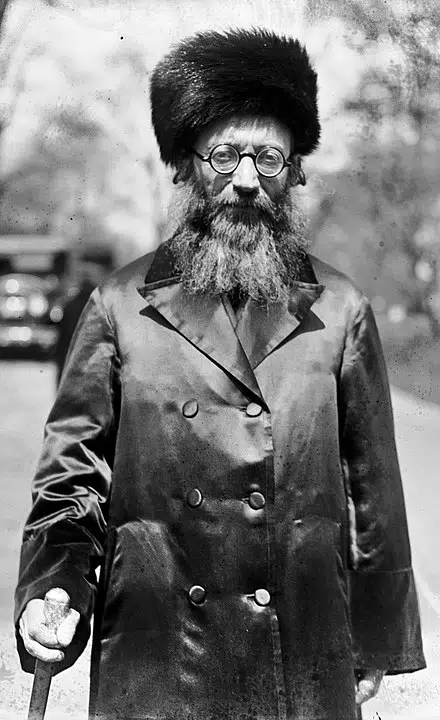
Rabbi Avraham Yitzchak Hakohen Kook - Rav Kook - 1865–1935. One of the major Torah personalities of the early 20th century and influential leader in both Lithuania and the Land of Israel. A master of many facets of Jewish literature, he wrote halachic and aggadic works, as well as philosophical and mystical tracts, responsa and commentaries. His voluminous correspondence covers a wide range of topics. He promoted Jewish return to agriculture, giving further halachic support to an earlier ruling allowing Jews to work the land in the Sabbatical year if it was sold for that year to non-Jews. In 1921 he was appointed the first Chief Rabbi of British Mandate Palestine. He also founded the yeshiva known today as Merkaz Harav to train a new cadre of scholars who would be conversant in prevalent cultural modes and capable of explicating Jewish practice and teaching in a manner which would speak to the young, nationally passionate but religiously disassociated pioneers.
(From Sefaria's introduction to Rav Kook, edited. https://www.sefaria.org/topics/avraham-yitzchak-hacohen-kook?tab=popular-writing-of)
(From Sefaria's introduction to Rav Kook, edited. https://www.sefaria.org/topics/avraham-yitzchak-hacohen-kook?tab=popular-writing-of)
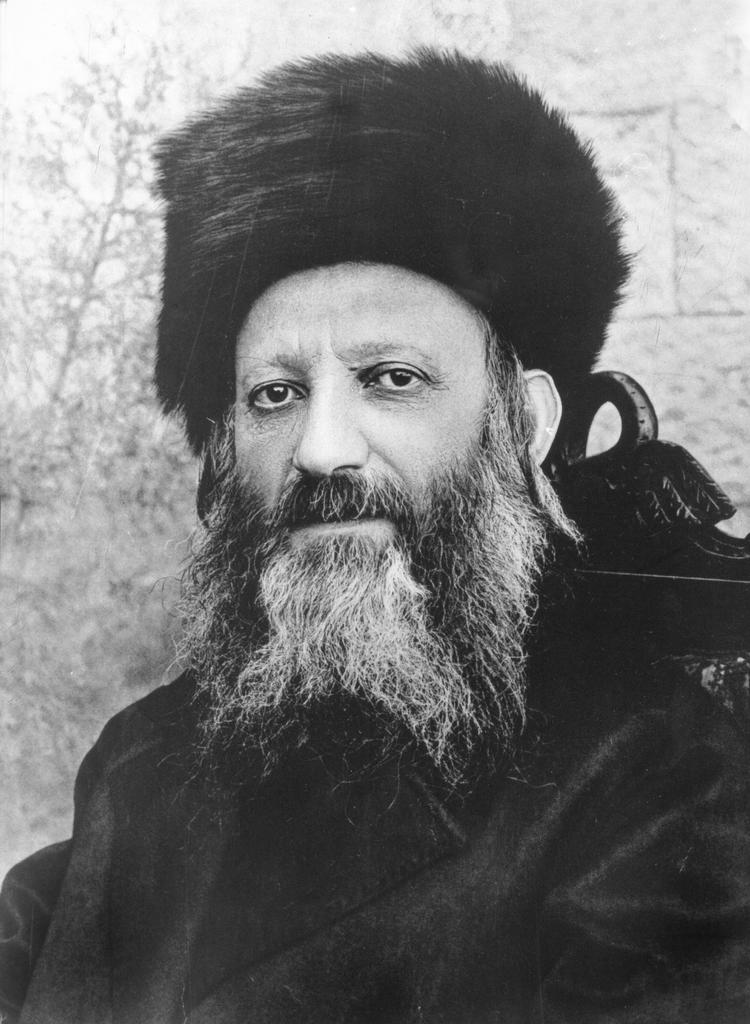
(Photo: Central Zionist Archives, source https://israeled.org/rav-abraham-isaac-kook-1865-1935/)
Kook's Commentary to the Siddur, excerpt
“Literature, painting and sculpture give material expression to all the spiritual concepts implanted in the depths of the human soul, and as long as even one single line hidden in the depth of the soul has not been given outward expression, it is the task of art [avodat ha-umanut] to bring it out."
(Olat Re-ayah, II, 3, https://www.rabbisacks.org/covenant-conversation/vayakhel/gods-shadow/)
“Literature, painting and sculpture give material expression to all the spiritual concepts implanted in the depths of the human soul, and as long as even one single line hidden in the depth of the soul has not been given outward expression, it is the task of art [avodat ha-umanut] to bring it out."
(Olat Re-ayah, II, 3, https://www.rabbisacks.org/covenant-conversation/vayakhel/gods-shadow/)
On Rembrandt
“When I lived in London I used to visit the National Gallery, and my favourite pictures were those of Rembrandt. I really think that Rembrandt was a Tzaddik. Do you know that when I first saw Rembrandt’s works, they reminded me of the rabbinic statement about the creation of light?
We are told that when God created light [on the first day of creation, as opposed to the natural light of the sun on the fourth day], it was so strong and pellucid, that one could see from one end of the world to the other, but God was afraid that the wicked might abuse it. What did He do? He reserved that light for the righteous in the world to come. But now and then there are great men who are blessed and privileged to see it. I think that Rembrandt was one of them, and the light in his pictures is the very light that God created on Genesis day.”
(Orot HaKodesh I, pp. 165-66, https://www.rabbisacks.org/covenant-conversation/vayakhel/gods-shadow/)
“When I lived in London I used to visit the National Gallery, and my favourite pictures were those of Rembrandt. I really think that Rembrandt was a Tzaddik. Do you know that when I first saw Rembrandt’s works, they reminded me of the rabbinic statement about the creation of light?
We are told that when God created light [on the first day of creation, as opposed to the natural light of the sun on the fourth day], it was so strong and pellucid, that one could see from one end of the world to the other, but God was afraid that the wicked might abuse it. What did He do? He reserved that light for the righteous in the world to come. But now and then there are great men who are blessed and privileged to see it. I think that Rembrandt was one of them, and the light in his pictures is the very light that God created on Genesis day.”
(Orot HaKodesh I, pp. 165-66, https://www.rabbisacks.org/covenant-conversation/vayakhel/gods-shadow/)
Early thoughts about Zionism
“He was born in 1865 on the western edge of the Russian Empire in Lithuania. The mass migration of Jews to the U.S. and the assimilation of both European and American Jews into gentile society were bringing about the collapse of the traditional Jewish world. At the same time, there was a remarkable Jewish creativity in spirituality, the arts, and communal life.
...he was riveted by the Jewish socialist revolutionaries and Zionists who thought of themselves as building a new Jewish society, culture, and eventually, a state and who rebelled against tradition in the name of ideals of social justice and care for Jewish welfare — and, crucially, were willing to put their lives on the line for those ideals.
Most Orthodox rabbis of the time rejected secular Zionism. Some chose to work with it but were careful to distance themselves from its efforts to create a new Jewish culture. Rav Kook, alone among his peers but with remarkable stature, affirmed the effort to create a modern Hebrew culture in a new state of Israel as something to be embraced for the betterment of Judaism and the world.”
(Mirsky interview https://www.brandeis.edu/jewish-experience/history-culture/2022/september/kook-zionism-mirsky.html)
“He was born in 1865 on the western edge of the Russian Empire in Lithuania. The mass migration of Jews to the U.S. and the assimilation of both European and American Jews into gentile society were bringing about the collapse of the traditional Jewish world. At the same time, there was a remarkable Jewish creativity in spirituality, the arts, and communal life.
...he was riveted by the Jewish socialist revolutionaries and Zionists who thought of themselves as building a new Jewish society, culture, and eventually, a state and who rebelled against tradition in the name of ideals of social justice and care for Jewish welfare — and, crucially, were willing to put their lives on the line for those ideals.
Most Orthodox rabbis of the time rejected secular Zionism. Some chose to work with it but were careful to distance themselves from its efforts to create a new Jewish culture. Rav Kook, alone among his peers but with remarkable stature, affirmed the effort to create a modern Hebrew culture in a new state of Israel as something to be embraced for the betterment of Judaism and the world.”
(Mirsky interview https://www.brandeis.edu/jewish-experience/history-culture/2022/september/kook-zionism-mirsky.html)
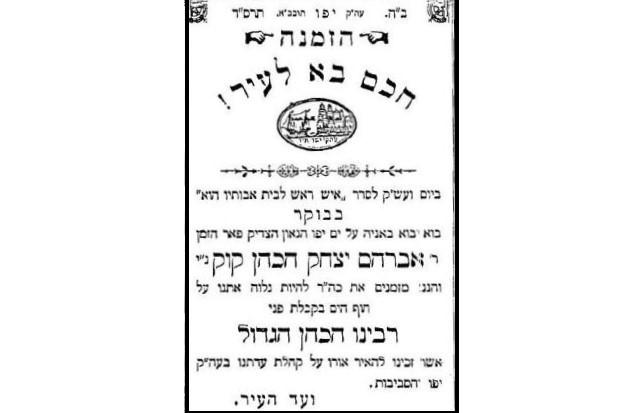
An announcement of Rav Kook's appointment as rabbi of Yaffo.
(Source https://ravkooktorah.org/YOMYER64.htm)
(Source https://ravkooktorah.org/YOMYER64.htm)
Entries from Rav Kook's journal, 1910-1914
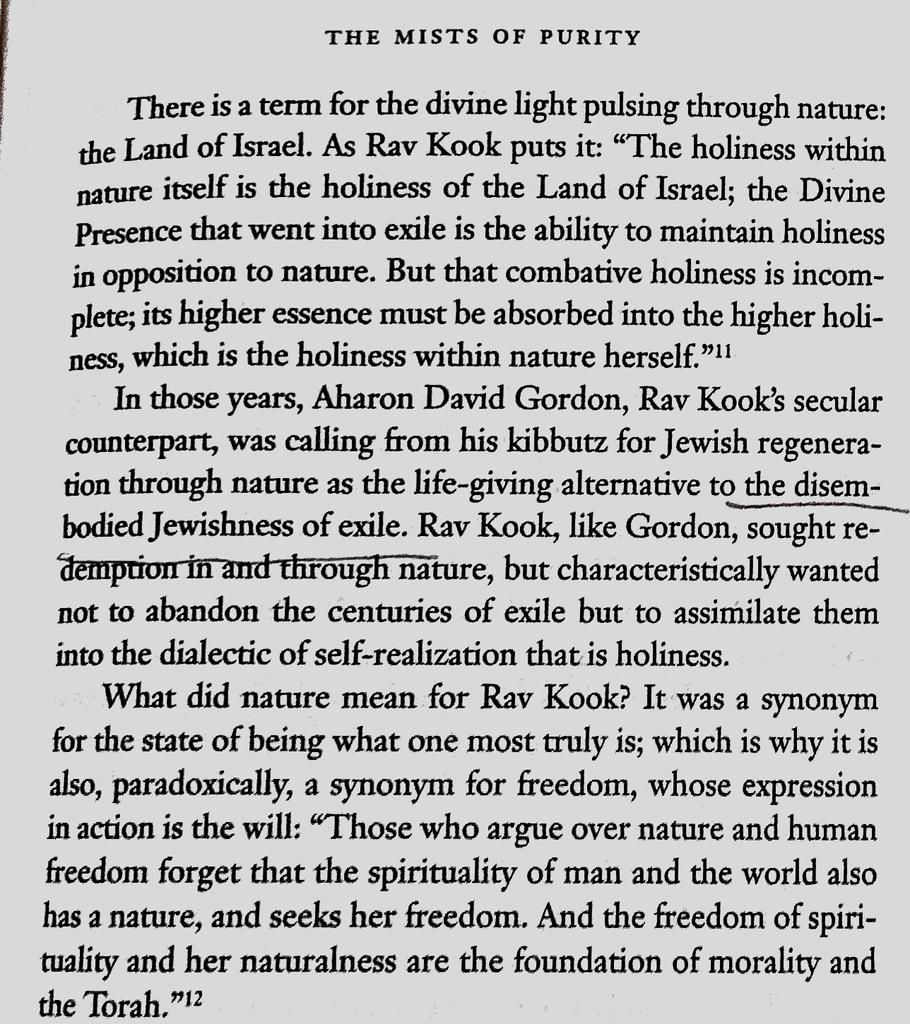
From Rav Kook: mystic in a time of revolution, Yehudah Mirsky, Yale 2014, p.99
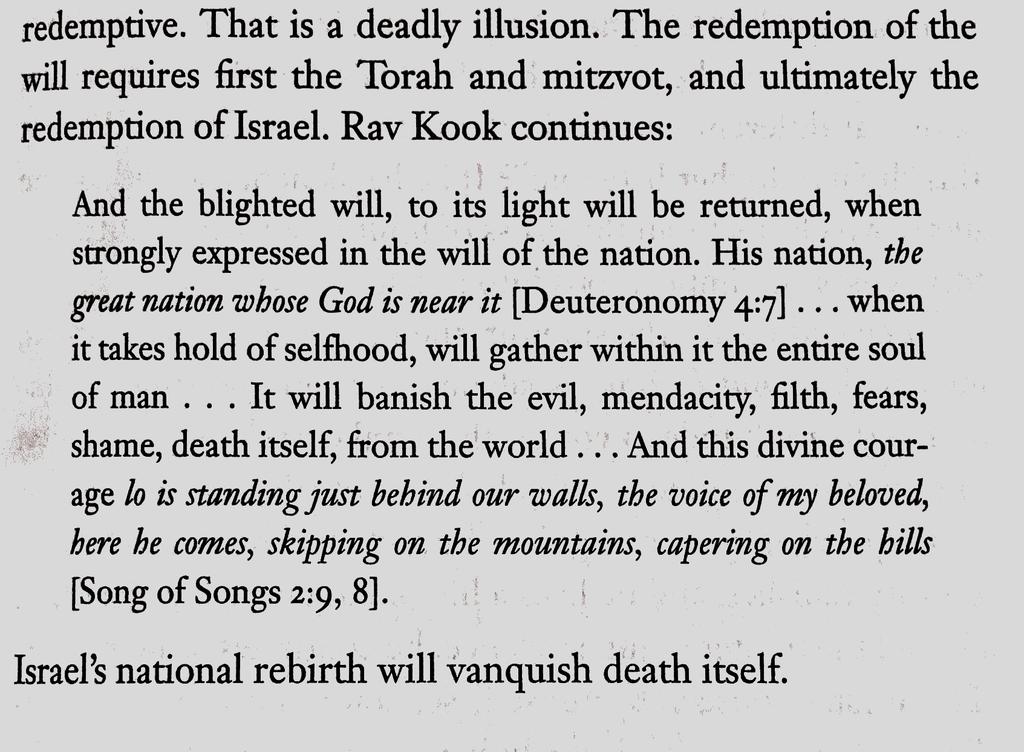
From Rav Kook: mystic in a time of revolution, Yehudah Mirsky, Yale 2014, p.101
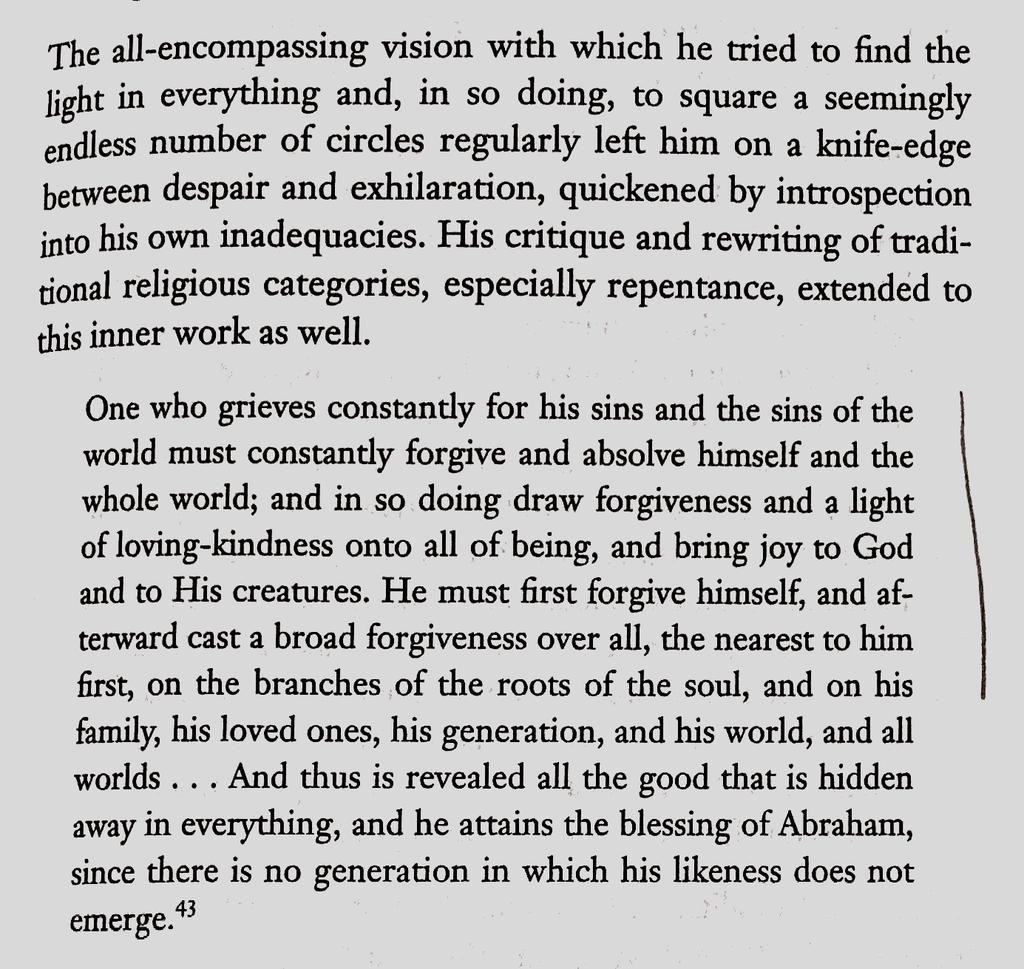
From Rav Kook: mystic in a time of revolution, Yehudah Mirsky, Yale 2014, p.113
A visit to a kibbutz
Rav Kook once visited a kibbutz, a cooperative agricultural settlement. The rabbi noticed that its members were very meticulous about their work, but not so much about the laws of the Torah.
“My sons,” he said to them, “let me tell you a true story.” There was a wise, old man who became ill. As a result of his illness, he forgot all twenty-two letters of the Hebrew alphabet. The doctors told the man, “We are sorry, but nothing can be done to restore your memory. You have no choice but to go back to school and start from scratch.” So the old man enrolled in the local kindergarten and began learning the alef-bet all over again.
After a while, the teacher noticed that his new pupil started acting like the other children. He would get into fights with his classmates and do other silly things. The teacher realized he needed to have a talk with the man. “It is true that, in terms of your studies, you are like the children here,” the teacher explained. “But do not forget that you are a wise, old man!”
Rav Kook concluded his story, telling the kibbutz members: “The same holds true for the Jewish people. Ever since we were exiled from our Land, we have forgotten how to work and farm. So we are starting again from scratch. Nonetheless, let us not forget that we are a wise, old nation.”
(Adapted from S. Raz's Malachim Kivnei Adam, p. 394, source: https://ravkooktorah.org/WISE_66.htm)
Rav Kook once visited a kibbutz, a cooperative agricultural settlement. The rabbi noticed that its members were very meticulous about their work, but not so much about the laws of the Torah.
“My sons,” he said to them, “let me tell you a true story.” There was a wise, old man who became ill. As a result of his illness, he forgot all twenty-two letters of the Hebrew alphabet. The doctors told the man, “We are sorry, but nothing can be done to restore your memory. You have no choice but to go back to school and start from scratch.” So the old man enrolled in the local kindergarten and began learning the alef-bet all over again.
After a while, the teacher noticed that his new pupil started acting like the other children. He would get into fights with his classmates and do other silly things. The teacher realized he needed to have a talk with the man. “It is true that, in terms of your studies, you are like the children here,” the teacher explained. “But do not forget that you are a wise, old man!”
Rav Kook concluded his story, telling the kibbutz members: “The same holds true for the Jewish people. Ever since we were exiled from our Land, we have forgotten how to work and farm. So we are starting again from scratch. Nonetheless, let us not forget that we are a wise, old nation.”
(Adapted from S. Raz's Malachim Kivnei Adam, p. 394, source: https://ravkooktorah.org/WISE_66.htm)
Debating a Jewish national home
“The entire debate whether it is our national or our religious heritage that preserves and sustains us [as Jews] is a bitter mockery. The perfection of 'You are one and Your Name is one, and who is like Your nation, Israel, one nation in the land' is indivisible."
(Source: https://ravkooktorah.org/YOM_ATZMAUT_66.htm)
“The entire debate whether it is our national or our religious heritage that preserves and sustains us [as Jews] is a bitter mockery. The perfection of 'You are one and Your Name is one, and who is like Your nation, Israel, one nation in the land' is indivisible."
(Source: https://ravkooktorah.org/YOM_ATZMAUT_66.htm)
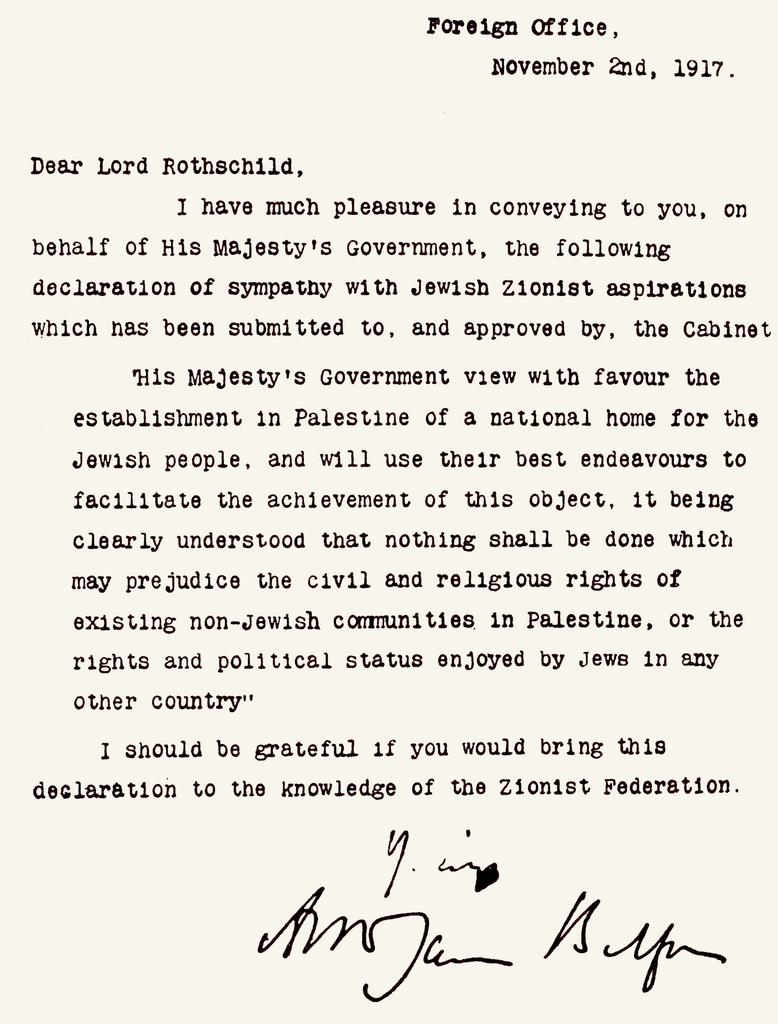
By United Kingdom Government signed by Arthur Balfour - British Library. Originally published 9 November 1917, Public Domain, https://commons.wikimedia.org/w/index.php?curid=3940876
After the Balfour Declaration
“I have come not only to thank the British nation, but even more, to congratulate it for the privilege of making this declaration. The Jewish nation is the “scholar” among the nations, the “people of the Book,” a nation of prophets; and it is a great honor for any nation to aid it. I bless the British nation for having extended such honorable aid to the people of the Torah, so that they may return to their land and renew their homeland.”
(https://ravkooktorah.org/YOM_ATZMAUT_66.htm)
Balfour Declaration Signified the Advent of the Messianic Era
Kook "was skeptical of the secular brand of political Zionism promoted by Theodor Herzl, contending that a Zionism divorced from religion, and from a sacred reading of Jewish history, was destined for failure... In 1904, he left Europe to accept an appointment in Palestine as rabbi of Jaffa. He arrived two months before Herzl’s sudden death at age forty-four from a heart attack. To Kook, steeped in kabbalah and given to interpreting visible and mundane events in terms of the unseen, the mysterious, and the messianic, this death took on spiritual significance. In his journal, he had toyed with the idea that Zionism itself might be a manifestation of the traditional rabbinic idea of a “messiah descended from Joseph”—a preliminary redeemer of Israel who would serve as precursor to the ultimate messiah descended from King David. In the first act of this messianic drama, according to the Talmud, the precursor would die. Could that be the meaning of Herzl’s premature demise?”
(Mirsky interview
https://mosaicmagazine.com/observation/uncategorized/2014/02/abraham-isaac-kook-receives-the-call/)
Kook "was skeptical of the secular brand of political Zionism promoted by Theodor Herzl, contending that a Zionism divorced from religion, and from a sacred reading of Jewish history, was destined for failure... In 1904, he left Europe to accept an appointment in Palestine as rabbi of Jaffa. He arrived two months before Herzl’s sudden death at age forty-four from a heart attack. To Kook, steeped in kabbalah and given to interpreting visible and mundane events in terms of the unseen, the mysterious, and the messianic, this death took on spiritual significance. In his journal, he had toyed with the idea that Zionism itself might be a manifestation of the traditional rabbinic idea of a “messiah descended from Joseph”—a preliminary redeemer of Israel who would serve as precursor to the ultimate messiah descended from King David. In the first act of this messianic drama, according to the Talmud, the precursor would die. Could that be the meaning of Herzl’s premature demise?”
(Mirsky interview
https://mosaicmagazine.com/observation/uncategorized/2014/02/abraham-isaac-kook-receives-the-call/)
"The Lamentation in Jerusalem"
Rav Kook's Eulogy for Theodore Binyamin Ze'ev Herzl
So, it came about that throughout the Exile there is a see-saw effect of these two opposing forces. At times, there is exhibited a drive toward material, worldly success that flows primarily from the foundation of Joseph and Ephraim; other times there is a stirring of the spiritual drive for observance of Torah and spiritual development, for awe and love of God. Since it is impossible for our nation to attain its lofty destiny other than by actualizing these two components — the universal symbolized by Joseph, and the distinctive symbolized by Judah — there arise in the nation proponents of each aspect. Those who would enhance spirituality prepare the way for Messiah son of David, whose focus is the final destiny. Truly the focus of life is spiritual attainment, except that the spiritual can only develop properly if it is accompanied by all the material acquisitions of which a full-bodied nation is in need. Those who redress the material, general aspects of life prepare the way for Messiah son of Joseph.
When these two forces work at cross purposes as a result of the calamity of exile, shortsightedness and disarray, these are the “birth pangs of Messiah,” or to be more exact, the “birth pangs of Messiahs”.
The Zionist vision manifest in our generation might best be symbolized as the “footstep of Messiah son of Joseph” (‘ikva de-Mashiah ben Yosef). Zionism tends to universalism (as opposed to Jewish particularism). It is unequipped to realize that the development of Israel’s general aspect is but the foundation for Israel’s singularity. The leadership of the Zionist movement must be greatly influenced by the gifted few of the generation, the righteous and the sages of Israel. On the other hand, the ideal of Israel’s national renascence, including all the material accouterment—which is a proper thing when joined to the spiritual goal—to date has not succeeded, and the lack of success has brought on infighting, until finally, the leader of the movement has fallen, a victim of frustration.
It behooves us to take to heart, to try to unify the “tree of Joseph” and the “tree of Judah (Ezekiel 37:15-19),” to rejoice in the national reawakening, and to know that this is not the end goal of Israel, but only a preparation. If this preparation will not submit to the spiritual aspect, if it will not aspire to it, then it is of no more value than the kingdom of Ephraim, “a cake readily devoured (Hosea 7:8),” because “they abandoned the source of living waters (Jeremiah 2:13),” and “Egypt did they call hither, to Assyria did they go (Hosea 7:11).”
This is the benefit to be gained by remorse over one whom we might consider the “footstep of Messiah son of Joseph” (‘ikva de-Mashiah ben Yosef), in view of his influence in revitalizing the nation materially and generally. This power should not be abandoned despite the wantonness and hatred of Torah that results in the expulsion of God-fearing Jews from the movement. We must develop the courage to seek that any power that is of itself good be fortified, and if it is lacking spiritual perfection, let us strive to increase the light of knowledge and fear of the Lord such that it (i.e. the light) is capable of conquering a powerful life-force and of being built up through it. Then there will be fulfilled in us the prophecy, “I will grant unto Zion salvation, unto Israel My glory (Isaiah 46:13.)” Return (teshuvah) must be from our side. Return will be enduring only if all the powers presently found (and possible to be found) in the nation will be vigorous, and directed to good. Then we will be a vessel for the divine will, “a crown of ornament in the hand of the Lord, and a royal diadem in the palm of your God (Isaiah 62:3).”
...This is the import of the cryptic passage in the Zohar: "The head of the academy in the palace of Messiah said, 'Whoever does not transform darkness to light and bitterness to sweetness, may not enter here (Zohar I, 4a).' The prerequisite for the generation of Messiah is the ability to utilize all forces, even the most coarse, for the sake of good and the singular sanctity with which Israel were crowned.
(the full text of the eulogy can be found here: https://www.machonso.org/uploads/images/13-D-10-lamentation.pdf)
Rav Kook's Eulogy for Theodore Binyamin Ze'ev Herzl
So, it came about that throughout the Exile there is a see-saw effect of these two opposing forces. At times, there is exhibited a drive toward material, worldly success that flows primarily from the foundation of Joseph and Ephraim; other times there is a stirring of the spiritual drive for observance of Torah and spiritual development, for awe and love of God. Since it is impossible for our nation to attain its lofty destiny other than by actualizing these two components — the universal symbolized by Joseph, and the distinctive symbolized by Judah — there arise in the nation proponents of each aspect. Those who would enhance spirituality prepare the way for Messiah son of David, whose focus is the final destiny. Truly the focus of life is spiritual attainment, except that the spiritual can only develop properly if it is accompanied by all the material acquisitions of which a full-bodied nation is in need. Those who redress the material, general aspects of life prepare the way for Messiah son of Joseph.
When these two forces work at cross purposes as a result of the calamity of exile, shortsightedness and disarray, these are the “birth pangs of Messiah,” or to be more exact, the “birth pangs of Messiahs”.
The Zionist vision manifest in our generation might best be symbolized as the “footstep of Messiah son of Joseph” (‘ikva de-Mashiah ben Yosef). Zionism tends to universalism (as opposed to Jewish particularism). It is unequipped to realize that the development of Israel’s general aspect is but the foundation for Israel’s singularity. The leadership of the Zionist movement must be greatly influenced by the gifted few of the generation, the righteous and the sages of Israel. On the other hand, the ideal of Israel’s national renascence, including all the material accouterment—which is a proper thing when joined to the spiritual goal—to date has not succeeded, and the lack of success has brought on infighting, until finally, the leader of the movement has fallen, a victim of frustration.
It behooves us to take to heart, to try to unify the “tree of Joseph” and the “tree of Judah (Ezekiel 37:15-19),” to rejoice in the national reawakening, and to know that this is not the end goal of Israel, but only a preparation. If this preparation will not submit to the spiritual aspect, if it will not aspire to it, then it is of no more value than the kingdom of Ephraim, “a cake readily devoured (Hosea 7:8),” because “they abandoned the source of living waters (Jeremiah 2:13),” and “Egypt did they call hither, to Assyria did they go (Hosea 7:11).”
This is the benefit to be gained by remorse over one whom we might consider the “footstep of Messiah son of Joseph” (‘ikva de-Mashiah ben Yosef), in view of his influence in revitalizing the nation materially and generally. This power should not be abandoned despite the wantonness and hatred of Torah that results in the expulsion of God-fearing Jews from the movement. We must develop the courage to seek that any power that is of itself good be fortified, and if it is lacking spiritual perfection, let us strive to increase the light of knowledge and fear of the Lord such that it (i.e. the light) is capable of conquering a powerful life-force and of being built up through it. Then there will be fulfilled in us the prophecy, “I will grant unto Zion salvation, unto Israel My glory (Isaiah 46:13.)” Return (teshuvah) must be from our side. Return will be enduring only if all the powers presently found (and possible to be found) in the nation will be vigorous, and directed to good. Then we will be a vessel for the divine will, “a crown of ornament in the hand of the Lord, and a royal diadem in the palm of your God (Isaiah 62:3).”
...This is the import of the cryptic passage in the Zohar: "The head of the academy in the palace of Messiah said, 'Whoever does not transform darkness to light and bitterness to sweetness, may not enter here (Zohar I, 4a).' The prerequisite for the generation of Messiah is the ability to utilize all forces, even the most coarse, for the sake of good and the singular sanctity with which Israel were crowned.
(the full text of the eulogy can be found here: https://www.machonso.org/uploads/images/13-D-10-lamentation.pdf)
Finding Oneself by Caring for Others
One must try to transcend one's individual world. Sometimes self-centeredness fills one's whole being, until all of one's thoughts are focused only one's own individual concerns. This way of thinking undermines a person's greatness and will eventually lead to both physical and spiritual suffering.
Instead, one must dedicate one's thoughts and desires to the greater good: others, the people, and the entire world. And (paradoxically) through doing this, one will come to know one's own essence.
(Orot Hakodesh 3, p.147, R. Meir Goldstein source sheet https://www.sefaria.org/sheets/151722.5?lang=bi&with=all&lang2=en)
(א) לְדָוִ֗ד מִ֫זְמ֥וֹר
לַֽ֭ה' הָאָ֣רֶץ וּמְלוֹאָ֑הּ
תֵּ֝בֵ֗ל וְיֹ֣שְׁבֵי בָֽהּ׃
(1) Of David. A psalm.
The earth is the LORD’s and the fullness thereof, the world and its inhabitants.
גְּמָ׳ מְנָא הָנֵי מִילֵּי? דְּתָנוּ רַבָּנַן: ״קֹדֶשׁ הִלּוּלִים לַה׳״, מְלַמֵּד שֶׁטְּעוּנִים בְּרָכָה לִפְנֵיהֶם וּלְאַחֲרֵיהֶם. מִכָּאן אָמַר רַבִּי עֲקִיבָא: אָסוּר לְאָדָם שֶׁיִּטְעוֹם כְּלוּם קוֹדֶם שֶׁיְּבָרֵךְ.
GEMARA: Concerning the fundamental basis for blessings, the Gemara asks: From where are these matters, the obligation to recite a blessing before eating, derived? The Gemara answers: As the Sages taught in the Sifra: With regard to saplings, it is stated that in their fourth year their fruit will be: “…sanctified for praises before the Lord” (Leviticus 19:24). This verse teaches that they require praise of God in the form of a blessing both beforehand and thereafter, as the verse says praises in the plural. From here, Rabbi Akiva said: A person is forbidden to taste anything before he recites a blessing, as without reciting praise over food, it has the status of a consecrated item, from which one is forbidden to derive pleasure.
אָמַר רַב יְהוּדָה אָמַר שְׁמוּאֵל: כׇּל הַנֶּהֱנֶה מִן הָעוֹלָם הַזֶּה בְּלֹא בְּרָכָה כְּאִילּוּ נֶהֱנָה מִקׇּדְשֵׁי שָׁמַיִם, שֶׁנֶּאֱמַר: ״לַה׳ הָאָרֶץ וּמְלוֹאָהּ״.
Similarly, Rav Yehuda said that Shmuel said: One who derives benefit from this world without a blessing, it is as if he enjoyed objects consecrated to the heavens, as it is stated: “The earth and all it contains is the Lord’s, the world and all those who live in it” (Psalms 24:1).
Rav Kook Commentary on Berakhot
One must understand that all of the enjoyments in the world have not actualized their identities unless they are used for the type of enjoyment that leads to ethical happiness, which is the knowledge of God. Therefore, one who benefits from the world without making a blessing and uses these things solely for the purpose of physical enjoyment is changing the identity of these things. It is actually parallel to using that which is consecrated to God, because those are things which are poised to help a person achieve spiritual completion, and instead one is minimizing their value and using them for physical pleasure, by misappropriating them and changing their identity. The sin of me’ilah is fundamentally that of making a change.
One must understand that all of the enjoyments in the world have not actualized their identities unless they are used for the type of enjoyment that leads to ethical happiness, which is the knowledge of God. Therefore, one who benefits from the world without making a blessing and uses these things solely for the purpose of physical enjoyment is changing the identity of these things. It is actually parallel to using that which is consecrated to God, because those are things which are poised to help a person achieve spiritual completion, and instead one is minimizing their value and using them for physical pleasure, by misappropriating them and changing their identity. The sin of me’ilah is fundamentally that of making a change.
(Rav Kook comment sourced from R. Meir Goldstein sheet: https://www.sefaria.org/sheets/154917.1?lang=bi&with=all&lang2=en)
Rav Kook's Continuing Influence in Modern Israel
Rav Henkin cites Rav Kook (Teshuvot Mishpat Kohen 144) and Rav Eliezer Waldenberg (Teshuvot Tzitz Eliezer 10:1:14) who rule that in the absence of a king appointed by Hashem, the right to elect a leader reverts to the country's populace. Thus, Halachah recognizes the results of a democratic election. Rav Henkin notes that Rav Kook and Rav Waldenberg did not state that only halachically observant Jews are eligible participants in the elections. These authorities believe that even non-observant Jews enjoy the right to choose a leader. Accordingly, Yitzchak Rabin was the legitimate political leader of the Jewish nation in Israel, even though most observant Jews voted for his opponents in the election. Thus, Prime Minister Rabin had the right to enact a policy that would endanger the country since he felt that it was in the best interest of the country to do so. Consequently, it is a grievous error to categorize Yitzchak Rabin as a rodeif.
Religious Zionists in turn, since the time of Rav Kook, have followed his call to partner with secular Jews in the task of nation building. Rav Kook advocated avoiding a confrontational relationship with non-observant Jews, as this is hardly conducive to developing a partnership (see, for example, Letters of Rav Kook 555). Thus, Religious Zionists, generally speaking, refrain from participating in such demonstrations. Non-Zionist observant Jews, on the other hand, view their mission in Israel as striving to create and preserve the Jewish and Torah character of Eretz Yisrael to the greatest extent possible.
Source: https://jewishunpacked.com/the-other-herzl-the-legacy-of-rav-kook/