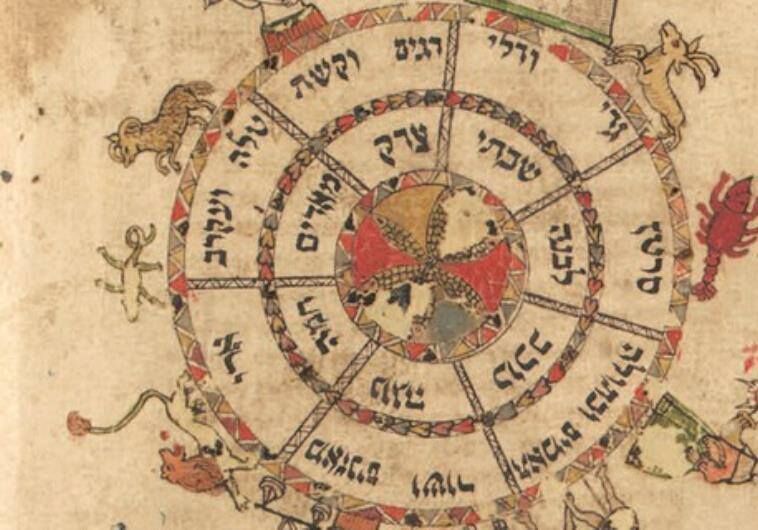
וְהִשְׁבִּ֣ית אֶת־הַכְּמָרִ֗ים אֲשֶׁ֤ר נָֽתְנוּ֙ מַלְכֵ֣י יְהוּדָ֔ה וַיְקַטֵּ֤ר בַּבָּמוֹת֙ בְּעָרֵ֣י יְהוּדָ֔ה וּמְסִבֵּ֖י יְרוּשָׁלִָ֑ם וְאֶת־הַֽמְקַטְּרִ֣ים לַבַּ֗עַל לַשֶּׁ֤מֶשׁ וְלַיָּרֵ֙חַ֙ וְלַמַּזָּל֔וֹת וּלְכֹ֖ל צְבָ֥א הַשָּׁמָֽיִם׃
He suppressed the idolatrous priests whom the kings of Judah had appointed to make offerings at the shrines in the towns of Judah and in the environs of Jerusalem, and those who made offerings to Baal, to the sun and moon and constellations—all the host of heaven.
Do not learn to go the way of the nations,
And do not be dismayed by portents in the sky;
Let the nations be dismayed by them!
After citing relevant halakhot written in the notebooks of various Sages, the Gemara relates that it was written in Rabbi Yehoshua ben Levi’s notebook: One who was born on the first day of the week, Sunday, will be a person and there will not be one in him. The Gemara asks: What is the meaning of the phrase: There will not be one in him? If you say that there is not one quality for the best, that cannot be, as Rav Ashi said: I was born on the first day of the week, and one cannot say that there was nothing good about him. Rather, it must mean that there is not one quality for the worst. Didn’t Rav Ashi say: I and Dimi bar Kakuzta were both born on the first day of the week. I became a king, the head of a yeshiva, and he became the head of a gang of thieves, clearly a negative quality. Rather, one born on a Sunday is either completely for the best or completely for the worst. What is the reason for this? It is because both light and darkness were created on the first day of Creation. One who was born on the second day of the week, Monday, will be a short-tempered person. What is the reason for this? It is because on that day, the second day of Creation, the upper and lower waters were divided. Therefore, it is a day of contentiousness.
One who was born on the third day of the week will be a rich man and a promiscuous person. What is the reason for this? It is because on that day, the third day, vegetation was created. It grows abundantly but is also mixed together without boundaries between the grass and the plants.
One who was born on the fourth day of the week will be a wise and enlightened person. What is the reason for this? It is because the heavenly lights were hung in the heavens on that day, and wisdom is likened to light. One who was born on the fifth day of the week will be a person who performs acts of kindness. What is the reason for this? It is because on that day the fish and fowl were created, and they do not receive their sustenance by performing work for people. They are sustained by the kindness of God alone.
One who was born on the sixth day of the week will be a seeker. Rav Naḥman bar Yitzḥak said that this means that he will be one who seeks out mitzvot, as most of the activity on Friday involves preparation for Shabbat.
One who was born on Shabbat will die on Shabbat, because they desecrated the great day of Shabbat on his behalf. Rava bar Rav Sheila said: And he will be called a person of great sanctity because he was born on the sacred day of Shabbat. Rabbi Ḥanina said to his students who heard all this: Go and tell the son of Leiva’i, Rabbi Yehoshua ben Levi: It is not the constellation of the day of the week that determines a person’s nature; rather, it is the constellation of the hour that determines his nature.
One who was born under the influence of the sun will be a radiant person; he will eat from his own resources and drink from his own resources, and his secrets will be exposed. If he steals he will not succeed, because he will be like the sun that shines and is revealed to all.
One who was born under the influence of Venus will be a rich and promiscuous person. What is the reason for this? Because fire was born during the hour of Venus, he will be subject the fire of the evil inclination, which burns perpetually.
One who was born under the influence of Mercury will be an enlightened and expert man, because Mercury is the sun’s scribe, as it is closest to the sun.
One who was born under the influence of the moon will be a man who suffers pains, who builds and destroys, and destroys and builds. He will be a man who eats not from his own resources and drinks not from his own resources, and whose secrets are hidden. If he steals he will succeed, as he is like the moon that constantly changes form, whose light is not its own, and who is at times exposed and at times hidden.
One who was born under the influence of Saturn will be a man whose thoughts are for naught. And some say that everything that others think about him and plan to do to him is for naught.
One who was born under the influence of Jupiter [tzedek] will be a just person [tzadkan]. Rav Naḥman bar Yitzḥak said: And just in this context means just in the performance of mitzvot.
One who was born under the influence of Mars will be one who spills blood. Rav Ashi said: He will be either a blood letter, or a thief, or a slaughterer of animals, or a circumciser. Rabba said: I was born under the influence of Mars and I do not perform any of those activities. Abaye said: My Master also punishes and kills as a judge. It was stated that Rabbi Ḥanina says: A constellation makes one wise and a constellation makes one wealthy, and there is a constellation for the Jewish people that influences them. Rabbi Yoḥanan said: There is no constellation for the Jewish people that influences them. The Jewish people are not subject to the influence of astrology. And Rabbi Yoḥanan follows his own reasoning, as Rabbi Yoḥanan said: From where is it derived that there is no constellation for the Jewish people? As it is stated: “Thus said the Lord: Learn not the way of the nations, and be not dismayed at the signs of heaven; for the nations are dismayed at them” (Jeremiah 10:2). The nations will be dismayed by them, but not the Jewish people.
And Rav also holds that there is no constellation for the Jewish people, as Rav Yehuda said that Rav said: From where is it derived that there is no constellation for the Jewish people? As it is stated with regard to Abraham: “And He brought him outside, and said: Look now toward heaven, and count the stars, if you are able to count them; and He said unto him: So shall your offspring be” (Genesis 15:5). The Sages derived from this that Abraham said before the Holy One, Blessed be He: Master of the Universe, “Behold, You have given me no offspring, and one born in my house is to be my heir” (Genesis 15:3). The Holy One, Blessed be He, said to him: No. “And, behold, the word of the Lord came to him, saying: This man shall not be your heir; rather, one that will come forth from your own innards shall be your heir” (Genesis 15:4). Abraham said before Him: Master of the Universe, I looked at my astrological map, and according to the configuration of my constellations I am not fit to have a son. The Holy One, Blessed be He, said to him: Emerge from your astrology, as the verse states: “And He brought him outside,” as there is no constellation for Israel. What is your thinking? Is it because Jupiter is situated in the west that you cannot have children? I will restore it and establish it in the east. And that is the meaning of that which is written with regard to Abraham: “Who has raised up one from the east, he will call justice [tzedek] to his steps [leraglo]. He gives nations before him, and makes him rule over kings; his sword makes them as the dust, his bow as the driven stubble” (Isaiah 41:2). God established Jupiter [tzedek] in the east on behalf of [leraglo] Abraham. And from that which transpired to Shmuel, one can also conclude that there is no constellation for the Jewish people. The Gemara relates that Shmuel and the gentile sage Ablet were sitting, and they saw these people were going to the lake. Ablet said to Shmuel: This person will go and he will not return, because a snake will bite him and he will die. Shmuel said to him: If he is a Jew, he will go and come back. As they were sitting for a while, the person they discussed went away and then returned. Ablet stood up, threw down the person’s burden, and inside he found a snake cut and cast in two pieces. Shmuel said to him: What did you do to merit being saved from death? The person said to him: Every day we all take bread together and eat from the bread. Today, there was one of us who did not have bread, and when it came time to gather the bread, he was embarrassed because he did not have any to give. I said to the others: I will go and take the bread. When I came to the person who did not have bread, I rendered myself as one who was taking from him so that he would not be embarrassed. Shmuel said to him: You performed a mitzva. Shmuel went out and taught based on this incident that even though it is written: “And charity will save from death” (Proverbs 10:2), it does not only mean that it will save a person from an unusual death but even from death itself. And from that which transpired to Rabbi Akiva as well it can be derived that there is no constellation for the Jewish people, as Rabbi Akiva had a daughter, and Chaldean astrologers told him that on the same day that she enters the wedding canopy, a snake will bite her and she will die. She was very worried about this. On that day, her wedding day, she took the ornamental pin from her hair and stuck it into a hole in the wall for safekeeping, and it happened that it entered directly into the eye of the snake. In the morning, when she took the pin, the snake was pulled and came out with it.
Of the letters written after the completion of the "Guide," the one addressed to the wise men of Marseilles (1194) is especially noteworthy. Maimonides was asked to give his opinion on astrology. He regretted in his reply that they were not yet in the possession of his Mishneh Torah; they would have found in it the answer to their question. According to his opinion, man should only believe what he can grasp with his intellectual faculties, or perceive by his senses, or what he can accept on trustworthy authority. Beyond this nothing should be believed. Astrological statements, not being founded on any of these three sources of knowledge, must be rejected. He had himself studied astrology, and was convinced that it was no science at all. If some dicta be found in the Talmud which appear to represent astrology as a true source of knowledge, these may either be referred to the rejected opinion of a small minority, or may have an allegorical meaning, but they are by no means forcible enough to set aside principles based on logical proof.
In the Jewish religious literature of modern times there remain only vestiges of earlier astrological beliefs. On joyful occasions in individual and family life, Jews everywhere congratulate each other by saying mazzal tov ("good luck"). A successful person is popularly referred to as a bar-mazzal ("one of luck"), and a perennial failure is known as a ra-mazzal ("poor luck"; Yid., shlimazl; Aram., bish-gadda). It was customary in some parts to begin no new undertaking on Mondays or Wednesdays (Sh. Ar., YD 179:2, on the basis of the responsa of Naḥmanides, no. 242), since Mondays were ruled by the moon and nothing could be properly done on them, while Wednesdays were ruled by Mars, a hard patron. Another custom was to perform marriages only in the first half of the month while the moon was waxing (ibid.; Naḥmanides, responsum no. 282). R. Mordecai Jaffe explains the custom of fasting on the anniversary of a parent's death (Isserles to Sh. Ar., YD 402:12) as deriving from the belief that on that day the luck of the child is vulnerable. Until recently it was the custom in certain localities to prepare a bed (or table; see Isserles, ibid., 65:11) in a mother's room on the eve of her son's circumcision so that the child should enjoy good luck (ibid., 178:3).
In Judaism, Astrology is not regarded as “idol worship,” even though the generic name for “idol worship” is “Avodat Kochavim U’Mazalot,” Worship of the Stars and the Signs of the Zodiac.”
From the Jewish perspective, the stars are not unrelated to events on earth. It is not irrelevant whether one was born on Pesach, or Yom Kippur, or Lag Ba’Omer or on any particular day. Each day is special and has a unique imprint.
On the other hand, if an individual was born under the “sign” of Mars, the Talmud says that he will have a tendency to spill blood. This tendency can be realized in a number of very different ways, however, which are subject to an individual’s choice. In this case, options might be a soldier, a surgeon, a murderer, a “shochet,” a ritual slaughterer of animals, or a “mohel,” one who performs ritual circumcisions. These options correspond to a potential hero, a healer, one who violates the “image of G-d,” to those who do “holy work” of different types.
There is a principle, “Ayn Mazal L’Yisrael,” “Israel’s fate is not determined by the stars.” The Jew, raised in his People’s traditions and Torah values, feels the reality of “freedom of choice” in his bones. So deeply ingrained is this knowledge and feeling, that the Jew rarely has cause to think about astrological factors.
It is the belief that one cannot escape from the grip of the stars that distinguishes Astrology from “Worship of the Stars and Signs of the Zodiac.” It is always possible to define one’s fate, by choosing behavior which is guided by morality and integrity, within the parameters – intellectual and emotional, physical and spiritual – which a person is given to work with.