


Map of the Kingdoms of the Levant (https://commons.wikimedia.org/wiki/File:Kingdoms_of_the_Levant_Map_830.png on 5/3/2023)
General notes:
- In preparation, I used
- Robert Alter's Ancient Israel The Former Prophets: Joshua, Judges, Samuel and Kings A Translation and Commentary (2011)
- I have quoted him without credit
- Louis Ginzberg's The Legends of the Jews Volume IV: Bible Times and Characters from Joshua to Esther (JPS, 1913) Chapters VI - IX
- Encyclopaedia Judaica Volume 9 (1972) articles about kings beginning with J-Jer
- Sepharia.org for the English and Hebrew quotes and definitions of Hebrew words
- Robert Alter's Ancient Israel The Former Prophets: Joshua, Judges, Samuel and Kings A Translation and Commentary (2011)
- What seems to be important to the author
- I read somewhere in an introduction to a Jewish translation of the Bible, that the Bible is the love song between God and the Jewish people
- therefore a Biblical history is going to emphasis our relationship with God, not economics, political alliances, social hierarchy and structure, everyday life, arts and science, fashion, or history
- the book of Kings seems to be mostly about kings in their relationship to prophets
- therefore a Biblical history is going to emphasis our relationship with God, not economics, political alliances, social hierarchy and structure, everyday life, arts and science, fashion, or history
- on the other hand, Chronicles recounts a similar history with a lot more detail
- a king is wicked if he worships other gods
- or if allows worship at the sites Jeroboam set up at Dan and Bethel
- stories about prophets/men of God, namely Elijah and his successor, Elisha, are featured
- battles, especially if God is somehow involved, and sometimes alliances are important
- the death of the king and how he died matter
- I read somewhere in an introduction to a Jewish translation of the Bible, that the Bible is the love song between God and the Jewish people
- What is of interest to me
- I like Midrash and I like finding connections between things.
- Because Sefaria.com makes it so easy, and because I like reading texts, there are a lot of quotes from other parts of the Tanach and other writings
- If Kings can get away with saying that if you want to know anything else about a king you should consult some other book, I can concentrate on what interests me and not talk a lot about historical background and archeological findings
- I like Midrash and I like finding connections between things.
- A section of II Kings 8-12 is a Haftarah connected to a Torah reading. This means it is read in public once a year and so may be more significant and certainly more memorable. (Or it was picked because it relates to the Torah portion.):
- Shabbat Shekalim: II Kings 12.1-17 (or 11.17-12.17) = Ex. 30.11-16 from Ki Tissa =
- Money brought to the temple for its upkeep connects to an additional reading from Ki Tissa about all men over 20 giving a half shekel for the service of the tent of meeting
- Shabbat Shekalim is one of four named Shabbatot before Passover
- Shabbat Shekalim: II Kings 12.1-17 (or 11.17-12.17) = Ex. 30.11-16 from Ki Tissa =
- Elijah and Elisha stories, even if not related to royal history (In fact, frequently the reigning king is not mentioned)
- these stories are like folktales (not original with me)
- incidents occurring three times
- miraculous (magical) objects
- lots of Midrash about them
- Elisha did twice as many miraculous things as Elijah but ...
- Elijah becomes much more significant in Jewish tradition
- his cup at the Seder; his chair at a Brit; so many Elijah stories; in Kabbalah; sung about during Havdalah at the end of Shabbat
- these stories are like folktales (not original with me)
- Basic structure of this sheet
- Chapter number and header
- rulers of Israel and Judah and their data and how they appeared in the eyes of the Lord
- Note: The spelling of some kings' names varies in the text. I have used Alter's spelling.
- Note: Some names seem to be popular. More than one king has the same name, sometimes living at the same time.
- The names of parents and times of reigning are not always consistent
- Summary
- Comments
- this frequently includes quotes from other Jewish texts that relate to words or themes in the chapter
- I have highlighted relevant words or text in English and Hebrew
- be warned, my knowledge of Hebrew comes from a few years of college-Hebrew courses from about 40 years ago
- some comments are more detailed than others
- this frequently includes quotes from other Jewish texts that relate to words or themes in the chapter
Chapter 8: Aram vs. Israel
- this is the fifth year in which Jehoram son of Ahab is king of Israel
- Jehoram son of Jehoshaphat succeeds his father to become king of Judah
- he is 32 and rules for eight years
- he marries Ahab's daughter and therefore does evil in the eyes of the Lord
- he dies attacking rebellious Edomites and is buried in the City of David
- Ahaziah, Jehoram's son, succeeds his father in the 12th year of Jehoram son of Ahab's reign in Israel
- Ahaziah is 22 and rules for one year
- his mother, Athaliah, is the daughter of Omri, king of Israel
- Larry's chart says she is the daughter of Ahab
- the Encyclopaedia Judaica says she is the sister of Ahab and the daughter of Omri
- he also does evil in the eyes of the Lord because he married into Ahab's family
Summary: The Shunammite woman from Chapter 4 was warned by Elisha that she should leave the country during the coming the seven years of famine. When she returns, she asks the king to help her get her property back. Gehazi just so happens to be discussing with the king her son's resurrection as one of the great things that Elisha has done when she appears.
Elisha goes to Damascus. Ben-Hadad, king of Aram, is ill and asks Hazael to bring tribute to Elisha and ask him if he (the kin) will survive. Elisha says he will survive the illness, but then is silent and then weeps and explains to Hazael that although the king will survive the illness, he will not live much longer and Hazael will do terrible things to the Israelites. Hazael kills Ben-Hadad and becomes king.
Edom rebels against Judah. As does Libneh. Jehoram, king of Judah, is killed when he attacks the Edomites, and his son, Ahaziah, becomes king.
Everything else that Jehoram, king of Judah, did is written in the Book of the Acts of the Kings of Judah.
Jehoram, son of Ahab and king of Israel, is wounded in battle by Hazael king of Aram and goes to Jezreel to recover. Ahaziah visits him.
Comments:
- Elisha's pronouncements about the serious illnesses of kings are interesting. The kings don't ask for a cure, just a prediction. And surviving an illness obviously doesn't mean living a long life; Ben-Hadad should have asked a better question.
- Hazael's suffocating Ben-Hadad makes it look like the king died of natural causes.
- What is Elisha's obligation? Did he have a choice about telling Hazael what the future held?
- Saying that if you want more information about a king you should see the official documents is a convenient way of avoiding talking about what doesn't interest you.
Chapter 9: Jehu vs the House of Ahab
- Jehoram, son of Ahab, is king of Israel at the beginning of the chapter
- he is the last king of the House of Ahab
- Ahaziah is king of Judah at the beginning of the chapter
- he became king in the 11th year of Jehoram son of Ahab's reign as king of Israel
- Jehu, son of Jehoshaphat son of Nimshi, is recognized as a king of Israel by his comrades and Elisha
Summary: Elisha sends one of his acolyte prophets to secretly anoint Jehu at Ramoth-Gilead so that Jehu will kill of the entire house of Ahab to avenge the prophets and servants of the Lord. Jehu's comrades quickly find out and support him.
Meanwhile, Jehoram, king of Israel, is in Jezreel recovering from his wounds. Ahaziah, king of Judah, has joined him there.
Jehu kills Jehoram with an arrow through the heart and has the king thrown into the field of Naboth the Jezreelite.
Ahaziah flees toward Beth-Gan, but he is struck down in his chariot on the Ascent of Gur near Jibleam and dies in Megiddo. He is carried back to Jerusalem and buried in the City of David.
Jehu goes to Jezebel in Jezreel and asks her servants to push her out of a window. He wants her buried because she is the daughter of a king, but she has been trampled by horses and all that is left of her are her skull, legs and the palms of her hands.
Comments:
- Samuel secretly anointed David while Saul was still king. David did not assume this meant he needed to immediately get rid of Saul.
- When Jehu and his men show up in Jezreel, Jehoram thinks they may come in peace. He sends two messengers and then goes with Ahaziah to meet Jehu in person. (One of many instances where things happen three times.) They meet in the field of Naboth. This is an fraught location. Chapter 21 of I Kings explains how Jezebel caused Naboth's death so that her husband Ahab could take his field. Elijah disapproved:
(19) Say to him, ‘Thus said the LORD: Would you murder and take possession? Thus said the LORD: In the very place where the dogs lapped up Naboth’s blood, the dogs will lap up your blood too.’”
Since Ahab seems to repent, the Lord postpones his family's disaster until after he dies.
(כח) וַֽיְהִי֙ דְּבַר־ה' אֶל־אֵלִיָּ֥הוּ הַתִּשְׁבִּ֖י לֵאמֹֽר׃ (כט) הֲֽרָאִ֔יתָ כִּֽי־נִכְנַ֥ע אַחְאָ֖ב מִלְּפָנָ֑י יַ֜עַן כִּֽי־נִכְנַ֣ע מִפָּנַ֗י לֹֽא־אָבִ֤י הָרָעָה֙ בְּיָמָ֔יו בִּימֵ֣י בְנ֔וֹ אָבִ֥יא הָרָעָ֖ה עַל־בֵּיתֽוֹ׃
(27) When Ahab heard these words, he rent his clothes and put sackcloth on his body. He fasted and lay in sackcloth and walked about subdued. (28) Then the word of the LORD came to Elijah the Tishbite: (29) “Have you seen how Ahab has humbled himself before Me? Because he has humbled himself before Me, I will not bring the disaster in his lifetime; I will bring the disaster upon his house in his son’s time.”
The words of Elijah in Chapter 21 of I Kings also say what will happen to Jezebel.
(23) And the LORD has also spoken concerning Jezebel: ‘The dogs shall devour Jezebel in the field of Jezreel. (24) All of Ahab’s line who die in the town shall be devoured by dogs, and all who die in the open country shall be devoured by the birds of the sky.’” (25) Indeed, there never was anyone like Ahab, who committed himself to doing what was displeasing to the LORD, at the instigation of his wife Jezebel.
Jehu talks about Jezebel's harlotries.
I think that particular accusation may be unfair. I don't think she was unfaithful to her husband. I think she was not faithful to the Lord and encouraged Ahab to also be unfaithful to Him.
Chapter 10: Jehu vs. the House of Ahab continued
- Jehu, son of Jehoshaphat son of Nimshi, is king of Israel
- he reigns for 28 years in Samaria
- Jehoahaz, his son, succeeds him
Summary: Jehu has all 70 of Ahab's sons in Samaria killed. He says he is fulfilling Elijah's prophecy.
When Jehu meets up with kinsmen of Ahaziah, he has all 42 them killed as well.
He calls all servants of Baal together and they are slaughtered and the pillars smashed and the house of Baal turned into latrines.
But he does not get rid of the golden calves at Bethel and Dan. So the Lord began to reduce the size of Israel.
The Lord promises that because of Jehu's good work with the House of Ahab, four generations of his sons will rule. (Based on Larry's wonderful, most helpful chart, this happens.)
Everything else Jehu did is in the Book of the Acts of the Kings of Israel.
Comments:
- No one is left behind to threaten Jehu's kingship. Athaliah in the next chapter isn't so successful.
- Hazael, king of Aram, may be committing the offenses that Elisha cried about.
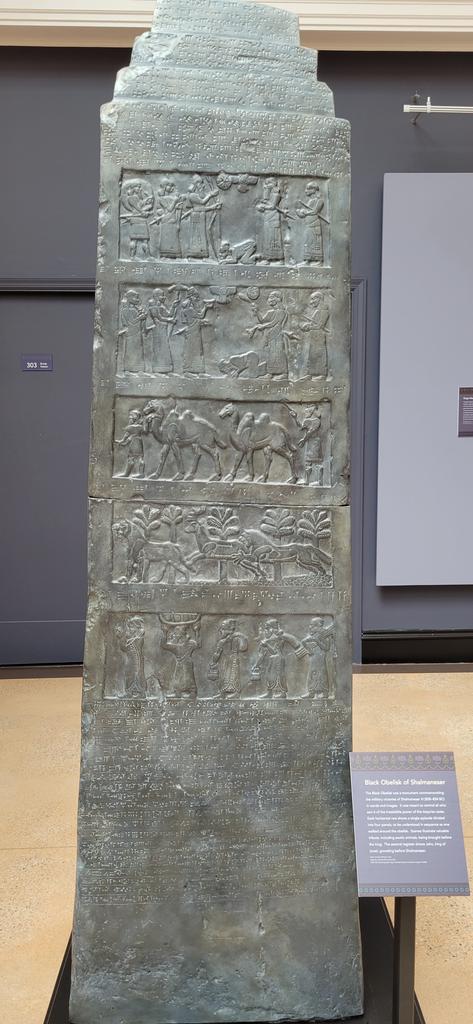
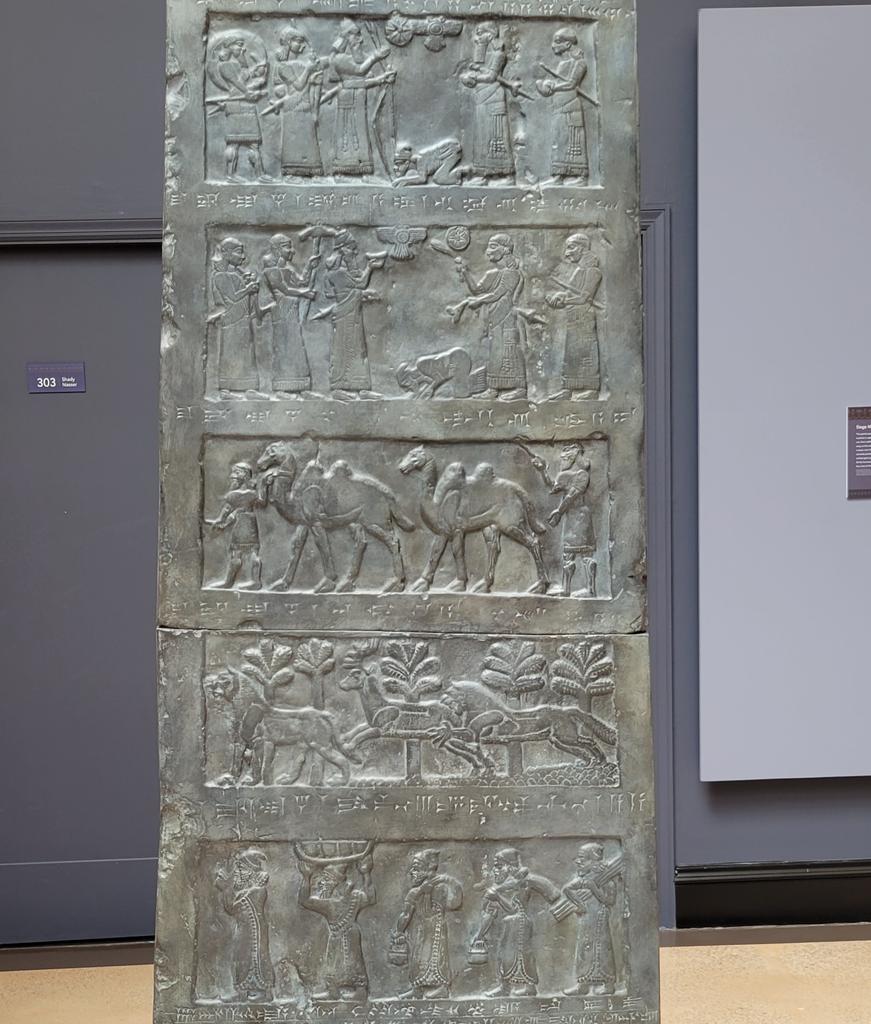
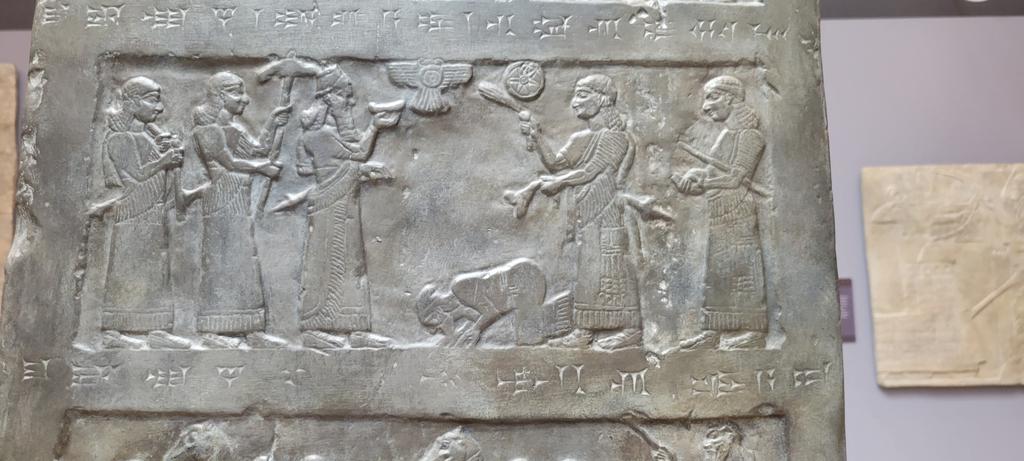
- The Semitic Museum of Harvard University in Cambridge, MA, has a copy of the Black Obelisk of Shalmaneser which shows Jehu or his messenger bowing before an Assyrian king. There seems to be no direct mention of this in Kings, beyond the Lord's trimming away of Israel. [see Alter, p. 782]
- From an article on Jehu in Volume 9 of the Encyclopaedia Judaica (p. 1330):
- "In another inscription known as the Black Obelisk, a relief has been found on which 'Jehu son of Omri', or his messenger, kneels before the king of Assyria while his retinue pays tribute to him. Assyria's campaigns against Hazael between 841-838 B.C.E. were invaluable to Jehu inasmuch as they prevented the Arameans from exploiting the internal confusion which beset Samaria immediately after his coup. But shortly afterward the Arameans recovered and Hazael succeeded in penetrating deep into Israelite territory and in conquering all of Israelite Transjordan as far as the Arnon (II Kings 10:32-33).
- This picture below shows the entire obelisk.
The picture below shows the illustrated part of the obelisk.
And here is the panel with Jehu or his representative.
Chapter 11: Athaliah vs her sons
- Athaliah, mother of Ahaziah, is queen of Judah
- she is either the daughter of Ahab and Jezebel or the daughter of Omri (according to the EJ)
- Joash, brother of Ahaziah and son of Athaliah, becomes king of Judah
Summary: Athaliah kills "all the royal seed." [Alter, p. 783] Or so she thinks.
Jehosheba, her sister and the daughter of King Jehoram, sneaks Joash, Ahaziah's son, and his nurse away and hides him in the house of the Lord for six years.
In the seventh year, Jehoiada, Jehosheba's husband and a high? priest, provides guards for Joash and has him anointed king to great rejoicing.
Athaliah hears this and goes to see what is happening. She is marched out of the house of the Lord and killed in the king's house.
All the people destroy the house of Baal and killed Mattan, the priest of Baal.
And the king sat on the royal throne.
Comments:
- In the time of the judges, someone kills of all of his possible rivals; only he misses one of them to his dismay and destruction:
- The queen thinking her family is dead is reminiscent of the wicked queen thinking that the huntsman has killed Snow White. Or King Laius, who hoped to thwart a prophecy, thinking Oedipus has died on a hillside.
- We don't know what kind of a ruler Athaliah is. She lasted at least six years, but the people seemed happy to see her go.
- The Encyclopaedia Judaica mentions that Jean Racine wrote a tragedy about Athaliah (1691) and that Christian art her murders are likened to Herod's massacre around the time of Jesus's birth.
- The EJ says she also was an idolator.
Chapter 12: Joash is king
- Joash is king of Judah
- he is seven years old when his reign begins
- he rules in Jerusalem for 40 years.
- Jehu is the king of Israel
- Joash becomes king of Judah in Jehu's seventh year
- Joash did right in the eyes of the Lord, but people still sacrificed and burned incense on the high places
- Amaziah, son of Joash, becomes king of Judah when Joash is killed
Summary: Joash becomes king.
He tells the priests that all the silver that people bring (as gifts?) to the house of the Lord should be used for its upkeep.
In the 23rd year, he discovers this isn't happening. So he gets a chest, bores a hole in it, sets it up by the altar, and has everyone put silver into it instead of handing it to the priests. When the box got heavy enough, money is given to contractors to do repairs; they are honest. The priests still got silver for guilt-offerings and offense-offerings.
Hazael, king of Aram, prepares to attack Jerusalem. Joash gives him all the consecrated things and the king's treasures to make him go away.
Everything else that Joash did is written in the Book of the Acts of the Kings of Judah.
Joash's servants kill him in Beth-Millo going down to Silla and he is buried with his fathers in the City of David.
Comments:
- All we know about Joash is how he interacts with the priests.
- The chest seems the forerunner to the modern pushka, a container where you privately put money that will go for Tzedakah to help people at a later time.
- Why did Joash's servants rise up against him?