6 Iyyar 5783 | April 28, 2023
Parshat Acharei Mot-Kedoshim
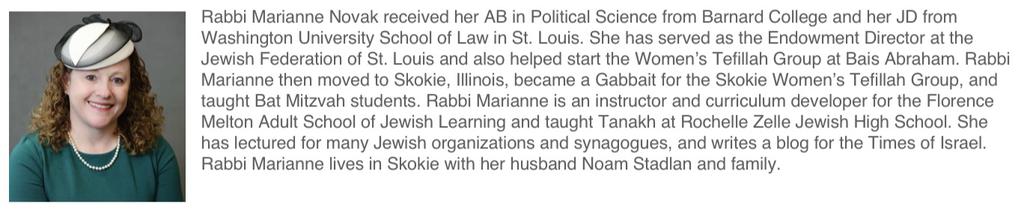
Rabbi Marianne Novak
Class of 2019
And God spoke to Moshe saying: Speak to the entire community of Israel and say to them, You Shall be holy, for I, the Lord your God, am holy.
So begins the second parsha for this Shabbat Vayikra, Kedoshim, its majority known as the Holiness Code. As we read this every year, it begs us to ask two eternal questions. First, what is holiness? And, second, what do I need to do in order to become holy?
This isn’t the first time that God has commanded us to be holy. In parshat Yitro, Shemot 19:5-6, we are told:
Now then, if you will obey Me faithfully and keep My covenant, you shall be My treasured possession among all the peoples. Indeed, all the earth is Mine, and then you shall be to Me a kingdom of priests and a holy nation…
So perhaps the way to be holy is to simply follow the mitzvot, the commandments. If you follow the particulars of the Covenant, then you will be holy. And in fact our Sages notice that in parshat Kedoshim, the seemingly disparate list of mitzvot actually has parallels to the Aseret HaDibrot, the Ten Commandments. And that is why HaShem tells Moshe to call the entire community of Israel – כל עדת בני ישראל –to hear these commandments, as a sort of recapitulation of Ma’amad Har Sinaiְ, the Revelation at Sinai.
Wonderful, my first question is answered. To be holy, I should follow mitzvot. But what does holiness mean? Perhaps holiness, or to be holy, is to be like God. But what aspect of God’s personality — in the way that we understand God – do we need to emulate to be considered holy?
The Kedushat Levi, Rabbi Levi Yitzchak of Berdichev, presents an interesting answer to this age old question:
ובית הלל שהיו במדת ענוה ביותר על כן אמרו מוסיף והולך כנ"ל. וזה כוונת המדרש קדושים תהיו, יכול כמוני, תלמוד לומר כי קדוש אני יקוק, קדושתי למעלה מקדושתכם, דהיינו מחמת רוב קדושתכם אזי נתקדש שמי ביותר. וזהו קדושתי למעלה , דהיינו שנתקדש שמי מחמת קדושתכם.
…And Beit Hillel, who took the character trait of humility very seriously, therefore, in my estimation. formulated the concept of מוסיף והולך, that a spark of holiness feeds upon itself and makes ripples like a pebble thrown on the surface of the water. This idea is also reflected in the opening words of our portion תהיו קדושים, commence the process to become holy, as it is continuous and feeds on itself.” An additional factor helping you to progress along this route is כי קדוש אני, for I am holy, i.e. when you contemplate My holiness this will inspire you to emulate My holiness to the extent that this is humanly possible. In fact, G’d says that His own holiness will increase proportionate to the amount of holiness to be found amongst His people on earth. (trans. Eliyahu Munk)
The Kedushat Levi begins with the same idea of the Sages that performing mitzvot is the way for us to become holy and to increase God’s holiness in the world. Thus, any time we can increase our mitzvot, any time we can be ma’aleen b’kedusha (increase in our holiness), we should absolutely take advantage of that opportunity. The Kedushat Levi then cites the classic argument between Hillel and Shammai regarding the procedure for lighting Chanukah candles. Beit Shammai says to begin the first night with all eight candles lit and then decrease by one candle each subsequent night. Beit Hillel says the opposite – that each night you should add another candle so that over time God’s kedusha in the world grows instead of diminishes.
The Kedushat Levi then takes an interesting turn, stating that when one performs mitzvot and increases God’s kedusha in the world, one then recognizes the utter greatness of God and the utter smallness of the human being by contrast. He defines this experience, this understanding, as ענוה, or humility. The paradox is that as we increase the holiness of God here on earth, we dramatically show how small we are, how we are אין–nothing compared to God. This humility is not something that should make us feel worthless or powerless. Rather, it should help us understand our limits and our capacities — what we as human beings and as Jews can and cannot do. And when we understand those realities, we can truly serve God and do great things.
It is no accident that regarding Moshe Rabbenu, the Torah states:
Now Moses was a very humble man, more so than any other man on earth.
Moshe’s greatness came from his humility—but obviously, Moshe wasn’t paralyzed by it and his understanding of limits allowed him to do great things for God and the Jewish people.
So perhaps the meaning of holiness for us as human beings is humility. In the exuberant words of the Kedushat Levi:
והנה מה טוב ומה נעים לכל איש הישראלי להתדבק במדת ענוה וכמאמר הכתוב (משלי כב, ד) עקב ענוה יראת יקוק, ואז יגרום שיתקדש שמו הגדול בזה על ידי אנשים אשר הם בוודאי חשובים ועושים מצות ומעשים טובים ואף על פי כן הם בעיניהם כאין נגד הבורא וזהו שנתגדל שמו ברבים. כן יתן לנו השם יתברך מדת ענוה ושאר מדת ישרות אמן:
How wonderful and pleasant it is for each Jew to devote him/herself to the quality of humility! As it is written in Proverbs: ‘the effect of humility is fear of God…’ ( 22:4). And this humility of the people then causes the sanctification, the making holy of God’s name. They, the humble ones, are important, they are great, because as they perform those mitzvot they realize they are nothing before the creator—but, precisely this moment, is what makes God’s name great.
So now we have an answer as to what we need to do to be holy. We need to perform mitzvot to the best of our ability — understanding the limits of that ability — to then increase God’s holiness in the world. Additionally, we also haven’t answered the question of what God means when God says כי קדוש אני... because I am holy (Vayikra 19:2).
Perhaps we can take the true meaning of ענוה, humility, as an understanding of one’s own abilities and apply elements of humility, or being limited, to God. Now, just to be clear, God has no limits - אין סוף - but He is the one who has the power to make those boundaries and limits. And when He does, when He makes those separations, kedusha is created. That holiness can be in time, as with Shabbat, or with place, as with the Mishkan and the Beit HaMikdash, or with us, the Jewish people. So when we perform mitzvot with humility, we in some ways mirror God’s ability to delineate those things and those processes where His kedusha can grow.
So, let’s go back to our opening pasuk and read it as follows: (Vayikra 19:2) ...קדושים תהיו... ‘You shall be holy’ —Through the performance of mitzvot with humility, you, B’nai Yisrael, will become holy… כי קדוש אני הי אלקיכם... Because, I the Lord your God, have the power to make things holy by separating and delineating them so that My holiness grows and increases.
HaShem has given all of us a way to be holy. May we merit the performance of mitzvot with true understanding of humility so that we can sanctify God to the best of our abilities and in that way, God’s kedusha can truly inhabit our world.