


Map of the Kingdoms of the Levant (https://commons.wikimedia.org/wiki/File:Kingdoms_of_the_Levant_Map_830.png on 5/3/2023)
General notes:
- In preparation, I used
- Robert Alter's Ancient Israel The Former Prophets: Joshua, Judges, Samuel and Kings A Translation and Commentary (2011)
- I have quoted him without credit
- Louis Ginzberg's The Legends of the Jews Volume IV: Bible Times and Characters from Joshua to Esther (JPS, 1913) Chapters VI - IX
- Encyclopaedia Judaica Volume 9 (1972) articles about kings beginning with J-Jer
- Sepharia.org for the English and Hebrew quotes and definitions of Hebrew words
- Robert Alter's Ancient Israel The Former Prophets: Joshua, Judges, Samuel and Kings A Translation and Commentary (2011)
- What seems to be important to the author
- I read somewhere in an introduction to a Jewish translation of the Bible, that the Bible is the love song between God and the Jewish people
- therefore a Biblical history is going to emphasis our relationship with God, not economics, political alliances, social hierarchy and structure, everyday life, arts and science, fashion, or history
- the book of Kings seems to be mostly about kings in their relationship to prophets
- therefore a Biblical history is going to emphasis our relationship with God, not economics, political alliances, social hierarchy and structure, everyday life, arts and science, fashion, or history
- on the other hand, Chronicles recounts a similar history with a lot more detail
- a king is wicked if he worships other gods
- or if allows worship at the sites Jeroboam set up at Dan and Bethel
- stories about prophets/men of God, namely Elijah and his successor, Elisha, are featured
- battles, especially if God is somehow involved, and sometimes alliances are important
- the death of the king and how he died matter
- I read somewhere in an introduction to a Jewish translation of the Bible, that the Bible is the love song between God and the Jewish people
- What is of interest to me
- I like Midrash and I like finding connections between things.
- Because Sefaria.com makes it so easy, and because I like reading texts, there are a lot of quotes from other parts of the Tanach and other writings
- If Kings can get away with saying that if you want to know anything else about a king you should consult some other book, I can concentrate on what interests me and not talk a lot about historical background and archeological findings
- I like Midrash and I like finding connections between things.
- Parts of II Kings 1-12 are Haftarot connected to Torah readings. This means they are read in public once a year and so may be more significant and certainly more memorable. (Or they were picked because they relate to the Torah portion.):
- II Kings 4.1-37 (or 23) = Gen. 18.1-22.24 = Vayera (Sarah is told she will give birth)
- The obvious connection is a promise that a woman (the Shunammite woman/Sarah) will have a son next season even though her husband is old. But in both cases the son very nearly dies.
- II Kings 4.42-5.19 = Lev. 12.1-13.59 = Tazria (leprosy)
- Naaman is cured of leprosy and converts
- but the haftarah also starts with the miracle of a small amount of food feeding many
- II Kings 7.3-20 = Lev. 14.1-15.33 = Metzora (leprosy)
- Four lepers tell the Israelites that the Aramean army has fled
- Shabbat Shekalim: II Kings 12.1-17 (or 11.17-12.17) = Ex. 30.11-16 from Ki Tissa =
- Money brought to the temple for its upkeep connects to an additional reading from Ki Tissa about all men over 20 giving a half shekel for the service of the tent of meeting
- Shabbat Shekalim is one of four named Shabbats before Passover
- II Kings 4.1-37 (or 23) = Gen. 18.1-22.24 = Vayera (Sarah is told she will give birth)
- Elijah and Elisha stories, even if not related to royal history (In fact, frequently the reigning king is not mentioned)
- these stories are like folktales (not original with me)
- incidents occurring three times
- miraculous (magical) objects
- lots of Midrash about them
- Elisha did twice as many miraculous things as Elijah but ...
- Elijah becomes much more significant in Jewish tradition
- his cup at the Seder; his chair at a Brit; so many Elijah stories; in Kabbalah; sung about during Havdalah at the end of Shabbat
- these stories are like folktales (not original with me)
- Basic structure of this sheet
- Chapter number and header
- rulers of Israel and Judah and their data and how they appeared in the eyes of the Lord
- Note: The spelling of some kings' names varies in the text. I have used Alter's spelling.
- Note: Some names seem to be popular. More than one king has the same name, sometimes living at the same time.
- The names of parents and times of reigning are not always consistent
- Summary
- Comments
- this frequently includes quotes from other Jewish texts that relate to words or themes in the chapter
- I have highlighted relevant words or text in English and Hebrew
- be warned, my knowledge of Hebrew comes from a few years of college-Hebrew courses from about 40 years ago
- some comments are more detailed than others
- this frequently includes quotes from other Jewish texts that relate to words or themes in the chapter
Chapter 1: Ahaziah vs. Elijah
- King of Judah: Jehoram son of Jehoshaphat (his 2nd year)
- King of Israel: Ahaziah, son of Ahab and Jezebel, (and then his brother, Jehoram)
Summary: (verse 1) Moab rebels against Israel after Ahab dies. (Nothing in this chapter relates to this, but see Chapter 3.)
Ahaziah is based in Samaria. He dies without an heir and his brother becomes king.
The details of his interaction with Elijah as he is dying take up most of the chapter, perhaps because Elijah, and therefore God, features prominently in this.
Elijah is hairy and wears a leather belt.
If you want to know more, check out the Annals of the Kings of Israel.
Comments:
- We know from the end of I Kings that Ahaziah reigned for two years and worshiped Baal.
- Ahaziah falls through a lattice and sends messengers to see if he will live, not to a doctor, but to Baal-zebub, the god of Ekron. Elijah learns of this from an angel of the Lord and is miffed. He tells the messengers that the Lord says Ahaziah will die because he (Ahaziah) didn't seek out the God of Israel. Elijah sends the messengers back to Ahaziah. Ahaziah is surprised by their quick return and asks for a description of the man they talked to. When told that the man is hairy and has a leather belt, he knows it's Elijah. Ahaziah then sends fifty soldiers and their captain to bring Elijah to him; he does this three times. The first two times, Elijah zaps them; the third time the captain treats Elijah with respect and Elijah goes with him and tells Ahaziah in person what he has already said. Ahaziah dies.
- There seems to be only one mention of the appearance of Elijah. The word seir means hair or a garment made of hair. In Kings it seems to refer to Elijah's hair. But when Esau is born, he is described as having a hairy mantle, aderet seir. Aderet means a mantle or cloak of fine fur or a prophet's garment. This is interesting because Elijah's mantle is an aderet; see I Kings 19:13 and 19 (when he throws his cloak over Elisha to make him his attendant) and Chapter 2 here.
- All the following quotes quotes are here because when I saw "hairy man" I thought of the skit with a sermon starting "And Esau was a hairy man ....". I thought it was by Jonathan Miller on Monty Python, but apparently it's from Alan Bennett in Beyond the Fringe (https://www.youtube.com/watch?v=v0qOD9rtOEE).
(ח) וַיֹּאמְר֣וּ אֵלָ֗יו אִ֚ישׁ בַּ֣עַל שֵׂעָ֔ר וְאֵז֥וֹר ע֖וֹר אָז֣וּר בְּמׇתְנָ֑יו וַיֹּאמַ֕ר אֵלִיָּ֥ה הַתִּשְׁבִּ֖י הֽוּא׃
(8) “A hairy man,” they replied, “with a leather belt tied around his waist.” “That’s Elijah the Tishbite!” he said.
(כה) וַיֵּצֵ֤א הָרִאשׁוֹן֙ אַדְמוֹנִ֔י כֻּלּ֖וֹ כְּאַדֶּ֣רֶת שֵׂעָ֑ר וַיִּקְרְא֥וּ שְׁמ֖וֹ עֵשָֽׂו׃
(25) The first one emerged red, like a hairy mantle all over; so they named him Esau.
(יד) וַיִּקַּח֩ אֶת־אַדֶּ֨רֶת אֵלִיָּ֜הוּ אֲשֶׁר־נָפְלָ֤ה מֵֽעָלָיו֙ וַיַּכֶּ֣ה אֶת־הַמַּ֔יִם וַיֹּאמַ֕ר אַיֵּ֕ה ה' אֱלֹקֵ֣י אֵלִיָּ֑הוּ אַף־ה֣וּא ׀ וַיַּכֶּ֣ה אֶת־הַמַּ֗יִם וַיֵּֽחָצוּ֙ הֵ֣נָּה וָהֵ֔נָּה וַֽיַּעֲבֹ֖ר אֱלִישָֽׁע׃
(14) Taking the mantle which had dropped from Elijah, he struck the water and said, “Where is the LORD, the God of Elijah?” As he too struck the water, it parted to the right and to the left, and Elisha crossed over.
- Zechariah links Esau's hairy mantle with false prophets.
(ד) וְהָיָ֣ה ׀ בַּיּ֣וֹם הַה֗וּא יֵבֹ֧שׁוּ הַנְּבִיאִ֛ים אִ֥ישׁ מֵחֶזְיֹנ֖וֹ בְּהִנָּֽבְאֹת֑וֹ וְלֹ֧א יִלְבְּשׁ֛וּ אַדֶּ֥רֶת שֵׂעָ֖ר לְמַ֥עַן כַּחֵֽשׁ׃
(4) In that day, every “prophet” will be ashamed of the “visions” [he had] when he “prophesied.” In order to deceive, he will not wear a hairy mantle,
Rashi's explanation about false prophets pretending to be righteous seems to translate mantles as tallitim, a plural of tallit (which nowadays is a feminine noun).
אדרת שער. כן דרך מסיתים ומדיחי' מתעטפי' בטליתם כאילו הם אנשים צדיקים למען יקובלו כחשיהם:
a hairy mantle So is the custom of those who entice or draw away [the people], to enwrap themselves with mantles as though they are righteous men in order that their lies be accepted.
- Elijah's leather belt is very special in the Midrash.
(ו) עֲשָׂרָה דְבָרִים נִבְרְאוּ בְּעֶרֶב שַׁבָּת בֵּין הַשְּׁמָשׁוֹת, וְאֵלּוּ הֵן, פִּי הָאָרֶץ, וּפִי הַבְּאֵר, וּפִי הָאָתוֹן, וְהַקֶּשֶׁת, וְהַמָּן, וְהַמַּטֶּה, וְהַשָּׁמִיר, וְהַכְּתָב, וְהַמִּכְתָּב, וְהַלּוּחוֹת. וְיֵשׁ אוֹמְרִים, אַף הַמַּזִּיקִין, וּקְבוּרָתוֹ שֶׁל משֶׁה, וְאֵילוֹ שֶׁל אַבְרָהָם אָבִינוּ. וְיֵשׁ אוֹמְרִים, אַף צְבָת בִּצְבָת עֲשׂוּיָה:
(6) Ten things were created on the eve of the Sabbath at twilight, and these are they: [1] the mouth of the earth, [2] the mouth of the well, [3] the mouth of the donkey, [4] the rainbow, [5] the manna, [6] the staff [of Moses], [7] the shamir, [8] the letters, [9] the writing, [10] and the tablets. And some say: also the demons, the grave of Moses, and the ram of Abraham, our father. And some say: and also tongs, made with tongs.
ר' חנניא בן דוסא אומר, אותו האיל שנברא בין השמשות לא יצא ממנו דבר לבטלה. אפרו של איל הוא יסוד על גבי המזבח הפנימי, גידי האיל אלו עשרה נבלים של כנור שהיה דוד מנגן בהם, עורו של איל הוא אזור מתניו של אליהו ז"ל, שנ' איש בעל שער וכו', קרניו של איל, של שמאל שתקע בו בהר סיני שנ' ויהי במשוך בקרן היובל, ושל ימין שהיא גדולה משל שמאל שהוא עתיד לתקוע בה לעתיד לבא, שנ' והיה ביום ההוא יתקע בשופר גדול והיה ה' למלך על כל הארץ.
Rabbi Chanina ben Dosa said: From that ram, which was created at the twilight, nothing came forth which was useless. The ashes of the ram were the base which was upon the top of the inner altar. The sinews of the ram were the strings of the harp whereon David played. The ram's skin was the girdle (around) the loins of Elijah, may he be remembered for good, as it is said, "And they answered him, He was an hairy man, and girt with a girdle of leather about his loins" (2 Kings 1:8). The horn of the ram of the left side (was the one) wherein He blew upon Mount Sinai, as it is said, "And it shall come to pass, that when the ram's horn soundeth long" (Josh. 6:5). (The horn) of the right side, which is larger than that of the left, is destined in the future to be sounded in the world that is to come, as it is said, "And it shall come to pass in that day, that a great trumpet shall be blown" (Isa. 27:13); and it is said, "And the Lord shall be king over all the earth" (Zech. 14:9).
Chapter 2: Elijah and his successor, Elisha
- no kings are mentioned
Summary: Elijah goes up to heaven in a whirlwind in a chariot of fire with horses of fire. Elisha asks for and gets a double portion of Elijah's spirit.
Elisha decontaminates water to make a town livable, gets teased for being bald by some kids and curses them so that they are ripped apart by two she-bears who come out of forest.
Comments:
- The King James Version and Alter use the term "chariot of fire." Sefaria has "fiery chariot."
- Elijah and Elisha go from Gilgal to Bethel to Jericho to the Jordan River. Each time, Elijah tells Elisha to stay and Elisha replies that he will not.
- The journeys that Elijah takes with Elisha, leading to a dramatic encounter with the Almighty, reminds me of the repetition in the Akedah, where Abraham and Isaac have another dramatic encounter. Both stories have "... and the two of them walked on."
וַיֹּ֩אמֶר֩ ל֨וֹ אֵלִיָּ֜הוּ שֵֽׁב־נָ֣א פֹ֗ה כִּ֤י ה' שְׁלָחַ֣נִי הַיַּרְדֵּ֔נָה וַיֹּ֕אמֶר חַי־ה' וְחֵֽי־נַפְשְׁךָ֖ אִם־אֶעֶזְבֶ֑ךָּ וַיֵּלְכ֖וּ שְׁנֵיהֶֽם׃
Elijah said to him, “Stay here, for the LORD has sent me on to the Jordan.” “As the LORD lives and as you live, I will not leave you,” he said, and the two of them went on.
(ו) וַיִּקַּ֨ח אַבְרָהָ֜ם אֶת־עֲצֵ֣י הָעֹלָ֗ה וַיָּ֙שֶׂם֙ עַל־יִצְחָ֣ק בְּנ֔וֹ וַיִּקַּ֣ח בְּיָד֔וֹ אֶת־הָאֵ֖שׁ וְאֶת־הַֽמַּאֲכֶ֑לֶת וַיֵּלְכ֥וּ שְׁנֵיהֶ֖ם יַחְדָּֽו׃
(6) Abraham took the wood for the burnt offering and put it on his son Isaac. He himself took the firestone and the knife; and the two walked off together.
(ח) וַיֹּ֙אמֶר֙ אַבְרָהָ֔ם אֱלֹקִ֞ים יִרְאֶה־לּ֥וֹ הַשֶּׂ֛ה לְעֹלָ֖ה בְּנִ֑י וַיֵּלְכ֥וּ שְׁנֵיהֶ֖ם יַחְדָּֽו׃
(8) And Abraham said, “It is God who will see to the sheep for this burnt offering, my son.” And the two of them walked on together.
(יט) וַיָּ֤שׇׁב אַבְרָהָם֙ אֶל־נְעָרָ֔יו וַיָּקֻ֛מוּ וַיֵּלְכ֥וּ יַחְדָּ֖ו אֶל־בְּאֵ֣ר שָׁ֑בַע וַיֵּ֥שֶׁב אַבְרָהָ֖ם בִּבְאֵ֥ר שָֽׁבַע׃ {פ}
(19) Abraham then returned to his servants, and they departed together for Beer-sheba; and Abraham stayed in Beer-sheba.
- Elijah's trying to turn Elisha away, reminds me of Naomi telling Ruth to go back. Ruth's response is echoed later in Chapter 3.
(יא) וַתֹּ֤אמֶר נׇעֳמִי֙ שֹׁ֣בְנָה בְנֹתַ֔י לָ֥מָּה תֵלַ֖כְנָה עִמִּ֑י הַֽעֽוֹד־לִ֤י בָנִים֙ בְּֽמֵעַ֔י וְהָי֥וּ לָכֶ֖ם לַאֲנָשִֽׁים׃
(11) But Naomi replied, “Turn back, my daughters! Why should you go with me? Have I any more sons in my body who might be husbands for you?
- At Bethel and Jericho, acolyte priests tell Elisha that the Lord is going to take his master away; Elisha says he knows and they should be quiet. They later unsuccessfully look for Elijah's body, even though Elisha tells them not to bother.
- Elijah and Elisha cross the Jordan, which parts like the Sea of Reeds when Elijah strikes the water with his rolled up mantle. After Elijah goes up to heaven, Elisha picks up Elijah's cloak and strikes the water with it.
- Elisha asks Elijah for a double portion of his spirit. He gets to do 16 miracles, while Elijah only does 8.
וִיהוֹרָם בֶּן אַחְאָב. אַף פָּרָשָׁה זוֹ, בִּשְׁבִיל לְהַגִּיד נֵס שֶל מֵישָׁע מֶלֶךְ מוֹאָב שֶׁנַּעֲשָׂה עַל יְדֵי אֱלִישָׁע נִכְתְּבָה כָּאן, שֶׁמָּנָה בְּאֵלִיָּהוּ שְׁמוֹנָה נִסִּים, וּבֶאֱלִישָׁע שִׁשָּׁה עָשָׂר, לְקַיֵּם: פִּי שְׁנַיִם בְּרוּחֲךָ אֵלַי, וּכְתָבָן כֻּלָּם זוֹ בְּצַד זוֹ, כָּךְ רָאִיתִי בִּשְׁלשִׁים וּשְׁתַּיִם מִדּוֹת דְּרַבִּי אֱלִיעֶזֶר בְּנוֹ דְּרַבִּי יוֹסֵי הַגְּלִילִי, וַחֲצִיַּת יַרְדֵּן שֶׁל אֱלִישָׁע, כִּשְׁתַּיִם דְּשֶׁל אֵלִיָּהוּ.
Yehorom, son of Achov. This section too [in order] to tell the miracle of Meisha the king of Moav, which was performed through Elisha, was written here, for [Scripture] enumerated for Eliyahu eight miracles and for Elisha sixteen, to fulfill “a double amount of your spirit upon me,” and he wrote them all, one juxtaposed to the other. I saw this in the “Thirty-two Methods of Rabbi Eliezer, son of Rabbi Yose Haglili.” And the dividing of the Yardein by Elisha, is [counted] like two of Eliyahu’s miracles.
- Elisha, in contrast to hairy Elijah, is bald, and he gets teased about it; he gets angry! Alter says that the rabbis said that the story about Elisha cursing the youths never happened: "'neither bears nor forest' became idiomatic in Hebrew for a cock-and-bull story." [p. 739] But the texts I found seem to treat the bears and forest as miraculous, not fantastic.
- The Midrash says that the kids were in fact men who sold wholesome water when the town's water was bad and resented Elisha taking away their livelihood. And that they were evil men.
- But Elisha was was punished for losing his temper.
Chapter 3: Israel vs. Moab
- Jehoram, son of Ahab, is king of Israel for 12 years.
- Jehoram becomes king in the 11th year of Jehoshaphat, king of Judah.
- Jehoram is wicked, but not as bad as his parents. He gets rid of their idol, but keeps the ones that Jeroboam made.
Summary: When Ahab died, Mesha, the king of Moab, stopped providing tribute and rebelled against Jehoram, the king of Israel. (See 1:1 above.) Jehoram invites King Jehoshaphat of Judah to fight with him against Moab. The king of Edom joins them. But they can't find any water. When Jehoshaphat asks if there is a prophet of the Lord around, one of Jehoram's servants mentions Elisha, who has no interest in helping Jehoram (he can go ask his parents' prophets!), but, for the sake of Jehoshaphat, king of Judah, he helps the three kings bring destruction upon Moab---the towns, trees, water, fields, and presumably a lot of people. The king of Moab then sacrifices his firstborn son and the Israelites leave him and the land of Moab.
Comments:
- Notice the similarity between Jehoshaphat's response and what Ruth tells Naomi as they leave Moab. (Ruth is an ancestor of King David.)
(ז) וַיֵּ֡לֶךְ וַיִּשְׁלַח֩ אֶל־יְהוֹשָׁפָ֨ט מֶלֶךְ־יְהוּדָ֜ה לֵאמֹ֗ר מֶ֤לֶךְ מוֹאָב֙ פָּשַׁ֣ע בִּ֔י הֲתֵלֵ֥ךְ אִתִּ֛י אֶל־מוֹאָ֖ב לַמִּלְחָמָ֑ה וַיֹּ֣אמֶר אֶֽעֱלֶ֔ה כָּמ֧וֹנִי כָמ֛וֹךָ כְּעַמִּ֥י כְעַמֶּ֖ךָ כְּסוּסַ֥י כְּסוּסֶֽיךָ׃
(7) At the same time, he sent this message to King Jehoshaphat of Judah: “The king of Moab has rebelled against me; will you come with me to make war on Moab?” He replied, “I will go. I will do what you do: my troops shall be your troops, my horses shall be your horses.”
וַתֹּ֤אמֶר רוּת֙ אַל־תִּפְגְּעִי־בִ֔י לְעׇזְבֵ֖ךְ לָשׁ֣וּב מֵאַחֲרָ֑יִךְ כִּ֠י אֶל־אֲשֶׁ֨ר תֵּלְכִ֜י אֵלֵ֗ךְ וּבַאֲשֶׁ֤ר תָּלִ֙ינִי֙ אָלִ֔ין עַמֵּ֣ךְ עַמִּ֔י וֵאלֹקַ֖יִךְ אֱלֹקָֽי׃
But Ruth replied, “Do not urge me to leave you, to turn back and not follow you. For wherever you go, I will go; wherever you lodge, I will lodge; your people shall be my people, and your God my God.
- Usually destroying trees and fields is frowned up. An exception is made for Moab.
(יט) כִּֽי־תָצ֣וּר אֶל־עִיר֩ יָמִ֨ים רַבִּ֜ים לְֽהִלָּחֵ֧ם עָלֶ֣יהָ לְתׇפְשָׂ֗הּ לֹֽא־תַשְׁחִ֤ית אֶת־עֵצָהּ֙ לִנְדֹּ֤חַ עָלָיו֙ גַּרְזֶ֔ן כִּ֚י מִמֶּ֣נּוּ תֹאכֵ֔ל וְאֹת֖וֹ לֹ֣א תִכְרֹ֑ת כִּ֤י הָֽאָדָם֙ עֵ֣ץ הַשָּׂדֶ֔ה לָבֹ֥א מִפָּנֶ֖יךָ בַּמָּצֽוֹר׃ (כ) רַ֞ק עֵ֣ץ אֲשֶׁר־תֵּדַ֗ע כִּֽי־לֹא־עֵ֤ץ מַאֲכָל֙ ה֔וּא אֹת֥וֹ תַשְׁחִ֖ית וְכָרָ֑תָּ וּבָנִ֣יתָ מָצ֗וֹר עַל־הָעִיר֙ אֲשֶׁר־הִ֨וא עֹשָׂ֧ה עִמְּךָ֛ מִלְחָמָ֖ה עַ֥ד רִדְתָּֽהּ׃ {פ}
(19) When in your war against a city you have to besiege it a long time in order to capture it, you must not destroy its trees, wielding the ax against them. You may eat of them, but you must not cut them down. Are trees of the field human to withdraw before you into the besieged city? (20) Only trees that you know do not yield food may be destroyed; you may cut them down for constructing siegeworks against the city that is waging war on you, until it has been reduced.
(ו) דָּבָר אַחֵר, צָרוֹר אֶת הַמִּדְיָנִים, לְפִי שֶׁכָּתַבְתִּי (דברים כ, יט): כִּי תָצוּר אֶל עִיר יָמִים רַבִּים לְהִלָּחֵם עָלֶיהָ לְתָפְשָׂהּ לֹא תַשְׁחִית אֶת עֵצָהּ, לְאֵלּוּ לֹא תַעֲשׂוּ כֵן, אֶלָּא חַבְּלוּ אִילָנוֹתֵיהֶן, וְכֵן אַתְּ מוֹצֵא בְּשָׁעָה שֶׁהָלַךְ יוֹרָם מֶלֶךְ יִשְׂרָאֵל לְהִלָּחֵם בְּמוֹאָב (מלכים ב ג, ט): וַיָּסֹבּוּ דֶּרֶךְ שִׁבְעַת יָמִים וְלֹא הָיָה מַיִּם לַמַּחֲנֶה וְלַבְּהֵמָה, הִתְחִילוּ בּוֹכִים, (מלכים ב ג, י): וַיֹּאמֶר מֶלֶךְ יִשְׂרָאֵל אֲהָהּ כִּי קָרָא ה' לִשְׁלשֶׁת הַמְּלָכִים הָאֵלֶּה לָתֵת אוֹתָם בְּיַד מוֹאָב. הֱשִׁיבוֹ יְהוֹשָׁפָט (מלכים ב ג, יא): הַאֵין פֹּה נָבִיא לַה' וְנִדְרְשָׁה אֶת ה' מֵאוֹתוֹ וַיַּעַן אֶחָד מֵעַבְדֵי מֶלֶךְ יִשְׂרָאֵל וַיֹּאמֶר פֹּה אֱלִישָׁע בֶּן שָׁפָט אֲשֶׁר יָצַק מַיִם עַל יְדֵי אֵלִיָּהוּ, לְהוֹדִיעַ רִשְׁעוֹ שֶׁל יוֹרָם שֶׁלֹא הָיָה מוֹדֶה בוֹ, וְלֹא הוֹדָה בוֹ אֶלָּא יְהוֹשָׁפָט (מלכים ב ג, יב): וַיֹּאמֶר יְהוֹשָׁפָט יֵשׁ אוֹתוֹ דְּבַר ה' וַיֵּרְדוּ אֵלָיו מֶלֶךְ יִשְׂרָאֵל וִיהוֹשָׁפָט, לָמָּה לֹא נֶאֱמַר כָּאן בִּיהוֹשָׁפָט, מֶלֶךְ, לְהוֹדִיעֲךָ עִנְוְתָנוּתוֹ שֶׁל אוֹתוֹ צַדִּיק שֶׁלֹא רָצָה לֵירֵד לִפְנֵי הַנָּבִיא בְּבִגְדֵי מַלְכוּת אֶלָּא כְּחָבֵר הֶדְיוֹט. וְיֵשׁ אוֹמְרִים מִפְּנֵי שֶׁנִּגְזְרָה גְּזֵרָה שֶׁיֵּהָרֵג עִם אַחְאָב, הָיָה הַכָּתוּב מוֹנֶה לִבְנוֹ מֵאוֹתָהּ שָׁעָה, לְפִיכָךְ לֹא נִכְתַּב מֶלֶךְ, וּבִשְׂכַר שֶׁיָּרְדוּ לִפְנֵי הַנָּבִיא זָכוּ לִרְאוֹת כָּל הַנִּסִּים. כְּשֶׁרָאָה אוֹתָם אֱלִישָׁע, אָמַר לְמֶלֶךְ יִשְׂרָאֵל (מלכים ב ג, יג): מַה לִּי וָלָךְ לֵךְ אֶל נְבִיאֵי אָבִיךָ וְאֶל נְבִיאֵי אִמֶּךָ, שֶׁלֹא שָׁאַל בּוֹ מִיָּמָיו, הִתְחִיל מִתְחַנֵּן לְפָנָיו (מלכים ב ג, יג): וַיֹּאמֶר לוֹ מֶלֶךְ יִשְׂרָאֵל אַל כִּי קָרָא ה' לִשְׁלשֶׁת הַמְּלָכִים הָאֵלֶּה לָתֵת אוֹתָם בְּיַד מוֹאָב. (מלכים ב ג, יד יז): וַיֹּאמֶר אֱלִישָׁע חַי ה' צְבָאוֹת אֲשֶׁר עָמַדְתִּי לְפָנָיו כִּי לוּלֵי פְּנֵי יְהוֹשָׁפָט מֶלֶךְ יְהוּדָה אֲנִי נֹשֵׂא אִם אַבִּיט אֵלֶיךָ וְאִם אֶרְאֶךָּ, וְעַתָּה קְחוּ לִי מְנַגֵּן וגו', כִּי כֹה אָמַר ה' לֹא תִרְאוּ רוּחַ וְלֹא תִרְאוּ גֶשֶׁם וְהַנַּחַל הַהוּא יִמָּלֵא מָיִם וּשְׁתִיתֶם אַתֶּם וּמִקְנֵיכֶם, נָתַן לָהֶם מַיִם מַה שֶּׁהָיוּ צְרִיכִין, וְעוֹד אָמַר לָהֶם, הַמּוֹאָבִים בְּיֶדְכֶם (מלכים ב ג, יח יט): וְנָתַן אֶת מוֹאָב בְּיֶדְכֶם, וְהִכִּיתֶם כָּל עִיר מִבְצָר, וְכָל עֵץ טוֹב תַּפִּילוּ וְכָל מַעְיְנֵי מַיִם תִּסְתֹּמוּ, אָמְרוּ לוֹ הַתּוֹרָה אָמְרָה: לֹא תַשְׁחִית אֶת עֵצָהּ, וְאַתָּה אוֹמֵר כֵּן, אָמַר לָהֶם עַל כָּל הָאֻמּוֹת צִוָּה דָּבָר זֶה, וְזוֹ קַלָּה וּבְזוּיָה הִיא, שֶׁנֶּאֱמַר (מלכים ב ג, יח): וְנָקַל זֹאת בְּעֵינֵי ה' וְנָתַן אֶת מוֹאָב בְּיֶדְכֶם, שֶׁאָמַר (דברים כג, ז): לֹא תִדְרשׁ שְׁלֹמָם וְטֹבָתָם, אֵלּוּ אִילָנוֹת טוֹבוֹת, לְכָךְ נֶאֱמַר: צָרוֹר אֶת הַמִּדְיָנִים.
(6) 6 Another interpretation (of Numb. 25:17) “Harass the Midianites”: Since I have written (in Deut. 20:19), “When you besiege (rt. tswr) a city a [long time] […], you shall not destroy its trees,” in the case of these (i.e., Moab and the Ammonites) you shall not do so. On the contrary, their trees you shall destroy. And so you find that when Joram king of Israel, Jehoshaphat king of Judah, and the king of Edom went to fight with Moab, (according to II Kings 3:9) “they circled around on a seven-day march, so that there was no water for the army or for the animals that were with them.” They began to weep, and (according to vs. 10) “The king of Israel said, ‘Alas, for the Lord has summoned these three kings to give them into the hand of Moab.’” Jehoshaphat answered (in vs. 11), “Is there no prophet of the Lord here through whom we may inquire of the Lord […]?” [This passage is] to make known the wickedness of Joram, in that he did not acknowledge Him, but rather only Jehoshaphat acknowledged Him. (Vs. 12) “Then Jehoshaphat said, ‘The word of the Lord is with him’; so the king of Israel, Jehoshaphat, [and the king of Edom] went down unto him”: Why is Jehoshaphat not called a king here? In order to make known the humility of that righteous man, in that he did not want to go down before the prophet in royal garb, but as a commoner. But some say, “[It was] because an edict had been decreed that he would be killed with Ahab that the scriptural text has reckoned [the reign of] his son from that hour. For that reason ‘king’ was not written.” But as a reward for their going down to the prophet, they attained the right to see all those miracles. When the king of Israel saw Elisha, Elisha said to the king of Israel (according to vs. 13,) “What have I to do with you; go unto the prophets of your father and unto the prophets of your mother,” as he never asked him [anything] all of his days. He began to implore him, (as in ibid., cont.) “And the king of Israel said to him […].” (Vss. 14-17) “Elisha said, ‘As the Lord of hosts lives […]. Now then get me a musician […].” He gave them the water that they needed. Moreover, he said to them “The Moabites shall fall into your hands, (in vs. 19) ‘thus you shall smite every fortified city and every choice city, [you shall also fell every good tree].’” They said to him, “[But] the Holy One, blessed be He, said (in Deut. 20:19), ‘You shall not destroy its trees’; yet you are saying [to do] so.” He said to them, “He gave the command with reference to the rest of the nations, but this one is insignificant and contemptable,” as stated (in II Kings 3:18), “This one is insignificant in the eyes of the Lord, so He will give Moab into your hands.” It is [also] stated (in Deut. 23:7), “You shall not seek their welfare and benefit (literally, their good).” [That is referring to] the good trees. It is therefore stated (in Numb. 25:17), “Harass the Midianites.”
The Moabites are tricked by water looking like blood, just as loud noises make the Arameans in chapter 7 flee. Both are miracles.
Chapter 4: Elisha stories
- the king of Israel is not named
Summary: A widow, whose husband was an acolyte priest, asks for Elisha's help to pay her debts to redeem her two children. He tells her to pour the oil from her one remaining jar of oil into many containers and she is able to regain her children and live on the proceeds of selling the oil.
A Shunammite woman, realizing Elisha is a holy man, offers him food and a place to stay whenever he is in town. In gratitude, he tells her that she will have a child. A few years later, the child dies, but Elisha is able to bring him back to life.
Elisha goes back to Gilgal, where acolyte priests are sitting before him. There is famine. Elisha tells his lad to make a big stew from nearby plants. But the stew is deadly poisonous until Elisha throws flour into the pot.
The chapter ends with a miracle similar to the one that began it---a small amount of food feeding many: When a man from Baal-Shalishah brings Elisha, the man of God, 20 loaves of barley bread and fresh grain to feed 100 people, his attendant doubts that it will be enough food, but it is.
Comments:
- Not original with me, but the Chanukkah miracle of one day's worth of oil lasting eight days is similar to two of the miracles in this chapter. There are many folktales with a magician who can produce a never-ending supply of something. (Frequently a helper learns how to start the process, but not how to stop it and the magician has to rescue him and the community; e.g., "The Sorcerer's Apprentice" and Tommie dePaola's original story, Strega Nona.)
- Twice, a small amount becomes abundant---for the widow at the beginning and for the men at the end of the chapter. Elijah does something similar in I Kings, but only once.
(14) For thus said the LORD, the God of Israel: The jar of flour shall not give out and the jug of oil shall not fail until the day that the LORD sends rain upon the ground.”
- Elisha asks Gehazi what he can do to thank the Shunammite woman. Why doesn't he talk to her directly. Is it possible that she speaks another language or dialect? Is one of them too modest or shy or intimidating? He offers to intercede on her behalf with the king or head of the army. (Implying that Elisha and the king get along!) Gehazi suggests that she might like a baby.
(יד) וַיֹּ֕אמֶר וּמֶ֖ה לַעֲשׂ֣וֹת לָ֑הּ וַיֹּ֣אמֶר גֵּיחֲזִ֗י אֲבָ֛ל בֵּ֥ן אֵֽין־לָ֖הּ וְאִישָׁ֥הּ זָקֵֽן׃ (טו) וַיֹּ֖אמֶר קְרָא־לָ֑הּ וַיִּ֨קְרָא־לָ֔הּ וַֽתַּעֲמֹ֖ד בַּפָּֽתַח׃ (טז) וַיֹּ֗אמֶר לַמּוֹעֵ֤ד הַזֶּה֙ כָּעֵ֣ת חַיָּ֔ה (אתי) [אַ֖תְּ] חֹבֶ֣קֶת בֵּ֑ן וַתֹּ֗אמֶר אַל־אֲדֹנִי֙ אִ֣ישׁ הָאֱלֹקִ֔ים אַל־תְּכַזֵּ֖ב בְּשִׁפְחָתֶֽךָ׃
(14) “What then can be done for her?” he asked. “The fact is,” said Gehazi, “she has no son, and her husband is old.” (15) “Call her,” he said. He called her, and she stood in the doorway. (16) And Elisha said, “At this season next year, you will be embracing a son.” She replied, “Please, my lord, man of God, do not delude your maidservant.”
This sounds very familiar:
(י) וַיֹּ֗אמֶר שׁ֣וֹב אָשׁ֤וּב אֵלֶ֙יךָ֙ כָּעֵ֣ת חַיָּ֔ה וְהִנֵּה־בֵ֖ן לְשָׂרָ֣ה אִשְׁתֶּ֑ךָ וְשָׂרָ֥ה שֹׁמַ֛עַת פֶּ֥תַח הָאֹ֖הֶל וְה֥וּא אַחֲרָֽיו׃ (יא) וְאַבְרָהָ֤ם וְשָׂרָה֙ זְקֵנִ֔ים בָּאִ֖ים בַּיָּמִ֑ים חָדַל֙ לִהְי֣וֹת לְשָׂרָ֔ה אֹ֖רַח כַּנָּשִֽׁים׃ (יב) וַתִּצְחַ֥ק שָׂרָ֖ה בְּקִרְבָּ֣הּ לֵאמֹ֑ר אַחֲרֵ֤י בְלֹתִי֙ הָֽיְתָה־לִּ֣י עֶדְנָ֔ה וַֽאדֹנִ֖י זָקֵֽן׃
(10) Then one said, “I will return to you next year, and your wife Sarah shall have a son!” Sarah was listening at the entrance of the tent, which was behind him. (11) Now Abraham and Sarah were old, advanced in years; Sarah had stopped having her periods. (12) And Sarah laughed to herself, saying, “Now that I’ve lost the ability, am I to have enjoyment—with my husband so old?”
- Twice, Elisha brings someone back from the dead---the Shunammite woman's son and later Naaman, because leprosy is like death. Elijah did something similar for the woman that he helped with an ongoing supply flour and oil during a famine.
(19) “Give me the boy,” he said to her; and taking him from her arms, he carried him to the upper chamber where he was staying, and laid him down on his own bed. (20) He cried out to the LORD and said, “O LORD my God, will You bring calamity upon this widow whose guest I am, and let her son die?” (21) Then he stretched out over the child three times, and cried out to the LORD, saying, “O LORD my God, let this child’s life return to his body!” (22) The LORD heard Elijah’s plea; the child’s life returned to his body, and he revived. (23) Elijah picked up the child and brought him down from the upper room into the main room, and gave him to his mother. “See,” said Elijah, “your son is alive.”
Twice Elisha gets rid of the poison in something---in the water near the town in chapter 2 and in the stew here.
Chapter 5: Elisha cures Naaman of leprosy
- the king of Israel is not named
Summary: Naaman, head of the Aramean army, is cured of leprosy and converts, but not before a lot of miscommunications. Gehazi gets greedy and is punished.
Comments:
- The Arameans sometimes attack the kingdom of Judah---Naaman's wife has an Israelite slave. But the slave thinks well enough of her situation that she suggests a way to help him. And while the king of Israel is worried that the request for a cure is a ploy to destroy him, Naaman is welcome.
- When Naaman learns that there is a prophet who can cure his leprosy, he tells his king, who writes a letter to the Israelite king asking for his help. and thereby creates unnecessary unease. All the misunderstandings would be farcical if the king's fears were not reasonable. It also might have helped if Naaman had been told the name of the prophet.
- It turns out the cure is quite simple---just bath in the Jordan River. Alas, it is so simple that Naaman feels slighted. He wanted to meet Elisha and have some ceremony worthy of his rank; he probably already takes baths. He misses the fact that the important part of the cure is the location of the bathing. His servants convince him to try the cure anyway and it works! There is no doubt an important lesson about the importance of seemingly simple actions.
- Naaman is so delighted that he asks for some Israelite dirt so that he can convert and pray only to the Israelite God, except for when he needs to accompany his king when he sacrifices to his pagan god. Naaman needs the earth because, I've been told, ancient people believed that a nation's god was tied to that nation's soil. Elisha understands his commitment to his king and accepts it.
- Elisha doesn't want any of the valuable stuff that Naaman brought, but Gehazi is not so noble and asks for just some of what Naaman has brought. Elisha is not happy about this and Gehazi gets leprosy on the spot. There is Midrash that points out that Gehazi failed to revive the Shunammite woman's son; i.e., he's always been less than perfect.
- Unlike Gehazi, Elisha prefers to impress Naaman with the greatness of the Lord. This reminds me of a story about Shimon ben Shetach.
Chapter 6: Aram vs. Israel
- the king of Israel is not named
Summary: Elisha and acolyte priests move to someplace more spacious near the Jordan River. When a borrowed iron blade falls into the water, Elisha is able to make it rise to the surface by throwing a stick into the river.
Meanwhile, the king of Aram, who wants to fight against Israel, is frustrated that his location keeps being discovered. When he learns that this is Elisha's doing, he tries to go after Elisha, who blinds his army and leads them to Samaria, the capital of Israel. At Elisha's suggestion, the king of Israel provides the Arameans with a feast and they stop sending raiding parties to Israel.
But then it turns awful. Ben-Hadad, king of Aram (a new king?) besieges Samaria and there is such a famine that two women agree to kill and eat their sons. The king of Israel is horrified, blames Elisha and wants his head.
Comments:
- Horses and chariots of fire show up again, this time to defend Elisha. But only if your eyes have been opened to see them.
- I'm reminded of Obi-Wan saying, "These aren't the droids you're looking for" in Star Wars. (May the 4th be with you!)
(19) Elisha said to them, “This is not the road, and that is not the town; follow me, and I will lead you to the man you want.” And he led them to Samaria.
- I like the idea that the king of Israel shouldn't kill this army that has miraculously appeared in his capital because he didn't capture them in battle.
- The king of Israel is confronted with a much more tragic case of two mothers and a dead child than Solomon was. There is no good solution. Tearing his clothes is the right reaction. And the fact that he has sackcloth hidden beneath his outer garments shows that he is already grieving. His anger at Elisha makes sense: if Elisha can bring an army peacefully into Samaria, then why can't he end the famine. Still, killing Elisha isn't going to make anything better. Here is the quote from Solomon's reign:
(26) But the woman whose son was the live one pleaded with the king, for she was overcome with compassion for her son. “Please, my lord,” she cried, “give her the live child; only don’t kill it!” The other insisted, “It shall be neither yours nor mine; cut it in two!”
Chapter 7: Aram vs. Israel
- the king of Israel is not named
Summary: Elisha predicts that food will be cheap in a day. Four lepers tell the Israelites that the Aramean army has fled.
Comments:
- Chapter 6 ended with the king of Israel wanting to kill Elisha because of the famine. This chapter starts with Elisha's prediction that the famine will soon be over.
- The Lord is an important player in the battle: The Arameans flee in haste because the Lord makes them hear the noise of chariots, horses and a great host and they think that the Hittites and Egyptians have been hired by the king of Israel to attack them.
- Elisha's prediction that the captain who doubted him would not survive comes true; in case we forgot what the captain doubted, the beginning of the chapter is repeated nearly verbatim at the end.
- Rashi says that the lepers are Gehazi and his three sons.
Chapter 8: Aram vs. Israel
- this is the fifth year in which Jehoram son of Ahab is king of Israel
- Jehoram son of Jehoshaphat succeeds his father to become king of Judah
- he is 32 and rules for eight years
- he marries Ahab's daughter and therefore does evil in the eyes of the Lord
- he dies attacking rebellious Edomites and is buried in the City of David
- Ahaziah, Jehoram's son, succeeds his father in the 12th year of Jehoram son of Ahab's reign in Israel
- Ahaziah is 22 and rules for one year
- his mother, Athaliah, is the daughter of Omri, king of Israel
- Larry's chart says she is the daughter of Ahab
- the Encyclopaedia Judaica says she is the sister of Ahab and the daughter of Omri
- he also does evil in the eyes of the Lord because he married into Ahab's family
Summary: The Shunammite woman from Chapter 4 was warned by Elisha that she should leave the country during the coming the seven years of famine. When she returns, she asks the king to help her get her property back. Gehazi just so happens to be discussing with the king her son's resurrection as one of the great things that Elisha has done when she appears.
Elisha goes to Damascus. Ben-Hadad, king of Aram, is ill and asks Hazael to bring tribute to Elisha and ask him if he (the kin) will survive. Elisha says he will survive the illness, but then is silent and then weeps and explains to Hazael that although the king will survive the illness, he will not live much longer and Hazael will do terrible things to the Israelites. Hazael kills Ben-Hadad and becomes king.
Edom rebels against Judah. As does Libneh. Jehoram, king of Judah, is killed when he attacks the Edomites, and his son, Ahaziah, becomes king.
Everything else that Jehoram, king of Judah, did is written in the Book of the Acts of the Kings of Judah.
Jehoram, son of Ahab and king of Israel, is wounded in battle by Hazael king of Aram and goes to Jezreel to recover. Ahaziah visits him.
Comments:
- Elisha's pronouncements about the serious illnesses of kings are interesting. The kings don't ask for a cure, just a prediction. And surviving an illness obviously doesn't mean living a long life; Ben-Hadad should have asked a better question.
- Hazael's suffocating Ben-Hadad makes it look like the king died of natural causes.
- What is Elisha's obligation? Did he have a choice about telling Hazael what the future held?
- Saying that if you want more information about a king you should see the official documents is a convenient way of avoiding talking about what doesn't interest you.
Chapter 9: Jehu vs the House of Ahab
- Jehoram, son of Ahab, is king of Israel at the beginning of the chapter
- he is the last king of the House of Ahab
- Ahaziah is king of Judah at the beginning of the chapter
- he became king in the 11th year of Jehoram son of Ahab's reign as king of Israel
- Jehu, son of Jehoshaphat son of Nimshi, is recognized as a king of Israel by his comrades and Elisha
Summary: Elisha sends one of his acolyte prophets to secretly anoint Jehu at Ramoth-Gilead so that Jehu will kill of the entire house of Ahab to avenge the prophets and servants of the Lord. Jehu's comrades quickly find out and support him.
Meanwhile, Jehoram, king of Israel, is in Jezreel recovering from his wounds. Ahaziah, king of Judah, has joined him there.
Jehu kills Jehoram with an arrow through the heart and has the king thrown into the field of Naboth the Jezreelite.
Ahaziah flees toward Beth-Gan, but he is struck down in his chariot on the Ascent of Gur near Jibleam and dies in Megiddo. He is carried back to Jerusalem and buried in the City of David.
Jehu goes to Jezebel in Jezreel and asks her servants to push her out of a window. He wants her buried because she is the daughter of a king, but she has been trampled by horses and all that is left of her are her skull, legs and the palms of her hands.
Comments:
- Samuel secretly anointed David while Saul was still king. David did not assume this meant he needed to immediately get rid of Saul.
- When Jehu and his men show up in Jezreel, Jehoram thinks they may come in peace. He sends two messengers and then goes with Ahaziah to meet Jehu in person. (One of many instances where things happen three times.) They meet in the field of Naboth. This is an fraught location. Chapter 21 of I Kings explains how Jezebel caused Naboth's death so that her husband Ahab could take his field. Elijah disapproved:
(19) Say to him, ‘Thus said the LORD: Would you murder and take possession? Thus said the LORD: In the very place where the dogs lapped up Naboth’s blood, the dogs will lap up your blood too.’”
Since Ahab seems to repent, the Lord postpones his family's disaster until after he dies.
(כח) וַֽיְהִי֙ דְּבַר־ה' אֶל־אֵלִיָּ֥הוּ הַתִּשְׁבִּ֖י לֵאמֹֽר׃ (כט) הֲֽרָאִ֔יתָ כִּֽי־נִכְנַ֥ע אַחְאָ֖ב מִלְּפָנָ֑י יַ֜עַן כִּֽי־נִכְנַ֣ע מִפָּנַ֗י לֹֽא־אָבִ֤י הָרָעָה֙ בְּיָמָ֔יו בִּימֵ֣י בְנ֔וֹ אָבִ֥יא הָרָעָ֖ה עַל־בֵּיתֽוֹ׃
(27) When Ahab heard these words, he rent his clothes and put sackcloth on his body. He fasted and lay in sackcloth and walked about subdued. (28) Then the word of the LORD came to Elijah the Tishbite: (29) “Have you seen how Ahab has humbled himself before Me? Because he has humbled himself before Me, I will not bring the disaster in his lifetime; I will bring the disaster upon his house in his son’s time.”
The words of Elijah in Chapter 21 of I Kings also say what will happen to Jezebel.
(23) And the LORD has also spoken concerning Jezebel: ‘The dogs shall devour Jezebel in the field of Jezreel. (24) All of Ahab’s line who die in the town shall be devoured by dogs, and all who die in the open country shall be devoured by the birds of the sky.’” (25) Indeed, there never was anyone like Ahab, who committed himself to doing what was displeasing to the LORD, at the instigation of his wife Jezebel.
Jehu talks about Jezebel's harlotries.
I think that particular accusation may be unfair. I don't think she was unfaithful to her husband. I think she was not faithful to the Lord and encouraged Ahab to also be unfaithful to Him.
Chapter 10: Jehu vs. the House of Ahab continued
- Jehu, son of Jehoshaphat son of Nimshi, is king of Israel
- he reigns for 28 years in Samaria
- Jehoahaz, his son, succeeds him
Summary: Jehu has all 70 of Ahab's sons in Samaria killed. He says he is fulfilling Elijah's prophecy.
When Jehu meets up with kinsmen of Ahaziah, he has all 42 them killed as well.
He calls all servants of Baal together and they are slaughtered and the pillars smashed and the house of Baal turned into latrines.
But he does not get rid of the golden calves at Bethel and Dan. So the Lord began to reduce the size of Israel.
The Lord promises that because of Jehu's good work with the House of Ahab, four generations of his sons will rule. (Based on Larry's wonderful, most helpful chart, this happens.)
Everything else Jehu did is in the Book of the Acts of the Kings of Israel.
Comments:
- No one is left behind to threaten Jehu's kingship. Athaliah in the next chapter isn't so successful.
- Hazael, king of Aram, may be committing the offenses that Elisha cried about.
- The Semitic Museum of Harvard University in Cambridge, MA, has a copy of the Black Obelisk of Shalmaneser which shows Jehu or his messenger bowing before an Assyrian king. There seems to be no direct mention of this in Kings, beyond the Lord's trimming away of Israel. [see Alter, p. 782]
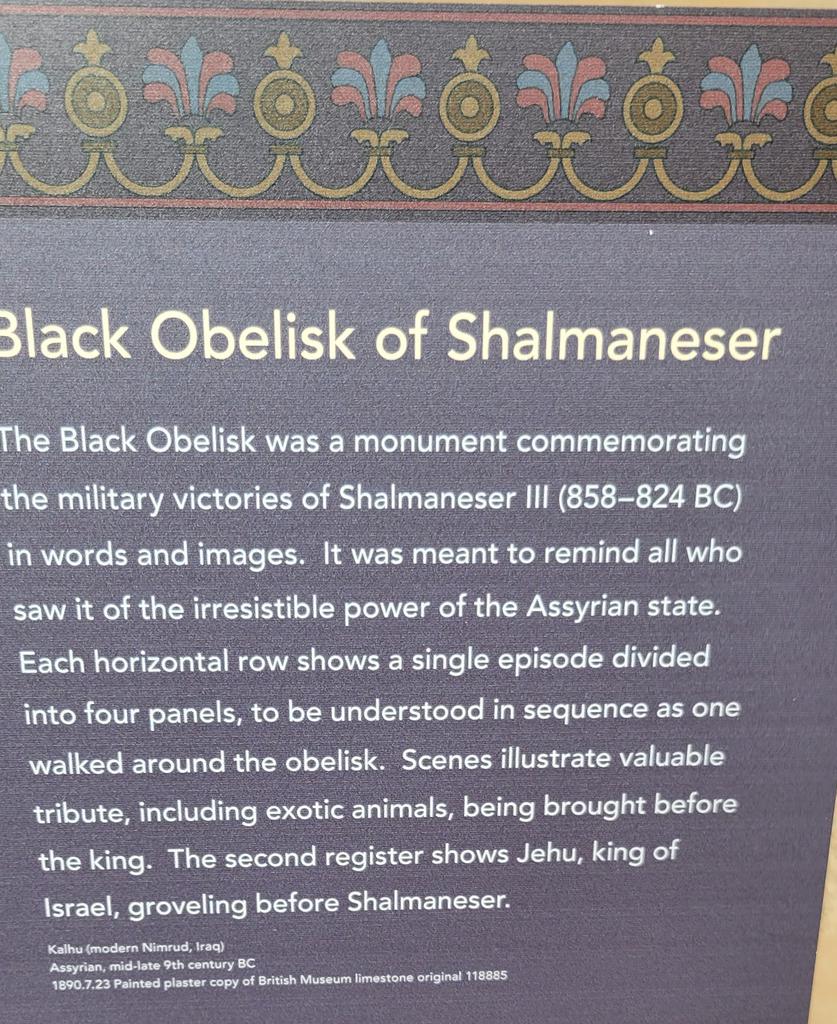
- This picture below shows the entire obelisk.
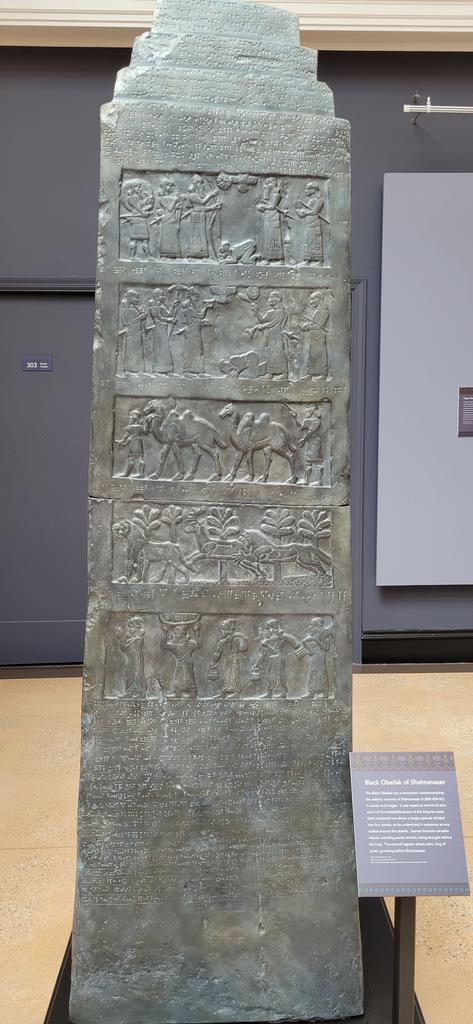
The picture below shows the illustrated part of the obelisk.
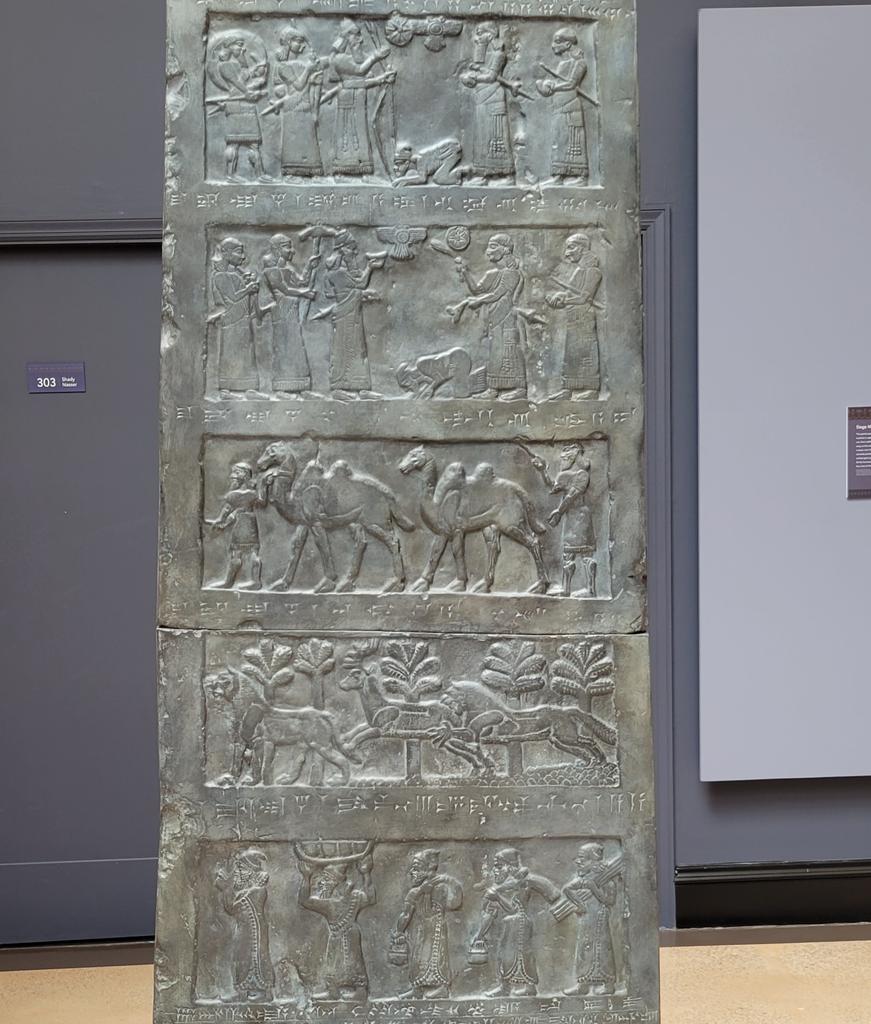
And here is the panel with Jehu or his representative.

Chapter 11: Athaliah vs her sons
- Athaliah, mother of Ahaziah, is queen of Judah
- she is either the daughter of Ahab and Jezebel or the daughter of Omri (according to the EJ)
- Joash, brother of Ahaziah and son of Athaliah, becomes king of Judah
Summary: Athaliah kills "all the royal seed." [Alter, p. 783] Or so she thinks.
Jehosheba, her sister and the daughter of King Jehoram, sneaks Joash, Ahaziah's son, and his nurse away and hides him in the house of the Lord for six years.
In the seventh year, Jehoiada, Jehosheba's husband and a high? priest, provides guards for Joash and has him anointed king to great rejoicing.
Athaliah hears this and goes to see what is happening. She is marched out of the house of the Lord and killed in the king's house.
All the people destroy the house of Baal and killed Mattan, the priest of Baal.
And the king sat on the royal throne.
Comments:
- In the time of the judges, someone kills of all of his possible rivals; only he misses one of them to his dismay and destruction:
- The queen thinking her family is dead is reminiscent of the wicked queen thinking that the huntsman has killed Snow White. Or King Laius, who hoped to thwart a prophecy, thinking Oedipus has died on a hillside.
- We don't know what kind of a ruler Athaliah is. She lasted at least six years, but the people seemed happy to see her go.
- The Encyclopaedia Judaica mentions that Jean Racine wrote a tragedy about Athaliah (1691) and that Christian art her murders are likened to Herod's massacre around the time of Jesus's birth.
- The EJ says she also was an idolator.
Chapter 12: Joash is king
- Joash is king of Judah
- he is seven years old when his reign begins
- he rules in Jerusalem for 40 years.
- Jehu is the king of Israel
- Joash becomes king of Judah in Jehu's seventh year
- Joash did right in the eyes of the Lord, but people still sacrificed and burned incense on the high places
- Amaziah, son of Joash, becomes king of Judah when Joash is killed
Summary: Joash becomes king.
He tells the priests that all the silver that people bring (as gifts?) to the house of the Lord should be used for its upkeep.
In the 23rd year, he discovers this isn't happening. So he gets a chest, bores a hole in it, sets it up by the altar, and has everyone put silver into it instead of handing it to the priests. When the box got heavy enough, money is given to contractors to do repairs; they are honest. The priests still got silver for guilt-offerings and offense-offerings.
Hazael, king of Aram, prepares to attack Jerusalem. Joash gives him all the consecrated things and the king's treasures to make him go away.
Everything else that Joash did is written in the Book of the Acts of the Kings of Judah.
Joash's servants kill him in Beth-Millo going down to Silla and he is buried with his fathers in the City of David.
Comments:
- All we know about Joash is how he interacts with the priests.
- The chest seems the forerunner to the modern pushka, a container where you privately put money that will go for Tzedakah to help people at a later time.
- Why did Joash's servants rise up against him?