14 Nissan 5783 | April 5, 2023
Pesach
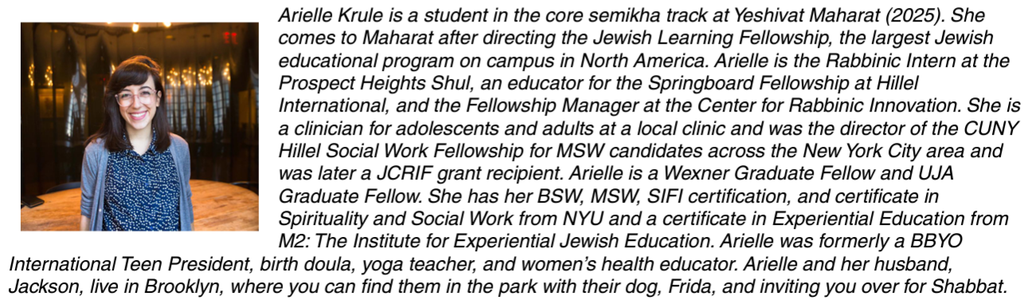
Arielle Krule
Class of 2025
Participants' Guide
Source 1 — The Moth - Our Values
- We believe that processing experience through narrative can provide insight and agency.
- We believe that listening to stories can widen our perspective and help us realize what we have in common.
- We believe that a community is strengthened when its members share stories with one another.
Reflection Questions:
- What are some of the key components of these values that stand out to you at this moment in your life?
- The Moth argues insight and agency are built through narrative. How does that line resonate with you?
- In what ways, if any, are these values reflected in our Passover “choreography”?
Source 2 — Excerpt from “Story” Robert Mcknee, On Being a Storyteller
*Thank you to R’ Sara Rich for pointing me to this years ago!
A story teller is a life poet, an artist who transforms day to day living, inner life and outer life, dream and actuality, into a poem whose rhyme scheme is events rather than words, a... metaphor that says: life is like this!
Therefore, a story must abstract from life to discover its essences, but not become an abstraction that loses all sense of life-as-lived.
A story must be like life, but not so verbatim that it has no depth or meaning beyond what’s obvious to everyone on the street.
*Thank you to R’ Sara Rich for pointing me to this years ago!
A story teller is a life poet, an artist who transforms day to day living, inner life and outer life, dream and actuality, into a poem whose rhyme scheme is events rather than words, a... metaphor that says: life is like this!
Therefore, a story must abstract from life to discover its essences, but not become an abstraction that loses all sense of life-as-lived.
A story must be like life, but not so verbatim that it has no depth or meaning beyond what’s obvious to everyone on the street.
Reflection Questions
- Are there people you know to be good at storytelling? What makes them that way?
- What are elements you agree with here? Disagree?
- What are the emotional implications?
Source 3 — Passover Haggadah
"In every generation a person must see (lir'ot) herself as though she personally left Mitzrayim (Egypt). For not just our ancestors did G-d redeem, but us as well.
"In every generation a person must see (lir'ot) herself as though she personally left Mitzrayim (Egypt). For not just our ancestors did G-d redeem, but us as well.
Reflection Questions
- What are the implications here?
- Does this feel resonant for you? What are the challenges?
- Brene Brown teaches that, “Empathy is a way to connect to the emotion another person is experiencing; it doesn't require that we have experienced the same situation they are going through.” Does that feel like a realistic practice for you at the seder?
Source 4 — Passover Haggadah of Maimonides (1138-1204)
"In every generation a person must make herself be seen (l'har-ot) as though she personally left Mitzrayim (Egypt). For not just our ancestors did G-d redeem, but us as well."
"In every generation a person must make herself be seen (l'har-ot) as though she personally left Mitzrayim (Egypt). For not just our ancestors did G-d redeem, but us as well."
Reflection Questions
- What is the new spiritual offering given here?
- How does this differ from Source 2?
Source 5 — “Manifesto of the Brave and Broken-Hearted” by Brene Brown, PhD
There is no greater threat to the critics and cynics and fearmongers than those of us who are willing to fall because we have learned how to rise. With skinned knees and bruised hearts; we choose owning our stories of struggle, over hiding, over hustling, over pretending. When we deny our stories, they define us. When we run from struggle, we are never free. So we turn toward truth and look it in the eye. We will not be characters in our stories. Not villains, not victims, not even heroes. We are the authors of our lives. We write our own daring endings. We craft love from heartbreak, compassion from shame, grace from disappointment, courage from failure. Showing up is our power. Story is our way home. Truth is our song. We are the brave and brokenhearted. We are rising strong.
There is no greater threat to the critics and cynics and fearmongers than those of us who are willing to fall because we have learned how to rise. With skinned knees and bruised hearts; we choose owning our stories of struggle, over hiding, over hustling, over pretending. When we deny our stories, they define us. When we run from struggle, we are never free. So we turn toward truth and look it in the eye. We will not be characters in our stories. Not villains, not victims, not even heroes. We are the authors of our lives. We write our own daring endings. We craft love from heartbreak, compassion from shame, grace from disappointment, courage from failure. Showing up is our power. Story is our way home. Truth is our song. We are the brave and brokenhearted. We are rising strong.
Reflection Questions
- What does Dr. Brown offer here in terms of storytelling?
- Are there pieces you agree with? Disagree with?
- Take a look at the lines in bold-face. How might Passover be a spiritual-emotional tool for developing presence and resilience?
Source 6 — Rabbi Michael Hattin, Beit Midrash Program, Pardes Center for Jewish Educators
The Rambam relates that "it is a positive command of the Torah to recount on the eve of the fifteenth of Nisan the miracles and wonders that were wrought for our ancestors in Egypt". While this mitzvah is concisely mentioned in the Torah on four occasions, it was only later during the Mishnaic, Talmudic and medieval periods that the exact procedures of the Seder night including the story of the Exodus were crystallized into a liturgical text: the Haggadah. It is instructive to note that the grammatical root of the noun Haggadah (literally “the telling”) and the infinitive להגיד (literally “to tell”) is actually נגד. This root is more commonly employed in its prepositional form signifying “opposite” and sometimes “in opposition” and is always used in a relational sense. For instance, when we sit at a table opposite a friend, we are positioned נגדה (negdah). We may therefore more accurately translate the term Haggadah not as “the telling” but rather as “the discussion that occurs between people who are in lively conversation with each other.” While a סיפור is a story that is told to a listener who listens, a הגדה is a conversation that takes place between two or more active partners. The particular pedagogic strategy that the Haggadah employs to foster this conversation involves asking probing but open-ended questions that are suitable for all ages offering general responses, which are intended as starting points for further conversation, and encouraging us to experience the evening through multiple modalities. To refer to the evening's telling as the הגדה rather than, for instance, the סיפור, is to suggest that our retelling of the Exodus story is not intended to be a detached, historical account communicated frontally to an audience of passive listeners but rather a dynamic, vigorous exchange of ideas that engages all of the participants in active dialogue.
The Rambam relates that "it is a positive command of the Torah to recount on the eve of the fifteenth of Nisan the miracles and wonders that were wrought for our ancestors in Egypt". While this mitzvah is concisely mentioned in the Torah on four occasions, it was only later during the Mishnaic, Talmudic and medieval periods that the exact procedures of the Seder night including the story of the Exodus were crystallized into a liturgical text: the Haggadah. It is instructive to note that the grammatical root of the noun Haggadah (literally “the telling”) and the infinitive להגיד (literally “to tell”) is actually נגד. This root is more commonly employed in its prepositional form signifying “opposite” and sometimes “in opposition” and is always used in a relational sense. For instance, when we sit at a table opposite a friend, we are positioned נגדה (negdah). We may therefore more accurately translate the term Haggadah not as “the telling” but rather as “the discussion that occurs between people who are in lively conversation with each other.” While a סיפור is a story that is told to a listener who listens, a הגדה is a conversation that takes place between two or more active partners. The particular pedagogic strategy that the Haggadah employs to foster this conversation involves asking probing but open-ended questions that are suitable for all ages offering general responses, which are intended as starting points for further conversation, and encouraging us to experience the evening through multiple modalities. To refer to the evening's telling as the הגדה rather than, for instance, the סיפור, is to suggest that our retelling of the Exodus story is not intended to be a detached, historical account communicated frontally to an audience of passive listeners but rather a dynamic, vigorous exchange of ideas that engages all of the participants in active dialogue.
Reflection Questions
- Rabbi Hattin transforms the idea of the haggadah from storytelling to having a conversation. What, if anything, about the two feels different?
- How might having others be in the process of haggadah be meaningful, or even healing, for you?
- What groundwork might encountering our stories of struggle this Passover help you lay for the rest of the year?
Bonus Material - Brene Brown, PhD Resource of Stormy First Drafts
Key concepts:
Key concepts:
- Introducing the idea of the Stormy First Draft.
- When something happens that triggers strong emotions, we often immediately create a story to make sense of what happened. These stories are often one-sided worse-case scenarios, and they seldom contain the full truth. We call this story the Stormy First Draft (SFD).
- Explaining that a SFDis out brain's way of making sense of something when we don't have full information. We are a meaning-making species. In the absence of data, we make up stories because having complete information is a self-protective survival skill. But these stories often magnify our fears and anxieties. When we learn how to get curious and reality check the stories we make up, we can increase our resilience and reset faster after failures, setbacks, and disappointments.
- Reality checking using the phrase: The story I'm making up: is a powerful tool for personal curiosity and reflection. When we are hooked by emotion, the brain has a hard time focusing on anything else. Being curious and checking the accuracy of a story with others can prevent the story from festering or turning into a bigger problem.
- We recently had a group of high school juniors tell us that this phrase brought their entire friend group closer, and they've taught their parents to use it. Now these students use the acronym SMU in texts for Story Making Up.