14 Adar 5783 | March 7, 2023
Purim
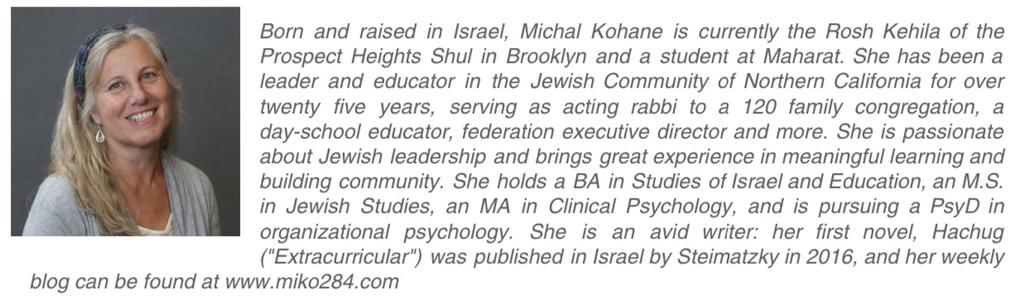
Rabbanit Michal Kohane
Class of 2020
Moses and Esther? Wait, don't you mean Mordechai and Esther? Or, perhaps Moses and Tzipora?
Every hero in our tradition has a corresponding, parallel heroine. This heroine is not necessarily his life partner who, in many cases, is the one who complements and completes him and is therefore not at all “like him", but someone else who represents his qualities - in a female. Let’s take as an example, Abraham and Sarah. Abraham is the embodiment of kindness. Sarah, on the other hand, is the embodiment of justice and valor. The person who exhibits Abraham’s kindness in a woman is therefore, not Sarah, but Rebecca. We can see the similarities in description, energy and verbs when we hear how they act towards guests and strangers. About Abraham, it is said (Genesis 18:7):
Then Abraham ran to the herd, took a calf, tender and choice, and gave it to a servant-boy, hurriedly preparing it.
And about Rebecca, it is said (Genesis 24:20):
Hurriedly, she emptied her jar into the trough, she ran back to the well to draw, and she drew for all his camels.
On the other hand, the qualities of Sarah, of judgment and bravery, are definitely not those of Abraham, her husband, or Rebecca, her daughter-in-law, but those of Isaac. Similarly, the one is most like Moshe is not Tzipora, his wife, but rather none other than... Queen Esther!
How so?
When we’re asked about Moses’ greatest quality--what made him the leader he was--it’s always about him being “humble”. How does “humility” translate into action? We know he stood up at the sin of the Golden Calf, fiercely breaking the Tablets. He also stood up to Korach and the Spies. So being humble didn’t mean being calm, not responding to crisis, not getting angry… What is it then? What is the quality that makes the one who leads us out of Egypt such a successful leader? Is he a talented and creative commentator, an army commander, perhaps a great innovator, a genius, a healer who saves lives? No. On the contrary: When Moses doesn’t know something, he says so and goes to ask God, which happens time and again, and we wonder: What did God find in him? He can’t do anything! All he does is “simply” accept the Torah. That's it! That’s it? Maybe we can say it differently: We trust that our Torah is the exact word of God only because we trust this ability of Moses – to transmit the word of the Divine without any ego, any interventions; to be a true Flow. This is the Exodus from Egypt, the departure from a place of constraints. This is redemption.
Our Sages said that "everyone who says a word in the name of the one who originally said it, brings redemption to the world" (Pirkei Avot 6:6). “Redemption” would make us think of Moses, except that the example given here is rather, Esther! As it is said, "And Esther reported it to the king in Mordecai’s name” (Esther 2:22, about the plot to kill king Ahasuerus). The chain of events that began with this statement and manifested in her enormous - and painful - ability to accept the situation and maximize her role in the new events unfolding before her, setting herself aside, is what ultimately led to this redemption, not very different from Moses!
Moses and Esther, Purim and Pesach, Adar and Nissan are connected in many different ways. They seem like complete opposites: Purim comes at the end of our calendar while Pesach is in the beginning; Pesach opens our story as a nation and Purim is towards the very end of the TaNaCh and that era in our history. Purim is in and about exile while Pesach is on route to the Land of Israel. Pesach is about birth, renewal, breakthrough, promise, looking ahead, while Purim is about barely surviving after the horrible destruction of the first Temple, trying to make it without God’s explicit intervention, without any visible miracles. We often connect Pesach with the other pilgrimage festivals, Sukkot and Shavuot, while we place Purim possibly with Hanukkah in the list of post-Torah holidays. And yet, Purim and Pesach are also, surprisingly, deeply connected.
A careful read reveals that most of the important events in Megillat Esther take place in Nissan, during Passover itself! The midrash debates how could Esther tell Mordechai that everyone should fast when it’s Seder night! In addition, according to tradition, Moses was born in the month of Adar. We are told that he was born circumcised, but had he had a brit, it would have been on… Purim.
In Tractate Chulin we come across a very strange gemara: “Where is Moses in the Torah?”, we’re asked, and we wonder, didn’t you read the text? Moses is in almost every Torah portion from Exodus on! But the gemara here means, where is Moses in the Torah, before he was born. On that we tend to say, well, he isn’t! But the gemara gives us a baffling answer (Genesis 6:3):
H’ said, “My breath shall not abide in humankind forever, since it too is flesh; let the days allowed them be one hundred and twenty years.”
Did you see Moses in this verse? There’s a double hint: the mention of 120 years, which is the age Moses lived to, and the word “beshagam”, here translated as “too” (also), which in gematria is the same value as “Moshe” (345).
Ok… a bit of a stretch, you say? Oh, but it gets better! Guess who are Moses’ “partners” in this piece of gemara (Tractate Chulin 139b)? None other than our Megillah heroes: Haman, Esther and Mordechai, all, just like Moses, hinted in the Torah, long before their official appearance on stage. What is Moses doing in the mix? Perhaps he’s here to remind us how Purim and Pesach, and what each stands for, are deeply connected.
Rav Soloveichik’s Torah in Fate and Destiny might help us understand this better. Rav Soloveichik speaks of two covenants, that of “fate” and that of “destiny”. He taught that fate “is an existence of compulsion… a pure factual existence… subjected to the forces of the environment unto which the individual has been cast by providence, without prior consultation.” Destiny, on the other hand, is an “active mode of existence, one wherein man confronts the environment into which he was thrown, possessed of an understanding of his uniqueness, of his special worth of his freedom, and of his ability to struggle with his external circumstances without forfeiting either his independence or his selfhood.” It seems that Pesach is a “covenant of destiny,” all active and forward looking, while Purim is more a “covenant of fate,” when the People were “subject to forces of the environment.” I wonder if we can see it the other way around too, with Pesach as fateful--a time we had to do absolutely nothing, but follow God’s command into a place where everything was provided--while Purim was a time when only due to the people’s courageous initiative and inspiring actions did salvation come.
One way or another it seems like both are very much needed in our existence - past, present and future. We cannot be only about one or the other. How to combine and balance the two seeming opposite? That is a question we still have to struggle with today.
Purim Same’ach!