


for ARJE's 3/15/23 Torah Lishma
(ב) זֶ֤ה אֵלִי֙ וְאַנְוֵ֔הוּ
(2) This is my God and I will glorify Him;
The Gemara asks: In accordance with whose opinion is that which is taught in this baraita: There is a mitzva to bind the myrtle and the willow with the lulav. And if he did not bind it, it is fit. If the baraita is in accordance with the opinion of Rabbi Yehuda, when one did not bind it, why is it fit? If it is in accordance with the opinion of the Rabbis, why is there a mitzva to bind it at all? The Gemara answers: Actually, it is in accordance with the opinion of the Rabbis. And the reason that there is a mitzva to bind it is due to the fact that it is stated: “This is my God and I will glorify Him [ve’anvehu]” (Exodus 15:2), which they interpreted to mean: Beautify yourself [hitna’e] before Him in the performance of the mitzvot. The Rabbis agree that although failure to bind the three species does not render them unfit for the mitzva, the performance of the mitzva is more beautiful when the lulav is bound.
- Midrash Mechilta, Shirata, chapter 3, ed. Lauterbach, p. 25
-
In the Shabbat and Sukkah texts, we’re told to add beauty to the mitzvot we perform. We often think of beauty as artistic in some way - more pleasing to the eye. If read that way, what does that imply about those who do not see themselves as artistic? How does hitna’e [beautify yourself] alter your understanding of hiddur mitzvah?
-
How does the text of Midrash Mechilta change or widen the meaning of the Torah text? Does it expand your thinking? How might it expand your teaching of the mitzvah of hiddur mitzvah? What, exactly, has Midrash Mechilta altered that created a change for you?
-
When we are teaching students who do not connect to the idea of God but wish to connect to the ideas of Judaism, how do we share the value of hiddur mitzvah?
- What do you think are the implications of this text?
- If you choose to spend more to purchase a more beautiful or better quality item, do you feel differently about it?
- Is there a way to reframe these texts so that we, and our students, can see beyond the challenge for those with less discretionary income?
- We know from the Talmud that the rabbis generally equated wealth with respect [e.g., God gave wealth to Moses so that the people would respect him]. Chasidic literature generally elevates the simplest and poorest Jews [e.g., the illiterate child whose flute playing reaches God when the congregation’s prayers do not]. How might you braid these two notions into a teaching that reaches all of your learners?
(1) Hallelujah.
Praise God in God's sanctuary;
praise God in the sky, God's stronghold. (2) Praise God for God's mighty acts;
praise God for God's exceeding greatness. (3) Praise God with blasts of the horn;
praise God with harp and lyre. (4) Praise God with timbrel and dance;
praise God with lute and pipe. (5) Praise God with resounding cymbals;
praise God with loud-clashing cymbals. (6) Let all that breathes praise Adonai.
Hallelujah.
- from Likutei Etzot by Nachman of Breslov
-
What, if any, role has music played in your connection to Judaism and to God? If you incorporate music into your teaching, what are you hoping the music “accomplishes” when it lands most successfully?
-
Are there ways that music has “beautified the mitzvah” for you? What is your own spiritual/emotional/aesthetic relationship to music?
-
What is your experience of Judaism’s prayer services in terms of the vibe, volume, and flavor of the music? Where does it fall on the continuum that runs from contemplative to raise-the-roof? How would it change your experience of tefillot as an expression of hiddur mitzvah to shift to a different point on the continuum?
- from Gates of the Seasons: A Guide to the Jewish Year, 1980, quoting Claude Goldsmid Montefiore and Herbert Loewe, A Rabbinic Anthology, 1938.
-
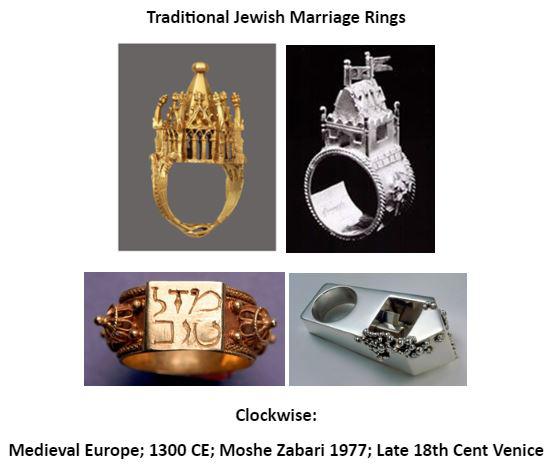
Traditional Jewish marriage rings were owned by a community. A groom needed to purchase it from the community (for a very minimal fee) so that he owned it during his wedding, but it later returned to the community to await the next wedding. Noting, and putting aside, the gender inequity which could easily be rectified with two such rings, what arguments would you make for or against a marriage ring such as the ones above that are owned by the community?
-
What modern analogs do we have, if any in your opinion, to the communally owned marriage ring whose beauty and value exceed that which the average couple could afford?
-
What is signified by the wedding rings above? Do you agree that “the Jew becomes beautiful as he/she performs a mitzvah” because of the object? How would you elaborate on your answer to someone who holds the opposite opinion?