


...מִשֶּׁנִּכְנַס אֲדָר מַרְבִּין בְּשִׂמְחָה.
...When the month of Adar begins, one increases rejoicing.
Opening Meditation: Dalai Lama--Inner World: Healing (Instrumental)
This piece is inspired by the mantras and teachings of His Holiness The 14th Dalai Lama, Tenzin Gyatso. HH is the leader of Tibetan Buddhism, the spiritual leader of Tibet, and a worldwide inspiration for mindfulness and contemplative practices. Because many of my understandings of meditation come from various Buddhist scholars/teachers, I use this resource to give an original context for the practice.
Now that we are more grounded in our bodies, minds, and spirits, I want to introduce us briefly to a selection of Jewish texts that help us to understand:
- the various ways we as humans exist in this world;
- the way joy (and "Jewish joy" as I like to call it) manifest in Jewish texts;
- the ways this is uplifted and made complicated during the month of Adar and the holiday of Purim;
- and the ways we can embody this joy, in healthy doses, and with mindful practices.
This source sheet was created to honor this time on the Jewish calendar, and it coinciding with national Eating Disorder Awareness Week. This is put on by the National Eating Disorder Association (NEDA), Project Heal, and other organizations.
You do not have to be in recovery from an eating disorder to utilize this source, and to be in a space where this material is taught. It's a resource for everyone.
Eating Disorder Statistics via ANAD: https://anad.org/eating-disorders-statistics/
- This includes statistics for the following communities: general, BIPOC; LGBTQ+; folks with disabilities; folks in larger bodies; athletes; veterans; and children & young adults.
The Four Worlds in Kabbalah (via RitualWell):
"The ancient kabbalists describe a system of Four Worlds—Assiyah/עֲשִׂיָּה (physical/world of action), Yetzirah/יְצִירָה (the heart/world of emotion), Beriah/בְּרִיאָה (the mind/world of intellect), and Atzilut/אֲצִילוּת (the intuitive world of spirit)—as a template for the divine world and the human experience...Aligning all of these worlds/levels in our self-care brings us to shlemut/wholeness and well-being."
Some ways to engage with these aspects of our selves include:
1. Grounding ourselves in text, such as with this source sheet.
2. Engaging in breath work/meditations that allows for physical, emotional, mental, and/or spiritual tranquility.
3. Using intuitive movement to "experience our bodies as a source of fluidity, playfulness, and joy."
Interpretation of the Four Worlds from Aleph: Institute for Jewish Renewal
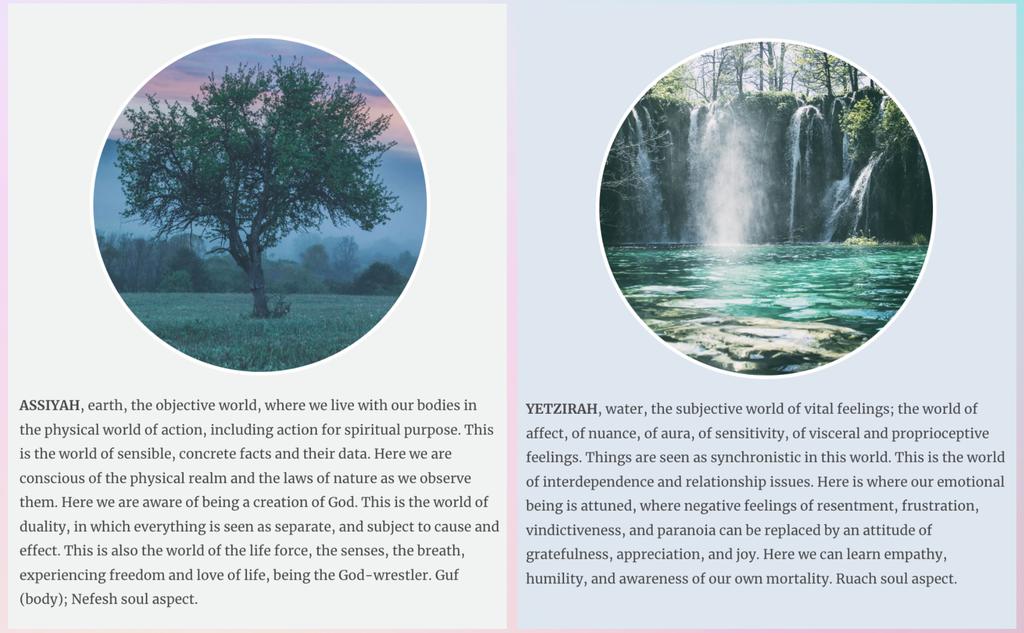
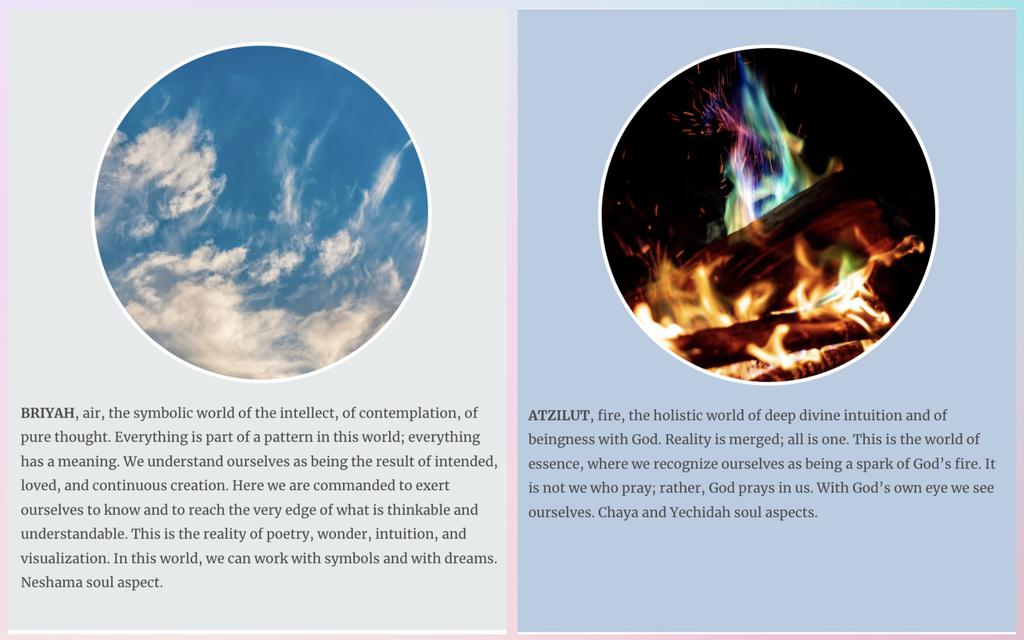
From here's let's talk about joy.
How do you define joy?
How do you experience joy?
Where do you feel joy in your body? In your mind? In your non-physical self, your spirit?
Rebbe Nachman of Breslov (z"l):
R. Nachman was a 18th/19th century scholar and founder of the Breslov Hasidic* movement in Judaism.
*The Hasidic Jewish movement is a stream within ultra-Orthodox Judaism that grew out of an 18th-century mystical revival movement.
סוכות - חַג הַסֻּכּות הַזֶּה זְמַן שמְחָתֵנוּ:
...the this holiday of Sukkot, a time of our joy/celebration.
(א) מִצְוָה גְּדוֹלָה לִהְיוֹת בְּשִׂמְחָה תָּמִיד, וּלְהִתְגַּבֵּר לְהַרְחִיק הָעַצְבוּת וְהַמָּרָה שְׁחֹרָה בְּכָל כֹּחוֹ.
(1) It is a great mitzvah to always be happy, and to make every effort to determinedly keep depression and gloom at bay.
(ח) [ח]. עַל־יְדֵי עֲשִׂיַּת הַמִּצְוָה בְּשִׂמְחָה זוֹכִין לְתַכְלִית הַכֹּל, כִּי זוֹכִין לְהַשִּׂיג הָאוֹר שֶׁהוּא לְמַעְלָה מִנַּפְשִׁין וְרוּחִין וְנִשְׁמָתִין וְהוּא אוֹר אֵין סוֹף, בִּבְחִינַת מָטֵּי וְלָא מָטֵּי. אַשְׁרֵי מִי שֶׁזּוֹכֶה שֶׁיִּרְדֹּף מַחֲשַׁבְתּוֹ לְהַשִּׂיג הַשָּׂגוֹת אֵלּוּ וְכוּ': (לק"א סי' כ"ד אות א' ב' ח')
(8) Through carrying out the mitzvoth in joy it is possible to reach the ultimate goal of all things. For there is a light which is beyond “soul,” “spirit” and “breath.” This is the Light of the Infinite, which it is possible to “reach, yet not reach.” Happy is [the person] who chases after [their] thoughts in order to reach such a vision (24).
(יב) [יב]. רִקּוּדִין שֶׁל מִצְוָה, כְּגוֹן שֶׁשּׁוֹתֶה יַיִן בְּשַׁבָּת וְיוֹם טוֹב אוֹ בַּחֲתֻנָּה שֶׁל מִצְוָה אוֹ בִּשְׁאָרֵי סְעוּדַת מִצְוָה, וְשׁוֹתֶה בְּמִדָּה וְכַוָּנָתוֹ לַשָּׁמַיִם, לִזְכּוֹת לְשִׂמְחַת יִשְׂרָאֵל, לִשְׂמֹחַ בְּהַשֵּׁם יִתְבָּרַךְ אֲשֶׁר בָּחַר בָּנוּ מִכָּל הָעַמִּים וְכוּ',
...וְהַיַּיִן שֶׁשָּׁתָה הוּא בְּחִינַת יַיִן הַמְשַׁכֵּר שֶׁמִּשָּׁם אֲחִיזַת הַחִיצוֹנִים חַ"ו. נִמְצָא, רִקּוּדִין דִּקְדֻשָּׁה מַמְתִּיקִין הַדִּינִים כְּמוֹ פִּדְיוֹן: (לק"א סי' מ"א)
(12) It is a wonderful thing when people dance for joy for the sake of a mitzvah! There are times when it is a mitzvah to drink wine — on Shabbat and Yom Tov, or at a wedding or other religious celebrations. If you drink on such occasions your intention should be for the sake of Heaven. Drink moderately and not to excess, and with the purpose of experiencing the true joy of Israel, which is to rejoice in God, who chose us from all the nations...
[When] the wine which [one] drinks is the “wine of drunkenness,” which gives a hold to the forces of the Other Side. But dancing with holy intentions has as much power to sweeten the harsh judgements as a redemption. (41).
Now that we have this grounding in this understanding of our full selves, and of "Jewish joy" in text, let's dive into how this joy may be complicated when one is faced with disordered eating/eating disorder experiences.
Here, we'll talk about this in context of Adar's holiday: Purim!
First, there is this declaration for celebratory feasting during the holiday:
(טז) לֵךְ֩ כְּנ֨וֹס אֶת־כׇּל־הַיְּהוּדִ֜ים הַֽנִּמְצְאִ֣ים בְּשׁוּשָׁ֗ן וְצ֣וּמוּ עָ֠לַ֠י וְאַל־תֹּאכְל֨וּ וְאַל־תִּשְׁתּ֜וּ שְׁלֹ֤שֶׁת יָמִים֙ לַ֣יְלָה וָי֔וֹם גַּם־אֲנִ֥י וְנַעֲרֹתַ֖י אָצ֣וּם כֵּ֑ן וּבְכֵ֞ן אָב֤וֹא אֶל־הַמֶּ֙לֶךְ֙ אֲשֶׁ֣ר לֹֽא־כַדָּ֔ת וְכַאֲשֶׁ֥ר אָבַ֖דְתִּי אָבָֽדְתִּי׃
(16) “Go, assemble all the Jews who live in Shushan, and fast in my behalf; do not eat or drink for three days, night or day. I and my maidens will observe the same fast. Then I shall go to the king, though it is contrary to the law; and if I am to perish, I shall perish!”
Later on in the Book of Esther, Esther declares a fast that she and others will observe, not because something evil has happened (which is why several fasts are observed in Judaism, such as the destruction of the First and Second Temple on Tisha B'Av), but because of the possibility of something evil happening.
(ח) וְהַשְּׁתִיָּ֥ה כַדָּ֖ת אֵ֣ין אֹנֵ֑ס כִּי־כֵ֣ן ׀ יִסַּ֣ד הַמֶּ֗לֶךְ עַ֚ל כׇּל־רַ֣ב בֵּית֔וֹ לַעֲשׂ֖וֹת כִּרְצ֥וֹן אִישׁ־וָאִֽישׁ׃(ט) גַּ֚ם וַשְׁתִּ֣י הַמַּלְכָּ֔ה עָשְׂתָ֖ה מִשְׁתֵּ֣ה נָשִׁ֑ים בֵּ֚ית הַמַּלְכ֔וּת אֲשֶׁ֖ר לַמֶּ֥לֶךְ אֲחַשְׁוֵרֽוֹשׁ׃ {ס}
(8) And the rule for the drinking was, “No restrictions!” For the king had given orders to every palace steward to comply with each man’s wishes.(9) In addition, Queen Vashti gave a banquet for women, in the royal palace of King Ahasuerus.
Discussion Questions:
1. What contrasts do you seen between Esther 1:8-9 and Esther 4:16?
2. How do you understand these tow statements from a mental health perspective? Do you see this as connecting to the various narratives around disordered eating/eating disorders?
These two texts create for many an unhealthy binary of binging on alcohol and food, and completely abstaining from food and drink.
As a person who does not engage in ritual fasting--and who practices mindful eating practices, particularly during the Jewish holidays--I admittedly do not find meaning in these practices.
I eat hamantaschen (Ashkenazi Jewish triangular filled-pocket pastry eaten on Purim; in Hebrew they're called אוזני המן oznei haman or "Haman's ears").
I eat my three meals and snacks throughout the day.
I boo at Haman's name.
I celebrate Esther's resilience and divine feminine inspiration.
This holiday helps to shape the entire month of Adar. As you can see, this joy can easily become complicated.
How do we work to seek this joy? Is it possible for us to seek this joy in the midst of internal/community/global darkness?
Source from At The Well's resource on "Adar I: Increasing Joy":
1. Have the group spend ~2-5 minutes in comfortable seats with their eyes closed (if that’s what feels best),
reflecting on the happiest moment or moments of their lives.
Consider playing some upbeat tunes from your adolescence during this moment to set the mood.
- Exploring Emotions: Focusing On e Joy In Times O TurmoilBy Al RosenbergAl Rosenberg is a trans, progressively-disabled millennial crying about plant life and small animals in the Chicagoland area. Once a journalist, they now write about illness, Judaism, and gender. They work in marketing and strategic planning for a Jewish nonprofit when they’re not proofreading fiction for their clients. Find them at www.alaboutwriting.com or on Twitter: @alaboutwritingFor the last several years, Adar has been a complicated month for me. It’s the month where we, the Jewish people, are meant to “increase joy” and welcome the season of miracles. Historically, this month has been one of the best for the Jews and we’re supposed to embrace that.This year, especially since it’s a Hebrew calendar “leap year,” and the whole month will come back for seconds, we have even more reason for miracles! Literally: because of the way the Hebrew calendar works (it’s both lunar and solar), the 12 lunar months add up to 11 days shorter than a solar year. The fix? In order to even things out, every few years we have Adar twice: Adar I and Adar II. Two whole months devoted to joy.Of course, joy, even in just small, intentional moments of happiness, can feel difficult when your life and the world around you is so filled with pain and uncertainty. But it’s important to remember that there’s power in joy, which is fitting, since “Adar” is associated with the Hebrew word “adir,” meaning strength.Choosing moments of joy for yourself even when it feels impossible, and bringing happiness to others is a powerful antidote during times of suffering. Jewish history has certainly taught us that.Activity For All: Letters of JoyMaterials Needed:
- OR: computers for writing emailsInstructions:
- 2 envelopes
- Writing/drawing instrument(s)
- Paper
- Set a timer for 2 minutes: Everyone should write down as many happy/joyful words as possible associated with those memories.
- Go around the circle and read out some of the words/phrases. Everyone should add words to their own list that spark joy for them as well.
- Set a timer for 5 minutes: Everyone will write a letter to their future self reminding them of the things that bring them joy. They can write about that specific memory or memories, or write an instructional list of how to find joy when it’s hard, using their list of words as inspiration.
At the end of the 5 minutes, they should sign it “Love, Me/You” and then seal it up in the envelope. Write on the outside of the envelope: “Open on a hard day”. - Set the time for 5 more minutes: Now, everyone will write a letter to someone in their life they know could use a little extra joy right now.
This can be about anything and for anyone! Sending happiness to others magnifies our own happiness. More is more is more. If it feels right, it can be a doodle, a poem, a thank you note, a list of puppies they saw recently that made them smile. At the end of five minutes, seal it up and folks can send those when they get home.
Additional Activity By And For Trans/Nonbinary Folks (though I welcome everyone to try this out as well!)
It’s a revolutionary act for trans and nonbinary folks to be happy and live their happiness out loud in a world that often tries to rob us of joy.
For trans/nonbinary folks—and everyone who wants to be brave about their gender! Consider adding the following exercise:
- Set a timer for 2 minutes: List all the things, words, feelings, etc. that cause a sense of gender euphoria (bliss and comfort that happens when our gender expression is aligned with our identity). This can be anything! It just has to be true to you.
- Set a timer for 5 minutes: Write a note, a how-to guide, drap a map, draw yourself, make something that reminds you of that sense of euphoria—the deep, bone-aching love for yourself that can be so hard to hold onto for long periods of time.
If this is feeling too hard, take care of yourself. Write a note about all the ways you can be a caretaker for you. (Examples: Your favorite steaming cup of tea, made just the way you like it. A warm comforter and cold pillow. A lap cat purring during a rainstorm.)
Regarding Ability Modifications:
For folks for whom writing is a pain (literally) or inaccessible, this activity can be modified so that it is done by typing lists, or voice recorded if the Circle is meeting on Zoom and everyone will be muted. If meeting in person, either spread out in the space enough so that everyone has a little more privacy (the person or people who will be using the voice recorders should not be the only folks outside of the Circle).
Author's Website: https://www.alaboutwriting.com/
From here, I want to include some writings from across faith/culture communities that can be connected to conversations around body image, recovery, and fatness. These include text from Thich Nhat Hanh (z"l), Fat Torah, and body image/fatness in Indigenous communities.
Fatness is often not part of mainstream eating disorder recovery dialogue. Fatness, fatphobia, and quality of life in a fat body is a justice issue and integral to ED conversations...
...
"The Story of a River" by Thich Nhat Hanh* (z"l):
*when I read this, I find the ways I can embody Thuy's words into how I view, experience, and find peace within my body.
Born on the top of a mountain, the little spring dances her way down.
The stream of water sings as she travels. She wants to go fast. She is unable to go slowly. Running, rushing, is the only way, maybe even flying. She wants to arrive. Arrive where? Arrive at the ocean. She has heard of the deep, blue, beautiful ocean. To become one with the ocean, that is what she wants.
Coming down to the plains, she grows into a young river. Winding her way through the beautiful meadows, she has to slow down. ” Why can’t I run the way I could when I was a creek? I want to reach the deep, blue ocean. If I continue this slowly, how will I ever arrive there at all?”
As a creek, she was not happy with what she was, she really wanted to grow into a river. But, as a river, she does not feel happy either. She cannot bear to slow down.
Then, as she slows down, the young river begins to notice the beautiful clouds reflected in her water. They are of different colors and shapes floating in the sky, and they seem to be free to go anywhere they please. Wanting to be like a cloud, she begins to chase after the clouds, one after another.
“I am not happy as a river. I want to be like you, or I shall suffer. Life is really not worth living”. So the river begins to play the game. She chases after clouds. She learns to laugh and cry. But the clouds do not stay in one place for very long. “They reflect themselves in my water, but then they leave. No cloud seems to be faithful. Every cloud I know has left me. No cloud has ever brought me satisfaction or happiness. I hate their betrayal.”
The excitement of chasing after the clouds is not worth the suffering and despair.
One afternoon, a strong wind carried all the clouds away. The sky became desperately empty. There were no more clouds to chase after. Life became empty for the river. She was so lonely she didn’t want to live anymore. But how could a river die? From something you become nothing? From someone, you become no one? Is it possible?
During the night, the river went back to herself. She could not sleep. She listened to her own cries, the lapping of her water against the shore. This was the first time she had ever listened to herself deeply, and in doing so, she discovered something very important: her water was made of clouds. She had been chasing after clouds and she did not know that the clouds were her own nature.
The river realized that the object of her search was within her. She touched peace. Suddenly, she could stop. She no longer felt the need to run after something outside herself. She was already what she wanted to become. The peace she experienced was truly gratifying and brought her a deep rest, a deep sleep.
When the river woke up the next morning, she discovered something new and wonderful reflected in her water – the blue sky. “How deep it is, how calm. The sky is immense, stable, welcoming and utterly free”. It seemed impossible to believe that this was the first time the river ever reflected the sky in her water. But that is true, because in the past, she was interested only in the clouds, and she never paid attention to the sky. No cloud could ever leave the sky. She knew that the clouds were there, hidden somewhere in the blue sky. The sky must contain within itself all the clouds and waters. Clouds seem impermanent, but the sky is always there as the faithful home of all the clouds.
Touching the sky, the river touched stability. She touched the ultimate. In the past, she had only touched the coming, going, being, and nonbeing of the clouds. Now she was able to touch the home of all coming, going, being, and nonbeing. No one could take the sky out of her water anymore.
How wonderful it was to stop and touch! The stopping and touching brought her true stability and peace. She had arrived home.
That afternoon, the wind ceased to blow. The clouds came back one by one. The river had become wise. She was able to welcome each cloud with a smile. The clouds of many colors and shapes seemed to be the same, but then again they were no longer the same for the river. She did not feel the need to possess or chase after any particular cloud. She smiled to each cloud with equanimity and loving kindness. She enjoyed their reflections in her water. But when they drifted away, the river did not feel deserted.
She waved to them, saying “Goodbye. Have a nice journey.” She was no longer bound to any of the clouds.
The day was a happy one. That night, when the river calmly opened up her heart to the sky, she received the most wonderful image ever reflected in her water – a beautiful full moon, a moon so bright, so refreshing, smiling.
The full moon...travels in the sky of utmost emptiness. If the rivers of living beings are calm the refreshing moon will reflect beautifully in their water.
All space seemed to be there for the enjoyment of the moon, and she looked utterly free. The river reflected the moon in her water and enjoyed the same freedom and happiness.
What a wonderful festive night for everyone – sky, clouds, moon, stars, and water. In the boundless peace, sky clouds, moon stars, and water enjoyed walking in meditation together. They walked with no need to arrive anywhere, not even the ocean. They could just be happy in the present moment. The river did not need to arrive at the ocean to become water. She knew she was water by nature and at the same time a cloud, the moon, the sky, the stars, and the snow. Why should she run away from herself?
Who speaks of a river as not flowing? A river does flow, yes. But she does not need to rush.
*Thuy (1926-2022) was a Vietnamese Thiền Buddhist monk who brought the teachings of The Buddha, the Vietnamese teachings of Zen Buddhism, and various personal and universal values into the world.
Excerpt from "'Chokecherry eyes and frybread thighs': Fatphobia in Indian Country" by Tenille K. Campbell:
"But everyone has an opinion on fatness and when we acknowledge that, as Indigenous people, we live in a world where one of our most notorious foods — that frybread though — was developed out of food rations given to us by colonial governments, fatness is inherently tied to colonial structures and fatness is seen as undesirable by colonial people...
It's constant talk about how decolonial diets mean better health aka slimmer bodies.
We have to actively seek out positive plus-sized bodies in order to see positive plus-sized bodies."
"A Torah That Is Fat" by Fat Torah:
"In some ways these two perspectives of spiritual care and social justice align with the Jewish mystical attributes of Hesed and Gevurah: hesed with its unbounded and unboundaried lovingkindness, flowing to all and not distinguishing between kinds. And Gevurah, boundary itself, the great “No!” which recognizes the world-building and world-saving power of judgment and justice. In Fat Torah, we recognize the deep value of each of these Divine attributes as well as the need to balance them.
And my grandest hope is that the necessity of including perspectives of both social justice and spiritual care in confronting weight stigma will also provide an opportunity to increase our understanding of how these approaches can work together in confronting other systems of oppression. While as an individual I may be limited by my positionality (as a white, straight-ish, temporarily-abled, educated, Ashkenazi woman), I dream of Fat Torah serving as a resource and an ally for anti-racism, disability justice, queer liberation, and other movements of the marginalized just as it learns so much from them and owes so much to them, a Fat Torah that embodies both the need for and the possibility of a complete healing of each human heart and of the world itself.
In other words, Fat Torah is a Torah --a source of wisdom and spiritual sustenance-- that is fat: rich and expansive, nourishing from itself and beyond itself, with room for all, teaching through its love of fatness a love of all other marginalized bodies --Black and brown and queer and trans and disabled and old and sick and neurodiverse.
“A Torah that is fat: an unfolding knowing of delicious plenitude and, God willing, a breadth of fresh air.”
"…But God Was Not in the Diet" by R. Minna Bromberg from Fat Torah:
"Mimeographed.
My child, it was mim-e-o-graphed.
Typed on a typewriter and mimeographed
and then given to me by elders I admired and trusted.
In the beginning...
this sacred text,
this key to the life I wanted: friends and fitting in.
Neat fractions
and small numbers:
1/2 a grapefruit
1 piece of toast or 1/2 a cup of oatmeal
Such options!
1200 calories or, if you weren't as serious, 1600 calories
And that's how my idolatry began.
My worship of what was not true.
My giving over of sovereignty.
My belief in this higher power: a lower number on the scale.
If only I would follow its commandments.
If only I was good.
I so wanted to be good.
I was 7.
...
I hear my four-year-old daughter’s voice in my head as I type this. 'Right, Imma?' she asks me several times a week, 'Right, Imma, I’m growing every day?' She doesn’t know it, but my answer to her is also my blessing: 'Yes, my sweet love, you are growing every single day.'"
None of these texts encompass this topic of "joy and body love" in their entirety. Rather, I see my creation of this source sheet as a starting point. As I return to this on a new day, my perspectives change. I may add a new text, or remove/edit some in Adar 5784. This is a living document for me, for anyone who comes across it.
I acknowledge, in bringing in all these complex sources, that many of us may be struggling with our own journeys. This is okay. This journey is never linear, in a forever-upward direction. With this month of Adar being a time of increasing joy, I wish to share one final thought on this:
It's okay to embrace the sadness on the sad days.
The Jewish calendar has built-in times of the year for sadness, for mourning, and for acknowledging that pain and suffering in our history, in our present realities, and in our world. There are days like this in recovery as well, in our journeys with our bodies.
Sadness is painful, and is sometimes brief, sometimes lasting. It is one of the many raw human emotions that without it, we would not know what joy is.
מִשֶּׁנִּכְנַס אָב מְמַעֲטִין בְּשִׂמְחָה וְכוּ׳. אָמַר רַב יְהוּדָה בְּרֵיהּ דְּרַב שְׁמוּאֵל בַּר שִׁילַת מִשְּׁמֵיהּ דְּרַב: כְּשֵׁם שֶׁמִּשֶּׁנִּכְנַס אָב מְמַעֲטִין בְּשִׂמְחָה — כָּךְ מִשֶּׁנִּכְנַס אֲדָר מַרְבִּין בְּשִׂמְחָה.
§ The mishna teaches that from when the month of Av begins, one decreases acts of rejoicing. Rav Yehuda, son of Rav Shmuel bar Sheilat, said in the name of Rav: Just as when Av begins one decreases rejoicing, so too when the month of Adar begins, one increases rejoicing.
One of my teachers taught me that it's then important to,
be happy on the happy days.
It's important to embrace the moments of joy, though they may be fleeting.
Eating disorder recovery is not about achieving this complete state of joy, peace, and serenity with our bodies.
Recovery is a journey.
Recovery is not linear.
And still,
it is possible to seek joy and embrace the joy when it comes onto our path.
"Wild Geese" by Mary Oliver:
You do not have to be good.
You do not have to walk on your knees
for a hundred miles through the desert repenting.
You only have to let the soft animal of your body
love what it loves
Tell me about despair, yours, and I will tell you mine.
Meanwhile the world goes on.
Meanwhile the sun and the clear pebbles of the rain
are moving across the landscapes,
over the prairies and the deep trees,
the mountains and the rivers.
Meanwhile the wild geese, high in the clean blue air,
are heading home again.
Whoever you are, no matter how lonely,
the world offers itself to your imagination,
calls to you like the wild geese, harsh and exciting -
over and over announcing your place
in the family of things.
Eating Disorder Resources:
National Eating Disorder Association (NEDA): https://www.nationaleatingdisorders.org/help-support/contact-helpline
ANAD: https://anad.org/
National Alliance for Eating Disorders: https://www.allianceforeatingdisorders.com/
Nalgona Positivity Pride: https://www.nalgonapositivitypride.com/
FEDUP (Fighting Eating Disorders in Underrepresented Communities): https://fedupcollective.org/
Eating Recovery Center: https://www.eatingrecoverycenter.com/
From Sefaria: "Texts To Bring you Joy In Adar"
- Purim on Sefaria: Resources for Educators is a collection of activities that can be used leading up to Purim or as part of a classroom Purim celebration. For a deeper look into Purim customs, check out Joy, Gifts, Scrolls, and More: The Many Customs of Purim.
- The Sefaria library now includes a complete English translation of Esther Rabbah, an exciting early midrash that interprets the book of Esther verse-by-verse and expands on the Esther narrative with additional stories. We hope you're enjoying our guided learning series that spotlights some great passages to learn and teach in the lead up to the holiday!
- Liven up your Purim celebration with the Emoji Megillah and built-in grogger for the Sefaria app. Instructions for both are found on Enabling the Emoji Megillah and App Grogger.
- Don't forget our huge selection of Megillah commentaries, including complete English translations of Rashi, Ibn Ezra, and Malbim.
Meditation for Simcha (Joy):