


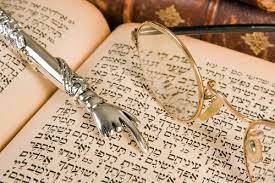
Exodus
WOLPE - Sinai
Ten Commandments are not in our prayers nevertheless an important part. We stand when we recite them.
Central portion of Torah (giving of 10 commandments) named after non-Jew. Yitro.
Moses going up and down the mountain demonstrates that Moses is only doing God’s bidding.
Wolpe - Your conception of God may be related to your relationship c your father.
Honor father and mother only one that gives a reward
All of 10 can be summarized in thou shall not steal.
Steal God’s honor. Steal property. Steal their good name. Steal their property.
Coveting most difficult to explain because it commands a thought.
We don’t think we can control what we want.
Iban Ezra - one can covet most beautiful girl in village but not the Queen.
You can only covet something that you could conceivably have.
In Hebrew it’s the 10 sayings.
Coveting is umbrella under which all other commandments fall
If you didn’t covet you would not steal, murder, etc
Maimonides letter to the convert Ovadiah
DAVIDS - WBT
complete set of 10 commandments
Deuteronomy 6
partial set in Leviticus 19
What does Lohan Dodi have to do c 10 commandments.
Shamor keep the sabbath day Zachary remember the sabbath day
Exodus 10 - zachor (understand, know, remember)
Deuteronomy - Shamor
Rabbis say Shamor and zachor were said simultaneously
Why are 10 commandments in Leviticus?
Torah woven together various literary strands.
Leviticus is P strand
Evidence that Torah is a combined document
Jews and Christians divide 1st commandment differently. View counting differently. Davids does not make clear why.
Sabbath commandment is the issue.
1st commands us to recognize the existence and authority of God.
Killing v. murder
intentionality
killing refers to other organisms other than man. killing cow for food. killing a fly.
can kill in certain circumstances but not others.
City of refuge available to accidental killer only.
revenge for killing is an allowed killing. but once “killer” gets to refuge city then he cannot be killed or it is murder to kill him.
How do 10 commandments stack up again New Testament?
Matthew 37-39
1st is Love the lord with all your heart. This is greatest
2nd is love your neighbor.
Why are 10 commandments problematic in Christianity?
They don’t observe the sabbath.
They move sabbath to Sunday and call it the Lord’s Day.
Sins of parents visited on children to 3rd and 4th generation
By the time you get to later parts of the Bible, Prophets, that is gone and replaced by soul of sinner is punished.Bible has evolved.
How does an infinitely abstract God have contact with humans?
Jews do this with ?Shekayna is the walking spirit among us?
Why are 10 commandments not in our liturgy?
Talmud - 10 commandments read during worship in Temple and then recite the Shema. Minim=heretics. This practice was stopped because of arguments among minim.
Who were heretics? any dissenters.
10 commandments became shorthand for jews who said all i have to do is this. This would destroy rabbinic judaism.
10 were put back into introductory prayers that preceded the morning service.
4 important non-jews in Torah -
Yitro. Balaam. Pharaoh. Melchizedek King of Salem. Priest of El-elyom. Genesis14:18
Job is not in Torah is a non-Jew.
Jesus is referred to as high priest on order of Melchizedek.
Melchizedek = "my king is Sedek"
king of Salem and priest of the Most High God to whom Abram paid tithe after the battle he fought to free Lot.
Saturday
Exodus 20:15
ALL the people SAW
How did they SEE thunder. Syncretism some people see sounds, numbers are seen as colors etc..
or translate as witness (as it does in Sefaria JPS)
Moses told people to stand back from mountain
Mysticism an attempt to get closer to God. Physical, intellectual, spiritual
How can you get physically closer to God?
Separateness of Bimah, sacred space.
ALL - men and women, people throughout time
Exodus 19:1
3rd new moon they entered Sinai
Celebrated as Shavuot, giving of Torah
Hard to be specific on exact day from Torah.
Moses brings down tablets, the 10 statements.
Oral Torah - what God told Moses but was not written down.
Oral law is what is not written down. expansion, additions and changes to the written law.
Oral law was written down and became the Talmud but that was not the end. Oral law is still happening.. Gives Judaism flexibility the survive 2500 years.
Not all response become part of the Oral Law.
Not until community accepts the Rabbi’s response.
SACKS
Justice or Peace
Moses must learn to delegate and share the burden of leadership. Interestingly, the sentence “What you are doing is not good (lo tov)” is one of only two places in the Torah where the phrase “not good” occurs. The other (Genesis 2:18) is “It is not good for man to be alone.” We cannot lead alone; we cannot live alone. That is one of the axioms of biblical anthropology. The Hebrew word for life, ḥayim, is in the plural, as if to signify that life is essentially shared. Dean Inge once defined religion as “what an individual does with his own solitude.” That is not a Jewish view.”
“What is less easy to understand is his final comment: if, with God’s permission, you delegate, “so too all these people will reach their place in peace.” The people were not exhausted; Moses was. How then would they gain by a system of delegation? Their cases would still be heard – but not by Moses. How was this to their advantage?2”
“Hence Netziv’s remarkable conclusion. By delegating the judicial function downwards, Moses would bring ordinary people – with no special prophetic or legal gifts – into the seats of judgment. Precisely because they lacked Moses’ intuitive knowledge of law and justice, they were able to propose equitable solutions, and an equitable solution is one in which both sides feel they have been heard. Both gain; both believe the result is fair. That, as the Talmud says above, is the only kind of justice that at the same time creates peace. That is why the delegation of judgment would not only help Moses avoid total exhaustion; it would also help “all these people” to “reach their place in peace.”
“They could bring peace between contending parties. They could create non-violent, non-coercive forms of conflict resolution. Not knowing the law with the depth that Moses did, not having his intuitive sense of truth, they had instead to exercise patience. They had to listen to both sides. They had to arrive at an equitable verdict that both parties could see as fair. A mediator has different gifts from a prophet, a liberator, a law-giver – more modest perhaps, but sometimes no less necessary.”
“What emerges at the end of the train of thought Netziv sets in motion is the deep significance of the idea that we can neither live nor lead alone. Judaism is not a faith transacted in the privacy of the believer’s soul. It is a social faith. It is about networks of relationship. It is about families, communities, and ultimately a nation, in which each of us, great or small, has a role to play.”
A Kingdom of Priests
“What does this have to do with the phrase “a kingdom of priests”? Normally we think of a priest in terms of his duties, ministering to God in a holy place. But priests also had certain capacities. The word “hieroglyphics” means “priestly script” – because only the priests could read and write. The English word “clerical” means (a) pertaining to the clergy, ministers of religion, and (b) office staff who type letters and keep records. The reason one word means two such different things is because, throughout the Middle Ages, ministers of religion were almost the only literate class. The first universities were primarily for the teaching of religious officials.”
“Functionally, a priest in the ancient world was one who could read and write. A kingdom of priests is therefore a nation of universal literacy. Understood this way, the nature of the covenant, and of Israel’s mission, becomes clear. The law God was about to reveal at Mount Sinai would become the possession of every member of the nation. He or she could know it, read it, study it, internalize it and make it their own. The Jewish people was summoned to become, as it were, a nation of constitutional lawyers. That, to a remarkable extent, is what they became, at least in the rabbinic period.”
A Holy Nation
“However, these analyses do not go far enough in explaining what the word “holy” means in the Torah. Its most obvious appearances in the Mosaic books are twofold, the first in relation to Shabbat – the day God Himself proclaimed holy – and the second in relation to the inner chamber of the Sanctuary, which was known as the holy of holies.3 It is in these contexts that we are best able to learn what holiness means when applied to a people.”
“Lurianic Kabbala – the school of mysticism associated with Rabbi Isaac Luria and his circle in sixteenth-century Safed4 – gave Judaism one of its most glorious concepts – an idea, to be sure, that had been present from the outset, but had never been articulated as simply before. The idea was tzimtzum, divine “contraction” or “self-effacement.”
Behind the idea of tzimtzum is the realization that there is a contradiction between the infinite and the finite. If God is everywhere, how can anything else exist? Two different entities (God and that which is not God) cannot occupy the same space. The kabbalistic answer is that the very act of creation involved a self-limitation on the part of God. God, as it were, contracted His presence so that finitude – space and time and the things that occupy them – could emerge.”
“The Hebrew word for space and time, olam, which means both “universe”, i.e., the totality of space, and “eternity,” i.e., the totality of time, also means “hidden” as in the word ne’elam. Thus, embedded in the Hebrew language is the idea that space and time are dimensions of the hiddenness of God, who is beyond space and time.
Yet were God entirely hidden from the universe it would be, experientially and functionally, as if He did not exist. At best, Deism would be true – the idea, widespread during the scientific Enlightenment of the seventeenth and eighteenth centuries, that God created the universe but thereafter played no part in it, neither intervening in history in the form of miracles, nor disclosing Himself through revelation. God would be a Deus absconditus, a creator who deserted humanity.
Thus the very terms of creation involve a paradox. Without God the universe would not exist; but the presence of God threatens the existence of anything apart from Him. “No man,” says God, “can see Me and live” (Exodus 33:20).”
“To this the Torah has an answer at once simple and profound. The universe was created in six days; yet creation itself involved seven days. The seventh day is declared by God Himself to be holy – meaning, henceforth it will become the window in time through which we see the presence of God.
How do we do so? By renouncing our own status as creators. On Shabbat, all melakha, which is defined as “creative work,” is forbidden. On Shabbat we are passive rather than active. We become creations, not creators. We renounce making in order to experience ourselves as made. Shabbat is the room we make for God within time.”
“The immensely detailed instructions for the construction of the Tabernacle and its service (like the equally detailed laws of Shabbat) are there to signal that nothing in holiness is the result of human initiative. To occupy holy space or time is to renounce human creativity so as to be existentially open to divine creativity. That is why Nadav and Avihu died because they brought an offering “that was not commanded” (Leviticus 10: 1). The holy is space / time as defined by divine, not human will. We enter God’s domain on his terms, not ours. That is not a consequence of holiness but its very meaning.”
“A world in which all time was Sabbatical, or in which all space had the sanctity of the Tabernacle, would be one in which human beings could not exist as human beings.”
“However, if no time or space were holy, the opposite danger would exist, namely, that a world in which God is hidden would be one in which, for many people, God does not exist. This would be a world with no limits on human self-assertion – always the prelude to political, military, economic or environmental disaster. Therefore there must be some window – some point of transparency – in the screen between the infinite and the finite. That is what holiness is.
Holiness is the space we make for God. In the simplest and most elegant way, holiness is to humanity what tzimtzum is to God. Just as God effaces Himself to make space for mankind, so we efface ourselves to make space for God. We do this by a temporary renunciation of creativity. Holiness is that bounded emptiness filled by the Divine Presence.”
“God desires the existence of human beings as responsible and creative beings, He does not ask for total renunciation. Thus some times are holy, not all; some spaces are holy, not all; some people are holy, not all. All nations contain holy individuals. What makes Israel unique is that it is a holy nation, meaning, a nation all of whose members are summoned to holiness. It was the first faith to see holiness as a property not of a sacred elite, but of national life itself.”
“Historically, the most remarkable outcome of the Sinai covenant was that even when they lost their land and sovereignty, Jews did not cease to be a nation – because they had already become a nation prior to attaining those elements of nationhood. In exile they became the world’s first global people, the first virtual nation, defined not by shared territory, fate, culture, political system or even spoken language, but purely by a covenant enacted by their ancestors more than a thousand years earlier.
Kadosh therefore means: that which in itself points beyond itself. It means the time which signals eternity (Shabbat), the space which intimates being-beyond-space (the Tabernacle), and the nation whose history and way of life bespeak something outside the normal parameters of history and ways of life.”
Mount Sinai the Birth of Freedom
“The revelation at Mount Sinai – the central episode not only of the parasha of Yitro, but of Judaism as a whole – was unique in the religious history of mankind. Other faiths (Christianity and Islam) have claimed to be religions of revelation, but in both cases the revelation of which they spoke was to an individual (“the son of God,” “the prophet of God”). Only in Judaism was God’s self-disclosure not to an individual (a prophet) or a group (the elders) but to an entire nation, young and old, men, women and children, the righteous and not-yet-righteous alike.”
“Three things about that moment were to prove crucial. The first is that long before Israel entered the land and acquired their own system of government (first by judges, later by kings), they had entered into an overarching covenant with God. That covenant (brit Sinai) set moral limits to the exercise of power. The code we call Torah established for the first time the primacy of right over might. Any king who behaved contrarily to Torah was acting ultra vires (beyond legitimate authority), and could be challenged. This is the single most important fact about biblical politics.”
ONE
“Individuals were empowered to disobey illegal or immoral orders. The first example, as we noted in the essay “Civil Disobedience,” (p. 21), was the Hebrew midwives who “feared God and did not do what the Egyptian king had commanded” (Exodus 1:17). Another key moment was when King Saul ordered his servants to kill the priests of Nob, who had given shelter to David, “But the king’s servants would not raise a hand to strike down the priests of the Lord” (I Samuel 22:17).”
TWO
Moses tells this to the people, who reply: “We will do everything the Lord has said” (19:8). Until the people had signified their consent, the revelation could not proceed. The principle at stake was that there is no legitimate government without the consent of the governed,8 even if the governor is Creator of heaven and earth. I know of few more radical ideas anywhere.”
“At the heart of Judaism is the idea – way ahead of its time, and not always fully realised – that the free God desires the free worship of free human beings. God, said the rabbis, does not act tyrannically with His creatures.12”
THREE
The third, equally ahead of its time, was that the partners to the covenant were to be “all the people” – men, women and children”
Excerpt From
Covenent & Conversation
Jonathan Sacks
HELD
“But at the opening of the next chapter, we learn that Moses and the Israelites have not yet arrived at Sinai—they are still journeying from a place called Rephidim (where chapter 17 leaves off) toward the mountain where they will receive God’s revelation (Exod. 19:1–2). Chronologically speaking it seems obvious that chapter 19 should have preceded chapter 18: Surely the story of the journey to Sinai should have been told before the recounting of a significant event that took place at Sinai. So why does the Torah present these stories out of order?”
“Bible scholar Moshe David (Umberto) Cassuto (1883–1951) takes Ibn Ezra’s insight further. He points out that the Torah provides an abundance of literary cues to draw our attention to the connection between the two stories. The Amalek episode repeats the root for battle (l-h-m) over and over again (Deut. 17:8,9,10,16); the Jethro story begins and ends with the word for peace or well-being (shalom) (18:7,23). In the Amalek story, Moses “chooses” men for war (17:9); in the Jethro story, he “chooses” men to dispense justice (18:25). When Amalek comes Moses “sits” on a rock to pray for victory in battle (17:12); when Jethro comes he “sits” to judge the people (18:13). In the first story Moses’s hands “grow heavy” (17:12); in the second, he is told that the burden of deciding disputes among the people is “too heavy” for him (18:18). And so on.”
“A people that has been brutally oppressed by one nation and then mercilessly attacked by another might well conclude that it has no friends, allies, or well-wishers. Descendants who read about these events might be tempted to conclude similarly. But the Torah wants to preempt this line of reasoning by reminding us that not all non-Jews are Amalek. Not everyone hates the Jews. Indeed Jethro serves as a paradigm of the non-Israelite who can seek the well-being of Israel and acknowledge the greatness of its God.”
“If we have God’s word, we simply don’t need anything else. The right thing to do, the courageous thing to do, is to shut out everything else lest it lead us astray.”
Exodus anticipates this religious posture and tries to nip it in the bud. Right before the Israelites stand at Mount Sinai, they are taught a crucial lesson in the administration of justice by a non-Israelite who has no access to Torah”
“There is wisdom among the nations, and there is wisdom to be found through the use of reason to evaluate a situation and the needs of the moment. Torah is incomparable, and it is the axis around which Jewish life should rotate. But Torah is not our only source of wisdom and insight. By telling us the story of Jethro, and by placing it exactly where it is in the narrative structure, the Torah itself here endorses and emphasizes that very point.”
Honoring Parents
“In general some of the most significant medieval rabbinic decisors seem to have held that there is no blanket obligation for a child to obey his or her parents. Obedience, they argue, is simply not what the Torah means by honor.”
Excerpt From
The Heart of Torah, Volume 1
Shai Held
Alter - Five Books
omer. This dry measure would have been a bit more than two quarts.
“I will surely wipe out the name of Amalek. The noun zekher, though cognate with “remembrance,” zikaron, in the previous clause, here bears its usual meaning of “name,” as in 3:15. The written record will continue to memorialize odious Amalek, but the nation will lose its “name,” its posterity—an ultimate curse in the ancient Near East. In all this, as in the Plagues narrative, history is transformed into symbolic typology. Ancient Israel was surrounded by enemies—the Canaanite peoples with whom it fought for territory, maurauders like the Midianites to the east and the Amalekites to the south, and the great empires of Mesopotamia and Egypt. Historical survival required nearly continual armed conflict”
“Jethro. As Umberto Cassuto and others have noticed, this episode stands in neat thematic antithesis to the preceding one. After a fierce armed struggle with a hostile nation that Israel is enjoined to destroy, we have an encounter with a representative of another people, Midian, that is marked by harmonious understanding, mutual respect, and the giving of sage counsel. Cassuto points out that this antithesis is underscored through thematic keywords: the Amalek episode begins and ends with a repetition of “battle” (or “war”). The Jethro episode begins with inquiries of “well-being” or “peace” (shalom) and near the end, “this people will come to its place in peace.” Moses “chooses” men for war in the first episode and men for justice in the second. He sits on a stone at the battle and then sits in judgment. His hands are “heavy” in the battle scene and the judicial burden is “heavy” in the judgment scene. As for Midian, the later biblical record shows them acting as marauders crossing the Jordan to attack Israelite farms, but Jethro belongs to the Kenite clan of Midianites that had a particular relationship of loyal alliance with Israel.”
Excerpt From
The Five Books of Moses: A Translation with Commentary
Robert Alter
LSJS - Lauran Levin
Exodus 18
Jewish people referred to as God’s people. a Nation. but,
but parishad is title Yitro.
Emphasis on personal, Moses, father in law, Yitro, Moses wife, sons Gershom and Eliezer.
10 - saved YOU from the Pharaoh - again the personal.
14 - Moses’ father in law - personal.
Why is Yitro in chapter about giving a Sinai? Why now?
Why emphasis on individuals?
Why not focus on nation, building a nation?
Why has Yitro thanked God but the jewish people have not?
Up until now jewish people have had a voice of complaint.
First thank you is from Yitro.
Song of the Sea is more about joy than thanks to God.
17 ends with fighting Amalek.
If Torah ended with fighting an enemy not as good as realizing that we need help from outside and that outsiders can be good, kind and wise (Yitro). Friends and foes are encountered in building a nation (Ibn Ezra).
We need to looking outward as well as inward.
Universality of Wisdom.
Exodus 19
They entered but He (Israel) camped. personal
You will be a kingdom of priests and a holy nation.
Kohanim were priests and role of priests was that of teachers, spiritual mentors.
Sacks
Creation & revelation.
at Sinai there is revelation, spirituality.
Yitro is part of wisdom and creation, (court system).