1) (Vayikra 11:36) ("But a spring or a pit where waters are gathered shall be clean; and he who touches their carcass [the carcass of the animals mentioned above] shall be tamei.") If it were written (only) "a gathering of waters shall be clean," I would think that even if he filled up (containers of water and carried them) on his shoulder and made a mikvah ab initio that it would be valid; it is, therefore, written "a spring" — Just as a spring is made by Heaven, so a mikveh must be made by Heaven. — But if so, I would say: Just as there is no involvement of man in a spring, so there must be no involvement of man in a mikveh — to exclude one's placing his vessels on the roof to dry, their filling up with (rain) water, (their breaking, and filling up a pit, in which instance I would think that the water is considered "drawn" and that the pit is pasul as a mikvah) — it is, therefore, (to negate this,) written "a pit." If so, I would think that a pit in a boat (i.e., a cavity into which sea water is admitted) would be valid; it is, therefore, written "a spring." Just as a spring is ground-based, a pit, too, must be ground-based. If so, I might think that just as a spring cleanses with any amount (that covers the object), so a mikvah cleanses with any amount. It is, therefore, written "But a spring" — a spring cleanses with any amount, but a mikvah requires forty sa'ah.
Mikvaot may be made clean [by joining drawn water from] a higher [mikveh to valid water] from a lower [mikveh or drawn water from] a distant [mikveh to valid water] in a [mikveh] near at hand. How so? One brings a pipe of earthenware or of lead and puts his hand beneath it till it is filled with water; then he draws it along till [the two waters] touch even if it be by a hair's breadth it is sufficient. If in the higher [mikveh] there were forty seahs and nothing in the lower, one may draw water and carry it on the shoulder and place it in the higher [mikveh] till forty seahs have flowed down into the lower [mikveh].
Three mikvehs, two of which held twenty seahs [of valid water] and the third held twenty seahs of drawn water, and that holding drawn water was at the side: If three persons went down and immersed themselves in them and [the water of the three mikvehs] joined, the mikvehs are clean and they that immersed themselves become clean. If the one holding the drawn water was in the middle and three persons went down and immersed themselves in them and [the water of the three mikvehs] joined, the mikvehs continue as they were before and they that immersed themselves are as they were before.
Mikvaot can be joined together [if their connection is as big] as the tube of a water-skin in thickness and in space, in which two fingers can be fully turned round. If there is a doubt [whether it is as big] as the tube of a water skin or not, it is invalid, because [this is a mitzvah] from the Torah. The same applies also to the olive's bulk of a corpse and the olive's bulk of carrion and the lentil's bulk of a sheretz. Anything which remains in [the space measuring] the tube of a water-skin lessens [its measure]. Rabban Shimon ben Gamaliel says: if it is any water creature whatsoever, [the mikvaot] remain clean.
These invalidate the mikveh and do not raise it up to [the required quantity]: Drawn water, whether clean or unclean, water that has been used for pickling or for boiling, and grape-skin wine before it becomes vinegar. How do they make the mikveh invalid and do not raise it up [the required quantity]? If a mikveh contained forty seahs less a kortov, and a kortov of these fell into it, it does not raise it up [the required quantity]; And if there were three logs of any of these, they would invalidate the mikveh. But other liquids, and the juice of fruits, brine, and liquid in which fish has been pickled, and grape-skin wine that has fermented sometimes raise it up to [the required quantity] and sometimes do not raise it up. How so? If a mikveh contained forty seahs less one, and a seah of any of these fell in it, it does not raise it up to [the required quantity]. But if the mikveh contained forty seahs and a se'ah of any of these was put in and one seah was removed, the mikveh is still valid.
Water from pickling, vegetable broths, and not-yet-fermented grape pomace and, similarly, dyed waters invalidate the mikveh when at (a volume of) 3 lugin. But any other liquids, fruit juices, fish pickling liquid, and fermented grape pomace do not invalidate the mikveh which is missing 3 lugin, and they also do not complete it to make it valid. So if it had 39 se'in and one se'ah of these (liquids) fell in, they do not complete it. But if it had 40 se'ah and one se'ah of these (liquids) fell in, and one took out one other se'ah, this is valid even if one did this 19 times. But with drawn waters, if one se'ah fell into 40 se'ah of valid waters, and one took out one other se'ah, and one se'ah of valid water fell in, even if one did this forever, it would be valid.
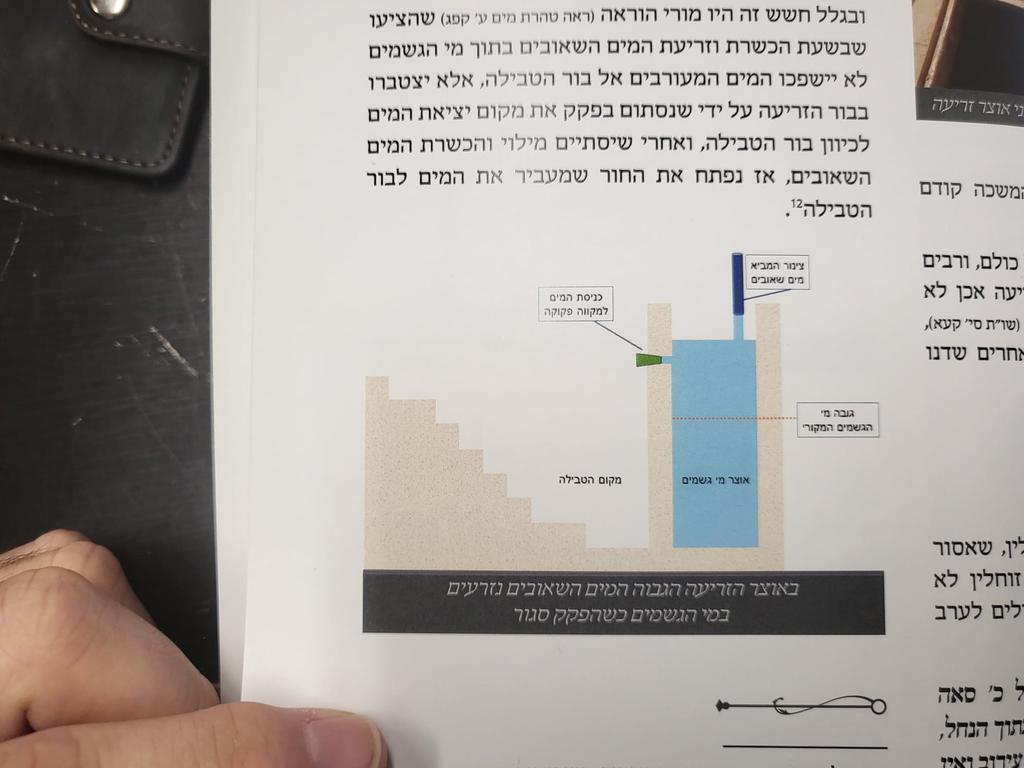
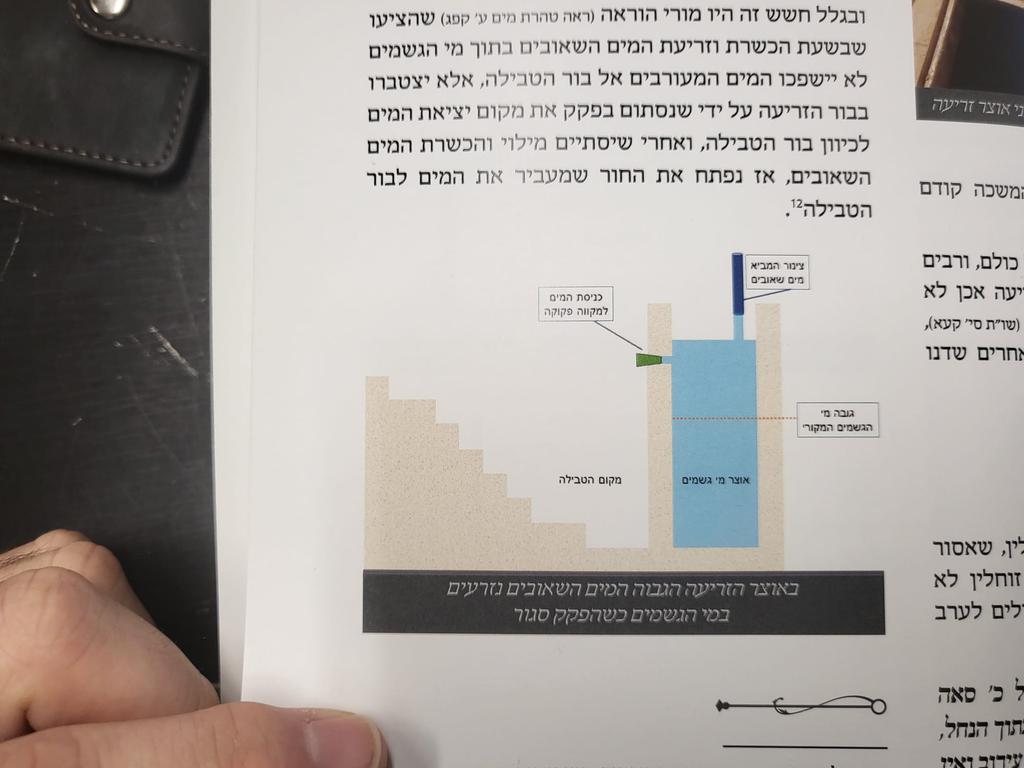
Zrieh: Sowing the city tap waters into the "otzar" of rainwater and making it kosher that way.
Challenges with Bor Zrieh method:
- Slowly losing original rainwater. Granted only a problem according to other opinions. "נתן סאה ונטל סאה". (they require 21 Seah, majority of rain water to remain)
- Pressure moves water while it is koshering the tap water, not good according to some opinions.
- If 3 Lugin (1 liter) of drawn water preceded the rainwater, it isn't kosher. Mikva attendant might forget to dry it well, (water in a pipe?). Some leave 21 seah of water in the dipping well, which means it's not cleaned as well.
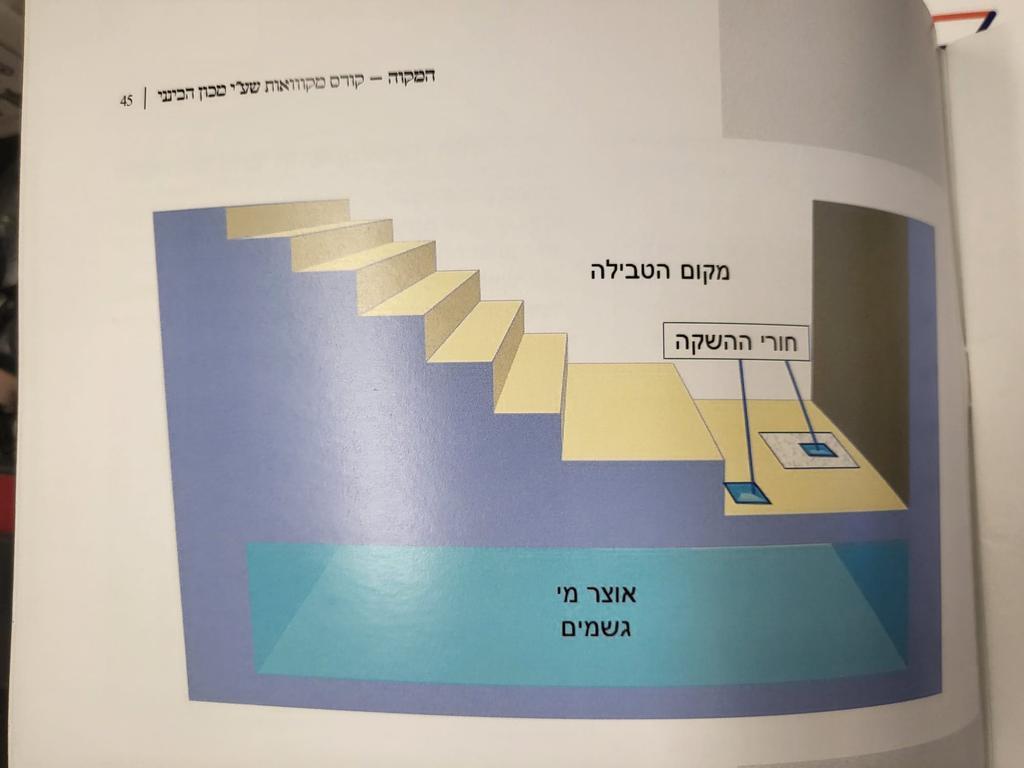
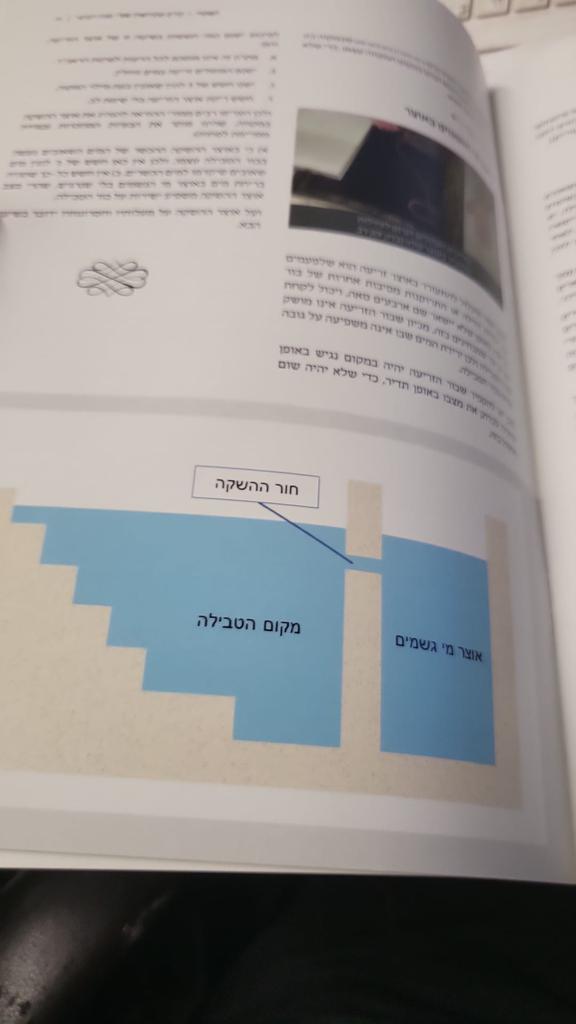
Hashaka: Kissing of the waters. The Tap water goes directly into the well where people dip, there's a small hole (shoferes hanod 5cm) that connects the two waters between the wall.
Advantages:
- Rain water is preserved for longer.
- Less movement of the waters while they kiss the mikva water. Water returns back into the Otzar, so the water isn't traveling out.
- No need to worry if the Mikva was totally dry before adding water (beacuse it becomes kosher only later when touching the water in the otzar).
Challenges with Hashaka Method:
- While dipping water goes back into Otzar and brings more water from there into dipping well. The Otzar water is not so clean.
- Sometimes the Mikva attendant closes the hole to keep the smelly water out. Some opinions say it must always be open to be Kosher. Of greater concern: what if s/he forgets to open it in the first place after filling the Mikvah? it would entirely not be kosher. This has sadly occured and only discovered a long time later.
- Same problem with losing original waters with time. A concern of the Ravaad. While open it shifts the waters back and forth.
- Entry of cold water via the hole that might deter some from toiveling.
How to tell what kind of Mikva it is:
- In Zirah Mikva the hole is above the waters.
- In Hashoko Mikva the hold is below the water level.
The invention of the Rebbe Rashab (Rabbi Sholom DovBer Schneerson, 5th Lubavitch Rebbe) to place the rainwater pit below the floor of the higher.
- Hole (actually two holes) the size of Tefach not just Shoferes Hanod.
Advantages:
- There's no movement of the rainwater out into the dipping pit while connected the waters, because it is right there below. (Care is given to keep upper waters hotter so they are less likely to mix with the lower waters). Additionally, upper waters remain clean.
- The main advantage is that because of the holes in the floor it is not considered two
boros where one water is becoming kosher by another but rather that one is dipping into the Otzar of rainwater itself. Of course in a manner where it is heated and clean.
The Rebbe Rashab gave these instructions to Rabbi Yaccov Landau OBM (later the Chief Rabbi of Bnai Brak, father of the current Chief Rabbi). He instructed him to make the hole(s) one Tefach large. (for Hashoko) usually Shfoferes Hanod is enough. Rabbi Mordechai Ashkenazi OBM, (referencing Shach YD 371:4) says this is because it nullifies the floor as a partition entirely. It is as if dipping in the lower bor of rainwater itself.
קובץ רז"ש, ע' 45:
"הנה בארץ מולדתי רוסיא היו בכל המקומות רק מקוואות של מעיינות, וכמעם שלא היה בנמצא מקוה של מי גשמים. מובן שהי' צריכים לירד להמקוה על ידי הרבה מדריגות, והי' מקומות שהי' צריכים לירד יותר מארבעים מדריגות. גם החימום של המים הי' כבד מאד, וגם עלה ביוקר. מכל מקום לא רצו רבני הדור שלפנינו לעשות של מי גשמים. והטעם כדי לצאת לדברי הש"ך בשם התשב"ץ שלכתחילה נכון לצאת דעת הראב"ד ז"ל (וגם הרמב"ם) ולמנוע החשש דנתן סאה ונטל סאה. בזמן האחרון לפני מלחמת העולמית הראשונה, ואחרי', שנראית התרשלות וחלישות בטהרת בנות ישראל, והרבה נשים נמנעו מלכת לטבול בהמקוואות העמוקות וכו', התחילו לעשות מקוואות על ידי מי גשמים, וגם התחילו להקפיד על הידור ויופי החיצוני, כדי להמשיך לבות בנות ישראל לזה".