Rosh Hashana 2013/5774
Rosh Hashana
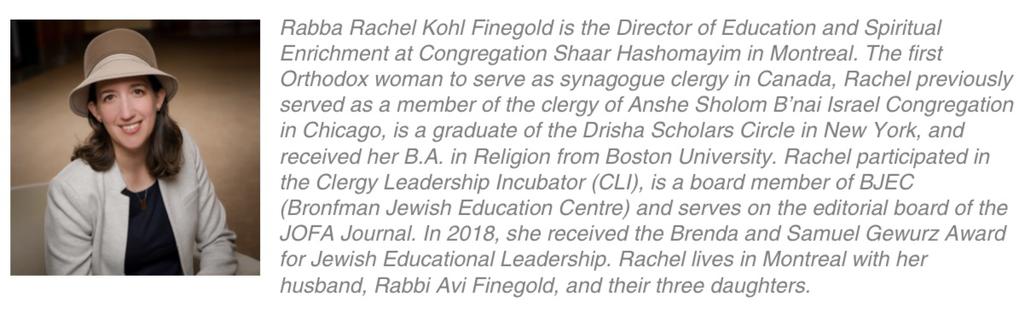
Rabba Rachel Kohl Finegold
Class of 2013
Rosh Hashana Address given to Congregation Shaar Hashomayim.
So, how many Orthodox women does it take to change a lightbulb? Ten. But they don’t make a minyan, and change takes time.
My arrival here to Congregation Shaar Hashomayim signifies an important change. Orthodox women are stepping into religious leadership in all areas of Jewish life across North America - in day schools, summer camps, hospitals, and yes, synagogues as well.
I’d like to tell you a story.
It is the story of my arrival at my previous congregation in Chicago. It was a time when only a small handful of Orthodox women were serving in clergy positions in synagogues, and even though it was only six short years ago, the conversation about women’s leadership in the Orthodox community was not what it is today. We’ve come quite a ways in six years.
I moved from NY to Chicago in August 2007, to work in a synagogue as the Education & Ritual Director. When I arrived, I immediately sensed a discomfort in the community. It was palpable. I felt people’s concern bubbling just beneath the surface of every conversation I had: Who is this woman and what is she going to do to our congregation? I knew that people were talking about me, around me, writing emails about me, but not speaking to me about it. You could imagine how frustrated I was, as people made assumptions about me, about my motivations, without having taken the time to get to know me. I felt I had to take matters into my own hands.
I was given an opportunity to speak to a packed house on Yom Kippur just before Ne’ilah, in order to introduce the new adult education programming that I was implementing. I spoke about the upcoming classes, showed the brochure, and then instead of sitting down, I continued. I looked out over the crowd of my new congregation, and I said to them, “It is Yom Kippur, a time for apologies. I’d like to apologize to anyone who I’ve unintentionally made feel uncomfortable with my presence here. I did not come here to make waves; I did not choose this line of work in order to make a statement. I do not wish that I could be called “rabbi”. I could have attended any number of fine institutions that would have called me “rabbi” - HUC, Hebrew Union College (the Reform rabbinical school), RRC (Reconstructionist Rabbinical College), JTS, and so on. But those are not who I am.” I continued, “I am just a nice Orthodox girl from Brooklyn,” and I held up the brochure, “and THIS is what I came here to do. So please forgive me if I made you feel uncomfortable. That was never my intention.”
I have to tell you, I was shaking, as I spoke in this way to my new community on the biggest day of the year. As I came down off the bimah, several people came up and hugged me, and I will never forget what one woman said to me: You should never have to apologize for who you are.
And after that, everything changed.
I tell you this story because it is about more than just women in Jewish leadership. It is about knowing who you are and what you have come to accomplish. It is about understanding one’s place, and balancing ego and humility. Let me explain.
The Chasidic master Rabbi Simcha Bunam of Peshischa said that every person should carry a note in each pocket. In one pocket, the note should read (Sanhedrin 4:5), Bishvili nivra ha’olam - The world was created for me. The second note should read (Bereishit 18:27), Anochi afar v’efer - I am dust and ashes.
When I first learned this concept as a teenager, I was taken with its message of the delicate balance between confidence and humility. In fact, I was so taken with it that when I spent a year in Israel after high school, while my friends hung photos of friends and family members on the walls of their dorm rooms, I hung these two verses. Just above my bed, to one side I taped a slip of paper that read, Bishvili nivra ha’olam (The world was created for me) and to the other side, I posted Anochi afar v’efer (I am dust and ashes). I guess it should have been obvious to me then that I was destined for a clergy career - while everyone put up photos and posters, and I was posting Torah on my wall!
During that year in Jerusalem, there was a trendy jewelry store where the girls my age would go to buy a ring that you could inscribe with any Hebrew phrase you wanted. Most girls chose the phrase Im eshkachech Yerushalayim (If I forget thee, O Jerusalem) as a memento of their time spent there. What did I choose for my ring? You guessed it - on the outside, I had them engrave Bishvili nivra ha’olam, and along the inside, Anochi afar v’efer.
So I have been mulling over this teaching for about 15 years now. And it still has not let loose its hold on me.
In many ways, it is easier to believe that we are dust and ashes, that our lives are miniscule. We look around at our world - watching the news coming out of Syria these days especially, we may feel we are tiny. We feel hopeless, powerless, we cannot make a difference, we cannot end the unspeakable suffering of innocents. We cannot even comprehend it.
Of course there are things we can do, and more than ever there are efforts in which to participate to alleviate suffering halfway across the world. But it often seems like a drop in the bucket. We feel our smallness in comparison to the work that must be done.
In many ways, the High Holiday liturgy is constantly trying to remind us of this sentiment, Anochi afar v’efer. Only a few minutes ago, in the Rosh Hashana Mussaf, we said Adam yesodo m’afar, v’sofo l’afar “Man comes from dust and ends in dust... He is like the grass that withers, the flower that fades, the shadow that passes, the cloud that vanishes, the breeze that blows...”
It is a reminder to us of how flimsy our lives are, compared to the eternal God.
During this High Holiday season, we feel quite acutely, the verse that sits in one pocket, Anochi afar v’efer.
And to be fair, today, on Yom Hadin, the day of judgment, this seems like an appropriate mood. As we appeal to God’s kindness and mercy, as we recognize that we are not the ones in charge, we feel our smallness, our powerlessness.
And yet... this feeling of powerlessness, this verse Anochi afar v’efer, is in ONE pocket. It is only half the story.
What is in our OTHER pocket? Bishvili nivra ha’olam. The world was created for me. For my sake.
After contemplating our smallness, it is hard to believe this verse. I am the reason all this exists? Tiny, little old me? How am I to believe it? How can I study the vastness of the scientific universe, and know that God has infinite power over my existence, and simultaneously feel that I actually matter that much, or even that I matter at all?
In order to take hold of these two truths simultaneously, we turn to the original context of Anochi afar v’efer. It was none other than our forefather Avraham who first uttered these words. It is absolutely critical to read this verse in its original context in order to understand how to relate to the sentiment, “I am dust and ashes.”
What is the context? Avraham is in the midst of arguing against God! After Avraham learns of God’s plans to destroy Sodom and Gemorrah, he steps up and advocates for them. How can you do this? he insists, asking God to reconsider. And although in the end Avraham essentially loses the argument, and Sodom is destroyed, his challenge to God becomes a model for us in terms of our responsibility toward justice in this world.
When Avraham says, Anochi afar v’efer, he is in fact saying: I understand that I am miniscule. I understand that I am nothing compared to you, God. But you put me here. You entrusted me with a mission, with a moral imperative.
Only a few verses prior Avraham had received that mission of tzedek u’mishpat - righteousness and justice. And so here, he is taking up that mission by asking God, Hashofet kol ha’aretz lo ya’aseh mishpat? “Could it be that the Judge of the world would not do justice?”
Avraham seems to understand: although I am dust, God expects me to do something. Bishvili nivra ha’olam - the world was created for me - does not mean the world is here for MY sake. Rather, Bishvili nivra is a statement of responsibility. The world was created for me to DO something with it. To change it for the better.
It may be hard to ignore our smallness. But instead of using Anochi afar v’efer as an excuse, as a reason to hide, Avraham uses it to embrace what’s in his other pocket.
The original context of Bishvili nivra ha’olam, the world was created for me, also helps us understand it further:
The Mishna in tractate Sanhedrin (4:5) states,
וּמֶלֶךְ מַלְכֵי הַמְּלָכִים הַקָּדוֹשׁ בָּרוּךְ הוּא טָבַע כָּל אָדָם בְּחוֹתָמוֹ שֶׁל אָדָם הָרִאשׁוֹן וְאֵין אֶחָד מֵהֶן דּוֹמֶה לַחֲבֵרוֹ. לְפִיכָךְ כָּל אֶחָד וְאֶחָד חַיָּב לוֹמַר, בִּשְׁבִילִי נִבְרָא הָעוֹלָם.
The King of Kings, God fashioned each human in the mold of Adam, and yet not one of them resembles another. Therefore, every single person is obligated to say, The world was created for my sake.
We can believe in the largeness of our lives if we remember that God put us here, each one of us individually. Essentially, if God believes in us, in our unique ability to contribute, then we can believe in ourselves.
When I stood up there on Yom Kippur in Chicago, I was responding to the tumult around me. People had made a big deal about my arrival. It almost felt too big. I experienced this even more acutely as I graduated from Yeshivat Maharat a few months ago - with the media blitz, and the blogs, it was a lot to take in. I needed to make it smaller, to say Anochi Afar v’efer, to put it in perspective, in order to be able to move forward, in order to do my job.
Anochi afar v’efer doesn’t mean I am nothing, or I am worthless. For me, it is a recognition that I am just one cog in the wheel. As I said in my Maharat graduation speech, which many of you have told me that you watched online: This moment in history was going to happen with or without me. I stand on the shoulders of the giants who came before me, and what I am doing is simply the next logical step for Orthodox women.
It is a way of reminding myself that I am not here to be the woman on the clergy staff. I am here because there is work to be done.
I would like to add one more layer, before I close. There is another way that we can experience Bishvili nivra ha’olam, that we can feel the significance of our lives.
When do I experience most acutely that my life truly matters? When I face another person. When I look someone in the eye, when I am present for that individual, it is as if no one else exists in the world for that instant. In that moment, it is as if Bishvili nivra ha’olam. It is not that this universe was created for me, or that suddenly I have become larger. It is that the world suddenly shrinks.
We might recognize this feeling when we behold a couple standing under their chuppah. For that instant, as they stand ready to begin their life together, it is as if no one else in the world exists. We can tell that for this man, she is the only woman in the world, and for her, he is the only man. In that instant, the world stands still. Their lives expand and they hold eternity inside that moment.
We may know intellectually that we are tiny. But there are moments when we feel larger than life. These are in moments when we are in relationship with another.
It happens in every kind of relationship, where two people are present to each other in an all-encompassing way.
I feel it every night, when I get up to feed our youngest daughter Hadar, who is 3 months old. It is 3:00 in the morning, the house is dark and quiet, and it is as if no one else exists but us.
The comedian Tina Fey describes this feeling. It is the experience of
(Only Tina Fey can say it quite like that.)
So it can be something mundane, like cleaning a child, where you feel that the essence of existence is right here, right now, as I am present with another person.
And these moments can even happen in an instant, and with anyone. A quick hello to someone at Kiddush, where you really stop and listen when you ask how they are doing; a sincere thank you, where you actually look the person in the eye, when a stranger holds the door for you. In the instant that two individuals connect, both of your lives truly and deeply matter to the other. For another person, we have made a difference; we have truly changed the world.
This is a central feature of the philosophy of Emmanuel Levinas. Or, in the words of Goethe:
Having someone else in one’s life, makes the world a bit smaller. This is the comfort of Bishvili nivra ha’olam. The world was created for me and for you, for us to connect to each other.
So on this very first day of the year, when our instinct is to feel our smallness, let us recognize that feeling, but let’s not allow that feeling to hold us back. Let us have the audacity to believe that our presence deeply matters. Let us do so by taking up the Godly mission of justice and goodness in the world - by not hiding but by speaking up, inspired by the ethic of Avraham.
And let us also remind ourselves that we can change the world by being present in the life of another.
Pick up that phone, and call your parent, or your child, just to see how their day was. Reach out and be a true friend, anticipating someone’s need before they’ve asked for help. or the next time you visit a shiva house, really take the time to tune in to the needs of the mourner.
These are the Bishvili nivra ha’olam moments. The moments when we make a difference in the life of another. It is true that “change takes time.” But the way to accomplish that change is in those small moments.
May we all have the courage to believe that the world was created for us. Let us recommit ourselves to being God’s agents of justice in the world, and let us also find the small moments when we can make this world a better place.