Rosh HaShanah 2013/5774
Rosh Hashana
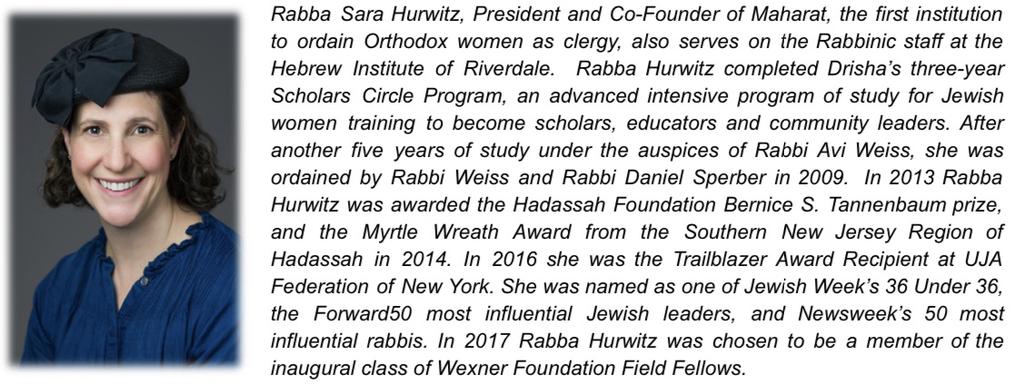
Rabba Sara Hurwitz
President and Co-Founder
When the first plane crashed into the North tower of the World Trade Center, Marissa Panigrosso was on the 98th floor of the south tower, talking to two of her co-workers. She felt the explosion, and a wave of anxiety swept through the office. Marissa didn’t pause to turn off her computer, or even pick up her purse. She walked to the nearest exit and left the building.
The two women she was talking to did not leave.
In fact, many people in Marissa Panigrosso’s office ignored the five alarm fire alarm, and even what they saw happening 131 feet away in the north tower. They did not panic or rush to leave. Some of them went into a meeting, or picked up the phone to call loved ones. A friend of Marissa’s, a woman named Tamitha Freeman, turned back after walking down several flights of stairs. Tamitha told Marissa that she had to go back for her baby pictures;... she never made it out.’ The people who stayed behind on the phone, and those who went into meetings, all lost their lives.
Psychoanalyst Dr Paul Grosz, in his book, “The Examined Life,” explains that research has shown that when a fire alarm rings, people do not act immediately. They talk to each other, stand around, and try to figure out what is going on.
We wait. And we feel stuck.
Why? For the simple reason that it is human nature to resist change. We are vehemently faithful to our own view of the world, our own story. The world that we know. We hesitate, in the face of change, because change usually means loss. If we want to truly change something about the world or about ourselves, we must be willing to make sacrifices.
Change, intertwined with willingness to give something up is a key ingredient of teshuva. In his second chapter of Hilchot Teshuva (2:4) Rambam defines authentic teshuva, by a willingness to change your name.
וּמְשַׁנֶּה שְׁמוֹ כְּלוֹמַר אֲנִי אַחֵר וְאֵינִי אוֹתוֹ הָאִישׁ שֶׁעָשָׂה אוֹתָן הַמַּעֲשִׂים.
One changes his or her name, as if to say “I am a different person and not the same one who sinned.
I don’t think Rambam actually intended for us to literally change our names—from Sara to Sarah, or Mark to Mike. Rather, Rambam teaches that teshuva, the change that we want to manifest, can only occur if we are willing to give something up. We must alter our very identity, our essence, in order to be our best selves.
And yet, most of us, even with the best intentions in mind, get stuck. It is not easy to shake a bad habit, and change. How many times have we vowed to be better people, more attentive listeners, more patient, more present. And yet, somehow, time and time again, we revert back to our old ways.
It is mayoral candidate hopeful, Anthony Weiner’s “old ways”, his inability to change that exemplifies the difficulty of cleansing oneself of the past by sacrificing. After his first public debacle, after he promised that he would change his ways, he was given a second chance, a chance of teshuva. A chance to redeem his name. And yet, he failed. Sending inappropriate text messages, once again showing that he is not willing, or perhaps unable to give up his habit, to sacrifice anything. He was stuck. Change became impossible.
Perhaps, our tendency to become stuck is why America stands by unsure what to do as unrest unfolds in the Middle East. Changing the status quo, even if we stand to benefit, is difficult.
Like Tamitha, who went back up to her office in the north tower, if you don’t accept some smaller loss, in her case, the loss of her baby photos, we stand to lose everything.
The Torah narratives that we read on Rosh Hashana, the stories of Akeidat Yitzchak and Chana, challenge us to reflect on what we are willing to give up, what we must sacrifice for the greater good, so that we can make both changes within ourselves as well as global changes, making our world a more just place.
Today/yesterday we encounter Chana, the hero of the Haftorah who models for us a complete willingness to change her destiny by giving something up, in this case, her child.
Every year, Chana and her husband Elkana come to worship in Shiloh.
The Torah highlights the monotony, the rote in which time and again, מימים ימימה, and shana b’shana, Year after year, they plod up to Shiloh. “to bow and bring offerings to God” להשתחות ולזבח לה (Shmuel 1 1:3).
The rote of time and time again, following the same course of worship is finally shattered when Chana, refusing to accept her fate, and when she couldn’t stand it any more, she rose up (vatakam chana) and took initiative. She rose above the usual routine of worshipping God, and fought for change. She turned her back on the time-honored custom of regular prayer, and created a prayer of supplication and sacrifice. She was prepared to give up her son, vowing to give him to God, to dedicate his life to Temple service as a priest. It is only after her promise to sacrifice, did her destiny change, and she was blessed with a son. It is then, that Chana can sing and celebrate with joy.
But this element of joy and celebration experienced by Chana, is completely lacking in the second story of sacrifice. Today/tomorrow, we read about Avraham’s ultimate sacrifice—his thwarted attempt to literally sacrifice, and kill his own son.
When Chana “sacrifices” her son to the Temple, it is not just a korban, a sacrifice that is merely a gift. Rather, her sacrifice, while it did entail giving, was giving for, being willing to sacrifice for a cause.
The sacrifice of Isaac, however, I would like to suggest, is sacrifice without purpose. Avraham’s willingness to sacrifice Yitzchak, went too far, and therefore, could not be a sacrifice with the intent to bring about change.
The common interpretation of the Akedat Yitzchak story is that the binding of Isaac is a test of Avraham’s complete faith in God in which the test is passed by killing his son, thereby obeying God’s command.
However, the Sefat Emet (1:67), amongst others, posits that Avraham misunderstood God’s true intention. God never wanted the sacrificial act to occur. Rather, God’s command to sacrifice was testing Avraham’s will to sacrifice his son, not actually murdering him. The Sefat Emet echoes the midrash in Bereishit Rabba that describes God’s utter shock at Avraham’s actions. The Midrash imagines God saying:
כְּשֶׁאָמַרְתִּי לְךָ קַח נָא אֶת בִּנְךָ, לֹא אָמַרְתִּי שְׁחָטֵהוּ, אֶלָּא וְהַעֲלֵהוּ, לְשֵׁם חִבָּה אָמַרְתִּי לָךְ, אֲסִקְתֵּיהּ וְקִיַּמְתָּ דְּבָרַי, וְעַתָּה אַחֲתִינֵיהּ.
When I asked you: ‘Pray take your son’ I did not tell you to slaughter him! Rather I said ‘Offer him. Take him up to the mountain (ve-ha'aleihu). You’ve taken him up. Now take him down!
Avraham, perhaps God was saying, you have proven your willingness to give something up. You are my faithful servant, and have passed all the trials I placed before you. Put the knife down. Take your son down. It is only then that the Angel of God blesses him:
וְהַרְבָּ֨ה אַרְבֶּ֤ה אֶֽת־זַרְעֲךָ֙ כְּכוֹכְבֵ֣י הַשָּׁמַ֔יִם וְכַח֕וֹל אֲשֶׁ֖ר עַל־שְׂפַ֣ת הַיָּ֑ם
And I will make your seed many like the stars of the heavens and the sand on the seashores.
The Avraham who is willing to murder, is almost unrecognizable from the Avraham we have encountered up to this point. We know Avraham as a man of holy audacity, who challenges God to not destroy the entire town of Sdom and Gomorrah. The man who God turns to as the guardian of “charity and justice,” of “zedek and mishpath?” (Bereishit 18:19). An Avraham who had an independent moral intuition, that empowered him to confront God, to try save some of the people of Sdom.
The Avraham of the Akeda, has changed so completely that he is now submissive, unconditionally surrendering to God, unaware of the moral implications of sacrificing his child. Avraham hasn’t just changed his name, as Rambam may have suggested he should do. Rather, he has become utterly unrecognizable, losing his essence, his moral intuition.
Avraham was willing to sacrifice. But he transcended the normative expectations for giving something up. He went too far.
David Hartman, alav hashalom, a central Jewish philosopher and teacher of our time whom we lost this past year, in his book Defender to Critic, embraces the ethic of change through sacrifice, in which we choose to give something up,
We must make the sacrifice of Chana, a sacrifice that resulted in the birth of another soul. Not Avraham’s that could have lead to death. We must make a sacrifice that brought us “tefilat chana” the prayer of chana whose formulation evolved into the amida, the shomenei esrai that we recite today. Not the sacrifice of Avraham that resulted in God’s silence, in a God that did not speak directly to Avraham again.
A sacrifice that is purposeful, propelling us forward to change ourselves and our world for the better.
It is the sacrifice of hours and days that citizens of New York, many of you sitting here today, gave to help restore homes and synagogues in the aftermath of Hurricane Sandy. We changed the lives of a few souls, struggling to get back on their feet. We were willing to get our hands dirty, give of our time, and money, to change the destiny of people we didn’t even know. It is the sacrifices, both big and small, that the American black community made to bring about equality. We just marked the 50th anniversary of the March on Washington, where Dr Martin Luther King, Jr. gave his famous “I have a dream” speech. MLK demanded us to change, and we must continue his work.
It is the sacrifices that many of us make on a daily basis, like working long hours in high stress environments, so that we can provide a Jewish education for our children.
It is the sacrifice of your time and resources in order to lovingly care for your ailing parents. It’ s the sacrifices we make for friends and family, for our spouses and loved ones, to change their lives for the better.
Sacrifice, a willingness to give something up, is a cornerstone of bringing about change. The change we want to see in our world, and the change that we want to see within ourselves. But through sacrificing, we must not lose our selves entirely. We cannot disregard our rational selves, our joyful spirit for the greater good.
When we hear the alarm of the shofar, in a few minutes, ask ourselves, are we really willing to Change.
Are we willing to give of ourselves to help those who are suffering from poverty? Or abuse? To help the environment? To help men and women alike have the same choices and opportunities in the world. What are we willing to sacrifice to bring about these changes?
And, as we look at our own lives, are we willing to change our very essence, “our names”, as the Rambam asks us to do in his description of teshuvah? Are we willing to lose something, sacrifice just a little bit, without losing our whole selves, in order to be better people.
If I were in that tower on September 11, 2001, and heard that fire alarm, I would like to think that I would have gotten up and walked out. That I would have been willing to accept a change, willing to lose my belongings, in order to get to safety.
I would like to think that when I hear the call of the shofar, that I am able to find it within myself to make the necessary sacrifices to bring about change. To be the parent I want to be. To be the wife I want to be. The teacher and leader that I want to be. In doing so, I must consider: what must I give up in order to change ? What will I be willing to sacrifice? And how can I do so, how can I make those sacrifices with my morality and integrity in tact?
Every few weeks, time and time again, I stand before you, and sometimes by rote, I read the tefila of refuah of healing, the prayer for Israeli solders, and for peace and tranquility around the world. And I stutter. The letters that form the words I know so well, become discombobulated, my dyslexic brain stutters. Over the years, I have compensated. I have read more Hebrew, less Hebrew, faster, and slower. I have made feeble attempts to change, to work on my flaws. But, I have become stuck. Change requires tremendous work and sacrifice. I hope, this year, the shofar will propel me to dedicate the resources and time to become unstuck. To make the sacrifice, and change.
What will you change this year? And what will you sacrifice to do it?