5774/2014
The Three Weeks
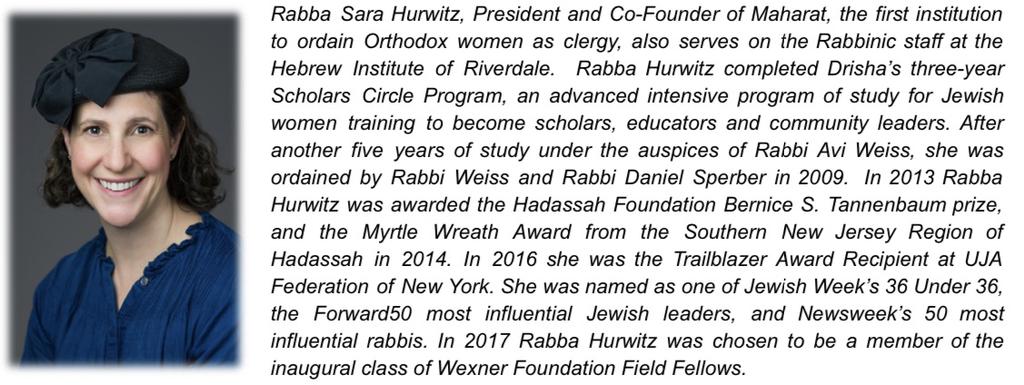
Rabba Sara Hurwitz
President and Co-Founder, Maharat
The world has gone mad. More than ever, I feel myself sinking into despair and darkness, filled with sorrow at the suffering and bloodshed that is rampant throughout the world.
In Africa: 961 people have already died from the Ebola virus. Around 1800 hundred are infected. Global health experts have declared the Ebola epidemic ravaging West Africa an international health emergency that will require a coordinated global approach. The predictions of the number casualties still to come is startling.
In Iraq: On a mountain in Sinjar, Northern Iraq thousands of people are huddled in the heat on top of a mountain. They are faced with the choice of massacre by ISIS, or starvation because of the fear of returning home. ISIS has already slaughtered thousands of Yazidis.
And, in the rest of the world, Anti-semitism is on the rise. Synagogues are being fire-bombed in France. Local British politicians speak of "Israeli-free zones." South Africa is prosecuting native Jews who serve in the Israeli army.
And, of course in Israel, we had a small reprieve, a glimmer of hope that Operation Protective Shield would be resolved. That the Gazan civilians could begin to rebuild, that our brothers, fathers, and sons, could return home. But, the war continues, and Hamas terrorists are still launching rockets at Israel.
Last week was Shabbat Nachamu, but I am having trouble feeling comforted. Tisha B’av is behind us, and yet, the words of Eicha, repeated four times, “ein menachem /there is no comfort” resonate more with me right now. How can we be comforted, knowing that 64 soldiers have already died plus several civilians, and blood continues to flow freely around the world? Where is the nechama, the comfort that Yishiyahu promises will come?
Shabbat Nachamu gets its name from the haftorah we read that begins with the words “Nachamu Nachamu” – “Take comfort, take comfort, my people.” This haftorah is the first of seven haftorot of comfort that will be read in the coming weeks. The haftorot are carefully selected from the words of the prophet Yishiyahu, but are not placed in continuous order: Last week we read from chapter 40, this week we will read chapter 51, then chapter 55, then chapter 51, back to chapter 54, then 60 and finishing with chapter 61-63. Addressing the strange order, the Tosafot in Megilah 31b notes that these haftarot of consolation are arranged in ascending order, for "it is the way of consolations to be increasingly consoling." In other words, the haftora of "Nachamu nachamu" offers the least consolation, while the haftorah of "Sos asis" read in 5 weeks from now, provides the most, thereby steadily increasing in consolation. Indeed, last week’s haftara (Yeshayahu 40:1-26) opens with an exceedingly minor consolation; it does not begin with tidings of redemption and return to Zion, but simply asserts that Israel's troubles will cease, and predicts a return to routine.
פַּנּוּ דֶּרֶךְ יקוק; יַשְּׁרוּ, בָּעֲרָבָה, מְסִלָּה, לֵאלֹהֵינוּ. וְנִגְלָה, כְּבוֹד יקוק.
“Clear a path for Hashem; make a straight road in the plain…Revealed shall the glory of God be…”
The road will be cleared, so God will eventually bring us back from exile, but we have not yet begun the journey. God’s glory will be revealed, but we do not quite feel it yet. We feel comforted, but only nominally.
The Ba'al Machzor Vitri, writing in the 12th century, notes this deliberate hierarchy in the order of the haftarot, and connects the national trajectory of mourning with the experience of individual loss. There are seven weeks of comfort, corresponding to the seven days of shiva. The haftorot, read from Tish'a B'Av until Yom Kippur, he says, "... which all speak of comfort, are the way that one comforts (a mourner) slowly by stages, for someone who offers comfort too close to the time of tragedy is like one who predicts the future: "Tomorrow you will be king," which the bereaved cannot believe... “
Tosefot and the Ba’al Machzor Vitri are picking up on an inherent human instinct to initially resist comfort. The first days of mourning are filled with raw emotion. After suffering a personal loss, we are not in the right frame of mind to accept grand gestures of consolation. Hearing platitudes like: “everything will be ok. You will get through this,” falls on deaf ears. We remain buried in our pool of misery and can only accept small doses of comfort.
And so, just like we can only offer minimal comfort to a mourner, who has just experienced a loss, we too, we must seek small doses of consolation. We must take note of small glimmers ofnechama. Small moments of light and hope that can begin to penetrate through the darkness and despair. And then, we will feel comforted.
And so, in thinking about the crisis in Israel that is still so painful, these are the glimmers, the shards of consolation that bring me comfort. I find small comfort in the gevuarh, the chachma, and theahava, strength, wisdom, and love that I have seen in Israel.
You see, in years past, I used to cringe at the “Israeliness” of Israel. The pushiness of people getting food in Machane Yehuda on erev Shabbat. The harshness of taxi drivers speeding through the narrow streets. The impatience of store owners if I lingered too long. But this summer has helped me see “Israeliness” at its best.
The chachma, the sheer Israeli brilliance of the kippat barzal, the iron dome, offers me nechama. For me personally, the iron dome boards on the miraculous. People asked me how my children fared in Israel—how did they respond to the sirens? Were they afraid? The truth is, my children never felt unsafe. It never occurred to them that they were in danger—the iron dome protected them every time a missile was directed our way. They wanted to see the “fireworks effect” of the iron dome hitting the missiles. They take for granted that rockets will not reach them. The chachma of Israelis is a small nechama.
The gevura—the strength of the IDF brings me nechama. The Israeli army, like any army, may make mistakes, and war brings tragedy. But, I tear up when I hear of the commitment and strength that the soldiers have displayed. Like Colonel Ghassan Alian, the first Golani officer from the Druze community who left his hospital bed to go back to his unit—the Golani unit who had been ripped apart in the first days of the ground invasion. “Even if I have to walk there, I will go back to Gaza,” he told reporters. And he did. The gevura of soldiers who attacked and stopped terrorists coming out of the ground in a kibbutz, before we were even aware of the tunnel system. The image of one soldier standing guard, as his battalion rests on the ground, a brief reprieve in between battles. The gevura of Israelis brings me small comfort.
And I am comforted by the ahava, the small and big acts of kindness that Israelis have shown over these few weeks. Over 50,000 Israelis attended the funerals of the three lone soldiers killed in Gaza—Sgt. Max Steinberg, 1st Sgt. Nissim Sean Carmeli and Sgt. Jordan Bensemhoun.
And I just heard that Nefesh B'Nefesh has organized a “Lone Soldiers' Flight” landing in Ben Gurion Airport next week, which will include 109 young adults age 18-23 - 55 boys and 54 girls (including our very own Pamela Kanner and Yoshi Gedasi), all who were inspired by Max, Jordan, and Nissim – who are going to enlist in the IDF. They were not alone.
And, I have seen other big and small acts of ahava- Emergency Missions of Americans have gone to visit the wounded. And while I was there, a community in Raanana delivered tons of Shabbat home cooked food to soldiers on the front. I am comforted by these acts of kindness.
The chachma, gevura, and ahava of Israelia, is “Israeliness” at its finest.
One final comfort. The statement of “nachamu nachamu ami” emphasizes the word “my”—take comfort, take comfort, MY people. Why didn’t God just say, “Take comfort,” or “Take comfort, Israel?” Why specify, “My people?” Rabbi Boruch, the grandson of the Ba’al Shem Tov suggests that “The people needed most to hear ‘My.’ They needed God’s assurance, ‘You remain My people. Even in your grief. I will not abandon you. You are not alone.’ Says God.
And so it is when we leave the house of mourning. It is hard to find the right words, and so, we offer a small sentence of consolation: “hamakom yinachaem etchem b’toch shear avlai zion v’yerushalayim - May God, makom, console you, among the mourners of zion and Jerusalem.” You are not alone. God will hold you and embrace you in your darkest hour. Others, in zion have had a similar experience. They will be at your side when you are ready.
On this Shabbat nachamu, that is so close the devastation around the world, I am not ready to hear platitudes—that “there will be peace. Everything will be ok.” But, I can take comfort in small ways. In the Israeliness of Israelis, their displays of chochma, gevura and ahavah; the feeling of God’s presence. These are my small nechamas.
I know that this is a slightly unusual message; not as uplifting as some may have expected. You see, I can’t declare that the world will be redeemed, that suffering and war, and illness will end tomorrow. But we must uncover small measures of comfort. Nachamu nachamu, take comfort take comfort. And perhaps, in 5 weeks from now, in the final reading of the Haftorot of nechama, we will stand up and rejoice in God, “sos asis b’hashem” “my soul shall exalt with my God, for God has dressed me in the raiment of salvation…with God’s compassion we will be redeemed.” שׂוֹשׂ אָשִׂישׂ בַּיקוק, תָּגֵל נַפְשִׁי בֵּאלֹקי--כִּי הִלְבִּישַׁנִי בִּגְדֵי-יֶשַׁע, בְּאַהֲבָתוֹ וּבְחֶמְלָתוֹ, הוּא גְאָלָם