26 Tishrei 5783 | October 21, 2022
Parshat Bereishit
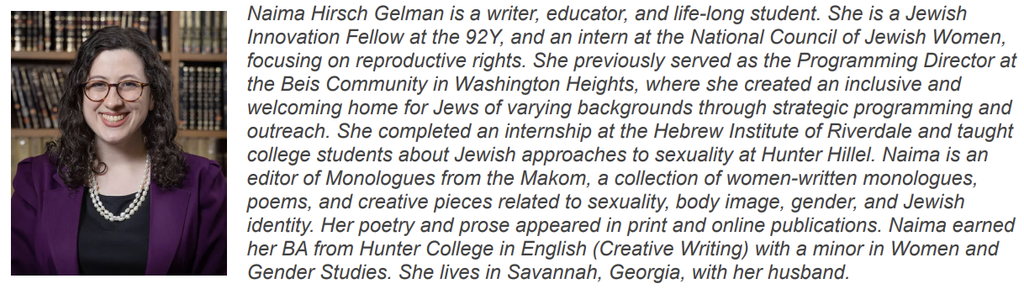
Naima Hirsch Gelman
Class of 2024
As many women can attest, being a woman entails pain. Period cramps, bloating, muscle aches and soreness, gynecological exams, mammograms, morning sickness, contractions, labor, c-sections, episiotomies, pain associated with menopause, side effects from contraceptives. Even the pain we inflict upon ourselves - waxing, shaving, high heels - to fulfill our own expectations of what a woman should look like contributes to our sense of shame and inadequacy.
This identification of womanhood with pain goes back to the paradigmatic woman, Chava. Even outside of Jewish text and tradition, “Eve’s curse” has been used by scholars and physicians alike to justify the pain women experience throughout their lives. In Bereshit 3:16, God issues Chava’s punishment for eating from the Tree of Knowledge and sentences her to a life imbued with physical and emotional pain:
To the woman [God] said, "I will greatly multiply your labor pangs; with pain will you bear children. Yet your desire will be for your husband and he will rule over you."
Many traditional commentaries and midrashim understand the double language of הרבה ארבה את עצבונך and the repetition of the root עצב to mean that not only will childbirth be painful, but child rearing as well. The Gemara in Masechet Eruvin further analyzes that menstruation and virginity play a role in Chava’s punishment, as we see on page 100b:
וְהָאָמַר רַב יִצְחָק בַּר אַבְדִּימִי: עֶשֶׂר קְלָלוֹת נִתְקַלְּלָה חַוָּה, דִּכְתִיב: ״אֶל הָאִשָּׁה אָמַר הַרְבָּה אַרְבֶּה״, אֵלּוּ שְׁנֵי טִפֵּי דָמִים — אַחַת דַּם נִדָּה, וְאַחַת דַּם בְּתוּלִים. ״עִצְּבוֹנֵךְ״, זֶה צַעַר גִּידּוּל בָּנִים. ״וְהֵרוֹנֵךְ״, זֶה צַעַר הָעִיבּוּר. ״בְּעֶצֶב תֵּלְדִי בָּנִים״, כְּמַשְׁמָעוֹ.
Rav Yitzḥak bar Avdimi proceeds to explain this verse. “To the woman He said: I will greatly multiply [harba arbe]”; these are the two drops of blood unique to a woman, which cause her suffering, one the blood of menstruation and the other one the blood of virginity. “Your pain”; this is the pain of raising children. “And your travail”; this is the pain of pregnancy. “In sorrow you shall bring forth children”; in accordance with its plain meaning, i.e., the pain of childbirth.
This interpretation rings true in its description of events in a woman’s life. Yes, raising children can be difficult and sorrowful. Yes, childbirth is incredibly painful and dangerous for mothers and children alike. Yes, I still have not become accustomed to period cramps. Yes, many women experience pain after they first have penetrative sex. But while modern medical innovations have mitigated much of the damaging effects of Chava’s punishment, we still have an unspoken understanding that womanhood and motherhood means pain as well as an unspoken agreement not to talk about it. Even as the shadow of Chava’s pain grows lighter, the shame surrounding it stays strong.
My middle school friends swapped tips for hiding tampons when ducking out of class; some girls put them in their Ugg boots, and others slipped them up their sleeves or palmed them against their skirts as they walked. And in my all-girls high school, we might have been more open in talking about periods, but talking about sex in any real terms - even among friends - was embarrassing despite our shared inexperience. I cannot help but feel sad for my teenage self and her friends for hiding what made them women. All we knew was this shame that taught us to make our womanhood a secret. What would our adolescence have been like if we hadn’t learned to feel embarrassed about our bodies and how we experience them?
After Adam and Chava ate from the tree, they not only set into motion the punishments that would define their descencent’s experiences, but they introduced shame into the world. The act of making fig-leaf clothing in Bereishit 3:7 after perceiving their own nakedness is not inherently one of shame; we can even appreciate their sense of modesty. But the following verses tell us something different. When God seeks Adam and Chava out, they hide. Verses 10 and 11 offer us an insight into why:
[Adam] replied, “I heard the sound of You in the garden, and I was afraid because I was naked, so I hid.” [God said] “Who told you that you were naked? Did you eat of the tree from which I had forbidden you to eat?”
The act of hiding lest they be seen to be naked implies that Adam and Chava felt that their bodies were no longer something natural, but something shameful that should be hidden. They could not bear to exist in the paradisiac world of Eden without hiding a crucial part of themselves, and in the process of doing so, they angered and disappointed the God who created them. Shame and pain had not existed before Adam and Chava ate from the tree, but Chava’s mistake cost her - and us - the Edenic state of self-love and bodily comfort.
Just as being naked caused Adam and Eve to hide from God, the pain we experience from being a woman might cause us to hide parts of ourselves. Perhaps we can atone for Chava’s sin not by shouldering the pain of childbirth, but by acknowledging and finding the power in what makes us human. Being a woman means pain, yes, but that does not mean we should suffer alone. Let our relationships with each other and with God be rooted in honest expression of our humanity. Let us speak freely of our bodies without shame. And as we conclude the season of teshuvah, of return, let us all work to unlearn shame and practice vulnerability so that we can one day reach Eden.
This essay is written from my perspective as a cisgender woman. When I refer to womanhood here, I am referring to the embodied experiences of cisgendered women. For more writing on trans womanhood in Jewish texts, I recommend the work of Dr. Joy Ladin and Abby Stein.