


By human [hands] shall that one’s blood be shed;
For in the image of God
Was humankind made.
אשכח ר' יעקב בר אחא דהוה כתיב בספר אגדתא דבי רב בן נח נהרג...
משום רבי ישמעאל אמרו אף על העוברין...
משום רבי ישמעאל אמרו אף על העוברין מאי טעמיה דרבי ישמעאל דכתיב (בראשית ט, ו) שופך דם האדם באדם דמו ישפך איזהו אדם שהוא באדם הוי אומר זה עובר שבמעי אמו.
ותנא קמא תנא דבי מנשה הוא דאמר כל מיתה האמורה לבני נח אינו אלא חנק ושדי ליה האי באדם אסיפיה דקרא ודרוש ביה הכי באדם דמו ישפך איזהו שפיכות דמים של אדם שהוא בגופו של אדם הוי אומר זה חנק
§ Rabbi Ya’akov bar Aḥa found that it was written in a book of Aggadot in the study hall of Rav: Contrary to the halakha with regard to a Jew, a descendant of Noah is executed...
The Sages said in the name of Rabbi Yishmael that a descendant of Noah is executed even for killing fetuses...
It is stated in that book of Aggadot that the Sages said in the name of Rabbi Yishmael: A descendant of Noah is executed even for killing fetuses. The Gemara asks: What is the reason for the opinion of Rabbi Yishmael? The Gemara answers: It is derived from that which is written: “One who sheds the blood of a person, by a person [ba’adam] his blood shall be shed” (Genesis 9:6). The word ba’adam literally means: In a person, and is interpreted homiletically: What is a person that is in a person? You must say: This is a fetus that is in its mother’s womb. Accordingly, a descendant of Noah is liable for killing a fetus.
The Gemara comments: And the first tanna, who does not derive the halakha concerning fetuses, is the tanna of the school of Menashe, who says that all death penalties stated with regard to the descendants of Noah are referring to nothing other than strangulation. And he interprets this verse as follows: Cast, i.e., redirect, this term: “In a person,” and explain it with regard to the latter part of the verse, and interpret it homiletically like this: “In a person, his blood shall be shed.” In what manner is a person’s blood shed while it is in the person’s body, without external bleeding? You must say that this is strangulation. It is therefore derived that the execution of a descendant of Noah is by strangulation.
בֶּן נֹחַ שֶׁהָרַג נֶפֶשׁ אֲפִלּוּ עֵבָּר בִּמְעֵי אִמּוֹ נֶהֱרָג עָלָיו.
A Noachide who slays any soul, even a fetus in its mother's womb, should be executed in retribution for its death.
יצא ראשו - באשה המקשה לילד ומסוכנת וקתני רישא החיה פושטת ידה וחותכתו ומוציאתו לאברים דכל זמן שלא יצא לאויר העולם לאו נפש הוא וניתן להורגו ולהציל את אמו
its head came out: With a women that is experiencing difficulty giving birth and is in [mortal] danger. And it is taught in the first section [of this teaching], "the midwife extends her hand and cuts it up and extracts [the pieces];" as the entire time that that it has not gone out into the air of the world, it is not [considered] a soul, and [so] it is possible to kill it and to save its mother.
On this basis, our Sages ruled that when complications arise and a pregnant woman cannot give birth, it is permitted to abort the fetus in her womb, whether with a knife or with drugs. For the fetus is considered a rodef of its mother.
If the head of the fetus emerges, it should not be touched, because one life should not be sacrificed for another. Although the mother may die, this is the nature of the world.
ליכא מידעם דלישראל שרי ולעובד כוכבים אסור
The Gemara answers: There is nothing that is permitted to a Jew and forbidden to a gentile.
ליכא מידעם דלישראל שרי בדבר -...מיהו קשה דאמרינן בפרק בן סורר ומורה (לקמן סנהדרין דף עב:) יצא ראשו אין נוגעין בו דאין דוחין נפש מפני נפש אבל קודם שיצא ראשו החי' פושטת ידה וחתכתו לאברים ומוציאה כדי להציל את אמו וכה"ג בעובד כוכבים אסור כיון שהוזהרו על העוברים וי"ל דהא נמי בישראל מצוה כדי להציל ואפשר דאפילו בעובד כוכבים שרי:
Tosafot HaRosh on Sanhedrin 59a

Translation:
It is also possible that it is even permissible for a gentile [to abort a fetus] in order to save, since it is not considered a life, even though the Torah decreed that [gentiles] should be liable [to capital punishment] because of it.
והנה בב"נ קי"ל דנהרג על העוברין אם כן אני מסופק בב"נ המקשה לילד אף דלא יצא ראשו אפשר דאסור לחתוך העובר כי הוי נפש ואין דוחין נפש מפני נפש ורודף לא הוי. א"ד דבאמת כיון דחזינן גבי ישראל דלא איקרי נפש רק דגזרה התורה שופך כו' באדם אבל נפש לא מיקרי שרי להציל עצמו כמו שאר עבירות ול"ש מאי חזית דדמא כו' דלא אקרי נפש...
ואם רודף אחר עובר להרגו דהיינו דרודף אחר האם ורוצה להרוג העובר תליא במ"ש לעיל אם נקרא נפש כי ב"נ נהרג על העוברין רשאי חבירו להרוג אותו אבל כבר כ' שנ"ל דגם אצל ב"נ לא נקרא ש"ד אלא הוי כמו שאר עבירות אם כן אסור לחבירו להרגו כי לא מקרי רודף...
שוב מצאתי בתוס' סנהדרין נ"ט ע"א ד"ה ליכא מידעם שכתבו שם מתחלה...
נראה מדבריהם דספוקי מספקא להו דין הנ"ל וגם כתבו סתם דחיה יכולה לחתוך נראה דאף משום הצלת אחר מותר הב"נ ומכל מקום צ"ע בדינים אלו.
Regarding a Noahide we hold that they are put do death for [aborting] fetuses. If so, I am in doubt regarding a Noahide who is having difficulty giving birth, even if the head has not emerged.It is possible that it is forbidden to cut up the fetus because it is considered human life, and we do not push aside one human life for another, and it thus cannot be considered a pursuer. or, perhaps, really, since we see that, regarding a Jew it is not considered human life, just that the Torah decreed that "someone who spills blood in a person," but that it is not considered human life. It would thus be permitted to save oneself [through an abortion] just like other prohibitions, and we do not apply the principle of "why do you think that the other person's blood is redder" since it is not considered human life...
If someone was chasing after a fetus to kill it, i.e., that the pursuer was chasing after the mother seeking to kill the fetus--this would be dependent on our earlier discussion as to whether a fetus is considered human life because Noahides are given the death penalty for fetuses. If that were the case, it would thus be permitted that another person would be permitted to kill the pursuer. However, we have already wrote that it is not considered murder for Noahides, and is thus considered to be like other sins. If that is correct, it would be forbidden for another to kill the pursuer, because they would be considered a pursuer...
Later, I found Tosafot Sanhedrin 59a...it seems from their words that they are in doubt regarding the issue we have discussed. They further write that a nurse is allowed to cut the fetus. Thus, it is permitted to kill a fetus even to save someone else., though it nonetheless requires further investigation regarding these laws.
Igrot Moshe Chosen Mishpat 2:69
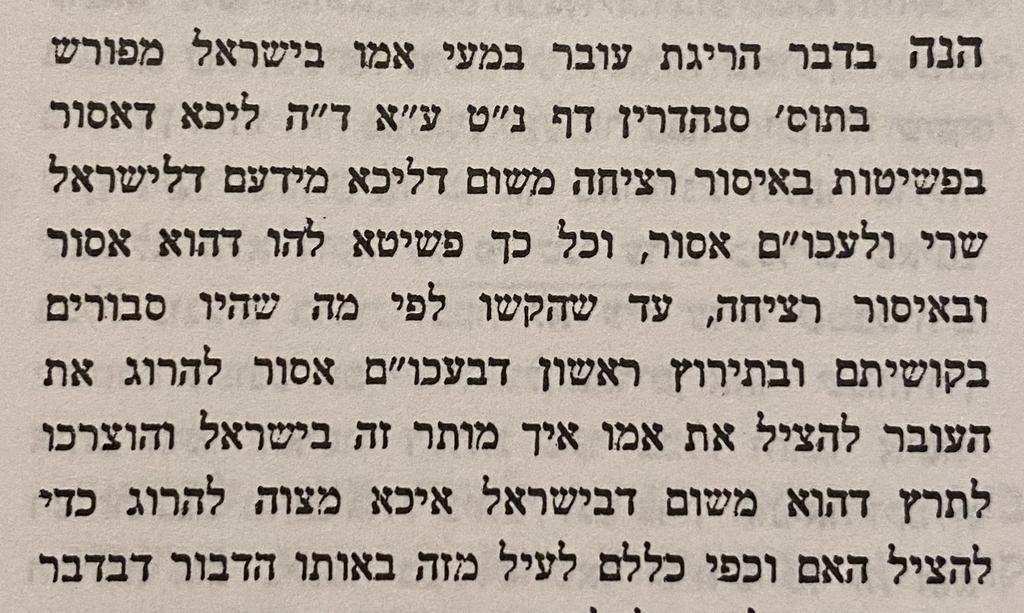
Translation:
With regard to filing a Jewish fetus in its mother's womb--It is explicit in Tosafot Sanhedrin 59a s.v. "Leika" that it is simply forbidden due to the prohibition of murder, because "there is nothing that is permitted to a Jew but forbidden to a gentile. It is all simple to [Tosafot] that it is forbidden because of the prohibition of murder. Such is the case since their question and first answer assume that a gentile is forbidden to kill a fetus even to save its mother, asking how doing so could be permissible for a Jew. They are thus forced to answer that the Jew has a special Mitzah to kill in order to save the mother as we established earlier...
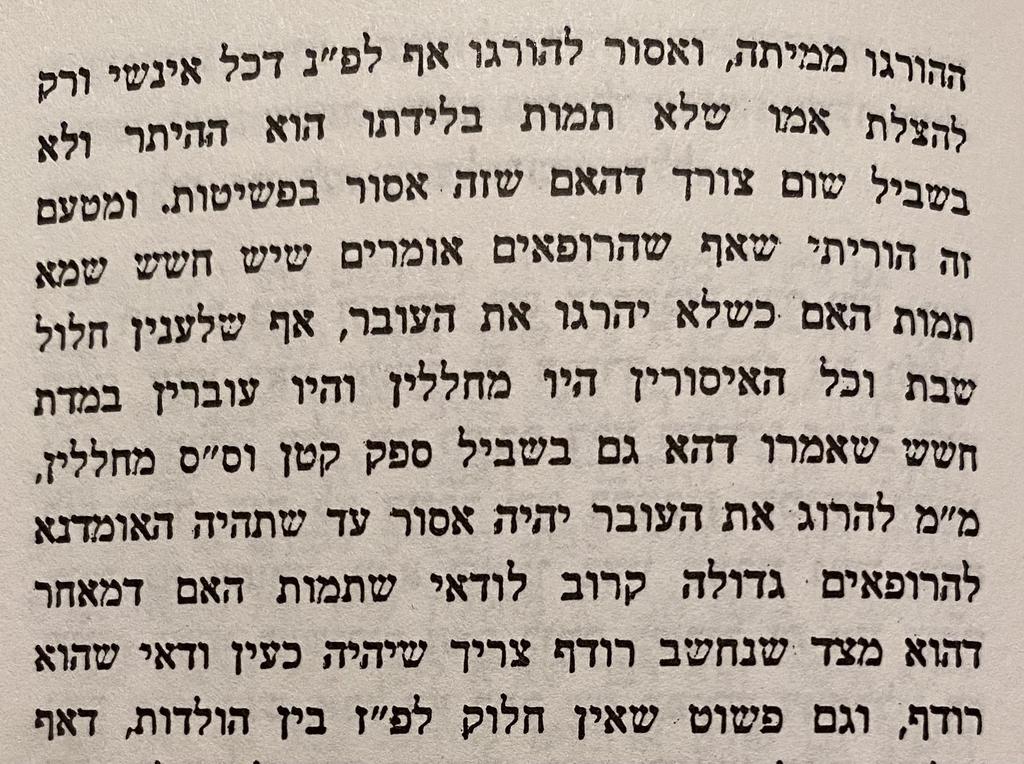
It is forbidden to kill [the fetus] even if there is a threat to the life of other people. The permission is only if it is necessary to the save the life of the mother so that she doesn't die during its birth, and not for any other need for the mother, as it would be simply forbidden. For this reason I have advised that even if the doctors say that there is a possibility that the mother will die if the fetus is not aborted--even though regarding the desecration of the Sabbath and other prohibitions we desecrate and violate the prohibitions even if there is only a concern, as they said that we even desecrate [the Sabbath] due to a small doubt or a doubt of a doubt. Nonetheless, to kill a fetus is forbidden unless and until there is an estimation by the doctors that there is close to certainty that the mother would die [otherwise]. This is because [the permission to abort a fetus] would be because it would be considered to be a pursuer, therefore there must be something like certainty that [the fetus] is a pursuer. It is thus also clear that there is no differentiation between types of fetuses.
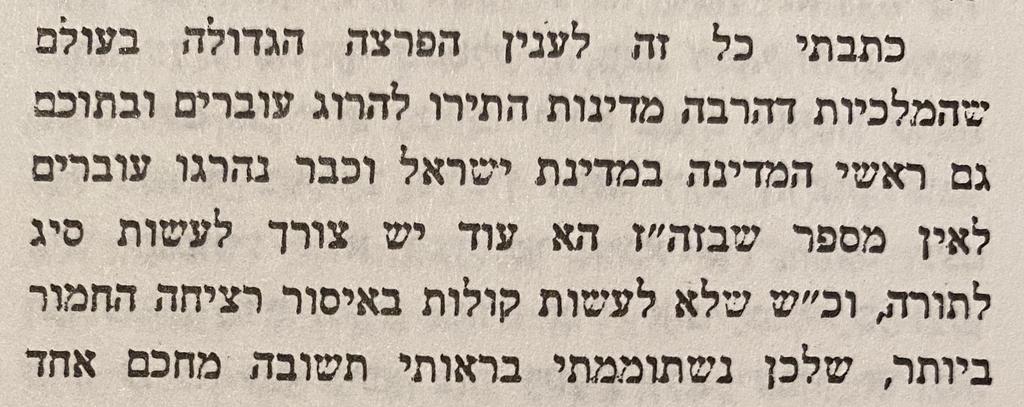
I write all this in response to the great breach in many countries all over the world, as many states permit killing fetuses, and amongst them even the heads of the state of Israel. Many fetuses have been killed beyond the ability to count. Nowadays, there is a further need to make a boundary for the Torah. Certainly to not create leniencies for the very severe prohibition of murder. Thus, I was dumbfounded when I saw the response of one sage...
עַד אַרְבָּעִים מַיָּא בְּעָלְמָא הִיא.
...until forty days from conception the fetus is merely water. It is not yet considered a living being...
Achiezer 3:65:14

Translation:
It is possible that this is only according to Rabbi Ishmael, who holds that Noahides are put to death for killing fetuses that it would thus be clear that there would be a biblical prohibition for Jews as well. However, it is possible to say that the first Tanna argues [with Rabbi Ishmael] and it is possible that, according to [the first Tanna], there is no such biblical prohibition, though it requires further study...
It seems that a Noahide would not be put to death over [aborting a fetus less than forty days from conception], and it is thus possible that there would neither be a biblical prohibition for a Jew.
Yabia Omer Even Ha-Ezer 4:1

Translation:
Furthermore, in our case, the fetus is not yet three months old. it thus seems that in a case like this, a Noahide would not be put to death over [killing it]. Further, there would not be a biblical prohibition for a Jew for doing such, since one cannot recognize a that a person is pregnant until three months have passed.
Tzitz Eliezer 9:51:3
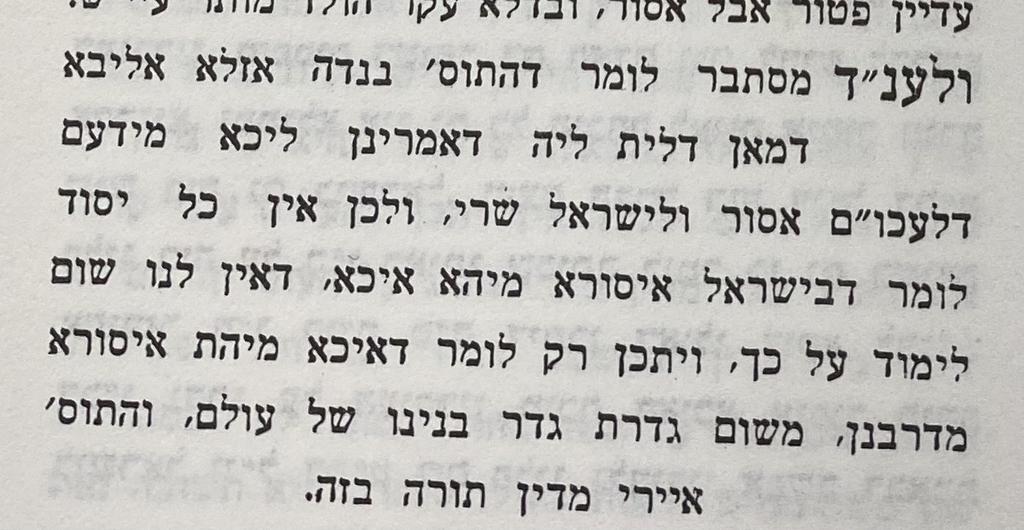
Translation
In my humble opinion, it makes sense to say that Tosafot in Niddah [where they seem to permit abortion] goes according to the opinion that we do NOT say that "there is nothing prohibited to a gentile and permitted to a Jew." Thus, there is no basis to say that there must be some prohibition [of abortion] for a Jew, as there is no such derivation. it is possible to say that there is only a rabbinic prohibition to create boundaries for building the world, while Tosafot [who use the language of "permitted"] were speaking with respect to the Torah.
To return for the moment to the violation of homicide and the proof from Noahide law, it seems to me that the Noahide is only liable in those instances where the fetus had developed to the point of independent viability (outside the uterus) at that time. In such circumstances, a Jew committing an abortion is exempt from capital punishment only because of the child's status as a fetus, i.e., not having left the womb and entered the world; this exemption is not granted to the Noahide. Hence the Jew would violate the prohibition of homicide and would be subject to divine punishment. In the early stages of pregnancy, however, the missing element of full human life is not merely that birth has yet to occur, but rather the absence of full development and the fact that in its current state it is not viable outside the womb. It would thus be logical to assume that such an abortion would not be classified as an act of murder. Murder, it would appear, is defined as the termination of currently existing life, and not the curtailment of potential life. Therefore, it would seem that the prohibition of murder proper should be limited to the latter part of pregnancy-practically speaking, more or less the last trimester.
לפעד"נ דלא פליגי דכ"ע מודים להמרדכי ותוס' בפ"ק דעבודת כוכבי' דבעובד כוכבי' ...שרי והגמ"ר ותוס' והרא"ש בפ"ק דשבת והר"ן פ"ק דעבודת כוכבים מיירי בישראל שהוא חייב להפרישו מאיסור... משא"כ בעובד כוכבי' וישראל מומר שאינו חייב להפרישו
(Translation by Rabbi Dr. Michael Broyde)
In my humble opinion, all authorities agree with the opinion of Tosafot and Mordechai that it is permissible to aid a Noachide ... [All those] who argue are discussing the case of a Jew whom one is obligated to separate from sin . . Such is not the case for a Noachide ...whom we are not obligated to separate from sin.
ונ"ל דלעכו"ם ליכא אסור לסייע במידי דאסור לו כמו אבר מן החי אם לא דקאי בענין שאינו יכול ליטלו
It seems to me that, regarding a non-Jew, there is no prohibition on helping them with something forbidden to them--like a limb from a living animal--unless it is a situation in which they would not be able to get it [without the Jew's help].
וגם נ"ל פשוט דהא דאם מושיט אבר מן החי לב"נ וכן שאר דבר האסור לנכרי... היינו דוקא דאם הנכרי יודע שהוא אמ"ה אי שאר איסור דעושה הנכרי איסור... אבל אם הנכרי אינו יודע כלל אם הוא אבמ"ה דאין הנכרי עושה איסור כלל דהא הוא שוגג גמור ואינו מכשילו כלל.. אבל לנכרי שהוא שוגג גמור מותר ליתן...
(Translation Rabbi Dr. Michael Broyde)
When is it prohibited to hand a Noachide something forbidden to him? This is only when he knows that it is prohibited; but when he does not know that it is prohibited, there is no prohibition, since in this case there is complete un-intentionality (lit: shegaga gemorah) and a Noachide violates no rule when his violation is completely unintentional.
https://thelehrhaus.com/timely-thoughts/what-does-jewish-law-think-american-abortion-law-ought-to-be/#_ftnref17
-
First, Jews have no halakhic obligation to encourage non-Jews to observe Noahide law... Finally, since abortion is prohibited for Gentiles under Noahide Law more strictly than for Jews under Jewish Law—a rare case where Jewish Law is more permissive than Noahide Law—it is almost impossible to fashion a secular law regulating abortion which is consistent with both Jewish Law and Noahide law.
Is there, then, a halakhic obligation for Jews to urge non-Jews to follow Noahide Law? Rambam (Hilkhot Malakhim 8:10) seems to indicate that Jews share an obligation to participate in and enforce Noahide Law, but nearly all other rishonim disagree... Indeed, most poskim of the last 500 years permit a Jew, for his or her economic benefit, to participate in a transaction even if a Gentile in the transaction thereby violates Noahide Law. This speaks volumes about practical Jewish Law on this subject.
Of course, there have always been dissenters. In the last century, the great dissenter was the late Lubavitcher Rebbe, Rabbi Menachem Schneerson...But this is clearly a minority opinion. The majority of halakhic authorities have never understood Jewish Law as requiring a Jew to stop a Gentile from sinning when the Gentile does not need the Jew’s assistance. If the Gentile will sin anyway, many even allow a Jew to assist the Gentile in such a violation—the exact opposite of what Rabbi Schneerson suggests. As Shakh simply avers, there is just no obligation to separate a non-Jew from sin in cases in which the non-Jew does not need this particular Jew’s assistance. If a Jew is permitted to aid a Noahide when he sins, it is not a violation of Jewish Law, or even odious (in my view), to do so.