


Meditation Before Yom Kippur for One who Cannot FastBy Rabbi Simkha Y. Weintraub, LCSW From Ritualwell, https://ritualwell.org/
Ribbono shel Olam/Master of the Universe;
Creator of All, Source of All Life,
Who Knows What is Deep in Human Hearts,
Who Nurtures Every Living Being:
As You know, dear God,
Yom Kippur is fast approaching, and because of my condition,
I am not able to keep the traditional fast
I cannot abstain totally from eating.
On this Day of Atonement, this Sabbath of Sabbaths,
this year and every year,
it is so central to join the people of Israel
in denying ourselves food and drink for one day
so that we focus on correcting our misdeeds,
on knowing our mortality;
on reaching for a life of Torah, mitzvot, and lovingkindness;
on You.
You know, dear God, that it is not my intent
to be apart from our people and our tradition.
My current state of health makes it unsuitable for me to fast
So, dear God, I turn to You now in sincerity and openness:
Creator of All, Source of All Life,
Who Knows What is Deep in Human Hearts,
Who Nurtures Every Living Being:
As You know, dear God,
Yom Kippur is fast approaching, and because of my condition,
I am not able to keep the traditional fast
I cannot abstain totally from eating.
On this Day of Atonement, this Sabbath of Sabbaths,
this year and every year,
it is so central to join the people of Israel
in denying ourselves food and drink for one day
so that we focus on correcting our misdeeds,
on knowing our mortality;
on reaching for a life of Torah, mitzvot, and lovingkindness;
on You.
You know, dear God, that it is not my intent
to be apart from our people and our tradition.
My current state of health makes it unsuitable for me to fast
So, dear God, I turn to You now in sincerity and openness:
Help me in the coming year to do my best in guarding my health.
Help us, Your children, learn how to protect our bodies from harm.
Help us support others in caring for their tzelem Elokim, their Image of God.
Teach us to help one another grow and thrive in Body, Mind, and Spirit.
Guide caring family and health care professionals in their partnering with you
to bring healing if not cure, support and strength if not an end to symptoms.
And if there is an opportunity for me to help others who suffer
by doing something they need or by being attentive company
Grant me the ability to do this mitzvah with love and devotion.
Rofeh khol basar/Healer of all living creatures:
I thank You for the breath that is in me
for the community of Israel that lives
for the possibilities of today and tomorrow.
May my eating be as a fast;
May it be dedicated to You, to T’shuvah
to the Renewal and Restoration of my Relationship
to You, to Others, and to Myself.
Help us, Your children, learn how to protect our bodies from harm.
Help us support others in caring for their tzelem Elokim, their Image of God.
Teach us to help one another grow and thrive in Body, Mind, and Spirit.
Guide caring family and health care professionals in their partnering with you
to bring healing if not cure, support and strength if not an end to symptoms.
And if there is an opportunity for me to help others who suffer
by doing something they need or by being attentive company
Grant me the ability to do this mitzvah with love and devotion.
Rofeh khol basar/Healer of all living creatures:
I thank You for the breath that is in me
for the community of Israel that lives
for the possibilities of today and tomorrow.
May my eating be as a fast;
May it be dedicated to You, to T’shuvah
to the Renewal and Restoration of my Relationship
to You, to Others, and to Myself.
(כט) וְהָיְתָ֥ה לָכֶ֖ם לְחֻקַּ֣ת עוֹלָ֑ם בַּחֹ֣דֶשׁ הַ֠שְּׁבִיעִ֠י בֶּֽעָשׂ֨וֹר לַחֹ֜דֶשׁ תְּעַנּ֣וּ אֶת־נַפְשֹֽׁתֵיכֶ֗ם וְכׇל־מְלָאכָה֙ לֹ֣א תַעֲשׂ֔וּ הָֽאֶזְרָ֔ח וְהַגֵּ֖ר הַגָּ֥ר בְּתוֹכְכֶֽם׃(ל) כִּֽי־בַיּ֥וֹם הַזֶּ֛ה יְכַפֵּ֥ר עֲלֵיכֶ֖ם לְטַהֵ֣ר אֶתְכֶ֑ם מִכֹּל֙ חַטֹּ֣אתֵיכֶ֔ם לִפְנֵ֥י ה׳ תִּטְהָֽרוּ׃(לא) שַׁבַּ֨ת שַׁבָּת֥וֹן הִיא֙ לָכֶ֔ם וְעִנִּיתֶ֖ם אֶת־נַפְשֹׁתֵיכֶ֑ם חֻקַּ֖ת עוֹלָֽם׃
(29) And this shall be to you a law for all time: In the seventh month, on the tenth day of the month, you shall practice self-denial; and you shall do no manner of work, neither the citizen nor the alien who resides among you.(30) For on this day atonement shall be made for you to purify you of all your sins; you shall be pure before ה׳.(31) It shall be a sabbath of complete rest for you, and you shall practice self-denial; it is a law for all time.
(יג) א"ר יוסי מנין לפקוח נפש שדוחה [את השבת] שנא' (שמות לא) את שבתותי תשמרו יכול במילה ועבודה ופיקוח נפש ת"ל אך חלק פעמים שאתה שובת פעמים שאי אתה שובת ר"א אומר מילה דוחין עליה השבת מפני מה מפני שחייבין עליה כרת לאחר זמן והרי דברים ק"ו ומה אם על אבר אחד ממנו דוחה את השבת דין הוא שידחה השבת על כולו אמרו לו ממקום שבאת מה להלן ודאי ולא ספק אף כאן ודאי ולא ספק א"ר עקיבה וכי במה החמירה תורה בעבודה או בשבת החמירה בעבודה יתר משבת שהעבודה דוחה את השבת ואין שבת דוחה אותה והרי דברים ק"ו ומה עבודה שדוחה את השבת ספק נפשות דוחה אותה שבת שעבודה דוחה אותה אינו דין שספק נפשות דוחה אותה הא למדת שספק נפשות דוחה את השבת.
(13) R. Yose said: Whence do we know that saving a life takes precedence over the Sabbath? As it is written.
R. Akiva said: And with respect to which was the Torah more stringent? With the temple service or with the Sabbath? [The Torah was more stringent] with the temple service than with the Sabbath, for the temple service takes precedence over the Sabbath and the Sabbath does not take precedence over the temple service. And the matter is a kal va’homer - if the temple service takes precedence over the Sabbath and a risk to life takes precedence over it, with regard to the Sabbath, which the temple takes precedence over - is it not logical that a risk to human life should supersede it? Behold, you have learned that a risk to life takes precedence over the Sabbath.
*Hebrew side includes the full text
R. Akiva said: And with respect to which was the Torah more stringent? With the temple service or with the Sabbath? [The Torah was more stringent] with the temple service than with the Sabbath, for the temple service takes precedence over the Sabbath and the Sabbath does not take precedence over the temple service. And the matter is a kal va’homer - if the temple service takes precedence over the Sabbath and a risk to life takes precedence over it, with regard to the Sabbath, which the temple takes precedence over - is it not logical that a risk to human life should supersede it? Behold, you have learned that a risk to life takes precedence over the Sabbath.
*Hebrew side includes the full text
מַתְנִי׳ עוּבָּרָה שֶׁהֵרִיחָה — מַאֲכִילִין אוֹתָהּ עַד שֶׁתָּשִׁיב נַפְשָׁהּ. חוֹלֶה — מַאֲכִילִין אוֹתוֹ עַל פִּי בְּקִיאִין, וְאִם אֵין שָׁם בְּקִיאִין — מַאֲכִילִין אוֹתוֹ עַל פִּי עַצְמוֹ עַד שֶׁיֹּאמַר דַּי.
MISHNA: With regard to a pregnant woman who smelled food and was overcome by a craving to eat it, one feeds her until she recovers, as failure to do so could lead to a life-threatening situation. If a person is ill and requires food due to potential danger, one feeds him according to the advice of medical experts who determine that he indeed requires food. And if there are no experts there, one feeds him according to his own instructions, until he says that he has eaten enough and needs no more.
Fasting for People Who Are Pregnant or Lactatingby Rabbanit Leah Sarna

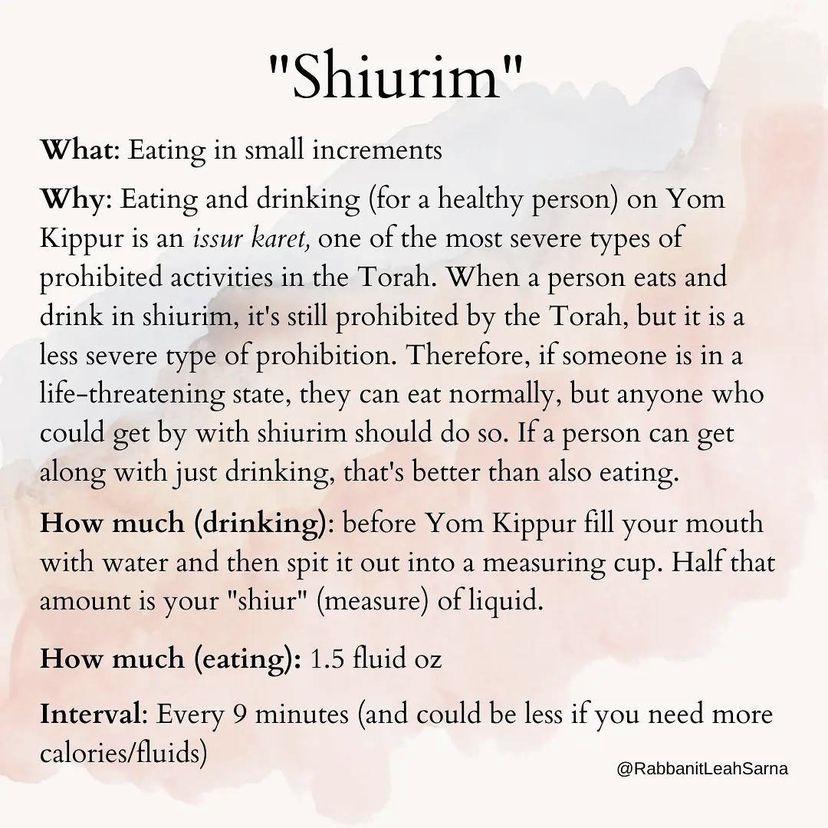
It is important to note here that eating in such "shiurim" or small increments is not sufficient for all. If this is the case, eating in sufficient amount is essential, as the Shulchan Arukh* describes.
*The Shulchan Arukh (“Set Table”) is the most widely accepted code of Jewish law ever written. It was compiled in the 16th century by Rabbi Joseph (Yosef) Karo.
וישקוהו פחות מאותו שיעור וישהו בין שתיה לשתיה כדי אכילת ארבעה ביצים ולפחו' ישהו בין שתיה לשתיה כדי שיעור שתיית רביעית ואם אמדוהו שאין השיעורים הללו מספיקים לו או שהחולה אומר כן או שנסתפקו בדבר מאכילים ומשקים אותו כל צרכו (מיד):
One should give him to drink (the above amount), and they should wait between one drink and the next one as long as the time that it would take to eat four eggs. And if he (the doctor) estimated that these amounts are not enough for him (the sick person), or if the sick person says thus, or they are doubtful about the matter, we give him food and drink according to his need (immediately).
"Observing Yom Kippur With a Disordered Eating Past"heyAlma article by Sarah SimoneCW: eating disorders, disordered eatinghttps://www.heyalma.com/observing-yom-kippur-with-a-disordered-eating-past/
"...I’ve come to realize several key things through my years of recovery regarding Yom Kippur, and what it means not to fast:
1. It’s a day for self-reflection, meaning that what everyone else is doing with their bodies in relation to their faith is none of your concern, and your eating habits should likewise be none of theirs (provided said eating habits are not causing you bodily harm).
2. The way to atonement is not throughpain, and punishing your body has nothing to do with redemption. My belief is that God wants each of us healthy and kind to ourselves, and when you are engaged in disordered behaviors, you’re not being either.
3. In terms of atonement, Yom Kippur is a day not only for thinking about your actions, but how your actions have affected others. When engaged in your eating disorder, you are thinking of yourself. This is an uncomfortable thought, since so many with this disease are people-pleasers and accommodators, but in practice, it has truth. So, think instead of your family, of those who love you and want you healthy and alive, and practice love for them by nurturing your own body."
Reminder:
Yom Kippur is not an opportunity to engage in eating disorder or disordered eating behaviors. It is not an opportunity to starve yourself. This is not teshuva (repentance). Eating, drinking water, nourishing your body is teshuva. Meditation is teshuva. Prayer, introspection, forgiveness from others and from yourself is teshuva. So do this, do this with kavana (intention). Make this day meaningful without risking your recovery, your health, your journey. And though it may feel this way, you are not a bad Jew for it.
And maybe include this blessing as you go about your day (from the last part of Adon Olam):
In my Maker’s hand I lay my soul
Both when I sleep
And when I wake,
And with my soul my body too,
My G-d is close, I shall not fear.
בְּיָדוֹ אַפְקִיד רוּחִי
בְּעֵת אִישָׁן וְאָעִירָה
וְעִם רוּחִי גְוִיָּתִי
ה׳ לִי וְלֹא אִירָא
- via Ritual Well “When Fasting Is Not Teshuvah: Yom Kippur with Eating Disorders” by Rabbi Debbie Young-Somers
Yom Kippur is not an opportunity to engage in eating disorder or disordered eating behaviors. It is not an opportunity to starve yourself. This is not teshuva (repentance). Eating, drinking water, nourishing your body is teshuva. Meditation is teshuva. Prayer, introspection, forgiveness from others and from yourself is teshuva. So do this, do this with kavana (intention). Make this day meaningful without risking your recovery, your health, your journey. And though it may feel this way, you are not a bad Jew for it.
And maybe include this blessing as you go about your day (from the last part of Adon Olam):
In my Maker’s hand I lay my soul
Both when I sleep
And when I wake,
And with my soul my body too,
My G-d is close, I shall not fear.
בְּיָדוֹ אַפְקִיד רוּחִי
בְּעֵת אִישָׁן וְאָעִירָה
וְעִם רוּחִי גְוִיָּתִי
ה׳ לִי וְלֹא אִירָא
- via Ritual Well “When Fasting Is Not Teshuvah: Yom Kippur with Eating Disorders” by Rabbi Debbie Young-Somers
גמר חתימה טובה.May you be sealed/inscribed in the Book of Life.
תָּנוּ רַבָּנַן: מְפַקְּחִין פִּקּוּחַ נֶפֶשׁ בְּשַׁבָּת, וְהַזָּרִיז הֲרֵי זֶה מְשׁוּבָּח, וְאֵין צָרִיךְ לִיטּוֹל רְשׁוּת מִבֵּית דִּין. הָא כֵּיצַד? רָאָה תִּינוֹק שֶׁנָּפַל לַיָּם — פּוֹרֵשׂ מְצוּדָה וּמַעֲלֵהוּ, וְהַזָּרִיז הֲרֵי זֶה מְשׁוּבָּח, וְאֵין צָרִיךְ לִיטּוֹל רְשׁוּת מִבֵּית דִּין. וְאַף עַל גַּב דְּקָא צָיֵיד כְּווֹרֵי. רָאָה תִּינוֹק שֶׁנָּפַל לְבוֹר — עוֹקֵר חוּלְיָא וּמַעֲלֵהוּ, וְהַזָּרִיז הֲרֵי זֶה מְשׁוּבָּח, וְאֵין צָרִיךְ לִיטּוֹל רְשׁוּת מִבֵּית דִּין. אַף עַל גַּב דִּמְתַקֵּן דַּרְגָּא.
§ The Sages taught in a baraita: One engages in saving a life on Shabbat, and one who is vigilant to do so is praiseworthy. And one need not take permission from a court but hurries to act on his own. How so? If one sees a child who fell into the sea, he spreads a fisherman’s net and raises him from the water. And one who is vigilant and acts quickly is praiseworthy, and one need not seek permission from a court, although in doing so he catches fish in the net as well. Similarly, if one sees a child fall into a pit and the child cannot get out, he digs part of the ground out around the edge of the pit to create a makeshift step and raises him out. And one who is vigilant and acts quickly is praiseworthy, and one need not seek permission from a court, although in doing so he fashions a step.