


In the Ge'onic era in Bavel two distinct services were discernible: One had its foundation in the integration of liturgical poems within the repetition [of the Amida] by the shali'ach tzibbur on Yom Kippur and on fast days; on Yom Kippur, in the beracha of Kiddush Ha-Yom [the sanctity of the day], and on the rest of the fast days (including Tish'a Be-Av) in the beracha "Selach lanu" [forgive us]. Between one liturgical poem and another the entire congregation said the verses of the thirteen attributes of mercy (Shemot 34:5-7), including opening segments ('El Melech Yoshev al kisei Rachamim' [God the King who sits on the throne of mercy] or a part of this opening prayer, from "God You taught us"). The liturgical poems are always placed within a framework within which are different utterances…These liturgical poems, and only they, are called "Selichot" in most ancient sources….The second service is completely different: at its basis it is not connected to fixed prayer at all, and its essence is in communal prayer gatherings in the ashmoret ha-boker [night watch-time toward morning] during the ten days of repentance, and at times also on select days in the month of Elul. This service is called in the siddurim of the Ge'onim Ashmorot or Rachamin, and its liturgical material, in its early sources, is different from Selichot: it includes long sequences of verses, petitionary prayers, some of them in Aramaic, and poetic segments in basic and simple structures…In the course of years these two services merged, and sometimes became intermixed to the point of not being able to separate them. From the end of the tenth century, and perhaps earlier, there are testimonies to gatherings of Ashmorot of the days of repentance into which developed Selichot were already integrated…
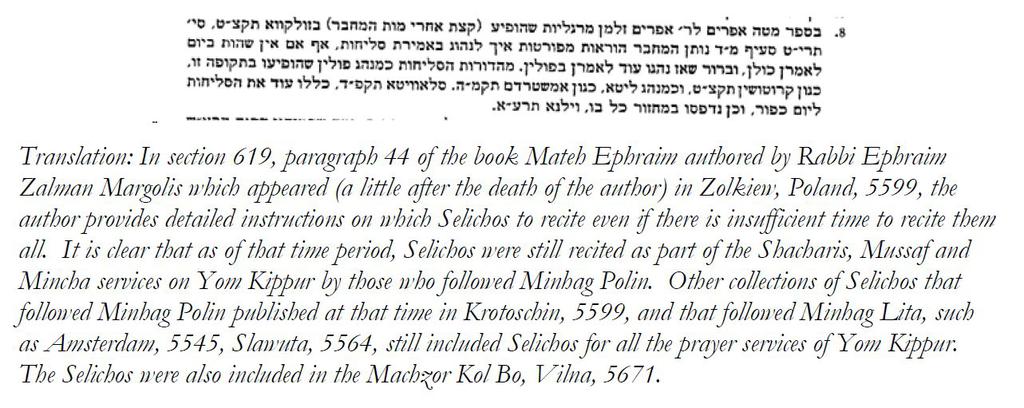
א"א קדיש בשעת קריאת ס"ת במנחה שהשלישי הוא המפטיר וא"א ואשרי ובא לציון ולא ואני תפלתי אף אם חל יוה"כ בשבת והש"ץ לוקח הס"ת אחר הגלילה מיד ואומר יהללו כו' ואומר לדוד מזמור ומכניסין בארון ואומר ובנחה יאמר והולך לפני העמוד ואומר חצי קדיש ומתחילין להתפלל תפלת מנחה ויש נוהגים לומר תחלה פ' התמיד וקטורת ואח"כ אומר חצי קדיש וכן מנהגנו ונוסח התפלה בלחש כמו ערבית ושחרית עם הוידוים לבסוף ואם חל בשבת מזכיר בה של שבת כמו בערבית ושחרית ומתחיל הש"ץ בקול רם התפלה והפיוטים וכשמגיע לכי אל מלך חנון ורחום אתה אם עוד היום גדול שיהיה שעות ביום להתחיל תפלת נעילה ביום או' סליחות ואחר גמר התפלה אומ' א"מ אם חל בחול ואם חל בשבת א"א א"מ וגם אין נוהגים במדינות אלו לומר צ"צ אף אם חל בשבת וא"א במרוצה כי טוב מעט בכוונה ואם אין שעות יש לדלג הסליחות לגמרי ואם היום רד יש לדלג גם הפיוטים וא"א עלינו וק"י:
We do not recite kaddish during the Torah reading of Mincha as the third oleh is the maftir, and we do not recite ashrei and u'va l'tziyon, nor va'ani tefilati even if Yom Kippur falls out on Shabbat. And the prayer leader takes the Torah scroll after it is rolled and immediately recites "yehallelu" etc. and recites "l'david mizmor" and returns it to the Aron and recited "uvenucho yomar" and precedes to the prayer lectern and recites half-kaddish and beings to pray Mincha. Some are accustomed to first recited the section of the daily offering and the incense offering and then recite half-kaddish and this is our custom. The text of the silent amidah is the same as the evening prayer and the morning prayer with the confessional at the end. If it falls on the Sabbath, the addition for the sabbath is mentioned just as in the evening and morning prayers. The prayer leaders begins the repetition and piyyutim in a loud voice and when he arrives at "for You are a merciful and compassionate King," if daylight is still extant such that there is sufficient time remaining to begin Neilah during the daytime, selichot are recited. After the conclusion of the amidah, avinu malkeinu is recited unless it falls on the Sabbath. Also, we are not accustomed in our locales recite tzidkatecha tzedek even if it falls on the Sabbath. Do not pray quickly for better less prayer but with intention. If there is not sufficient time, there are some who skip selichot entirely and if the day's end is rapidly approaching, they skip the piyutim as well. We do not recite aleinu or mourner's kaddish.

Yom Kippur Shacharit - We pray as usual. And the custom is to recite Shir HaYichud for that day, Anim Zemirot, and the daily psalm - all before the prayers. And the blessing, "Who takes care of all of my needs" is not recited. The Rosh, Ran, and Tur (Chapter 613) disagree with this ruling, see there, and each person can proceed as they see fit. Based on the Rambam, it appears that we should not recite the blessing. As for the piyyutim - everything according to the custom.
Now, here's something that puzzles me: The Rosh and Tur (commentary on Yoma) recount, in the name of the Geonim, that we should recite "vaya'avor" five times during the morning prayers. And some say thirteen times in conjunction with the thirteen attributes. And some say seven times, and seven during Mussaf, and seven during Mincha, see there. But we do not recite selichot even once. Now, there are certain customs without legitimate basis yet still, we adhere to them anyway, but this, which is from the Geonim and mentions the recital of the thirteen attributes, and yet we ignore it! (This all came about because of the elongation of musical numbers to such an extent that there was no longer time to recite selichot. And the recitation of the thirteen attributes is not permissible without the recitation of selichot. Already, the greatest sages have lashed out at the cantors, but they have been powerless to stop them. May Hashem forgive us).