4 Tevet 5775 | December 26, 2014
Parshat Vayigash
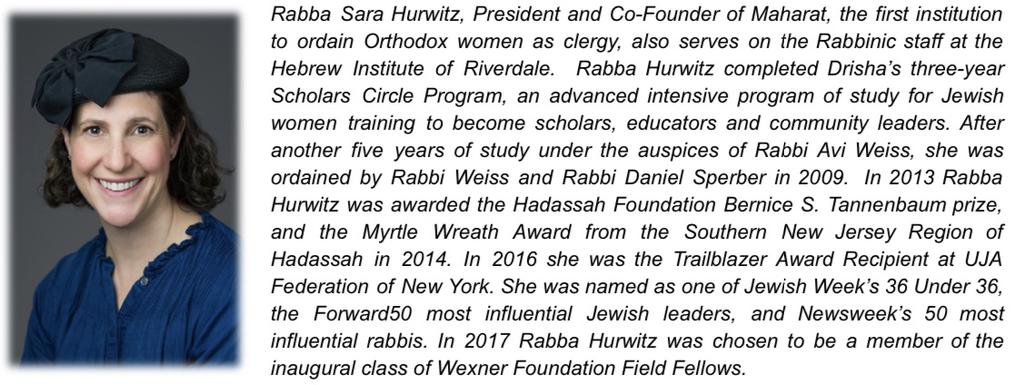
Rabba Sara Hurwitz
President and Co-Founder
The ethic of favoritism plagued Yosef’s entire life. So it is painfully surprising when Yosef seems to favor some of his siblings over the other.
In our story, Yosef has revealed himself to his brothers. He and his father have reunited and Yosef begins to settle his family into their new home in Goshen. And then, at the beginning of chapter 47:2, Yosef comes before Pharaoh and the Torah narrates:
(2) From a portion of his brothers, he took five men and presented them to Pharaoh.
Yosef chose 5 out of his 11 brothers. Why not present them all to Pharaoh? Why pick only 5? And which brothers did he choose?
The text is palpably silent about which of the five brothers were chosen, and so two divergent lists of who the five were, emerged:
The Midrash Rabbah (95:4) explains that Yosef chose Reuben, Simeon, Levi, Issachar and Benjamin because according to Yosef, they were the least mighty of the tribes. The Sifre (Sifre Deuteronomy Finkelstein edition, p. 415, par. 354), however, implies that Yosef chose Zevulun, Gad, Dan, Naphtali and Asher because they were blessed last by Moshe, and were “lesser” in importance—they are Leah’s youngest and the four sons of the concubines. Both explanations capture Yosef’s fear that if Pharaoh would see strong men, he would make them his men of war. Therefore, he presented the five who were theoretically physically weaker or less prominent.
Whatever the reason for their selection, it is clear that the commentaries cannot agree upon which sons were picked, highlighting the absurdity of favoring some of the brothers over others. Did Yosef not learn anything from his own experience? Was Yosef perpetuating his father’s actions of judging: Who was in and who was out?
As the story of Jewish peoplehood unfolds, fierce and bitter fighting ensues between the tribes. After the reign of King David, the Jewish nation splits into two fractured kingdoms—the North and the South, each with its own leaders.
However, the Haftorah associated with parshat vayigash presents Yechezkel’s prophetic vision that the tribes of Israel will be gathered together to form a single nation, no longer divided into two kingdoms (Yechezkel 37:22). He reveals a dream of equality—where one tribe is not favored over another. There is no Zebulun, Gad, Dan, Naphtali and Asher, versus Reuben, Simeon, Levi, Issachar and Benjamin. One does not emerge as superior, or more worthy than the other. There is only bnei yisrael. Each tribe, with its unique qualities, becomes intertwined to form one nation.
In light of Yechezkel’s dream, perhaps Yosef’s intention of picking five brothers can be interpreted not as showing favoritism, not of determining who is in and who is out, but rather as conveying unity. A biblical scholar once suggested to me that the number five in ancient Egyptian society stands for completeness, just like the number 7 conveys completeness in Judaism. So when Yosef bought “mikzay echav,” five of his brothers before Pharaoh, he was actually projecting to the king that he and his brothers were united.
We could read Yosef’s decision to bring only five as an attempt to perpetuate enmity and foster favoritism and resentment between him and his brothers. But, if we dig a little deeper, Yosef is actually sending a message of unity and brotherly love, where superiority, discord, and discontent gave way to parity and brotherhood.
Rabba Sara's Overarching Theme:
Feeling God’s presence, shouldn’t be that difficult. “You shall walk after the Lord your God,”(Devarim 12:5) we are told; seek out God’s presence. And yet, astonished, R. Hama son of R. Hanina (Talmud Bavli, Sotah 14a) asks, how is it possible to walk with the Shechina? Rav Hama quotes an early pasuk from Devarim that describes “... the Lord your God as a devouring Fire.”(Devarim 4:24). How is it possible to get close to God without being scorched? R. Hama answers his own question: We must walk after the midot, after the attributes of God, not his immediate presence.
In Hebrew, good attributes, midot, are translated as “good measures.” Rabbi Adin Steinsaltz in The Thirteen Petalled Rose, suggests that a quality is determined by its proportion. In other words our midot are the balance of our varied characteristic traits. To act Godly is to put our best spiritual essence forward, while trying to keep in check the inevitability of negative attributes. We are at once both good and bad, compassionate and injurious.
At Yeshivat Maharat, our students are ordained with the ability to lead, pasken, and teach. But, they must also be finely attuned to the nuances of the human condition. Spiritual leaders are most effective when they have confronted and understand their own midot, their own balance of human traits. Our Torah narratives bring to bare the multi-layers of the characteristic traits that individuals must learn to balance within themselves.
And so, I offer this weekly parsha column as a model of Yeshivat Maharat’s Pastoral Torah curriculum, where we will explore the rich and varies layers of the human condition.