11 Tevet 5775 | January 2, 2015
Parshat Vayechi
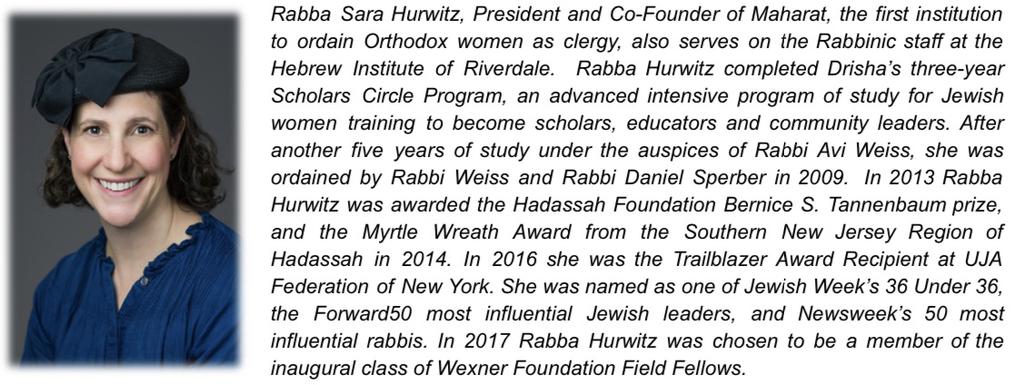
Rabba Sara Hurwitz
President and Co-Founder
The quintessential question that troubles our sages in this weeks Torah portion is one of survival. In parshat vayechi (and [Yaakov] lived) we learn about the death of Yaakov. The Torah describes Yaakov’s passing somewhat ambiguously:
When Jacob finished imparting his instructions to his sons, he drew his feet into himself, and breathing his last, he was gathered to his people.
This unusual language inspires a shocking interpretation recorded in The Talmud Bavli, Massechet Taanit 5b which says:
הָכִי אָמַר רַבִּי יוֹחָנָן: [...] הָכִי אָמַר רַבִּי יוֹחָנָן: יַעֲקֹב אָבִינוּ לֹא מֵת.
Rabbi Yitzchak stated, so said Rabbi Yochanan, ‘Jacob our father did not die.’
On the most human level, Rabbi Yitzchak’s statement can be explained as expressing a deeply rooted but natural psychological response to death: denial. Denial is a coping mechanism that protects from the pain associated with loss, and can in some cases create a distortion of reality. Yaakov’s sons, bnei Yaakov, are watching their beloved father, their rock, take his last breath. Imagining this scene, Rabbi Yitzchak placed words into the mouths of Yaakov’s children, of Asher and Gad, Yehuda and Benjamin: “Jacob our father did not die,” his sons say, because, they could not conceive of a world where their father would no longer exist to guide, teach, and lead them.
But Yaakov is not only the progenitor of b’nei Yaakov, the father to twelve sons. He is b’nei Yisrael as well, father to the Jewish nation. Ramban explains, “the point of this Midrash is that the souls of the righteous are bound up in the bond of life, and Jacob's soul will ... put on a second garment that will not be taken off..." In other words, Yaakov’s soul, his legacy, will live on in the body of the Jewish people, for as long as the Jewish people are alive. And so, in Rabbi Yitzchak’s statement “Jacob, our father, did not die,” there is an echo not of denial, but of hope from the rabbis living in the Amoraic period. As they looked out the windows of their batei midrash (study halls) in the Babylonian diaspora, they asked rhetorically, “will the Jewish nation be able to survive without the soul of our Patriarch Jacob at its epicenter?” Their statement “Jacob our father did not die” was offered as prayer. Yaakov’s body was indeed embalmed and buried, as the verses in Bereishit go on to recount. But the Rabbis knew that the soul of Jacob would only survive if the Jewish people remain alive.
Indeed, the children of Israel have survived religious intolerance, mass destruction, and assimilation. History proves that we will continue to flourish. The richness of our dynamic and evolving tradition will gird us with the strength to live in perpetuity, with the spirit of Jacob, our father, carrying us. Jacob did not die, and neither will we.
Rabba Sara's Overarching Theme:
Feeling God’s presence, shouldn’t be that difficult. “You shall walk after the Lord your God,”(Devarim 12:5) we are told; seek out God’s presence. And yet, astonished, R. Hama son of R. Hanina (Talmud Bavli, Sotah 14a) asks, how is it possible to walk with the Shechina? Rav Hama quotes an early pasuk from Devarim that describes “... the Lord your God as a devouring Fire.”(Devarim 4:24). How is it possible to get close to God without being scorched? R. Hama answers his own question: We must walk after the midot, after the attributes of God, not his immediate presence.
In Hebrew, good attributes, midot, are translated as “good measures.” Rabbi Adin Steinsaltz in The Thirteen Petalled Rose, suggests that a quality is determined by its proportion. In other words our midot are the balance of our varied characteristic traits. To act Godly is to put our best spiritual essence forward, while trying to keep in check the inevitability of negative attributes. We are at once both good and bad, compassionate and injurious.
At Yeshivat Maharat, our students are ordained with the ability to lead, pasken, and teach. But, they must also be finely attuned to the nuances of the human condition. Spiritual leaders are most effective when they have confronted and understand their own midot, their own balance of human traits. Our Torah narratives bring to bare the multi-layers of the characteristic traits that individuals must learn to balance within themselves.
And so, I offer this weekly parsha column as a model of Yeshivat Maharat’s Pastoral Torah curriculum, where we will explore the rich and varies layers of the human condition.