25 Tevet 5775 | January 16, 2015
Parshat Va’era
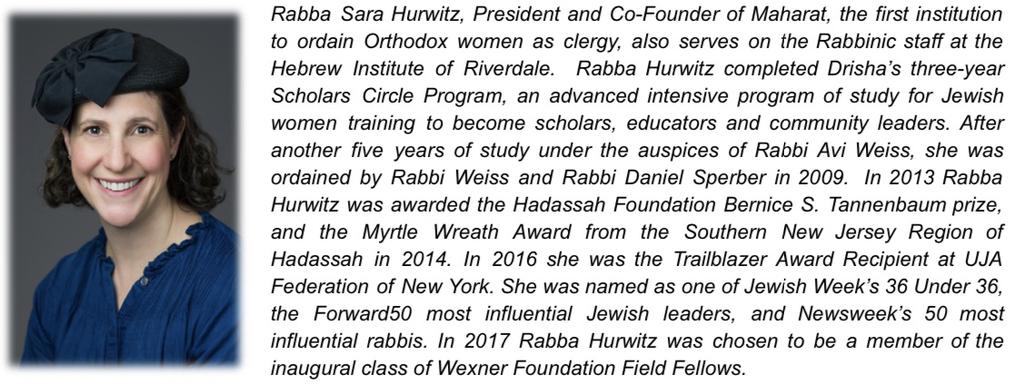
Rabba Sara Hurwitz
President and Co-Founder
Parshat Va’era opens with God’s promise, once again, to redeem the Jewish people:
וְהוֹצֵאתִ֣י אֶתְכֶ֗ם מִתַּ֙חַת֙ סִבְלֹ֣ת מִצְרַ֔יִם וְהִצַּלְתִּ֥י אֶתְכֶ֖ם מֵעֲבֹדָתָ֑ם וְגָאַלְתִּ֤י אֶתְכֶם֙ בִּזְר֣וֹעַ נְטוּיָ֔ה וּבִשְׁפָטִ֖ים גְּדֹלִֽים׃ (ז) וְלָקַחְתִּ֨י אֶתְכֶ֥ם לִי֙ לְעָ֔ם וְהָיִ֥יתִי לָכֶ֖ם לֵֽאלֹקִ֑ים
hotzayti—I shall take you out of slavery; v’hizalti—I shall rescue you from the burdens of the work; v’ga’alti - I shall redeem you, and take you through the Red Sea, and lakachti—I shall take you out as a nation to Mount Sinai. (Annotated Translation, Shemot 6:6-7)
But, perhaps because of their slave mentality, their inability to imagine themselves as free agents, the Jewish people resist.
So Moshe spoke accordingly to the Children of Israel; but they did not heed Moses, because of shortness of breath and hard work.
This phrase, “shortness of breath,” is strange, and prompts Rashi to use a play-on-words: “whoever is troubled (mayzar), his spirit (ruach) and his breathing are short (kazra), and he cannot breathe a long breath.” (Rashi ibid.) As if to say that the prisoners’ spirit is short or low. The slaves in Egypt simply did not did not have the spirit—the ruach—to stand up to their masters. Mi’kozer ruach, captures the dispirited attitude of being stuck in slavery for eternity. Of being stuck in Mitzrayim (Egypt), which has the same root mayzar (troubled). The Jews were stuck in a troubled, narrow-minded land in a troubled, dispirited state of mind.
After 430 years in Egypt, the Jews were broken. As slaves, they could not and would not imagine the dream of redemption, of the promised land. It is this mentality that Rav Yosef Ber Soloveitchik, in an essay “Slavery and Freedom,” describes as the slave personality (typological-personalistic).
A person in this state of mind, one who is enslaved, is barred from living as a free Jew. In fact, in halakhic terminology, the Rav explains, there are three limitations imposed upon a slave, and each ach of these prohibitions shed light on the limitations of the slave personality. First, a slave is disqualified from testifying in civil and criminal cases, because an eved (slave) cannot be trusted to choose between right and wrong. The eved is denied the ability of choice. The slave is denied options. He need not make any decisions, as someone makes them for him, and therefore, a slave lacks initiative.
Second, a slave is relieved from positive time bound mitzvot because the eved cannot have awareness of time. A slave floats along with time, waiting for the days and months to pass. He has no right to shape his future or luxuriate in the present.
And finally, the slave cannot marry. Marrying implies that one is not only self aware, but also has an awareness of another. Devotion to a spouse leads to a sense of mutual responsibility and commitment, which leads to a meaningful existence. An eved, however, is always looking to flee, for a way out, bearing no responsibility for anyone else.
As long as the Jewish people were burdened with this slave personality, they would be bound to live as slaves-- living a life of no initiative; a life of being unable to shape their own time; a life void of meaning. They would only be able to leave Mitzrayim, the narrow place, at the moment when they could shed their mi’kozer ruach, their dispirited attitude, and begin seeing themselves as free. Where they could learn, once again, how to breathe, to draw long, unhampered breaths and emerge from the depths of their darkness.
As free people, we still ask God to help us shed our slave personality every morning during birkat shacharit (morning blessings), we ask : Baruch ata…Blessed are you God for releasing the bound/freeing the imprisoned--matir asurim.
The Gemara in Brachot (60a) proposes that we physically purge ourselves from worries that have been burdening us during the night. In what may be the first suggestion to add yoga to our daily routine, chazal recommends reciting the words “matir asurim,” when we sit up in bed, and perhaps even stretch our limbs which have been "bound" during the night. Help us God, we say as we acknowledge that we are physically free and unbound, to first identify, and then free ourselves from the litany of concerns that enslave us.
And in doing so, unlike a slave, we can find the initiative to seek alternative options to the status quo. Perhaps, for some, it is changing professions, or working less hours. For others working more, in a career that is more meaningful.
Unlike a slave, we can decide how to spend our time, and shape our future. Choose to learn more Torah. Exercise. Do yoga. Spend more time with family. Prioritize what is important.
And, unlike a slave, we can then find meaning to our existence, to our lives.
Every morning, I recite the blessing: blessed are you God for releasing the bound--matir asurim—with renewed fervor, knowing that I must not, cannot become a slave again.
Rabba Sara's Overarching Theme:
Feeling God’s presence, shouldn’t be that difficult. “You shall walk after the Lord your God,”(Devarim 12:5) we are told; seek out God’s presence. And yet, astonished, R. Hama son of R. Hanina (Talmud Bavli, Sotah 14a) asks, how is it possible to walk with the Shechina? Rav Hama quotes an early pasuk from Devarim that describes “... the Lord your God as a devouring Fire.”(Devarim 4:24). How is it possible to get close to God without being scorched? R. Hama answers his own question: We must walk after the midot, after the attributes of God, not his immediate presence.
In Hebrew, good attributes, midot, are translated as “good measures.” Rabbi Adin Steinsaltz in The Thirteen Petalled Rose, suggests that a quality is determined by its proportion. In other words our midot are the balance of our varied characteristic traits. To act Godly is to put our best spiritual essence forward, while trying to keep in check the inevitability of negative attributes. We are at once both good and bad, compassionate and injurious.
At Yeshivat Maharat, our students are ordained with the ability to lead, pasken, and teach. But, they must also be finely attuned to the nuances of the human condition. Spiritual leaders are most effective when they have confronted and understand their own midot, their own balance of human traits. Our Torah narratives bring to bare the multi-layers of the characteristic traits that individuals must learn to balance within themselves.
And so, I offer this weekly parsha column as a model of Yeshivat Maharat’s Pastoral Torah curriculum, where we will explore the rich and various layers of the human condition.