17 Shevat 5775 | February 6, 2015
Parshat Yitro
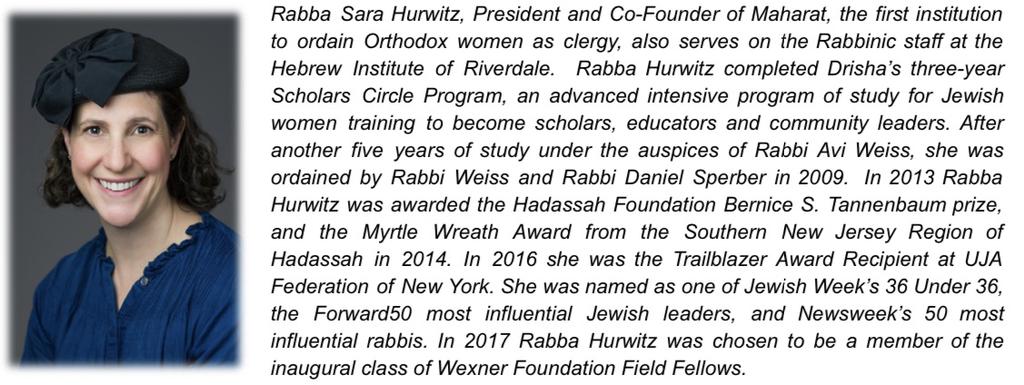
Rabba Sara Hurwitz
President and Co-Founder
Parshat Yitro introduces the obligation to create ramps. After the Aseret Hadibrot (Ten Commandments) are given, the Torah discusses the mitzvah of building the mizbeach (altar):
You shall not ascent My altar on steps, so that your nakedness will not be uncovered upon it.
The Kohen, must be able to access the altar not by way of steps, but by a ramp.
After the climax of the Aseret Hadibrot, including the imperative to worship one God, honoring parents, observing Shabbat, and the prohibition against murdering and stealing, this pasuk seems inconsequential. The Aseret Hadibrot form the central core of our halachik (legal) system, which outlines an ethical and religious code of laws to live by, and continues to be developed in the very next chapter, in parshat Mishpatim. It is strange, then, to veer off into a detailed account of how to construct the altar when the command to build the Mishkan (Tabernacle) has not yet been given. Rashi is bothered by this sudden, detailed, technical law of the altar and interprets this halakha (law) through a metaphorical lens.
He explains that the Kohen cannot climb steps to the altar lest he expose himself to the stones. Doing so would cause one
וְאַתָּה נוֹהֵג בָּם מִנְהַג בִּזָּיוֹן; [...] וּמָה אֲבָנִים הַלָּלוּ שֶׁאֵין בָּהֶם דַּעַת לְהַקְפִּיד עַל בִּזְיוֹנָן, אָמְרָה תוֹרָה הוֹאִיל וְיֵשׁ בָּהֶם צֹרֶךְ לֹא תִנְהַג בָּהֶם מִנְהַג בִּזָּיוֹן, חֲבֵרְךָ שֶׁהוּא בִדְמוּת יוֹצֶרְךָ, וּמַקְפִּיד עַל בִּזְיוֹנוֹ, עַל אַחַת כַּמָּה וְכַמָּה:
to behave toward the stones in a humiliating manner...If the stones on the altar, which have no intelligence and therefore cannot be humiliated, how much more so would your friend, who is [created] in the likeness of your Creator and who does object to being humiliated, how much more [must you be careful not to embarrass him.
Rashi is underscoring the importance of being sensitive to others. This law, which relates to the mizbeach, is also central to our system of ethics, in the same way that honoring Shabbat and our parents are. The ramp up to the mizbeach is a core ethical law as opposed to a merely technical one.
To extend the metaphor a little further-- this altar is called “mizbeach adamah” the altar of the ground. However, one can also translate adamah from its root adam—the altar of the person. The altar, then, is a metaphor for people, the mizbeach adamah, to strive to treat our peers with deep sensitivity.
It is with deep sensitivity that God demands B’nei Yisrael stand at Har Sinai to receive the Torah. There’s a famous midrash (Bereishit Rabah 95:1) that suggests at the moment of revelation at Sinai all the blind could see and the deaf could hear. I can’t help but wonder - were these disabilities actually cured? Did the fire and brimstone, the shofar blasts and the thunder have curative capacity, causing the blind to see and the deaf to hear? Rather, at that moment of heightened spiritual purity, perhaps all of God’s creations, those with and without a disability, were seen as whole (shalem). Everyone, with all of their flaws, was created with b’tzelom elokim (in God’s likeness).
We must build ramps that allow for all members of the community to be valued and treated with sensitivity. Where all people will be seen and heard. Where inclusion means that everyone has access to revelation and all that our community stands for.