5 Iyyar 5775 | April 24, 2015
Parshat Tazria
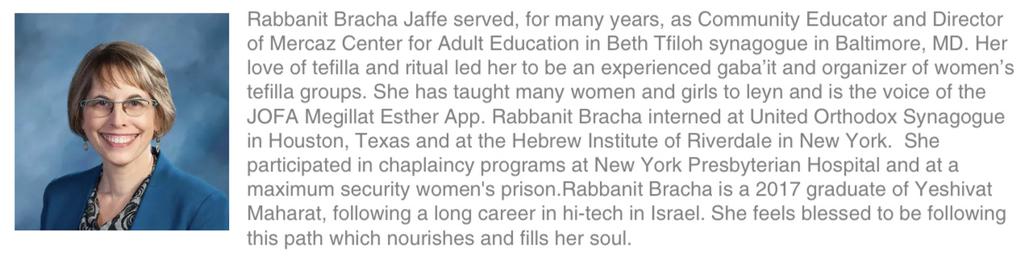
Rabbanit Bracha Jaffe
Class of 2017
Delivered as the sermon for Parshat Tazri’a-Metzora at United Orthodox Synagogues of Houston, Texas in 2015.
When I was a little girl, my sister and I used to cut out paper dolls. After cutting we would open them up and have a chain of paper dolls. But I harbored a shameful secret. I didn’t cut very well and my dolls ended up lopsided while my sister’s dolls were beautiful. This happened in school as well and I started shying away from anything having to do with cutting and in fact all arts and crafts. I thought there was something wrong with me and I was embarrassed to mention it out loud. After all, everyone else seemed to be doing it so well! It took years until I discovered that I couldn’t cut well because I’m a lefty and scissors are made for right-handed people. It’s as if left-handed people simply do not exist. No one noticed it - no one came to me - I was ashamed to tell anyone. This was the first time that I understood what it means to feel excluded.
This community is so welcoming- I have felt that from Day One. Right away I noticed the ramp that makes every place accessible in the shul but even more than that. I have listened to you and learner from you and about you. I have seen intergenerational friendships - age doesn’t seem to matter. I have heard you talk about each other - from a place of caring and concern for each other.
And it is to just such a community that I feel I can talk about an issue that is so important and personal to me. I want to talk about noticing people who feel excluded - specifically people with disabilities and families of people with disabilities.
In every community there are people with disabilities - some more visible and some less so. Physical disabilities, cognitive disabilities, social disabilities, learning disabilities.
We all know someone who has a limitation in some way. Is there anyone in this room without a limitation? Everyone has the right to participate in a Jewish life to the fullest extent. Each and every one of us is created בצלם אלוקים - in the image of G-d and worthy of our love and respect.
How do we see the person with a disability? Do we recognize the צלם אלוקים within? Can we see past the disability to the wonderful and special person that he is? Appreciate her unique contribution? Are we sensitive to the challenges faced by their families?
I believe that the Parshiyot we are reading now send us a similar message. Last week, we read in Parshat Shmini about the inauguration of the Mishkan. At the beginning of the festivities, Aharon’s two sons brought an אש זרה - a strange fire and died by G-d’s hand. Next week we will read Acharei Mot - when G-d speaks to Moshe about the work in the Mishkan right after the death of Nadav and Avihu - these two sons. Strangely, there is a long break between these two chapters.
The break contains a section about kosher and non-kosher animals and then what we read today - two whole Parshiot that talk about a man or woman who becomes tame (impure) and is excluded and isolated from the community for a short time.
Why would the Torah make this long break between two sections that should immediately follow each other? I would like to suggest that this break has something to do with exclusion from and inclusion in the community.
People with disabilities often feel different and excluded. What happens to the little boy or girl with Down’s Syndrome who doesn’t have play dates? What about someone with ADHD who cannot control her impulsivity and finds it difficult to make friends? What about the boy with Tourette’s who cannot sit quietly in shul?
There’s another aspect as well. There are families with disabled children who cannot ever come to shul or to social functions as they cannot leave their child alone and do not have a caretaker or perhaps cannot afford one. Often they cannot even spend time alone with each other, which is crucial for sustaining a loving relationship between husband and wife.
Even everyday activities require extra energy and can be emotionally draining. They often feel left out, invisible. Who sees their pain? Do we reach out to them?
I was recently visiting a family and talking with their 2nd grader about her friends. She told me who she plays with and mentioned that there was a new girl in her class. I asked if she played with her.
-
She said: “No”
-
Why not?
-
Because she is different
-
Different - how?
-
She has a funny smell. She runs so slowly - it’s like when we walk. She always goes over to girls and asks to play with them - all the time. They push her away - they say: Oh, we’re not playing. We’re just talking.
-
I said to her: Would you want to play with her?
-
Her eyes filled with tears: Yes - I do. But I won’t play with her. If I do - none of the other girls will play with me.
Not only was the new girl excluded but also this little girl who has an open heart cannot reach out or she will be excluded as well!
Everyone wants to feel cared about and to feel that they belong.
Everyone wants to feel that they are vital members of the community.
Looking through the lens of community, we can now understand the layout of the Parshiyot. I would like to suggest that the Mishkan is all about building a community and Nadav & Avihu took themselves out of the community. They brought their own Korban - offering, not one that G-d had mandated. Aharon’s sons said, in front of the whole Jewish nation, “we are different, we are above the law.” Before G-d could continue talking to Moshe about the Mishkan after seeing this separation from community - the Torah needed to give us some blueprint on what it means to build a community.
First the Torah tells us what we’re supposed to do and then what we’re not supposed to do.
It lists the foods that we may and may not eat, which animals are kosher and which are not. Sharing food - the fellowship of eating - brings a community together.
Then it tells us what we’re not supposed to do: We find that in double-Parshiot that we read today - Tazri’a-Metzora. Although it talks about different kinds of uncleanliness, the main focus is on Tzara’at - not to be confused with the physical disease called leprosy or Hansen’s disease.
Tzara’at is a spiritual disease, which manifests itself physically. Throughout the Talmud and Midrashim, our sages view tzara’at as a punishment or consequence for various transgressions involving interpersonal misconduct, in particular the sin of lashon ha-ra, which is the act of spreading gossip or slander.
The gossiper is doing more than just telling a story. Conceptually - what is the sin of gossip?
The gossiper is highlighting how another person is different and doesn’t belong. And what are the consequences? The victim may be stared at, pointed at, or even completely ostracized, made to feel excluded by the community.
So the person spreading lashon harah is now diagnosed with Tzara’at by the kohen. And what are the consequences of an individual having Tzaraat?
The Torah tells us explicitly in Chapter 13, verse 46:
בָּדָ֣ד יֵשֵׁ֔ב מִח֥וּץ לַֽמַּחֲנֶ֖ה מוֹשָׁבֽוֹ׃ {ס}
He shall live in seclusion and make his home outside the camp:
Even more so - when seeing someone else he must announce about himself that he is UNCLEAN.
וְטָמֵא טָמֵא יִקְרָא
And he shall call out, “Unclean! Unclean!”
Rashi explains: Tzara’at is a Divine punishment for lashon hara. These activities create division and strife within the community - even between man and wife! It is appropriate that he should be excluded from the community.
Taking this idea a bit further: The temporary exclusion of the individual with Tzara’at is meant to be instructive, helping this person to experience what it feels like to be an outsider. With this understanding, knowing the harm and feeling the pain lashon harah can bring about, the gossiper will no longer want to hurt someone else in this way. Having learned this lesson, this person can now rejoin the community.
Only after G-d has taught these lessons on building an inclusive community can He get back to discussing the work in the Mishkan.
We just celebrated Yom Ha’atzma’ut this past week. In a very innovative way, Israel has opened the door towards more inclusivity in Tzahal. The IDF has started employing soldiers on the autistic spectrum for specific tasks, which use their particular strengths at decoding and deciphering satellite images. These complex tasks require long hours of concentration, focus and constant attention to detail.
How did this program happen? Because people were able to look past the “disability” and see the person. They saw members of the community who had strengths and weaknesses, like everyone, who wanted to belong and have a place at the table.
As a community - what can we do? We can make a difference. Here is a story that one mother shared about her community. One of her children is on the autistic spectrum; during the week she shoulders the responsibilities of caring for her son alone as her husband works late hours. However, on Shabbat they have worked with him on spending time in shul with various books and toys while sitting next to his father. This is one of the highlights of his week and hers as well. She has a whole hour free on Shabbat morning.
A few months ago her husband had to be away and she stayed home with this son and their baby. She realized: the cherished shul activity would have to be suspended while her husband was gone. Then - before Shabbat she received a phone call from a man in the shul. He said: “I heard that your husband is away and I just want you to know that I’m expecting to have your son sit next to me in shul on Shabbat”. And so it was.
This is what it feels like to be embraced by community.
As an individual, what can each of us do? First of all - notice. Be aware. See the person, not the disability. Ask them how they’re doing so they know how important they are to you. Notice if someone doesn’t show up in shul. Call them up, send an email, send a text. Show that you care. And - then - if you feel that there is room to help - you can gently ask: “Is there something that I can do to help you out?” Remember that sometimes just listening is enough.
What did we see today? Within these two Parshiot of Tazria-Metzora, the Torah gives us a blueprint for building a strong and tightly knit community. We started with the building of the community via the Mishkan but we are forced to pause due to Aharon’s sons disregard for community. Only once the lesson of community building has been taught through the example of Tzara’at can we resume the communal task of building the Mishkan.
A beautiful story is told about Rabbi Aaron Lichtenstein, the Rosh Yeshiva of Yeshivat Har Etzion who passed away this week. He was a great Torah scholar and Modern Orthodox leader. Rav Aaron was attending a wedding and asked to meet a certain woman. He said to her: “You probably don’t remember me, my name is Aaron Lichtenstein. 50 years ago I came to Baltimore as a refugee from Europe. I was dressed as a European kid with short pants and long socks and no one would play with me. I remember - as a little girl - that you played with me. I want to thank you.”
This is what it’s all about - this little girl understood not to exclude somebody just because he or she is different.
We must open our hearts to look past differences and handicaps to the godliness within each human being. We must open our mouths to speak words of welcome and caring.
The true test of a community is not how we treat the most powerful but how we treat the most vulnerable.