19 Iyyar 5775 | May 8, 2015
Parshat Emor
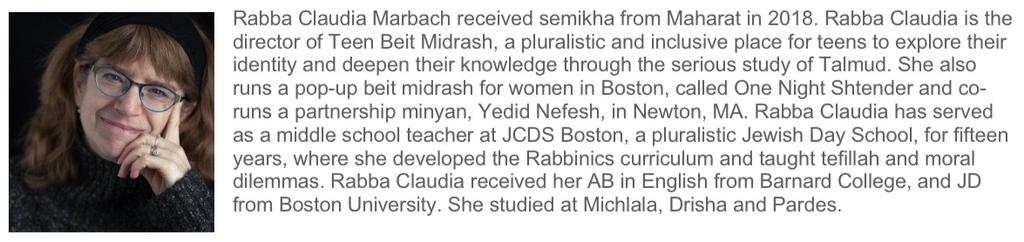
Rabba Claudia Marbach
Class of 2018
A blind man was walking down the street at night with a flashlight in one hand and a white cane in the other. Someone walking in the opposite direction was puzzled and asked "why are you carrying a light?” The blind person replied, "As long as I carry the light, people can see me coming and come to my aid so that I do not trip and fall."
This story comes from the Talmud in Masechet Megillah 24b. Rabbi Yossi is puzzled by the pasuk from Devarim 28:2
(כט) וְהָיִ֜יתָ מְמַשֵּׁ֣שׁ בַּֽצׇּהֳרַ֗יִם כַּאֲשֶׁ֨ר יְמַשֵּׁ֤שׁ הַֽעִוֵּר֙ בָּאֲפֵלָ֔ה וְלֹ֥א תַצְלִ֖יחַ
"You will grope at noontime as a blind person gropes in the darkness".
"What difference does it make 'to a blind person, he asks, whether it be day or night? He cannot see in either case."
The Gemara responds with a story that shows a person with a disability teaching responsibility to a sighted person. The sighted person is invited into relationship from an unexpected direction. Even when we can see we don’t always understand.
As a community, Orthodox Jews are just beginning to think about and improve our efforts in the inclusion of people with disabilities. In that light, how then are we to react when we read in Parashat Emor of Kohanim who are barred from working in the Mishkan because of a disability? As it says: (Vayikra chapter 21)
17 Speak unto Aaron and say: No man of your offspring throughout the ages who has a defect, shall be qualified to offer the bread of his God. 18 No one at all who has a defect shall be qualified : no man who is blind, or lame, or has a limb too short or too long; 19 No man who has a broken leg, or broken arm, 20 or hunchback, or a dwarf, or who has a growth in his eye, or a boil scar, or scurvy;
The kohen bal mum (a priest with congenital or acquired disability) was barred from his familial calling. His father, brothers, uncles everyone he knew — got to go up to Jerusalem for two weeks a year to serve in the Beit haMikdash (Temple). These Kohanim, who lived scattered amongst the tribes of Israel, were sent off to do their service with a fanfare. The nonKohanim from the district had a minifestival to celebrate that their local Kohanim were representing their community by participating in the central devotions. Put yourself in the place of poor Mr. Aaron the Kohen, with the chicken pox scars or a limp because he hadn't yet had his hip replaced, who had to stay home, even though as far as he could see, his disability would not make much of a difference in his service of God and certainly could be accomplished with only a small accommodation.
Some commentators say that the physical labor of the Beit haMikdash would have been too much for a kohen baal mum. But there were many aspects to the work in the Beit Hamikdash. Perhaps for some the work would be difficult, but not everyone needed to lift the animals on to the altar for the sacrifice. Surely someone needed to mix the ingredients for the ketoret (incense offering)?
In the previous Parasha, Parshat Kedoshim, we read in Vayikra 19:14:
(יד) לֹא־תְקַלֵּ֣ל חֵרֵ֔שׁ וְלִפְנֵ֣י עִוֵּ֔ר לֹ֥א תִתֵּ֖ן מִכְשֹׁ֑ל
Do not curse the deaf or place a stumbling block in front of the blind...
There we are commanded to be kadosh (holy), in part, by not placing these michsholim (stumbling blocks) in front of those with disabilities. Then in parashat Emor, in contrast, the Torah itself places a michshol, based solely upon physical disabilities, in front of the kohen who wants to serve God.
What is more, the disability is a Godgiven disability! We like to think of God as the giver of our blessings. A story in Masechet Taanit 20a highlights our discomfort in this respect:
We present ourselves to the world in the manner that God has made us. Rabbi Simeon is chastised for dismissing a person by looks, only to be reminded that we are all made in God’s image by God. When we see a person with a disability, do we see the disability or do we see the person who was made בצלם אלוקים (in the image of God)? And how do we think of the variations in the vessels that God has made?
Rashi, on these pesukim, raises the parallel between the defects that bar the Kohen and those of the animals forbidden to be sacrificed. He quotes harsh words from Malachi 1:8-9.
You ask, 'How have we shown contempt for your name?' By offering defiled food on my altar. But you ask, 'How have we defiled you?' By saying that the Lord’s table is contemptible. When you offer blind animals for sacrifice, is that not wrong? When you sacrifice lame or diseased animals, is that not wrong? Try offering them to your governor! Would he be pleased with you? Would he accept you? – says the Lord Almighty.
Malachi was chastising the people for lax observance and miserly offerings. He was also contrasting the respect the people would give to a מלך בשר ודם (a human ruler) to that which they were NOT giving to God. And so Rashi implied that just as offering an animal with a mum (blemish) was disrespectful to God, so a kohen with a mum or disability was not an appropriate representative for the people to send before God.
In our society we might think it outdated that a person with a disability is not fit to appear before a ruler. We have members of Congress with prosthetic legs and back a little further in history we had a President, Franklin Roosevelt, who was elected four times despite being paralyzed from the waist down. So what do we do with this text today?
Interestingly, halacha has evolved on this issue as it does on many issues. I would like to describe some of this evolution to you and present to you some ideas of how we can proceed on this issue today.
After the destruction of the Beit haMikdash, tefillah replaced the korbanot. Birkat Kohanim, the Priestly blessing or duchening, is an ancient practice and was incorporated into our tefillah. The question then arose: Is a physically imperfect kohen prohibited from blessing the congregation?
The initial statement in the Mishna was a resounding yes! The mishna in Masechet Megillah 4:7 says:
(ז) כֹּהֵן שֶׁיֵּשׁ בְּיָדָיו מוּמִין, לֹא יִשָּׂא אֶת כַּפָּיו. רַבִּי יְהוּדָה אוֹמֵר, אַף מִי שֶׁהָיוּ יָדָיו צְבוּעוֹת אִסְטִיס וּפוּאָה, לֹא יִשָּׂא אֶת כַּפָּיו, מִפְּנֵי שֶׁהָעָם מִסְתַּכְּלִין בּוֹ:
A Kohen who has a disability may not raise his hands in blessing. Rabbi Yehudah says that even if his hands are colored with dye he should not raise his hands since the nation will look at him.
The first statement of the mishna gives no qualification to the ban on participation. Yet notice, Rabbi Yehuda seems to extend the ban to anything that is unusual or strange which would distract the congregation, who in accordance with our practice today should not be looking at the Kohanim anyway. Does this apply to all qualities that might distract the kahal? Would that mean according to Rabbi Yehuda someone with blue hair could not duchen today? What if he were incredibly handsome or ugly as in the story of Rabbi Simeon ben Elazar? What if he sang off key?
The Tosefta, a contemporary and parallel text to the mishna, written in the first and second century CE, in Masechet Megillah explains this further.
כהן שיש בו מום בפניו בידיו וברגליו הרי זה לא ישא את כפיו מפני שהעם מסתכלין בו
A kohen with a disability on his face, hands or legs may not bless the people because the people will look at him.
The Tosefta acknowledges that it is human nature to stare at something or someone unusual. By prohibiting the disabled Kohen from duchening the Tosefta seems to be removing a stumbling block not from the person with the disability, but from the kahal.
As Rabbi Eliyahu Meir Bloch (18941955), wrote in his commentary on the Torah, Peninei Da'at al HaTorah,
While Rabbi Bloch may be speaking the truth, I am not content to leave it at that. We live in a society that highly values tolerance. Our Mussar tradition asks that we work on our faults constantly perhaps here a stumbling block is our “human emotions” which need to be overcome.
The Rabbis are concerned that a person with a disability might distract us, the kahal, from our tefillah. The language of distraction seems to separate the person with disability from the kahal. Instead of a member of the community who wants to serve God and the kahal, he or she becomes shunned. I certainly can think of lots of things in shul that distract me from my tefillah despite no longer having my own small children demanding my attention. But I’m not ready to use a kohen with a disability as an excuse for my inattention.
Another way of thinking about our Tosefta, is that the Rabbis were focusing on the feelings of the kohen baal mum. Perhaps the Rabbis wanted to save him from all those peeping eyes, all that attention. A mishna in Baba Kama explicitly warns us against embarrassing the blind person, to the point where it is considered a tort and has legal consequences. But what if our kohen is not embarrassed and wants to participate and feel like a full member of the kahal. Should he still be banned? To me this seems patronizing and contrary to our societal attitudes. Is the michshol (stumbling block) our patronizing attitudes?
Our very Tosefta might provide a more satisfactory answer to our dilemma. It continues by carving out an interesting exception:
ואם היה חבר עיר הרי זה מותר הרי… אין כבוד שיקרא ויתרגם ויעבור לפני התיבה וישא את כפיו
But if he, the kohen, were known in the city then he is allowed to bless the people.
That statement is amazing! The Tosefta, is upending prohibition on the basis of familiarity! It is alright, we can let Shimon the Kohen bless us even though his hands are gnarled with arthritis because we know him and he is our friend. The stumbling block of our perception of inability or incapacity for a task is removed by familiarity and exposure.
The Talmud Yerushalmi in Megillah 32 further expands the kinds of disabilities that do not disqualify a person. One example of this is drooling. I was thinking that drooling was a strange disability to include. It made me wonder if Rav Huna could have been referring to someone with Down's Syndrome. A syndrome which sometimes, due to its effect on formation of facial features, can result in an excess saliva around the mouth. Aspects of disabilities about which we might not know have become another stumbling block of ours.
With some exceptions, over the centuries since the Talmud, the halacha has evolved to emphasize inclusion and to deemphasize the discomfort of the kahal. Rav Yosef Caro in the Shulchan Aruch codified Rav Huna's position allowing a fully blind Kohen to duchen if he is a familiar in his town. However, Rabbi Jacob Emden, the imminent 18th century German scholar, in his responsa Sheelot Yavetz 1:75 disagreed with the Shulchan Aruch arguing that the dignity of the kahal is compromised by such a representative.
In the 20th century, the great leader and posek Rav Moshe Feinstein turned this discussion on its head in his collection of responsa called Igrot Moshe. There he allows a kohen with a prosthetic leg to duchan without removing his shoes because it would be difficult. He said,
Rav Moshe seems to take it one step further than the tosefta. He is not only allowing a kohen bal mum to duchen, but he is giving him an exemption from the normal practices to account for his disability! Not only is this kohen allowed to but he must bless the community and he may do so with shoes on!
Many questions remain and I recommend Rabbi Aryeh Klapper’s article on his Modern Torah Leadership website for those who are interested it seems however, in summary, that the participation of a kohen baal mum is allowed today.
But what about the attitude of the Kahal? How do we remove our stumbling blocks of discomfort or ignorance? Our blindnesses?
What do we as a community do? One possible attitude is what I would call the Gemilut Hasadim model, acts of loving kindness, in which the person with disabilities is the recipient of our kindness. The Talmud in Sotah 14a tells us that the Torah begins and ends with gemilut hasadim as practiced by God. God clothed Adam and Eve doing something for them that they could not do for themselves. The Gemara continues that the Torah ends with God's gemilut hasadim when God buries Moshe again an act that Moshe could not do for himself.
Another Gemara in Megillah 29a shows us God's gemilut hasadim for the blind Rav Sheshet. The father of Samuel and Levi were sitting in the synagogue in Nehardea that had been made of stones from the destroyed Beit HaMikdash. The Shechinah, God's presence that is often associated with compassion, came and they heard a sound of tumult and rose and went out. Rav Sheshet, who was blind, was once sitting in the same synagogue, when the Shechinah came. He did not go out, and the ministering angels came and threatened him. He turned to God and said: Sovereign of the Universe, if one is afflicted and one is not afflicted, who gives way to whom? God thereupon said to them: Leave him.
What can we learn from this story? One way to approach people with disabilities is to provide accommodations, like Rav Moshe Feinstein did. I recently heard a rabbi tell a story of a congregant who approached him and offered him a $10,000 dollar unrestricted donation to the shul. The Rabbi said fantastic! Let's build an elevator to ensure that people in wheelchairs can get into the shul. The congregant was shocked and replied, 'But Rabbi, don’t we have more pressing issues? And besides, we don't have anyone who comes to our shul in a wheelchair.' To this the Rabbi answered, “Is that the chicken or the egg? They certainly won’t come if they cannot get in.” And that was the point another stumbling block that the congregant did not see.
The problem with the gemilut hasadim model is that the person with the disability remains an “other”. Someone we do things for. Now our communities are well practiced in Chesed and Gemilut Chasadim and I in no way want to belittle the time and effort that people devote to helping others. Those efforts are truly Avodat Kodesh. Many shuls have ramps or handicap accessible bathrooms. Yet as a framework, it keeps the michshol, the stumbling block at the front and center of our thoughts.
As a next step, I would like to propose that we work on changing the way we, as a Kahal, incorporate those with disability not as chessed, but as part of our culture. For every event we plan we ask what are the stumbling blocks and how can we remove them, not only for those who need accommodations but for the congregation as a whole. What stumbling blocks are we placing that we might not be aware of?
There are hidden disabilities in our communities. Each of us has a disability whether it is physical, mental or attitudinal. As Rabbi Samson Raphael Hirsch (1808-1888) said about the pasuk about the stumbling block: “This is a sentence of the most far reaching import. It warns against carelessness in word or deed through which the material and spiritual well-being of our fellow men could in any way be endangered. By [blind person] is understood not only the actual blind, but also those who are, in any way, spiritually or morally blind, dazzled by passion or ignorance.”
As Rabbi Benny Lau, who is doing a lot of work both halachically and politically in Israel on behalf of the disability communities, said, “[T]he public has enormous power to define the place and standing of people with disabilities in society. Our attitude towards the disabled is not decreed from heaven. It rests upon the attention and responsibility of the entire community. If we know to see the good and the light within each one of us, we will succeed in containing every creation, in fixing the place of people with disabilities in the very heart of the community, and in allowing each and every person to take a part in our shared effort to repair the world by the light of the Torah.”
The disabilities are ours let’s work to overcome them.