25 Sivan 5775 | June 12, 2015
Parshat Shelach
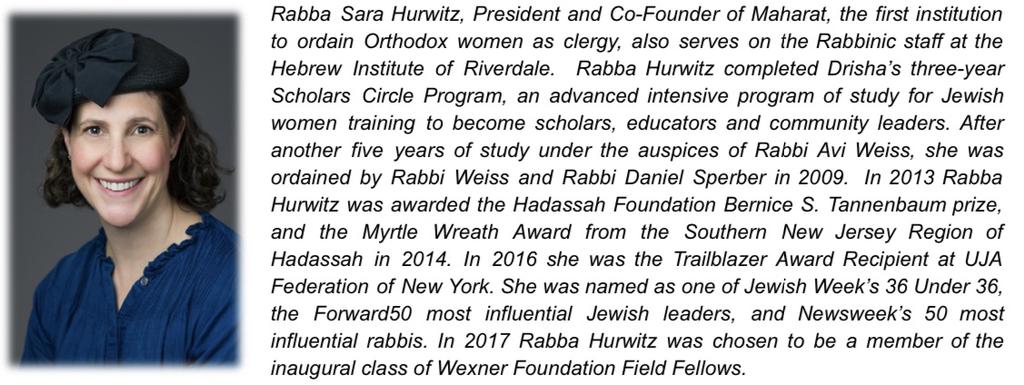
Rabba Sara Hurwitz
President and Co-Founder
Rioting is often caused by what psychologists call herd behavior, or in lay person’s terms, mob mentality. This is a phenomenon where a few people incite others, stirring the crowd to begin acting violently. The crowed thoughtlessly follows one another, inspiring further damage. The earliest version of mob mentality is the story of the meraglim (spies). Ten spies, who are meant to report their findings to Moshe alone, gather the whole eida (congregation) together and describe a land filled with evil enemies and giants waiting to annihilate them. The result was a unified unthinking mob. The verse describes:
כׇּל־הָ֣עֵדָ֔ה לִרְגּ֥וֹם אֹתָ֖ם בָּאֲבָנִ֑ים
The entire congregation came together to pelt them [their leaders] with stones.
And with arms raised, and stones in hand, k’vod hashem, the glory of God appears and prevents the mob from killing.
Many commentators explain that it is this moment—of inciting the community-- that is the real sin of the spies. Not that they went to spy the land, but rather that they attempted to incite others to rebellion and cause a riot. This is the reason why God punished B’nei Yisrael, forcing them to wander in the desert for forty years.
But there was a tikkun (rectification) of this sin in the the story of the wood gatherer—the mikoshesh—who acts as an antidote to the story of the meraglim. At first glance, the two stories have very little to do with one another. In chapter 15, after the episode of the spies, B’nai Yisrael come across a man who is desecrating the Shabbat, gathering wood on the holy day. The people brought him to Moses who, not knowing what to do with him, put him in custody until the matter could be clarified. God told Moses to put him to death by stoning.
וַיֹּצִ֨יאוּ אֹת֜וֹ כׇּל־הָעֵדָ֗ה אֶל־מִחוּץ֙ לַֽמַּחֲנֶ֔ה וַיִּרְגְּמ֥וּ אֹת֛וֹ בָּאֲבָנִ֖ים
Tell the entire assembly that they should pelt him with stones.
The Torah uses the exact same phrase that is employed just a few chapters earlier as the mob is about to stone Kalev and Yehoshua to death.
Despite these similarities, the behavior of the crowed in relation to the mikoshesh is radically different than their behavior a few chapters earlier. In theory, they could have come across a man desecrating Shabbat and turned into an unthinking mob. They could have taken matters into their own hands and tried to punish him in a riotous, mutinous way, like they did before. But rather than incite rebellion, they calmly brought him to Moses. This is the moment of tikkun, when the people begin to repair the sin of the meraglim.
But why does the tikun for the spies have to come on the back of violence and the stoning of one man? The Gemara in Shabbat (96b-97a) suggests that the mikoshesh is none other than Zlophchad—the father of the five women who were to inherit their father’s land. The mefarshim generally agree that Zlophchad was actually a righteous person. So how could it be that he so openly and blatantly desecrated Shabbat?
The Gemara explains that Zlophchad purposefully gathered sticks, purposefully desecrated Shabbat as a tremendous sacrifice for others. After the sin of the spies, the people’s spirit was deeply wounded, believing that God had deserted them. To prove that God still cherished the people and the mitzvot that God gave them, Zlophchad broke Shabbat, forcing God to come down to interact with the people again. This stoning, in a strange way, was for the sake of heaven, a Kiddush haShem, to uplift the spirit of B’nai Yisrael by showing them God still cared enough to be present in their lives.
In a further tikkun, b’not Zlophchad (daughters of Zlophchad) were blessed by inheriting land from God in Eretz Yisrael. The meraglim were denied entry into the land, but the decedents of Zlophcahd—the very man who sacrificed his life for the sake of heaven - were rewarded with a stake in the land of Israel.
Although Zlophchad sacrificed his life to bring God back into the world, today, God is not present in the same way as God was during Biblical times. God does not prevent or condone the stoning of another. But God’s presence, is felt through the way the community confronts adversity: through mutinous rioting or by deliberate action. And this was the lesson of Zlophchad: his actions served to transform the eida from a mutinous mob into a committed community, intent on ultimately entering the Land of Israel, and upholding God’s mitzvot.