29 Av 5775 | August 14, 2015
Parshat Re’eh
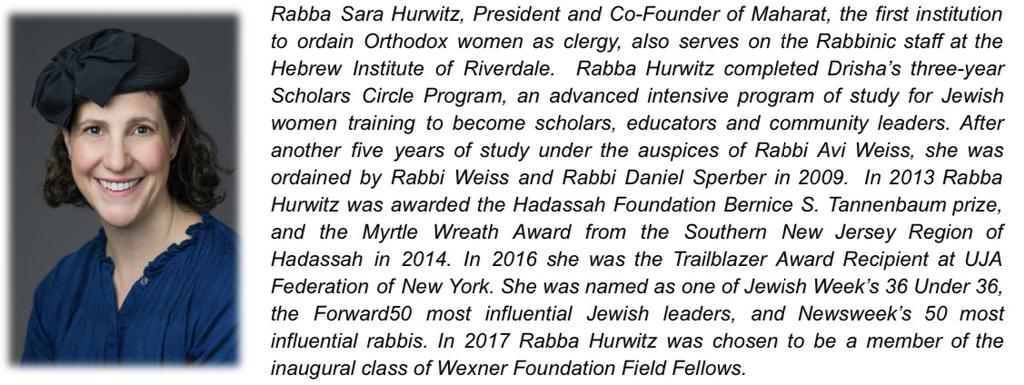
Rabba Sara Hurwitz
President and Co-Founder
The word Galut (Diaspora) was coined over 2,000 years ago and has been the hallmark of Jewish existence since the Jewish community was exiled after the destruction of the Beit HaMikdash. Diaspora Jewry is defined by a profound sense of longing to return to the Homeland, while at the same time, attempting to live securely in exile. This sentiment is present in our liturgy: Next Year in Jerusalem - b’shana haba b’Yerushalayim. We long to return. So, I wonder, is it possible, in the 21st century, to yearn for Israel and still remain in the Diaspora?
The Torah, in its wisdom, intrinsically understands the pull to at least visit Israel. The Torah demands that we make pilgrimages to the holy city, specifically to the Beit HaMikdash, bringing the ma’aser she’ni (second tithe) to the Temple. Unlike the other mitzvot to tithe, which generally benefit the poor or the Levites, ma’aser she’ni is unique, as it ultimately benefits the owner. The Torah commands:
(כב) עַשֵּׂ֣ר תְּעַשֵּׂ֔ר אֵ֖ת כׇּל־תְּבוּאַ֣ת זַרְעֶ֑ךָ הַיֹּצֵ֥א הַשָּׂדֶ֖ה שָׁנָ֥ה שָׁנָֽה׃ (כג) וְאָכַלְתָּ֞ לִפְנֵ֣י ׀ יקוק אֱלֹקֶ֗יךָ בַּמָּק֣וֹם אֲשֶׁר־יִבְחַר֮ לְשַׁכֵּ֣ן שְׁמ֣וֹ שָׁם֒ [...] לְמַ֣עַן תִּלְמַ֗ד לְיִרְאָ֛ה אֶת־יקוק אֱלֹקֶ֖יךָ כׇּל־הַיָּמִֽים׃
You shall tithe all the produce of your seed that comes from your field in the course of the year. You shall eat before the Lord your God, in the place which God will choose for God’s name to dwell there... so that you may learn to fear the Lord your God all the days.
Why go all the way to Yerushalayim to separate tithes? Rashbam (ibid.) answers that just being in sight of the holy Temple is a religious experience. “When you witness that place of God's immanent presence (shekhina), the priests going about the Temple service, the Levites at their posts, and Israel gathering (to pray and study),” we are affected and inspired by our surroundings, and we grow spiritually. We feel God’s presence more deeply.
The Sefer Hachinuch, takes the pasuk in a different direction. The Torah says that we must “learn to fear God.” Bringing ma’aser she’ni to Jerusalem provided the people with an opportunity to engage with scholars, with the Sanhedrin, “the religious and intellectual authorities.” Surely, suggests the anonymous author of the Sefer Hachinuch, while people are bringing their material wealth, their crops, cattle, and oils, they will pause to study Torah from the great scholars, thereby improving their character!
As Diaspora Jews, it is essential to experience the kedusha (holiness) of Israel. Visiting Israel both deepens our relationship with the Divine and nourishes our thirst for Talmud Torah. It is for these reasons, that the Torah felt it essential to create an obligation to enter into the land, to bring ma’aser she’ni, so our soul and minds can be re-invigorated.
Diaspora Jews stand to benefit from the land of Israel for our own spiritual growth. But do Diaspora Jews have anything to offer Israel and Israelis in return?
AB Yehoshua, an Israeli novelist, was invited in 2006 to America to address this very question. To everyone’s surprise, he offered a harsh critique of American Jews. He admonished that a "full Jewish life could only be had in the Jewish state." Jews elsewhere (in his words) are only "playing with Judaism.” (New York Times). Diaspora Judaism, he went on to explain, is likened to a fancy spice box. Perhaps implying that we are Jewish once a week, and like a fragrance, our commitment to Judaism and Israel is fleeting and irrelevant. Therefore, American Jews can never relate to the full scope of Israeli challenges, and therefore, cannot and must not enter the Israeli conversation, even with intentions to help Israel’s economy, political landscape, and culture.
These are harsh sentiments. Surely from the Diaspora, we can with integrity and authenticity, yearn for Israel, with all of its holiness and with all of its flaws, while at the same time offer something to contribute?
Ruth Calderon, past Knesset member, offers a potential response. Calderon spent two years, around 2005, as a Scholar in residence at a JCC in New Jersey. She witnessed first hand what American Jewry can teach Israel.
In a series of essays she wrote for Sh’ma Magazine, Calderon describes her initial reaction to American Patriotism. It is impossible, she writes, not to notice that this country is covered in flags… a flag tablecloth, a pair of clogs… a flag bathing suit. If someone in Israel wore a blue and white bathing suit with a Star of David, he would probably end up in the hospital, if not in court. I ask myself, what are Americans trying to prove?” She goes onto suggest that the beauty of American patriotism is the ability to co-exist with independent cultural identities in a positive and non-threatening way. In other words, you can love a country, but still yearn for another, for Israel. And, you can feel a sense of patriotism, while calling public servants in Israel to action.
Even from the comfort of America, we can and must yearn for Israel. We must yearn to go there, to inspire and nourish ourselves, and get a spiritual boost. And we must yearn to demand more from the country we love. To demand greater democracy between men and women, religious and non-religious. We can bring our own democratic American experiences to help create a place where we can strive to live together in harmony.
And, we can still yearn to live there permanently, to fulfill the call of “Next year in Jerusalem—b’shana haba, b’Yerushalayim.”