6 Elul 5775 | August 21, 2015
Parshat Shoftim
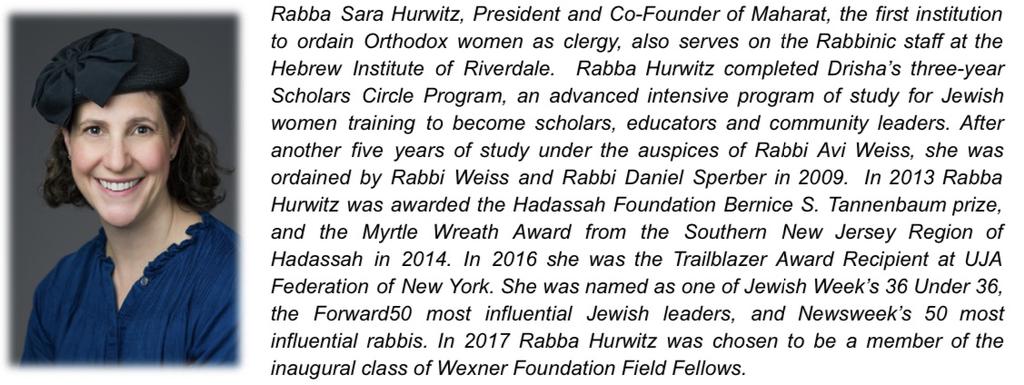
Rabba Sara Hurwitz
President and Co-Founder
Parshat Shoftim recounts the command to erect arei miklat (cities of refuge). These cities, built upon entry into Eretz Yisrael, will provide refuge to a person who inadvertently murders his companion. Perhaps, the Talmud (Makkot 7b) explains, he mistakenly killed because his “hand slipped while bringing down the blow of an axe against a tree, or the axe-head slipped from its handle, mistakenly killing another.” Lest the deceased relatives’ seek revenge, the rokeach mishgaga (unintentional murderer) finds asylum in an ir miklat, a city that must be designated from amongst the cities of Israel.
On one hand, it seems the purpose of the ir miklat is a detention center - a prison where a person sits and awaits trial, with little hope of rebuilding his life. However, it is also possible that the cities of refuge are set up as a haven in which each sinner is given the chance to do teshuva, to repent and grow from their mistakes. And live.
The Torah tells us:
(ד) וְזֶה֙ דְּבַ֣ר הָרֹצֵ֔חַ אֲשֶׁר־יָנ֥וּס שָׁ֖מָּה וָחָ֑י
This is the matter of the murderer who shall flee there and live.
The person doesn’t just go to the ir miklat to be incarcerated and wallow. Rather, he must live there. How does he “live?” Rambam in Hilchot Rechitza 8, explains that if a student inadvertently kills, his Rebbe has to go with him to the ir miklat. The rabbi, who did nothing, must flee and accompany his talmid (student) to the ir miklat. It is the Rebbe’s duty to continue to edify his student and take responsibility for his well-being. And more importantly, help him grow to a life that he can live—u’vechay.
Additionally, the Torah does not only require that the city of refuge be built, the Torah commands that we, the community, must prepare the way to the ir miklat as well:
תָּכִ֣ין לְךָ֮ הַדֶּ֒רֶךְ֒
Prepare the way for yourself to the city of refuge.
Chazal are quite elaborate and specific in imagining the extremes that we must go to “prepare the way.” Rashi says the road must be clearly signposted, “advertising Miklat, miklat—refuge, refuge (ibid.)” I imagine bright yellow signs, giving the person fleeing the necessary direction and guidance to the city of refuge, thereby lessening the likelihood that his pursuers would catch him and avenge the death.
Second, the arei miklat must be a reasonable distance from the nearest city, providing easy access to the person seeking refuge. Rambam teaches the roads leading to the arei miklat must be 32 cubits wide and well-paved, ensuring that the person fleeing can properly navigate his way. Furthermore on the 15th of Adar, the beit din would dispatch deputies to repair the roads, personally taking responsibility for the safe arrival of each refugee (Rambam Mitzvah 342).
The message seems to be clear. For a person to have any chance at arriving to the ir miklat - a place where he would have the opportunity to repent - the journey to the city of refuge must be seamless. If the purpose of the arei miklat is to provide a place for teshuva, to give him the opportunity to learn from his mistakes, the community must take responsibility to ensure his safe arrival.
“Tachin lecha haderech - Prepare the way for yourself,” not for the inadvertent murderer. Perhaps, the community has to invest so much effort in preparing the way to account for the fact that we are all potential, unintentional sinners. As humans, mistakes are inevitable. And therefore, each of us must personally attend to the signs and prepare the road, as there may come a time when each of us metaphorically speaking, may need to seek the city of refuge. To be embraced by the community within and be given the chance to repent.
Therefore, the derech (path) must be easily demarcated—we must all have the opportunity to seek refuge. But once there, we must live in the city, by learning, growing, and doing teshuva.